


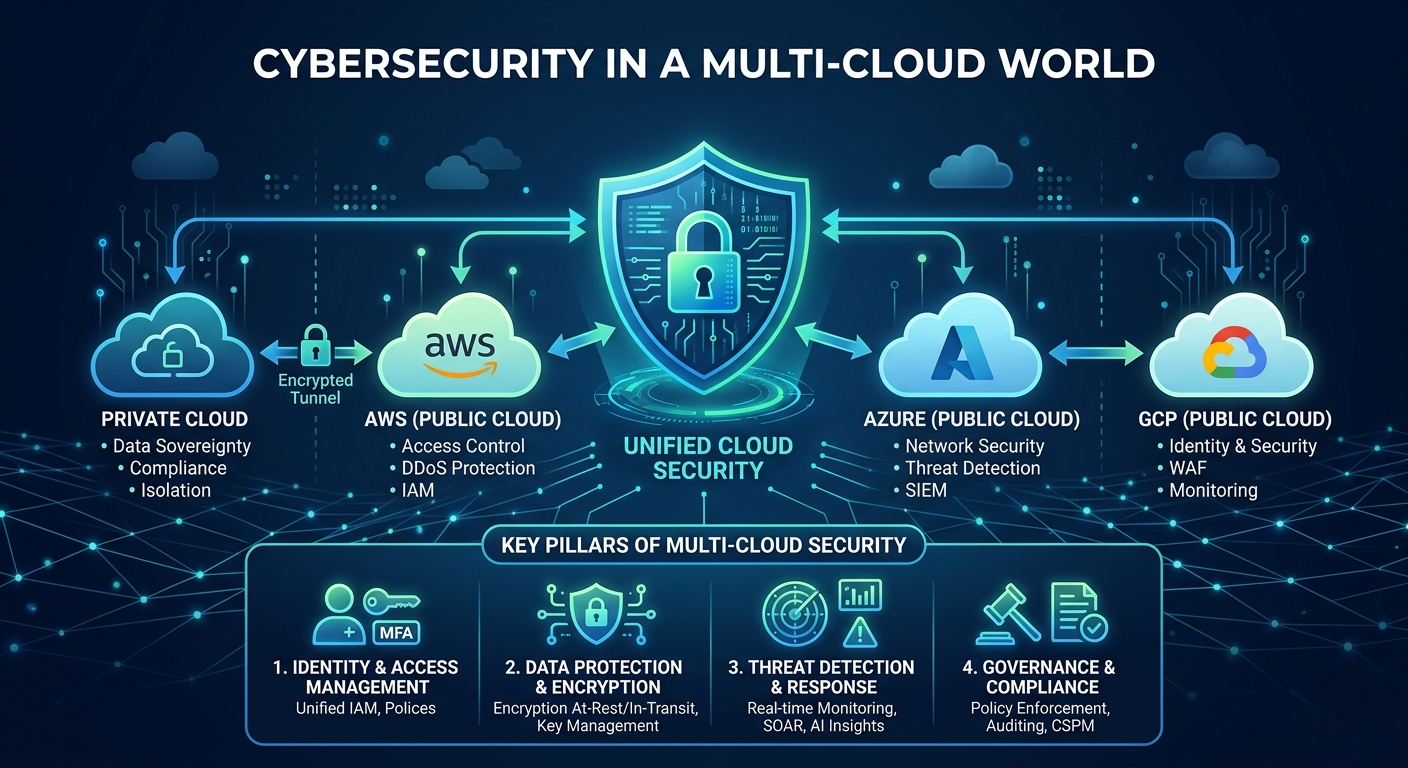

As organizations increasingly adopt multi-cloud strategies, the cybersecurity landscape has become significantly more complex. Multi-cloud environments—where businesses use services from multiple cloud providers such as Amazon Web Services, Microsoft Azure, and Google Cloud Platform—offer flexibility, scalability, and resilience. However, they also introduce new security challenges that require a more sophisticated and unified approach to risk management.
Understanding the Multi-Cloud Security Challenge
In a traditional single-cloud or on-premises setup, security policies are relatively centralized. In contrast, a multi-cloud environment distributes workloads across different providers, each with its own security tools, configurations, and compliance requirements. This fragmentation often leads to visibility gaps, inconsistent policy enforcement, and increased vulnerability to cyber threats.
Additionally, each cloud provider operates under a shared responsibility model, which can vary slightly. Misunderstanding these responsibilities can leave critical assets exposed. Organizations must clearly define which aspects of security are managed by the provider and which remain under their control.
Key Security Risks in Multi-Cloud Environments
Multi-cloud environments are prone to several security risks due to their distributed nature. Some of the most common threats include:
- Misconfigured cloud settings leading to unauthorized access
- Insecure APIs that expose sensitive data
- Data breaches due to lack of encryption or poor access control
- Identity and access management (IAM) issues across multiple platforms
- Shadow IT where unauthorized cloud services are used without oversight
These risks are often amplified when organizations lack a centralized security strategy or rely on manual processes to manage configurations.
The Importance of Unified Security Management
To effectively secure a multi-cloud environment, organizations must adopt a unified security framework that provides centralized visibility and control. This involves integrating security tools and policies across all cloud platforms to ensure consistent protection.
A strong unified security strategy typically includes real-time monitoring, automated threat detection, and centralized logging. Security Information and Event Management (SIEM) systems and Cloud Security Posture Management (CSPM) tools play a crucial role in achieving this integration.
Best Practices for Multi-Cloud Cybersecurity
Implementing best practices is essential to mitigate risks and ensure robust security across multiple cloud platforms. Organizations should focus on proactive and automated approaches rather than reactive measures.
Some effective best practices include:
- Implement Zero Trust Architecture: Never trust, always verify—regardless of the source
- Use strong identity and access management (IAM) policies with least-privilege access
- Encrypt data both at rest and in transit
- Regularly audit and monitor configurations across all cloud services
- Automate security processes to reduce human error
- Ensure compliance with industry standards and regulations
These practices help organizations maintain consistency and reduce the chances of misconfigurations or overlooked vulnerabilities.
The Role of Automation and AI in Cloud Security
Automation and artificial intelligence are transforming how organizations approach cybersecurity in multi-cloud environments. AI-driven tools can analyze vast amounts of data to detect anomalies, predict threats, and respond in real time.
Automation also plays a key role in enforcing policies, managing patches, and responding to incidents. By reducing reliance on manual intervention, organizations can improve response times and minimize the risk of human error.
Compliance and Regulatory Considerations
Operating in a multi-cloud environment often means dealing with multiple regulatory frameworks depending on geographic regions and industries. Ensuring compliance with standards such as GDPR, HIPAA, or ISO certifications becomes more challenging when data is distributed across different cloud providers.
Organizations must implement consistent data governance policies and maintain detailed audit trails to demonstrate compliance. Failure to do so can result in legal penalties and reputational damage.
Conclusion
Cybersecurity in a multi-cloud world requires a shift from traditional security models to more dynamic, integrated, and automated approaches. While multi-cloud strategies offer undeniable benefits, they also introduce complexities that cannot be ignored.
By adopting unified security frameworks, leveraging automation and AI, and following best practices, organizations can effectively manage risks and protect their digital assets. In an era where cyber threats are constantly evolving, a proactive and well-structured security strategy is not just an option—it is a necessity for sustainable growth and resilience.
