

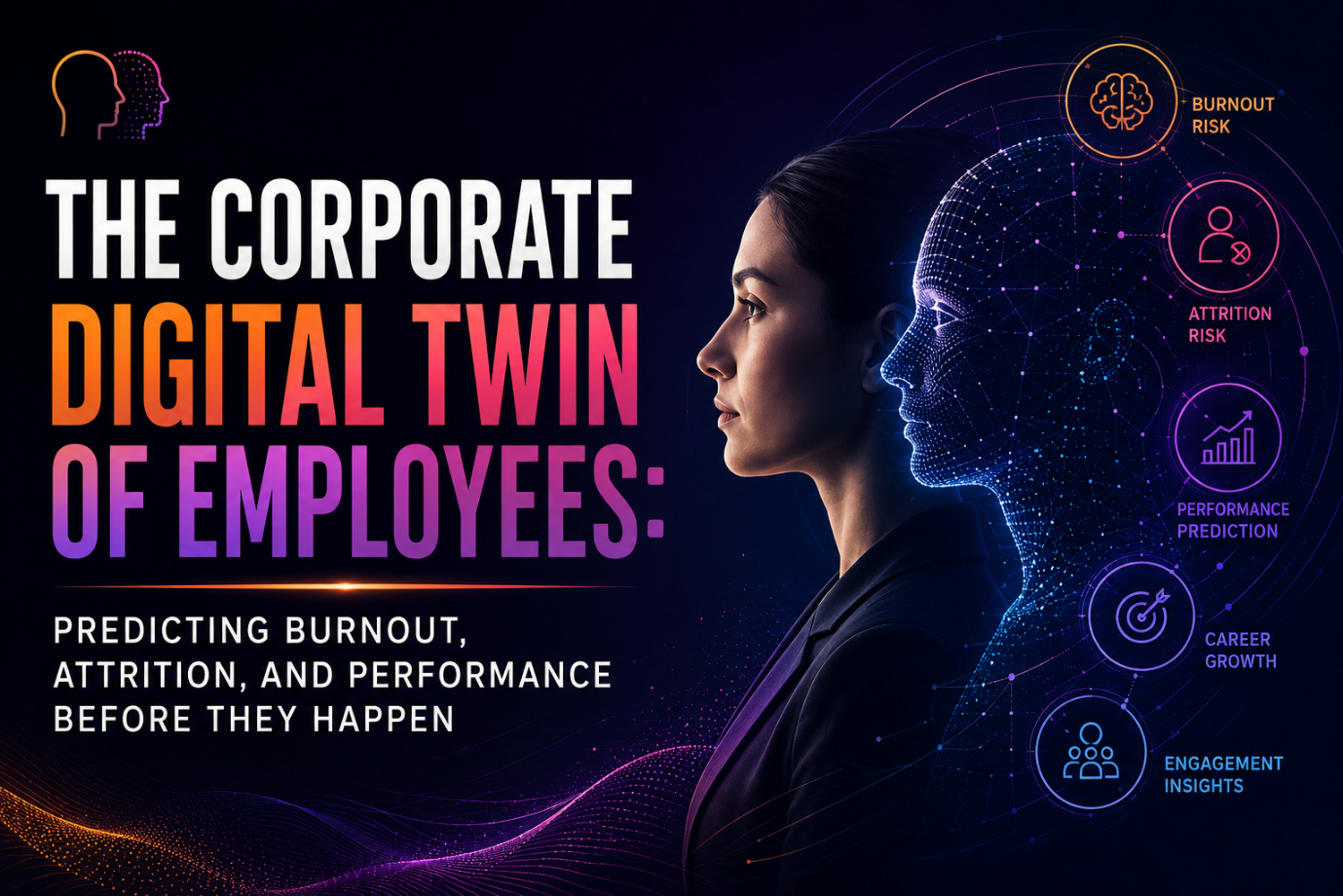

For years, the concept of Digital Twins was primarily associated with manufacturing plants, aerospace engineering, smart cities, and industrial equipment. Companies created virtual replicas of physical assets to monitor performance, simulate failures, optimize maintenance schedules, and improve operational efficiency without interrupting real-world operations. Today, however, the digital twin concept is expanding far beyond machines and infrastructure. Enterprises are beginning to explore one of the most transformative, and controversial, applications of artificial intelligence: creating intelligent digital representations of their workforce. These are not virtual avatars or surveillance tools designed to monitor employees minute by minute. Instead, they are sophisticated AI models that continuously analyse organizational data to understand work patterns, collaboration dynamics, skill evolution, engagement levels, productivity trends, learning behaviour, and career progression. This emerging concept, often referred to as the Corporate Digital Twin of Employees, has the potential to fundamentally reshape Human Resources by allowing organizations to predict burnout, identify disengagement, forecast attrition, personalize career development, and improve workforce planning long before problems become visible.
Traditional HR has largely been reactive. Performance reviews happen quarterly or annually. Employee engagement surveys are conducted once or twice a year. Exit interviews provide insights only after valuable talent has already left the organization. Managers often recognize burnout only when productivity declines significantly or when employees begin taking excessive leave. By the time warning signs become obvious, organizational damage has already occurred. High performers resign unexpectedly, projects lose continuity, recruitment costs increase, institutional knowledge disappears, and remaining employees experience additional workload pressure. Corporate Digital Twins introduce a predictive layer into workforce management by continuously interpreting thousands of organizational signals that collectively reveal how employees experience work over time. Instead of waiting for outcomes, organizations begin understanding the conditions that create those outcomes.
A Digital Twin of an employee is not a copy of the individual but an AI-generated behavioural model built from enterprise data sources that employees already generate during normal work. Project management systems reveal workload distribution. Collaboration platforms indicate communication patterns. Learning management systems show skill development. HR platforms contain career history and performance records. Calendar data reflects meeting intensity. Internal mobility records reveal career progression. Recognition platforms measure peer appreciation. Productivity systems indicate work rhythms, while anonymous engagement surveys contribute emotional context. Individually, these datasets provide fragmented information. Combined intelligently, they create a continuously evolving model capable of recognizing trends that human managers rarely have the time or analytical capacity to identify.
One of the earliest and most valuable applications of employee digital twins is burnout prediction. Burnout rarely occurs overnight. It develops gradually through increasing workload, reduced recovery time, declining collaboration quality, excessive after-hours activity, prolonged meeting schedules, role ambiguity, repetitive tasks, and limited career progression. Traditional management often focuses only on visible performance, assuming that employees who continue delivering results are coping effectively. AI models recognize that sustained productivity under worsening work conditions frequently precedes burnout rather than disproving it. Digital twins evaluate workload trends, overtime frequency, meeting density, task switching, communication patterns, vacation utilization, project complexity, and organizational changes to estimate burnout risk before employees themselves fully recognize the problem. HR leaders can intervene through workload redistribution, additional support, career discussions, or wellness initiatives while meaningful change remains possible.
Attrition prediction represents another transformative capability. Employee resignations often appear sudden, but organizational data typically reveals subtle behavioural changes months beforehand. Individuals preparing to leave may reduce participation in collaborative discussions, engage less frequently with internal learning resources, avoid long-term project commitments, limit cross-functional communication, decline leadership opportunities, or demonstrate changing productivity patterns. While none of these signals independently indicate resignation, AI evaluates their combined probability alongside broader organizational trends, compensation benchmarks, promotion history, manager effectiveness, internal mobility opportunities, and external labour market conditions. Rather than replacing human judgment, the digital twin alerts HR professionals to employees who may benefit from career conversations, mentorship opportunities, development planning, or leadership engagement before resignation becomes inevitable.
The technology also introduces unprecedented opportunities for personalized employee development. Traditional training programs frequently apply standardized learning paths across entire departments despite significant differences in individual strengths, aspirations, experience levels, and learning preferences. Employee digital twins continuously evaluate skill acquisition, project exposure, collaboration networks, certifications, knowledge gaps, and career ambitions to recommend highly personalized development journeys. An engineer showing increasing leadership behaviour may receive management training earlier. A sales professional demonstrating analytical strengths may be guided toward revenue operations. An HR specialist displaying strong technology adoption could transition into HR analytics. Career development becomes dynamic and evidence-based rather than relying solely on annual discussions or manager intuition.
Corporate Digital Twins also redefine workforce planning at an organizational level. Business leaders often struggle to answer strategic questions such as which teams are approaching capacity limits, where future leadership shortages may emerge, which departments face the highest attrition risk, or what skills will become scarce over the next five years. Conventional workforce planning relies heavily on spreadsheets, historical hiring patterns, and executive assumptions. AI-generated workforce simulations enable organizations to model future scenarios with far greater accuracy. Companies can evaluate how mergers, geographic expansion, automation initiatives, new product launches, economic downturns, regulatory changes, or technological disruption may affect workforce requirements before major strategic decisions are implemented. HR evolves from an administrative support function into a strategic planning partner capable of influencing enterprise growth.
Manager effectiveness is another area where digital twins provide valuable insights. Employee engagement is often shaped less by company-wide policies than by immediate leadership experiences. AI systems can evaluate patterns across teams to identify which leadership behaviours consistently improve retention, accelerate skill development, increase collaboration, or reduce burnout. Rather than ranking managers through simplistic performance metrics, digital twins uncover relationships between leadership practices and long-term employee outcomes. Organizations can replicate successful management approaches while providing targeted coaching where leadership challenges emerge. The objective is not surveillance but continuous organizational learning supported by measurable evidence.
The integration of generative AI further enhances employee digital twins by enabling conversational workforce intelligence. HR leaders may ask natural language questions such as, “Which departments show the highest burnout risk over the next quarter?”, “What development opportunities would improve retention among senior engineers?”, or “How will planned hiring delays affect project delivery?” Instead of manually compiling reports from multiple systems, AI synthesizes enterprise data into strategic recommendations supported by predictive analysis. Managers gain immediate access to actionable workforce intelligence without requiring advanced analytics expertise.
However, the emergence of employee digital twins also introduces profound ethical, legal, and cultural considerations. Employees may understandably worry about excessive monitoring, algorithmic bias, privacy violations, or automated employment decisions. Organizations implementing these technologies must establish transparent governance frameworks defining exactly what data is collected, how models operate, who can access predictions, and how insights will be used. Predictive analytics should never become the sole basis for promotions, disciplinary action, compensation decisions, or employment termination. Human oversight remains essential because organizational data cannot fully capture personal circumstances, motivation, creativity, resilience, or interpersonal relationships. Ethical implementation requires clear communication, informed consent where appropriate, rigorous bias testing, data minimization principles, and strict compliance with privacy regulations.
Another important limitation is that digital twins predict probabilities rather than certainties. Human behaviour remains inherently complex, influenced by family circumstances, health, financial conditions, changing aspirations, external opportunities, and countless variables beyond enterprise data. A high attrition probability does not guarantee resignation, just as low burnout risk does not eliminate the possibility of emotional exhaustion. Organizations that misunderstand predictive models as deterministic systems risk making poor decisions based on incomplete understanding. The true value of digital twins lies in informing better conversations rather than replacing them.
Forward-thinking enterprises are already exploring how employee digital twins may integrate with broader AI ecosystems. Workforce intelligence could combine with financial planning, project management, customer demand forecasting, operational analytics, and strategic planning to create a holistic organizational decision platform. Before launching a major digital transformation initiative, executives could evaluate not only financial feasibility but also workforce readiness, leadership capacity, skill availability, change fatigue, and learning requirements through predictive simulation. HR would become deeply embedded within enterprise strategy rather than operating separately from core business planning.
The next decade will likely redefine how organizations understand their people. Just as businesses now monitor supply chains, manufacturing equipment, customer journeys, and financial performance through continuous intelligence, workforce management is entering an era where prediction replaces reaction. The Corporate Digital Twin of Employees is not about reducing individuals to algorithms or replacing empathy with automation. Its greatest potential lies in enabling more human workplaces by identifying challenges before they become crises, supporting employees before they burn out, creating development opportunities before careers stagnate, and helping leaders make decisions grounded in insight rather than assumption. Organizations that embrace this balance between artificial intelligence and authentic human leadership will build workforces that are not only more productive but also more resilient, more engaged, and better prepared for the rapidly evolving future of work.
