


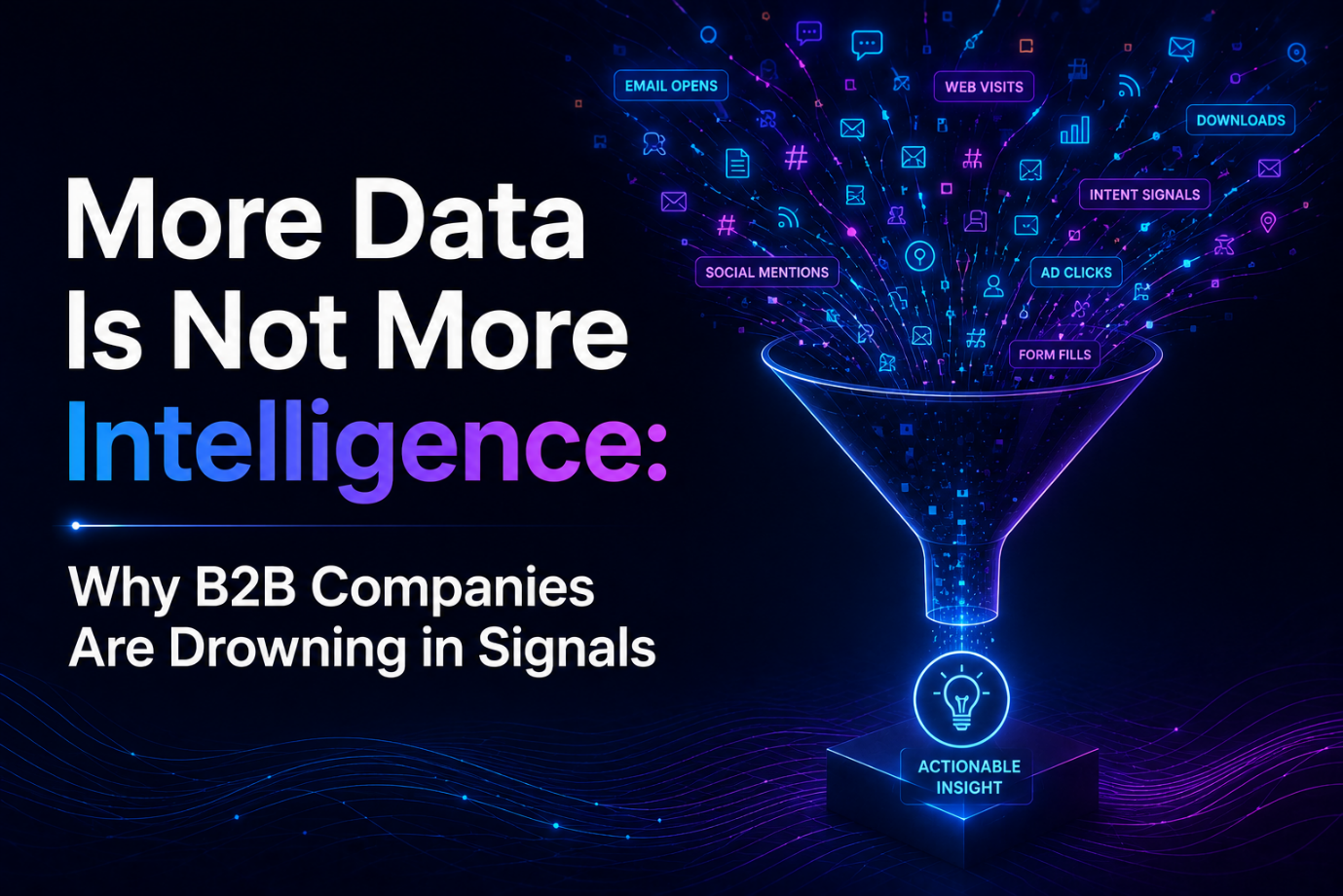

B2B data intelligence is becoming increasingly important as companies collect more information than ever before. B2B organizations now have access to massive amounts of data, including customer and prospect information, buyer intent signals, website activity, CRM records, technographic data, engagement metrics, social activity, business events and AI-generated insights.
Yet more data does not automatically create better intelligence.
B2B companies have spent years being told that the answer to better decision-making is more data. More contacts, more intent signals, more website activity, more CRM fields, more technographic information, more engagement data, more dashboards, more analytics and now, more AI-generated insights.
On paper, this should make B2B selling dramatically easier. In practice, many organizations are experiencing the opposite. Sales teams are overwhelmed by alerts. Marketing teams are buried under dashboards. RevOps teams are trying to reconcile conflicting signals. Data teams are constantly cleaning and enriching records. AI systems are producing recommendations faster than people can evaluate them.
The problem is no longer a lack of information.
The problem is knowing which information actually deserves attention.
The competitive advantage is therefore shifting from simply collecting B2B data to understanding, prioritizing and acting on the signals that matter most.
Why B2B Data Intelligence Matters More Than Data Volume
For a long time, data scarcity was one of the biggest challenges in B2B marketing and sales. Companies had incomplete databases, limited customer information and little visibility into what prospects were doing before they contacted sales. The natural response was to collect more. Data providers expanded their databases. Marketing platforms introduced behavioural tracking. Intent platforms began monitoring research activity. CRMs captured more interactions. Sales intelligence platforms added company and contact information. Every new capability promised a clearer picture of the buyer.
The Difference Between Data Collection and B2B Data Intelligence
This is where B2B data intelligence becomes critical. The goal is not simply to collect more information, but to identify which data points can influence a revenue decision. But somewhere along the way, the industry began confusing data accumulation with intelligence. A company can have millions of records and still have very little understanding of which accounts actually matter. It can receive thousands of intent signals and still struggle to identify the ten accounts that deserve a sales conversation today.
This distinction is becoming even more important as AI enters the B2B revenue stack. AI is exceptionally good at processing large volumes of information, identifying patterns and generating summaries. That makes it incredibly useful in a data-rich environment. But AI does not automatically know which signals are strategically important simply because those signals exist. If an organization feeds an AI system fragmented, outdated or low-value information, it may produce a highly sophisticated interpretation of a fundamentally noisy dataset. The output can look intelligent while still leading the business in the wrong direction.
The real competitive advantage is therefore moving from collecting signals to prioritizing signals.
Why B2B Intent Signals Need Context
Consider what happens inside a typical target account. An employee opens an email. Another employee visits a website. Someone downloads a report. A third person attends a webinar. The company posts about an expansion initiative. A new VP joins the organization. The business starts hiring aggressively. Its technology stack changes. An analyst publishes an article about the industry. An employee searches for a relevant solution. An account registers for an event. A salesperson makes a call. A contact replies to a message but says the timing is not right. Every one of these events can become a data point. But they are not equally valuable, and treating them as though they are creates noise.
Effective B2B data intelligence requires organizations to connect behavioral signals with account fit, business circumstances, stakeholder relevance and timing.
An email open is not the same as a new executive appointment. A webinar attendance is not necessarily the same as a major business transformation announcement. A website visit from an unknown employee may be interesting, but a cluster of activity across multiple senior stakeholders can be much more meaningful. A technology change may matter enormously for one vendor and not at all for another. The challenge is not identifying whether a signal exists. It is understanding what the signal means in context.
Context is the missing layer in many B2B data strategies.
A signal becomes more valuable when it can be connected to account fit, business circumstances, stakeholder relevance and timing. A company hiring hundreds of salespeople may be a powerful signal for a sales enablement provider, but it may be almost irrelevant to a cybersecurity company. A new CIO may be highly significant for an infrastructure vendor but less important to a company selling marketing services. A funding announcement may indicate expansion, but it does not necessarily mean every function inside the business has increased its budget. The same event can have different commercial meanings depending on who is observing it.
Building a B2B Signal Hierarchy
This is why the future of B2B intelligence will not simply be about collecting more signals. It will be about creating a signal hierarchy. A strong B2B data intelligence strategy therefore needs a clear hierarchy that separates low-value activity from commercially meaningful signals.
At the bottom are low-value activity signals: individual opens, clicks, isolated visits and other behaviours that may indicate awareness but provide limited context. Above them are engagement patterns, where multiple interactions begin to form a more meaningful picture. Further up are account-level signals such as multiple stakeholders engaging with related topics. Above those are business events that can change an organization’s priorities: leadership changes, acquisitions, expansion, restructuring, funding, new product launches and strategic initiatives. At the highest level are combinations of signals that create a compelling commercial hypothesis: a high-fit account experiencing a relevant business change, showing increased engagement and involving stakeholders who are connected to the problem your company solves.
That is the difference between signal collection and signal intelligence.
From Traditional Lead Scoring to Contextual Account Intelligence
It also changes the way lead scoring should work. Traditional lead scoring often assigns points to individual actions. Open an email: points. Download content: more points. Attend a webinar: more points. Visit a pricing page: even more points. The total score then determines whether the lead is ready for sales. This model is easy to understand, but it can create false precision. A person can accumulate activity points without representing a genuine buying opportunity. At the same time, several people inside a strategic account can collectively demonstrate meaningful interest without any one person reaching the threshold.
Modern scoring needs to become more contextual and account-aware. Instead of asking, “How active is this contact?” organizations should ask, “What is happening across this account, who is involved and how relevant is that activity to the business problem we solve?” That shift can dramatically improve prioritization because it moves the organization away from treating every action as an isolated event. This approach moves B2B data intelligence beyond traditional contact-level lead scoring toward contextual, account-aware prioritization.
Why Account-Level Intelligence Matters in B2B Buying
The rise of buying committees makes this even more important. B2B decisions increasingly involve multiple stakeholders who may never behave in exactly the same way. One person may research the technology. Another may evaluate vendors. Another may build the financial case. Another may assess implementation. Procurement may negotiate the contract. Senior leadership may approve the investment. Looking at each person’s activity separately can make the buying process appear fragmented when it is actually progressing across the organization.
Account-level intelligence brings those pieces together.
It can identify patterns such as increasing engagement from several departments, movement among senior stakeholders or a growing concentration of activity around one business problem. This allows sales and marketing teams to recognize that the account may be entering a buying process even before anyone fills out a form or requests a demo.
Not Every B2B Signal Should Trigger an Action
But there is another challenge that organizations need to address: not every signal should trigger an action.
This sounds obvious, but it becomes surprisingly difficult once automation enters the picture. If every signal creates an alert, salespeople eventually stop paying attention to alerts. If every engagement spike triggers an email, buyers receive irrelevant outreach. If every leadership change launches a campaign, marketing creates noise rather than relevance. Automation without prioritization simply turns human overload into machine-generated overload.
The goal should not be to automate every possible response.
The goal should be to automate the right response to the right signal.
That requires organizations to define what different signals actually mean. Which events should increase account priority? Which should trigger research? Which should initiate nurture? Which should prompt a salesperson to investigate? Which should be ignored? Which combinations of signals are meaningful? Which signals are strong enough to change a territory plan? Which are simply useful background information?
How AI Can Help Filter B2B Signals
This is where AI can become genuinely valuable. Rather than functioning as a machine that sends more messages, AI can function as a signal-filtering layer between the market and the revenue team. It can examine thousands of events and identify the relatively small number of situations that deserve human attention. The objective is not to make salespeople aware of everything. It is to help them become aware of what matters.
Imagine a sales representative responsible for 200 strategic accounts. Across those accounts, thousands of digital interactions could occur every week. A traditional system may surface dozens or hundreds of notifications. A smarter system might identify fifteen accounts where meaningful changes have occurred and rank the five that appear most relevant based on fit, business context, stakeholder engagement and previous outcomes. That is far more valuable than simply increasing the number of alerts.
AI can make B2B data intelligence more scalable by analyzing thousands of signals and identifying the accounts that deserve human attention.
Moving From Engagement Metrics to Account Movement
The same principle applies to marketing.
Modern marketing teams often have access to huge amounts of campaign data. They can measure impressions, clicks, opens, conversions, page visits, content engagement, event participation and audience behaviour across multiple channels. But the volume of metrics can make it difficult to distinguish activity from progress. A campaign can generate excellent engagement rates while having almost no impact on the accounts the company actually wants to win.
This is why B2B marketing needs to move from engagement measurement to account movement.
Did engagement increase within priority accounts? Did more stakeholders become active? Did previously inactive accounts begin researching the category? Did target companies move closer to a sales conversation? Did engagement spread from one department to another? Did the campaign influence opportunities? These questions are much more useful than simply asking whether the campaign produced a high click-through rate.
The Role of Data Architecture and Governance in B2B Intelligence
The problem becomes even more complicated when organizations use multiple data platforms. Marketing may have one view of an account. Sales may have another. Intent data may provide a third. Customer success may maintain its own information. Finance has another system. Data teams have yet another. If those systems do not share consistent account identifiers and definitions, the organization can end up with multiple versions of reality.
AI cannot fully solve this fragmentation by itself. Without a reliable data foundation, organizations cannot build effective B2B data intelligence, regardless of how advanced their AI systems become.
If the same company appears under several names, subsidiaries are not connected correctly, contacts are outdated and departments are classified differently across systems, the AI layer may struggle to understand that seemingly separate signals belong to one organization. The result is fragmented intelligence. The business has plenty of data but cannot reliably connect the dots.
This is why data architecture and data governance are becoming strategic issues for revenue teams. The foundation needs to be strong enough for different systems to recognize the same account, understand relationships between contacts and companies, identify current decision-makers and maintain relevant historical context. Without that foundation, every additional AI capability increases complexity without necessarily increasing clarity.
Why Human Judgment Still Matters in AI-Powered Sales
There is also a human problem. More data can create a false sense of certainty. When a dashboard displays twenty different signals, a sales manager may feel that the account is well understood. But information is not understanding. A list of activities does not automatically explain buyer motivation. A collection of intent topics does not necessarily reveal budget. A technology profile does not tell you whether a company plans to change its technology. A leadership announcement does not guarantee a buying initiative.
Human judgment remains essential because commercial signals are rarely deterministic.
The best revenue teams therefore treat signals as evidence, not truth. A signal creates a hypothesis. It suggests that something may be happening. The job of sales and marketing is to investigate that possibility rather than assume that the signal represents buying intent. AI can help identify the hypothesis, but humans still need to validate it through context and conversation.
This is particularly important because AI systems can become extremely persuasive when they present recommendations with confidence. A ranking of “top accounts to contact” can look objective even when the underlying model is based on incomplete data. Organizations need to understand why an account was prioritized and which signals influenced the recommendation. Explain ability is therefore not merely an AI governance concern. It is a sales productivity concern.
If a salesperson understands why an account has been prioritized, they can decide how to approach it. If they only see a score, they may blindly follow the system or ignore it altogether.
Using AI to Turn B2B Signals Into Actionable Recommendations
The strongest AI-enabled revenue organizations will therefore build systems that provide recommendations with context. Instead of saying, “Account X has a high intent score,” the system should ideally help explain: “Account X fits the priority segment, has recently expanded into two new markets, hired a new sales leader and has increased engagement across three relevant stakeholders.” That information gives the salesperson something they can act on.
It also creates a more intelligent approach to personalization.
For years, personalization has often meant inserting a person’s name, company name or industry into a generic message. But true personalization is increasingly about demonstrating an understanding of why a conversation might be relevant now. The more context a company has about an account, the more capable it becomes of creating meaningful outreach. Instead of saying, “We help technology companies generate leads,” a message can be built around a specific business situation that makes the problem more urgent.
This does not mean every message should mention every signal. In fact, the opposite may be true. Too much personalization can feel invasive or artificial. The objective is to use intelligence internally so that the external communication feels relevant and natural.
That is another reason why more data does not necessarily mean more personalization. More data only helps when it improves understanding.
The same principle applies to AI-generated content. AI can produce thousands of variations of emails, landing pages, articles and social posts. But if the underlying strategy is unclear, the organization simply creates more content faster. The competitive advantage will not come from generating more words. It will come from knowing which audience, account, problem and moment deserve attention.
The future B2B marketer may therefore spend less time asking, “What content should we create?” and more time asking, “What market signal are we seeing, what does it mean and what response would be most useful?”
That is a much more strategic role for marketing.
For sales, the shift is equally significant. The best salespeople have always been good at filtering information. They know when a prospect is genuinely interested, when an objection is real and when an account is simply being polite. AI can extend that ability across hundreds or thousands of accounts. But the objective should be to give salespeople better judgment at scale, not to eliminate judgment.
This distinction will become especially important as AI agents become more deeply integrated into outbound and revenue workflows. An autonomous system may be able to identify accounts, research contacts and initiate communication. But if it cannot distinguish between meaningful buying signals and random digital activity, it can create enormous volumes of irrelevant outreach. The result is not better demand generation. It is simply more noise.
The organizations that succeed with AI will therefore be the ones that build discipline around signals. They will define their ideal customer profile clearly, maintain accurate data, establish signal hierarchies, monitor combinations of events rather than isolated actions, continuously test which signals correlate with revenue and give sales teams recommendations they can understand and challenge.
This creates a powerful feedback loop. When an account converts, the organization can look backward and ask which signals appeared before the opportunity. When an account fails to convert, it can examine which signals were misleading. Over time, the system becomes better at distinguishing meaningful patterns from noise. The goal is not to find a universal definition of intent. It is to build a model that becomes increasingly useful for the company’s specific market.
That is ultimately what makes proprietary revenue intelligence valuable.
The advantage does not come from knowing that a company visited a website. Thousands of companies can access similar behavioural data. The advantage comes from combining that information with your own historical performance, account knowledge, customer patterns and sales outcomes to understand what the signal means in your specific context.
The next generation of B2B companies will therefore compete not on who has the most data, but on who can turn data into decisions faster and more accurately.
PMG’s role in that environment is naturally connected to this shift. Data Dynamo can help establish the accurate account and contact foundation required to interpret signals properly. Prospect Pinnacle can help identify and reach the decision-makers who matter within priority organizations. Impact Sphere can turn account intelligence into coordinated ABM engagement, while Inbox Oracle can support targeted communication and Proffer.ai can bring AI and automation into the process. The objective is not to bombard the market with more activity. It is to help businesses identify the accounts that matter, understand what is changing within them and act when the opportunity becomes commercially relevant.
Conclusion: B2B Intelligence Is About Knowing What Matters
B2B companies do not have a data problem anymore.
They have an attention problem.
The future of B2B data intelligence is therefore not about knowing everything about every account. It is about knowing what matters, why it matters and what action should follow.
They have more signals than their teams can process, more dashboards than they can regularly interpret and more automated recommendations than they can blindly trust. The next competitive advantage will belong to the organizations that can filter that complexity and consistently identify the few signals that deserve action.
Because the future of B2B intelligence is not about knowing everything.
It is about knowing what matters, why it matters, and what to do about it.
