


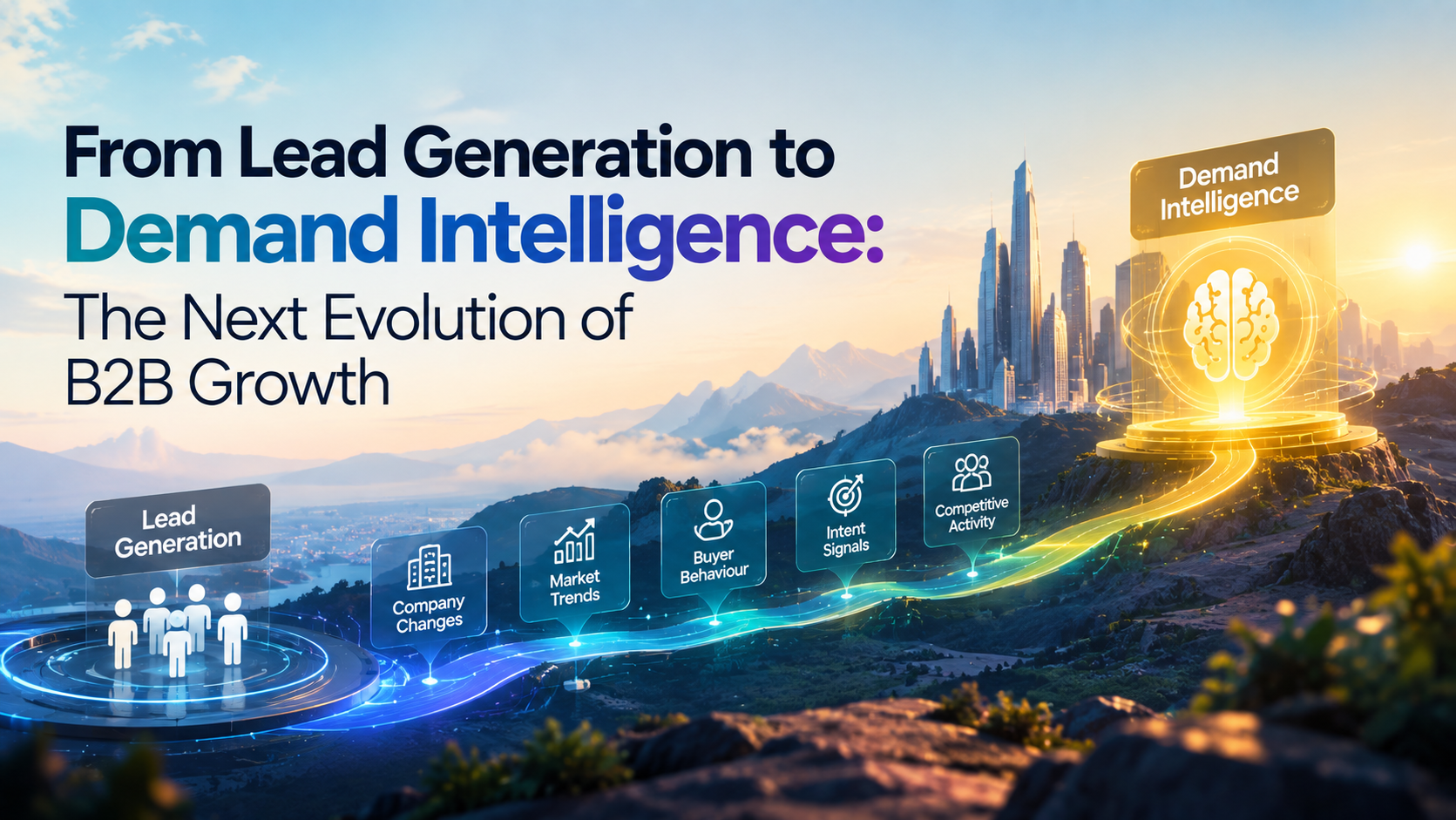

B2B demand intelligence is becoming the next evolution of B2B growth, changing how companies identify opportunities, understand buyer intent, and approach demand generation. For years, B2B growth was built around a relatively straightforward model: identify companies that fit a target profile, find the relevant decision-makers, reach out to them, generate interest, and move those conversations into the sales pipeline. This model created an enormous industry around databases, email campaigns, cold calling, marketing automation, CRM systems, and lead generation.
But the B2B market has changed dramatically, and the traditional definition of demand generation is starting to feel increasingly incomplete. Businesses have access to more contacts than they can possibly engage, more channels than they can effectively manage, and more data than their teams can realistically interpret. The next evolution of B2B growth is therefore not about generating more activity. It is about developing the intelligence to understand where demand is emerging, what is causing it, and when a business should act.
The distinction matters because demand and leads are not the same thing. A lead is an identifiable person or company that may fit certain criteria. Demand is a business condition. Demand emerges when a problem becomes important enough, urgent enough, or strategically relevant enough for an organization to consider solving it.
The distinction matters because demand and leads are not the same thing. A lead is an identifiable person or company that may fit certain criteria. Demand is a business condition. Demand emerges when a problem becomes important enough, urgent enough, or strategically relevant enough for an organization to consider solving it. That distinction has been blurred for years because lead generation provides something that is easy to count.
Companies can report how many contacts were generated, how many forms were completed, how many meetings were booked, and how many opportunities entered the CRM. But the existence of a contact does not necessarily tell you whether there is a business problem behind that contact. The more important question is what is happening inside the organization that could create a reason to buy.
Think about a company that has just entered a new international market. On the surface, it may simply look like another account in a database. But that expansion can trigger an entirely different set of business requirements: new sales teams, new technology, new operational processes, new partners, new marketing programs, and potentially new demand generation needs. The expansion itself is not a purchase signal in isolation. It is a business event that changes the company’s environment.
When combined with other information, it can become a meaningful indicator that certain categories of solutions may become more relevant. This is the fundamental shift from lead generation to demand intelligence: instead of simply asking who can we contact, we begin asking what is changing inside the market and which changes create new opportunities.
What Is B2B Demand Intelligence?
The problem is that traditional B2B systems were largely designed around static information. B2B demand intelligence addresses this limitation by focusing on changes, signals, and business events rather than relying only on static account information. A CRM contains accounts, contacts, job titles, opportunities, activities, and historical interactions. A database can tell you that a company has 2,000 employees. A segmentation platform can tell you that the company belongs to a particular industry. An enrichment platform can tell you who the executives are.
All of this information is useful, but it represents a snapshot. Businesses are constantly changing, and the information that matters most for demand generation is often the information that captures that change. A company that was irrelevant to your sales strategy yesterday can become highly relevant tomorrow because something changed. The ability to identify that change is where demand intelligence becomes powerful.
Why Traditional B2B Lead Generation Is No Longer Enough
This is also where the traditional funnel starts to show its limitations, and why B2B demand intelligence is becoming increasingly important for modern go-to-market teams. The funnel assumes that buyers move through a relatively predictable sequence, but modern B2B buying journeys are much less linear. Buyers research independently, revisit problems at different points in time, involve different stakeholders, compare multiple vendors, and sometimes pause for months before restarting a conversation.
They may interact with your brand without ever filling out a form. They may be researching a problem long before they have a formal project or budget. They may also become highly active because of an internal event that has nothing to do with your previous marketing campaigns. If the only way a company identifies demand is through traditional inbound or outbound activity, it can miss a significant portion of what is happening before the buyer becomes visible through conventional channels.
How B2B Demand Intelligence Identifies Emerging Demand
Demand intelligence attempts to move that visibility further upstream. It looks at the environment around a potential buyer rather than waiting for the buyer to announce themselves. What is happening in the company? What has changed recently? What strategic direction appears to be emerging? What technologies are being adopted? What functions are expanding? What leadership changes have occurred? What markets are being entered? What problems appear to be receiving more attention? What behaviours are increasing? None of these signals should be treated as a guaranteed buying indication, but collectively they can help businesses form a more informed hypothesis about where demand may be developing.
The Role of AI in B2B Demand Intelligence
This is where AI becomes particularly interesting. AI can make B2B demand intelligence much more scalable by continuously processing signals that would be difficult for human teams to monitor manually. The amount of information available about a B2B market is simply too large for human teams to continuously monitor and interpret at scale.
An organization could theoretically assign people to track thousands of companies, monitor business announcements, analyse hiring patterns, follow technology changes, study engagement behaviour, examine content activity, and continuously update account priorities. In reality, that would be expensive, slow, and difficult to maintain.
AI creates the possibility of doing much of the heavy analytical work at scale. It can process large volumes of information, identify relationships between different signals, recognize patterns, and bring potentially meaningful changes to the attention of the people responsible for making commercial decisions.
How AI-Powered Demand Generation Improves B2B Growth
But AI should not be viewed as a magic layer that automatically creates demand. That is another misconception the industry needs to move away from. Technology cannot manufacture a genuine business need where none exists. What AI can do is help companies become better at recognizing the conditions under which demand is more likely to emerge. It can reduce the amount of manual research required, improve the speed at which teams identify relevant accounts, and help sales and marketing teams approach their markets with greater context. The value is not simply automation. The value is improved decision-making.
Turning Demand Intelligence Into Action
At its core, B2B demand intelligence is about connecting these fragmented signals and turning them into actionable commercial insight. We started looking at the problem from a simple perspective: B2B companies already have enormous amounts of information available to them, but much of that information remains disconnected. Sales teams have one view of the market. Marketing teams have another.
CRM systems contain historical interactions. External data provides information about companies. Digital behaviour creates additional signals. Business events create even more context. The opportunity is to connect these different pieces of information and turn them into something that a business can actually use. Instead of giving teams another spreadsheet or another dashboard, the goal is to help them understand where meaningful opportunity may be emerging and why.
Aligning Sales and Marketing Through Demand Intelligence
This shift also changes the relationship between sales and marketing. For years, these functions have often operated with different definitions of success. Marketing focuses on generating awareness, traffic, engagement, or leads, while sales focuses on meetings, opportunities, and revenue.
B2B demand intelligence creates the possibility of a shared market view. Both teams can begin with the same question: where is the market changing, and where should we focus? Both teams can begin with the same question: where is the market changing, and where should we focus? Marketing can use those insights to develop more relevant content and campaigns, while sales can use them to prioritize accounts and conversations. The result is not simply better alignment in meetings; it is alignment around the same underlying understanding of the market.
From Reactive Lead Generation to Proactive B2B Growth
There is also a strategic advantage to this approach. Companies that develop B2B demand intelligence can potentially become less dependent on reactive selling and better understand where future opportunities may be developing. Instead of waiting for a buyer to raise their hand, they can continuously monitor their market and look for changes that may create future opportunities. This does not mean aggressively contacting every account that generates a signal.
In fact, the opposite should happen. Better intelligence should allow businesses to be more selective. The objective is to know when there is a compelling reason to pay attention and when there isn’t. That can make commercial teams more efficient because their time is directed toward situations where context actually exists.
The Future of B2B Demand Generation
The evolution from lead generation to B2B demand intelligence is therefore not about replacing everything that came before it. Lead generation, marketing, sales development, content, events, advertising, and outbound programs will continue to have important roles. The evolution is about putting those activities inside a smarter decision-making framework.
Instead of asking whether a campaign generated a certain number of leads, companies can begin asking whether they are getting better at identifying the accounts, markets, and moments where their solution is genuinely relevant. Instead of measuring activity alone, they can begin measuring their ability to understand and respond to market movement.
Why B2B Demand Intelligence Is the Future of Growth
B2B growth is ultimately becoming less about how much information a company can collect and more about how effectively it can interpret information and turn it into action. The organizations that understand this shift will have an opportunity to build a more responsive go-to-market engine, one that does not simply react to visible demand but continuously searches for the signals and circumstances that indicate where demand could be forming next.
That is the real promise of demand intelligence: not more data, not more automation, and not simply more leads, but a smarter way of understanding the market before the opportunity becomes obvious to everyone else. That is the real promise of B2B demand intelligence: not more data, not more automation, and not simply more leads, but a smarter way of understanding the market before the opportunity becomes obvious to everyone else.
