



Composable Commerce vs. Monolithic Platforms: Choosing the Right B2B Architecture
Introduction
The B2B e-commerce landscape is evolving rapidly as businesses adopt digital technologies to improve customer experiences, streamline operations, and accelerate revenue growth. Modern B2B buyers expect the same convenience, personalization, and flexibility from business purchasing platforms that they experience in B2C e-commerce. To meet these expectations, organizations need an e-commerce architecture that supports complex pricing structures, bulk ordering, customer-specific catalogs, account-based purchasing, and integration with enterprise systems.
Two major approaches to building B2B e-commerce platforms are composable commerce and monolithic commerce architecture. Both approaches enable businesses to establish and manage digital commerce operations, but they differ significantly in flexibility, scalability, customization, and long-term maintenance. While monolithic platforms provide an integrated solution with most essential commerce capabilities in one system, composable commerce allows organizations to combine specialized technologies to create a customized digital commerce ecosystem.
Understanding the differences between composable commerce and monolithic platforms helps businesses select the right B2B e-commerce architecture based on their operational requirements, technology investments, and growth objectives. This article explores both approaches, their benefits and limitations, and the key factors businesses should consider when choosing the right architecture for their digital commerce strategy.
What Is Composable Commerce?
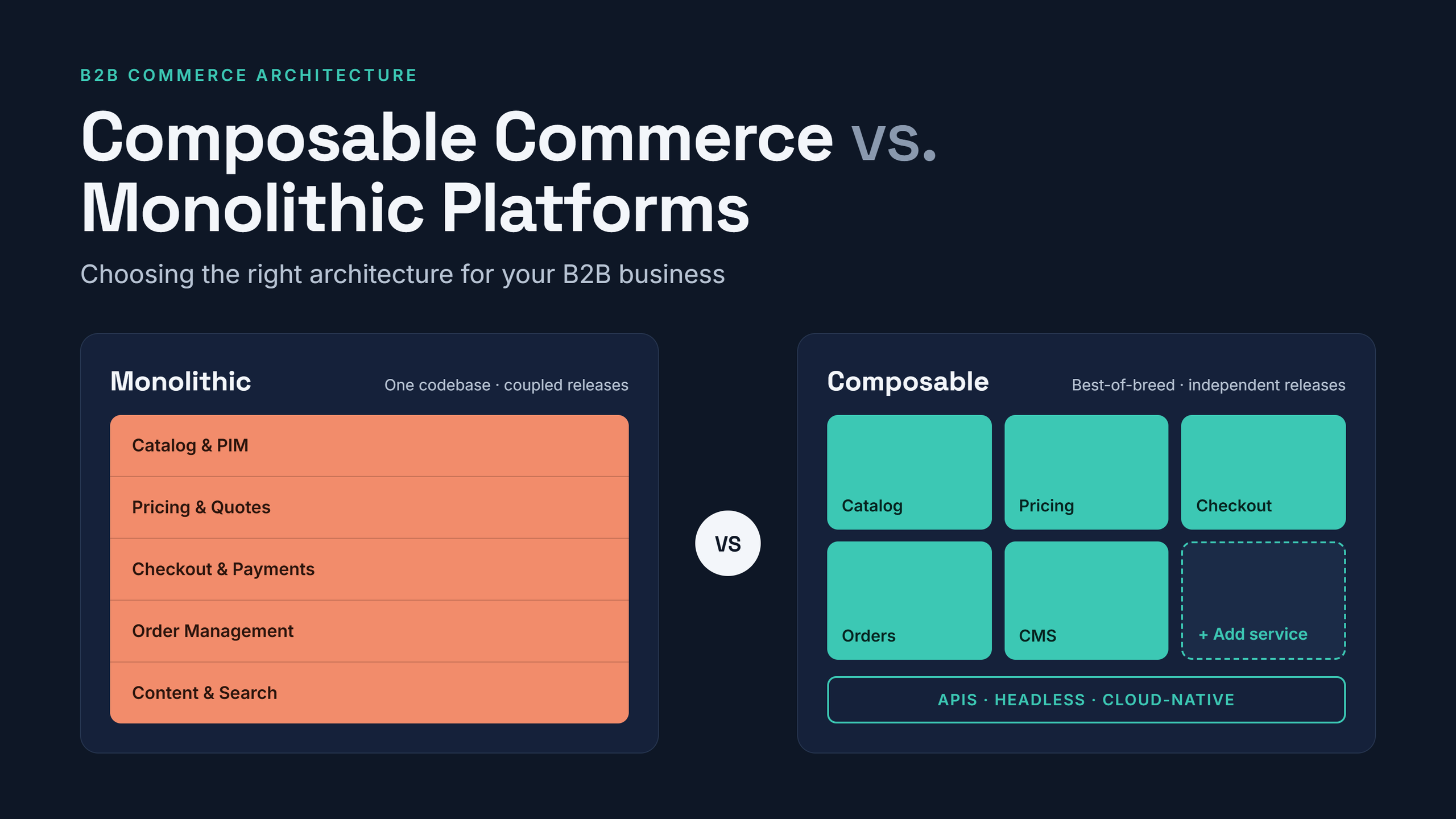
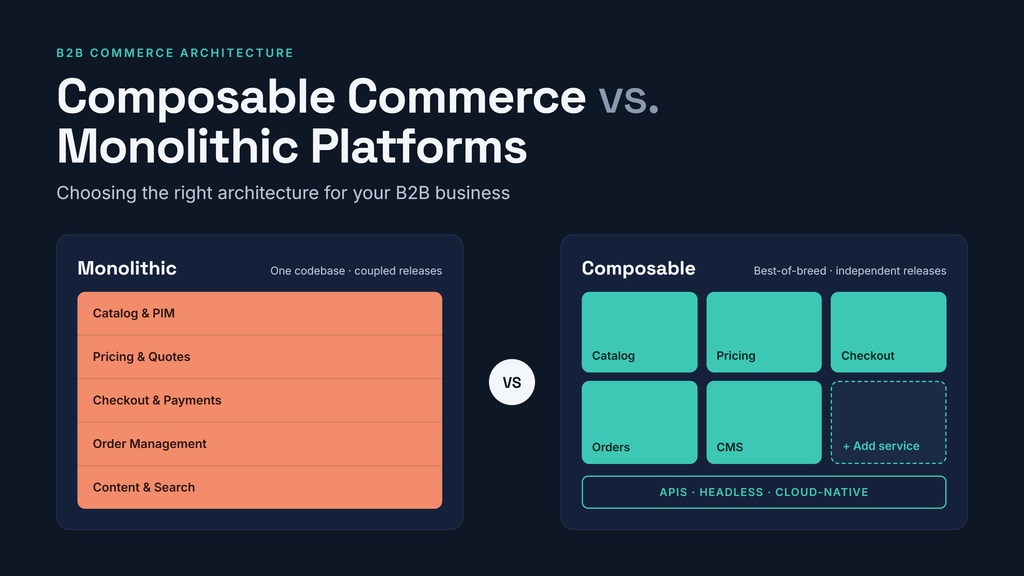
Composable commerce is a modern e-commerce architecture that enables businesses to build digital commerce experiences by combining independent, specialized software components. Instead of relying on a single platform to manage every commerce function, organizations can select different solutions for product information management, content management, search, checkout, payments, customer data, pricing, and order management.
This approach is commonly associated with the principles of MACH architecture: Microservices, API-first development, Cloud-native infrastructure, and Headless technology. These principles allow businesses to integrate different applications through APIs and develop a flexible commerce ecosystem that can evolve as business requirements change.
For example, a B2B manufacturer might use one solution to manage product information, another to deliver its online storefront, a dedicated pricing engine to calculate customer-specific discounts, and an enterprise resource planning (ERP) system to manage inventory and order fulfillment. These components communicate with one another to deliver a unified purchasing experience without depending on a single application for every function.
Composable commerce is particularly useful for businesses with complex sales processes, multiple customer segments, international operations, or rapidly changing digital requirements. It allows organizations to replace or upgrade individual components without rebuilding the entire commerce platform. However, this flexibility also requires careful integration planning, technical expertise, and ongoing management of multiple systems.
What Is a Monolithic Commerce Platform?
A monolithic commerce platform is a traditional e-commerce architecture in which most core commerce capabilities are developed and managed within a single integrated application. These capabilities typically include product catalog management, shopping cart functionality, checkout, customer accounts, promotions, order processing, and administrative tools.
Rather than selecting separate technologies for each business function, organizations use one primary platform to manage most of their digital commerce operations. Additional integrations may connect the platform to ERP, CRM, payment gateways, shipping providers, and other enterprise applications, but the core commerce experience remains largely centralized.
For B2B companies, monolithic platforms can simplify implementation by providing a unified environment for managing customer accounts, product catalogs, pricing rules, and online orders. Businesses can benefit from established workflows, integrated administration, and a consistent approach to platform management.
This architecture is often suitable for organizations that need a dependable commerce solution with predictable functionality and limited integration complexity. However, customization can become more challenging as business requirements grow. Changes to one part of the system may affect other components, and organizations may find themselves dependent on the platform vendor’s release schedule, supported extensions, and customization framework.
Although monolithic architecture is sometimes described as outdated, it can still be an effective choice for businesses whose requirements align closely with the capabilities of an integrated platform.
Key Differences Between Composable Commerce and Monolithic Platforms
The primary difference between composable commerce and monolithic architecture is how commerce capabilities are organized, integrated, and maintained. Composable commerce distributes functionality across independently deployable components, whereas monolithic platforms centralize most core capabilities within a single application.
From a customization perspective, composable commerce gives businesses greater freedom to select technologies that address specific requirements. Organizations can introduce specialized pricing engines, advanced search tools, or personalized content experiences without replacing the entire platform. Monolithic commerce generally provides customization through built-in features, plugins, extensions, and platform-specific development tools.
Scalability also differs between the two approaches. Composable architectures can allow individual services to scale according to workload demands, provided the underlying services and infrastructure support independent scaling. A monolithic platform may require broader application-level scaling, although many modern platforms also support cloud infrastructure and sophisticated scaling strategies.
Integration is another important consideration. Composable commerce relies heavily on APIs, event-driven communication, and integration services to connect independent components. Monolithic platforms typically offer more centralized functionality, which can reduce the number of integrations required for core commerce processes.
Maintenance responsibilities also vary. Composable commerce requires organizations to manage integration reliability, component compatibility, monitoring, security, and vendor relationships across multiple systems. Monolithic platforms can simplify administration through centralized tooling, although upgrades, customizations, and platform dependencies still require careful management.
Ultimately, the right architecture depends on business complexity, internal technical capabilities, total cost of ownership, and the speed at which the organization expects its digital commerce requirements to change.
Benefits of Composable Commerce for B2B Businesses
Greater Flexibility and Customization
B2B purchasing processes often involve negotiated pricing, contract-specific product catalogs, volume discounts, approval workflows, and customer-specific purchasing rules. Composable commerce allows organizations to choose specialized applications that support these requirements without forcing every business function into a single platform.
For example, a distributor serving thousands of business customers may need a pricing engine that calculates discounts based on contract terms, order volume, customer tier, and regional agreements. A composable architecture allows the distributor to integrate a dedicated pricing service with its storefront, customer management system, and order processing infrastructure.
This flexibility helps businesses create digital commerce experiences that align more closely with their sales models and customer expectations.
Faster Innovation and Feature Deployment
Composable commerce allows development teams to introduce or replace individual components without necessarily changing the entire commerce environment. A business can upgrade its search technology, implement a new personalization engine, or introduce an additional sales channel while retaining other existing systems.
This modular approach can shorten development cycles when teams have well-defined APIs, effective automated testing, and reliable deployment processes. It also helps organizations experiment with new digital capabilities while limiting the scope of individual changes.
However, faster innovation is not automatic. Poorly designed integrations, incompatible APIs, and inadequate testing can introduce delays. Businesses must establish strong development standards and integration practices to realize the full benefits of composable commerce.
Improved Scalability and Performance
B2B commerce platforms may experience significant fluctuations in traffic during seasonal purchasing periods, promotional campaigns, or major customer ordering cycles. Composable architectures can help businesses scale selected components according to their workload requirements.
For instance, an organization may need additional search capacity during high-volume product discovery periods while its content management service continues operating at its normal capacity. Independent scaling can help allocate infrastructure resources more efficiently when the architecture and hosting environment support it.
Performance improvements depend on the design of the complete system. Excessive API calls, poorly managed caching, network latency, and service dependencies can negatively affect the customer experience. Businesses must optimize the entire commerce journey rather than evaluating each component in isolation.
Better Omnichannel Commerce Experiences
Modern B2B buyers may interact with suppliers through websites, mobile applications, customer portals, sales representatives, electronic data interchange (EDI), and procurement marketplaces. Composable commerce can make it easier to deliver consistent product information, pricing, and purchasing capabilities across these channels.
A headless architecture separates the customer-facing presentation layer from the commerce backend. This enables organizations to develop different interfaces while connecting them to shared commerce services through APIs.
For B2B organizations, this can support self-service portals, mobile ordering, partner marketplaces, and sales-assisted purchasing experiences without duplicating all underlying business logic.
Reduced Dependence on a Single Platform Vendor
Composable commerce allows organizations to select different vendors for different business capabilities. If a particular service no longer meets performance, pricing, or functionality requirements, the business may be able to replace it without migrating the entire commerce platform.
This can provide greater technology choice and help organizations adapt to changing business needs. However, replacing a component still involves migration, data mapping, integration changes, testing, and potential operational disruption. Businesses should design clear interfaces and avoid unnecessary dependencies to make future replacements practical.
Benefits of Monolithic Commerce Platforms for B2B Businesses
Simplified Implementation and Administration
Monolithic commerce platforms often provide a broad set of built-in commerce capabilities through one integrated application. This can simplify implementation for businesses that need standard product catalogs, customer accounts, order processing, checkout, and promotional functionality.
A centralized administrative interface can also reduce the effort required to manage everyday commerce operations. Instead of coordinating multiple specialist systems for basic functions, business teams can use a common environment to manage much of the digital sales process.
For organizations with straightforward commerce requirements, this simplicity can reduce operational overhead and make the platform easier to support.
Lower Initial Complexity
A monolithic platform can be a practical option for businesses that want to establish an online sales channel without designing a complex distributed architecture. Its integrated functionality may reduce the need for custom APIs, separate infrastructure components, and extensive integration development during the initial implementation.
The total implementation cost still depends on licensing, customization, data migration, hosting, and integration requirements. Businesses should distinguish between lower initial complexity and lower long-term cost, because extensive custom development or expensive upgrades can increase the total cost of ownership over time.
Consistent Commerce Workflows
When core commerce functions operate within one platform, product, pricing, cart, and order workflows may share a common data model and transaction-handling approach. This can simplify coordination between related functions and reduce the need to synchronize certain types of information across independent systems.
For B2B companies, consistent workflows can support routine purchasing processes, administrative reporting, and order management. Nevertheless, integration with external ERP, CRM, inventory, and fulfillment systems may still be necessary to maintain accurate enterprise data.
Established Vendor Support and Ecosystems
Many monolithic commerce platforms offer established implementation partners, support services, extensions, documentation, and integration options. This ecosystem can help organizations implement common requirements without building every capability from scratch.
Businesses should evaluate the quality of vendor support, the availability of qualified implementation partners, the platform’s upgrade policy, and the long-term roadmap before making a decision. A strong ecosystem can be valuable, but organizations must also understand the risks associated with vendor dependency and proprietary customization.
Challenges of Composable Commerce Architecture
Despite its flexibility, composable commerce introduces several challenges that B2B organizations must consider before implementation.
One major challenge is integration complexity. When commerce capabilities are distributed across multiple applications, businesses must ensure that product information, pricing, inventory, customer records, and orders remain synchronized. Integration failures or inconsistent data can lead to incorrect prices, unavailable products, and unsuccessful transactions.
Another challenge is technical expertise. Teams need experience with APIs, distributed systems, cloud infrastructure, observability, security, and deployment automation. Organizations without these capabilities may require external implementation partners or additional investment in training and engineering resources.
The total cost of ownership can also increase if businesses adopt too many separate services. Individual subscriptions, integration platforms, monitoring tools, support contracts, and specialist development resources can create substantial ongoing expenses. Composable commerce is most effective when each component serves a clear business purpose and the organization actively manages the overall technology portfolio.
Security requires particular attention because data and business logic are distributed across multiple services and vendors. Organizations must coordinate identity management, access controls, API authentication, encryption, vulnerability management, audit logging, and incident response across the complete architecture.
Finally, troubleshooting can become more complicated when a customer-facing problem involves several connected services. Businesses need centralized logging, distributed tracing, performance monitoring, and clear ownership of each component to identify and resolve issues efficiently.
Challenges of Monolithic Commerce Platforms
Monolithic commerce platforms can also present limitations as B2B businesses expand their digital operations.
One common challenge is customization complexity. Organizations with unique pricing models, specialized purchasing workflows, or highly personalized customer experiences may need extensive platform-specific development. Over time, these customizations can become difficult to maintain, especially when they rely on proprietary frameworks or modify core application behavior.
Another limitation is the potential for slower technology adoption. If a business wants to introduce a new search engine, customer experience tool, or pricing capability, the implementation may depend on available extensions, supported integrations, or the platform’s underlying architecture. This can restrict technology choices compared with a well-designed composable approach.
Platform upgrades can also become more difficult when organizations maintain extensive custom code. Businesses must test whether customizations remain compatible with new releases and may need to modify or replace components before upgrading.
Scaling can be another consideration. Depending on the platform design, increased demand in one area may require scaling a larger portion of the application. Modern monolithic platforms can mitigate this through cloud infrastructure, caching, and other performance techniques, but the available options depend on the product and deployment model.
Finally, organizations may become highly dependent on a single vendor for licensing, platform functionality, upgrade schedules, and technical support. This does not necessarily make monolithic architecture unsuitable, but it reinforces the importance of evaluating flexibility, extensibility, and long-term platform strategy.
Composable Commerce vs. Monolithic Platforms: Which Is More Cost-Effective?
Cost is one of the most important factors when choosing a B2B e-commerce architecture. However, the most cost-effective solution is not necessarily the platform with the lowest initial licensing or implementation expense.
Composable commerce can require greater upfront investment in architecture design, integration development, infrastructure, and specialist engineering. Businesses may also need to pay for multiple software subscriptions and maintain additional monitoring and security capabilities. In return, they gain greater control over technology selection and may be able to optimize individual components as requirements change.
Monolithic platforms may offer a more predictable implementation path because many commerce functions are included in a single product. This can reduce initial integration requirements and simplify administration. However, licensing costs, proprietary extensions, complex customizations, upgrade projects, and vendor-specific limitations can influence long-term expenses.
To make a meaningful comparison, organizations should calculate the total cost of ownership over a suitable planning period. This assessment should include software licensing, implementation, integration, hosting, security, maintenance, upgrades, support, staffing, and the cost of future changes.
Businesses should also consider the financial impact of downtime, slow feature delivery, poor customer experiences, and limited scalability. An architecture that appears more expensive initially may provide better business value if it improves conversion rates, accelerates product launches, or reduces operational friction.
How to Choose the Right B2B Commerce Architecture
Selecting the right B2B commerce architecture begins with understanding business objectives rather than choosing technology based on popularity. Organizations should evaluate their current operational requirements, customer expectations, growth plans, and internal technology capabilities.
Assess Business Complexity
Businesses with standard purchasing processes and relatively straightforward product catalogs may benefit from a monolithic platform that provides the required capabilities with minimal customization. Companies with complex contract pricing, multiple brands, international storefronts, diverse sales channels, and specialized customer workflows may benefit from composable commerce.
The key is to identify where standard functionality is sufficient and where differentiation requires more specialized capabilities.
Evaluate Integration Requirements
B2B commerce systems commonly connect to ERP, CRM, product information management (PIM), warehouse management, payment, tax, and procurement systems. Organizations should map these dependencies before selecting an architecture.
A composable model can provide flexibility when many specialized systems must work together, but it also increases the importance of API quality and integration governance. A monolithic platform may simplify core workflows, particularly when it offers established connectors for the systems the business already uses.
Consider Internal Technical Capabilities
Composable commerce requires strong architectural planning, integration management, security practices, and ongoing technical support. Organizations with experienced engineering teams and mature cloud operations may be well positioned to manage this complexity.
Businesses with smaller IT teams may prefer an integrated platform or a managed commerce solution that reduces the operational burden. The architecture should match the organization’s ability to maintain it reliably, not simply its ambition to adopt newer technology.
Plan for Future Growth
Businesses should consider how their commerce requirements may change over the next three to five years. Expansion into new markets, additional sales channels, acquisitions, customer self-service capabilities, and new pricing models can all influence architecture decisions.
A monolithic platform may remain appropriate if it can support the expected roadmap without excessive customization. Composable commerce may be more suitable when frequent changes and specialized capabilities are central to the business strategy.
Evaluate Security and Compliance
Both architectures require strong security controls. Organizations should assess identity management, data protection, payment security, access permissions, auditability, backup and recovery, and relevant regulatory requirements.
Composable implementations need consistent controls across multiple services, while monolithic implementations require careful management of the core application, extensions, hosting environment, and external integrations. Security should be evaluated across the complete solution rather than assumed from the architecture alone.
Compare Long-Term Total Cost of Ownership
Businesses should evaluate the expected costs of implementation, licensing, integration, maintenance, staffing, upgrades, and future development. They should also estimate the business value of faster releases, better customer experiences, operational efficiency, and reduced technology constraints.
A structured financial assessment helps decision-makers choose an architecture that supports sustainable growth rather than optimizing only for short-term implementation costs.
Can B2B Businesses Combine Composable and Monolithic Architecture?
Yes. B2B organizations do not always need to choose between a completely composable ecosystem and a fully monolithic platform. A hybrid approach can provide a practical balance between integration simplicity and flexibility.
For example, a manufacturer might retain its existing commerce platform for product catalogs, cart management, checkout, and order processing while introducing an independent search solution, a specialized pricing service, or a separate content management system. The organization can modernize the capabilities that deliver the greatest business value without replacing the entire platform.
This incremental approach can reduce migration risk and allow businesses to validate the benefits of new technologies before making broader architectural changes. It can also help organizations preserve existing investments while addressing limitations in specific areas.
However, hybrid architecture still requires clear integration boundaries, reliable data synchronization, consistent security policies, and effective system monitoring. Businesses should avoid creating unnecessary complexity by introducing separate services without a defined business need.
A phased modernization strategy is often a sensible starting point for organizations that want to move toward composable commerce while maintaining business continuity.
Future Trends in B2B Commerce Architecture
B2B commerce architecture will continue to evolve as organizations invest in artificial intelligence, automation, personalization, and connected digital experiences.
AI-powered product discovery and conversational commerce are creating opportunities for businesses to help buyers identify relevant products, compare specifications, and find answers more efficiently. These capabilities depend on accurate product information, reliable integrations, and access to relevant customer and catalog data.
Personalization is also becoming increasingly important. B2B buyers expect product recommendations, relevant pricing, account-specific catalogs, and purchasing experiences that reflect their business relationships. Both monolithic and composable platforms can support these capabilities, but implementation flexibility depends on the architecture, available integrations, and underlying data quality.
API-driven integration will remain important as organizations connect commerce platforms with procurement systems, ERP applications, customer relationship management tools, and partner ecosystems. Businesses will also need to pay greater attention to data governance, cybersecurity, system observability, and the reliability of automated workflows.
Another important trend is the shift toward incremental modernization. Instead of replacing entire commerce platforms in a single project, organizations can increasingly evaluate specific capabilities and modernize them according to business priorities.
The most successful B2B commerce architecture will not necessarily be the most complex or technologically advanced. It will be the one that enables the organization to serve customers effectively, operate reliably, and adapt to changing business requirements.
Conclusion
Choosing between composable commerce and monolithic platforms is an important decision for B2B organizations looking to modernize their digital commerce infrastructure. Both approaches offer advantages, and the right choice depends on business complexity, customization requirements, integration needs, technical expertise, and long-term growth objectives.
Composable commerce provides greater flexibility by allowing businesses to combine specialized technologies, modernize individual components, and develop tailored digital experiences. It can be particularly valuable for organizations with complex B2B purchasing workflows, multiple sales channels, and evolving technology requirements. However, its benefits must be balanced against integration complexity, ongoing maintenance, security coordination, and total cost of ownership.
Monolithic commerce platforms offer an integrated approach that can simplify implementation, administration, and routine commerce operations. They are often suitable for organizations whose requirements align with the platform’s built-in capabilities and that prioritize operational simplicity. Their limitations may become more apparent when extensive customization, rapid innovation, or specialized functionality is required.
For many B2B businesses, a hybrid approach offers a practical path forward by combining the stability of an existing commerce platform with the flexibility of selected composable components.
Ultimately, the best B2B e-commerce architecture is one that aligns with business goals, supports an excellent customer experience, integrates effectively with enterprise systems, and delivers sustainable long-term value. By evaluating both composable commerce and monolithic platforms against these criteria, organizations can make informed technology decisions and build a digital commerce foundation that supports future growth.
Frequently Asked Questions (FAQs)
1. What is the difference between composable commerce and monolithic commerce?
Composable commerce uses independent software components connected through APIs to deliver commerce functionality. Monolithic commerce centralizes most core capabilities within a single integrated application. Composable commerce emphasizes modularity and technology choice, while monolithic commerce generally emphasizes integration and centralized management.
2. Is composable commerce better for B2B businesses?
Composable commerce can be beneficial for B2B organizations with complex pricing, specialized purchasing workflows, multiple sales channels, and frequent technology changes. However, it is not automatically better for every business. Organizations with straightforward requirements and limited technical resources may find a monolithic platform more practical.
3. Is monolithic commerce architecture outdated?
No. Monolithic commerce platforms remain suitable for many organizations, particularly when their integrated functionality meets business requirements. Modern platforms can support cloud deployment, personalization, APIs, and scalability. The important consideration is whether the platform can meet current and future business needs.
4. What is MACH architecture in composable commerce?
MACH stands for Microservices, API-first, Cloud-native, and Headless. These principles support modular software design, API-based communication, cloud infrastructure, and separation between customer-facing interfaces and backend commerce services. MACH is a common foundation for composable commerce, although not every composable implementation follows every MACH principle.
5. How does composable commerce affect B2B e-commerce costs?
Composable commerce can increase initial investment and ongoing expenses because businesses may need multiple software subscriptions, integration services, and specialist technical resources. However, it can also offer greater flexibility and more targeted modernization. The financial outcome depends on implementation quality, operational complexity, licensing, and long-term business value.
6. Can a business migrate from monolithic commerce to composable commerce gradually?
Yes. Businesses can adopt a phased migration strategy by replacing selected capabilities, such as search, content management, or personalization, while retaining the existing commerce platform for core transactions. This approach can reduce migration risk and allow organizations to modernize according to their priorities.
7. What factors should businesses consider when choosing a B2B commerce platform?
Key factors include business complexity, customer experience requirements, customization, scalability, integration capabilities, security, technical expertise, vendor dependency, implementation effort, and total cost of ownership. Organizations should evaluate these factors against their long-term digital commerce strategy.
