


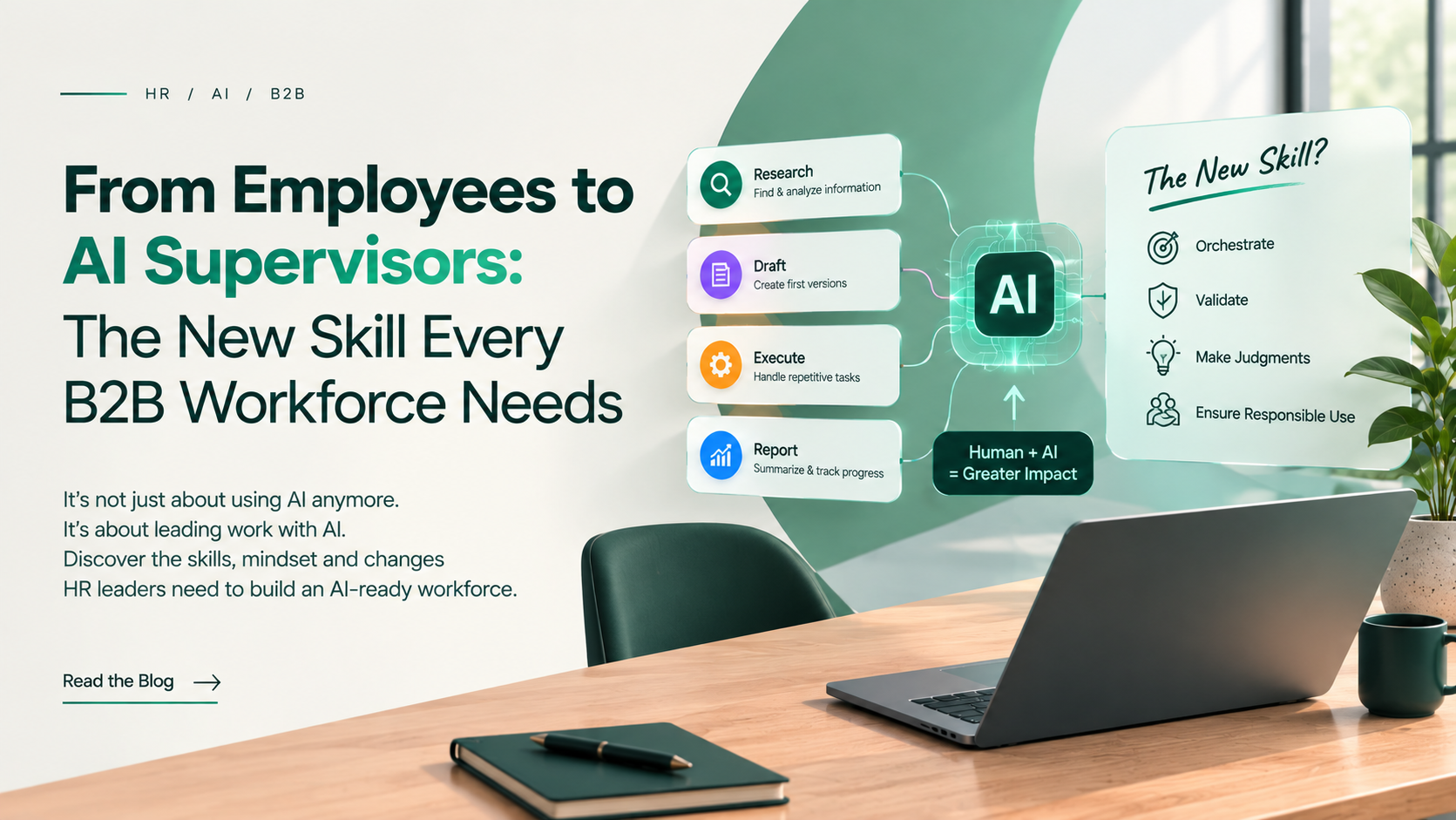

AI orchestration is becoming one of the most important skills in the modern B2B workforce. As AI agents move beyond answering questions and begin executing multi-step business tasks, employees are increasingly shifting from simply using technology to directing, supervising, and validating it.
How AI Agents Are Changing the Role of Employees
For decades, organizations designed jobs around the assumption that humans would perform most of the work while technology helped them perform it faster. Employees learned software, followed processes, completed tasks, collaborated with colleagues, and escalated difficult decisions to managers. Artificial intelligence is changing this structure.
As AI agents become capable of executing increasingly complex workflows, employees are taking on a new role: AI supervisors and orchestrators. They determine which tasks should be delegated to AI, provide the necessary context, establish constraints, review outputs, identify errors, and decide when human intervention is required.
For B2B organizations, this shift creates an important HR question: what does a job look like when part of the execution layer is no longer human?
As AI agents become capable of executing multi-step tasks rather than simply answering questions, employees are increasingly moving into a different position: they are not only using technology; they are directing it. Microsoft’s 2026 Work Trend Index describes this shift as an expansion of human agency as agents take on more execution, while Microsoft’s research in India reports that a significant share of AI-using professionals are already working with agents on multi-step tasks.
This creates an important HR question: what does a job look like when part of the execution layer is no longer human?Consider a recruiter. Traditionally, the recruiter might search for candidates, screen profiles, schedule interviews, communicate with applicants, maintain records, and prepare hiring reports.
An AI agent could potentially handle parts of candidate research, organize applications, identify profiles against defined criteria, schedule meetings, generate summaries, and assist with communication. The recruiter does not necessarily become irrelevant. Instead, the nature of the job changes. More time can be spent understanding hiring managers, evaluating complex candidate situations, improving candidate experience, advising leadership, and making judgment-heavy decisions.
The same pattern can appear across almost every department. A finance employee may use agents to reconcile information and prepare reports. A customer success manager may use agents to analyse accounts and identify risks. A marketing manager may delegate campaign research and content workflows. An IT professional may work with agents that monitor systems, investigate alerts, or prepare remediation steps. A salesperson may delegate account research and administrative work. The common thread is that employees increasingly become responsible for directing, validating, and governing machine-executed work.
What Is AI Orchestration?
This creates a new workplace capability that deserves more attention: AI orchestration. Prompt writing is only a small part of it. AI orchestration involves knowing how to break a business objective into tasks, determine which tasks should be delegated to an AI system, provide the right context, establish constraints, review outputs, detect errors, and decide when human intervention is necessary. An employee who can effectively manage these processes may accomplish significantly more than someone who simply knows how to ask an AI chatbot a question.
Why AI Orchestration Is Changing Workforce Productivity
For HR leaders, this means traditional definitions of productivity and skill development may need to evolve. In the past, productivity often meant completing more tasks in less time. In an agentic workplace, productivity may increasingly depend on how effectively an employee manages a combination of human and AI capabilities.
One employee may supervise several AI workflows while another performs most tasks manually. Measuring only hours worked or individual task volume may therefore become less useful. Organizations will need to understand the quality of decisions, outcomes, customer impact, error rates, and the ability to manage AI responsibly.
AI Orchestration and the Skills Employers Need
The implications for recruitment are equally significant. Companies may increasingly look for candidates who demonstrate AI orchestration skills alongside traditional professional expertise. But AI fluency should not be confused with knowing a handful of popular prompts. A strong AI-enabled professional needs domain knowledge because AI output still requires interpretation.
They need critical thinking because AI systems can produce inaccurate or incomplete information. They need communication skills because humans still have to explain decisions and manage stakeholders. They need judgment because not every task should be delegated. They also need the ability to understand risk, especially when AI interacts with confidential information or business systems.
Building AI Orchestration Skills Through Role-Specific Training
This changes the way organizations should approach training. One-off AI workshops may create temporary familiarity, but they do not necessarily create durable capability. Organizations should therefore treat AI orchestration as an ongoing workforce capability rather than a one-time technology skill. Google Cloud’s 2026 research emphasizes the need for organizations to build AI-ready workforces through continuous learning rather than treating AI training as a single event. The more useful approach is likely to be role-specific.
A salesperson should learn how to use AI within the sales process. A recruiter should learn how to use AI while maintaining fairness, confidentiality, and human oversight. An IT professional needs to understand agent security and access controls. A marketer needs to understand how AI affects research, content, personalization, and measurement. AI literacy becomes much more valuable when connected to the actual work employees perform.
Human Accountability in an AI-Driven Workplace
There is also a cultural challenge. Employees may initially see AI as a productivity tool, but organizations need to establish clear expectations about responsibility. If an employee delegates a task to an AI agent and the agent makes an error, who reviews the result? If an AI system makes a recommendation that influences a hiring decision, who validates it? If an agent sends inaccurate information to a customer, who owns the communication? The answer cannot simply be “the AI did it.” Organizations need clear accountability structures. Employees should know where AI can act independently, where approval is required, and which decisions must remain human-owned.
Why Human Skills Still Matter in the Age of AI
Interestingly, the rise of AI agents could make certain human skills more valuable rather than less valuable. As machines become better at execution, organizations may place greater value on problem framing, leadership, relationship building, negotiation, creativity, ethical judgment, and strategic thinking. If an AI system can produce ten possible solutions in seconds, the human advantage may increasingly come from deciding which problem is actually worth solving. If an agent can execute a workflow automatically, the employee’s value may come from designing the workflow correctly and understanding its consequences.
How Managers Will Lead Human-AI Workforces
This also means managers may need to rethink their role. Instead of managing only people, some managers will increasingly manage systems of people and AI agents. They may need to understand how work is distributed, where bottlenecks occur, which processes should be automated, and where human oversight adds the most value. The organization itself begins to resemble a hybrid workforce in which digital agents become part of operational capacity. HR will therefore move closer to technology strategy because workforce planning will increasingly involve both human and non-human contributors.
The Future of Work: Employees Working Through AI
The future workplace will not simply be a place where employees “use AI.” It will be a workplace where employees work through AI. That distinction is important. Using AI means opening a tool when assistance is required. Working through AI means redesigning workflows around a combination of human judgment and machine execution. Organizations that understand this difference can build stronger workforce strategies, while those that treat AI as another software subscription may struggle to capture its full potential.
The emerging HR challenge is therefore not just preparing employees for AI. It is preparing employees to lead work in an environment where AI can increasingly perform the work itself. The most valuable professionals may be those who know when to delegate, when to intervene, when to challenge an AI output, and when a human decision is simply too important to automate. In the agentic workplace, the future of work may depend less on how much work one person can personally execute and more on how effectively that person can orchestrate an entire system of human and digital capabilities.
