



Introduction: The Growing Dependence on Technology in the Modern Workplace
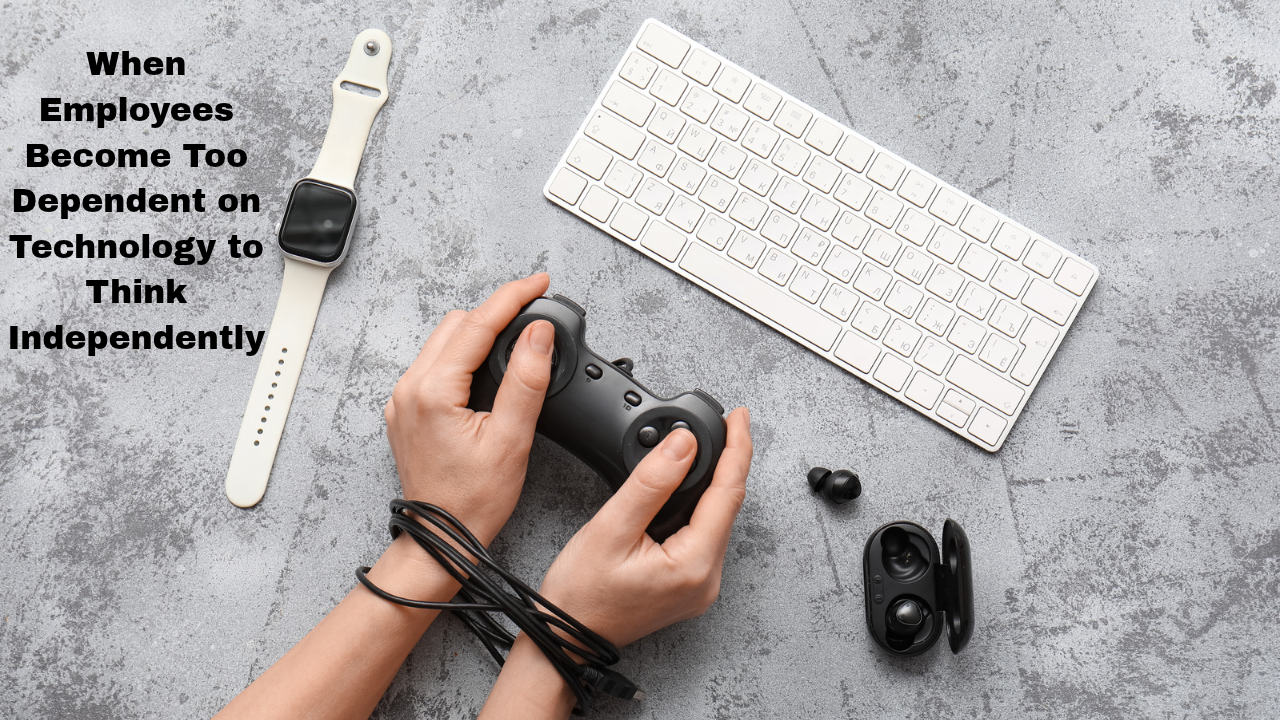
Employees Dependent on Technology are becoming increasingly common in modern workplaces as businesses adopt artificial intelligence, automation platforms, digital collaboration tools, and data analytics systems to improve productivity. While these technologies help employees complete tasks faster, access information more easily, and simplify complex workflows, excessive dependence on digital tools can create challenges for independent thinking, critical reasoning, and decision-making.
As technology becomes deeply embedded in everyday business operations, employees may gradually become more comfortable accepting automated recommendations than developing solutions independently. Instead of analysing problems, exploring different possibilities, or applying their professional experience, they may immediately turn to AI assistants, search engines, and automated platforms for answers. Although these resources offer significant advantages, relying on them without questioning their accuracy or relevance can weaken essential workplace skills.
The real challenge for organisations is finding the right balance between technological efficiency and human intelligence. Technology should strengthen employees’ capabilities, encourage innovation, and support better decisions rather than replace the independent thinking and professional judgement that drive long-term business success.
Technology has become an essential part of modern business operations, transforming how employees communicate, collaborate, analyse information, and complete everyday responsibilities. From artificial intelligence (AI) assistants and automated workflows to cloud-based platforms and advanced data analytics, organisations are increasingly relying on digital solutions to improve workplace productivity and operational efficiency. Employees now use technology to organise their schedules, generate content, analyse business information, automate repetitive activities, and support important decisions. While these innovations have made work faster and more convenient, they have also introduced a concern that businesses cannot afford to overlook: Are employees becoming too dependent on technology to think independently?
As digital tools become more sophisticated, employees may gradually lose the habit of approaching problems through their own reasoning, experience, and judgement. Instead of investigating an issue, evaluating different possibilities, or developing an original solution, they may immediately turn to AI platforms, search engines, or automated recommendation systems for answers. Although technology can simplify complex tasks, excessive dependence on it can weaken critical thinking, independent decision-making, creativity, and problem-solving abilities.
The objective of workplace technology should be to strengthen human capabilities rather than replace the thinking processes that make employees valuable. Organisations must therefore find a balance between digital efficiency and independent thinking to ensure that technological progress contributes to long-term workforce development rather than creating an overreliance on automated assistance.
1. How Technology Is Changing the Way Employees Solve Problems
One of the most noticeable changes in the modern workplace is how employees approach everyday challenges. Traditionally, when employees encountered a problem, they were expected to investigate the situation, understand its underlying causes, explore possible solutions, and develop an appropriate response. This process encouraged individuals to apply their knowledge, learn from previous experiences, and develop practical problem-solving skills.
Today, however, many employees immediately turn to digital tools whenever they face a challenge. Search engines provide instant information, AI assistants suggest possible solutions, and automated platforms offer ready-made recommendations. These resources can save considerable time and help employees complete tasks more efficiently. However, the concern begins when individuals accept the first available answer without examining its accuracy, relevance, or suitability.
For example, an employee troubleshooting a technical issue may follow an AI-generated solution without understanding the underlying problem. Similarly, a marketing professional may use an automatically generated campaign strategy without evaluating whether it aligns with the target audience or business objectives. When this behaviour becomes routine, employees may become less willing to investigate problems independently.
Over time, this dependence can affect their ability to approach unfamiliar situations, evaluate alternative solutions, and make decisions without external assistance. Businesses should therefore encourage employees to use technology as a starting point for problem-solving rather than treating it as the final authority.
2. Artificial Intelligence and the Decline of Critical Thinking Skills
Artificial intelligence has made workplace technology dependence particularly relevant. AI-powered tools can generate reports, write emails, develop marketing strategies, summarise documents, analyse datasets, and provide recommendations within seconds. These capabilities have transformed productivity across departments such as marketing, sales, human resources, finance, customer service, and IT.
However, faster output does not necessarily mean better judgement. AI-generated information can sometimes contain inaccuracies, overlook important business requirements, or provide recommendations based on incomplete context. An answer may sound professional and convincing while failing to address the actual requirements of a particular situation.
For instance, an HR professional using AI to create a job description must still understand the position’s responsibilities, required experience, organisational expectations, and industry-specific skills. Similarly, a sales representative using AI-generated email content must evaluate whether the message reflects the customer’s interests and the relationship the organisation wants to build.
The growing challenge is that employees may begin confusing the ability to generate information with the ability to understand it. Critical thinking requires individuals to question assumptions, identify inconsistencies, assess evidence, and determine whether a recommendation makes sense in a particular context.
Organisations must encourage employees to review AI-generated content, verify important information, and explain the reasoning behind their decisions. AI should support human intelligence, not become a substitute for independent analysis and professional judgement.
3. Reduced Confidence in Independent Decision-Making
Another important consequence of excessive technology dependence is the gradual loss of confidence in making decisions independently. When employees regularly rely on automated suggestions, digital instructions, and AI-generated recommendations, they may become uncomfortable situations where these resources are unavailable.
Consider a manager who depends heavily on business intelligence dashboards to evaluate performance. While dashboards provide useful insights, the manager may struggle to make an informed assessment when the relevant information is missing, outdated, or incomplete. Similarly, an employee who regularly uses AI writing assistants may find it difficult to structure an important business communication without technological support.
This issue is not necessarily a reflection of employees lacking intelligence or professional ability. Instead, it may indicate that workplace practices have gradually encouraged dependence on ready-made answers rather than individual reasoning.
Independent decision-making develops through experience, practice, accountability, and the confidence to evaluate different possibilities. Employees need opportunities to make decisions, understand their consequences, and learn from mistakes. If every decision is guided by an automated recommendation, individuals may have fewer opportunities to strengthen these capabilities.
Businesses should create an environment where employees feel confident expressing their opinions, suggesting alternative approaches, and making informed decisions without constantly seeking technological validation.
4. The Impact of Technology Dependence on Workplace Creativity and Innovation
Creativity and innovation are important drivers of business growth. Organisations depend on employees to develop new ideas, identify opportunities, improve existing processes, and discover better ways to serve customers. However, excessive reliance on automated content generation and recommendation systems can influence how individuals approach creative work.
AI tools can generate marketing concepts, social media posts, presentation outlines, product descriptions, and business proposals. These capabilities are valuable for overcoming creative blocks and accelerating initial development. However, when employees depend entirely on generated suggestions, their work may become increasingly predictable and lack originality.
For example, a marketing team that repeatedly uses AI-generated campaign ideas without conducting independent research may produce content that resembles existing industry approaches. Although the output may appear polished, it may not reflect the unique preferences of the target audience or communicate the organisation’s distinctive value proposition.
True creativity involves more than generating ideas. It requires curiosity, experimentation, observation, understanding customer behaviour, and connecting information in new ways. These abilities develop when employees are encouraged to explore possibilities rather than simply select from automated suggestions.
Organisations should use AI as a creative assistant that helps employees explore new directions while ensuring that original thinking, strategic understanding, and human creativity remain central to the process.
5. How Technology Dependence Can Affect Leadership and Business Decisions
Technology dependence is not limited to employees performing operational tasks. It can also influence managers, department heads, and senior business leaders who increasingly rely on dashboards, predictive analytics, automated reports, and AI-powered decision-support systems.
These technologies provide valuable information about business performance, customer behaviour, employee productivity, and operational efficiency. However, data alone cannot explain every factor influencing a business situation. Effective decision-making requires the ability to interpret information, understand context, and recognise factors that may not be visible through digital systems.
For example, a dashboard may indicate that a marketing campaign is underperforming, but it may not fully explain changing customer expectations, weaknesses in the campaign message, or external market conditions. Similarly, employee engagement reports may highlight declining satisfaction levels, but understanding the reasons requires meaningful conversations, observation, and direct feedback.
Leaders who depend exclusively on automated reports may overlook important human and organisational factors. They may also become less prepared to make decisions when data is incomplete or when unexpected situations require immediate action.
Successful leadership requires a combination of data-driven insights, professional experience, emotional intelligence, and independent judgement. Technology should help leaders make better-informed decisions, but the responsibility for evaluating consequences and choosing the right direction must remain with people.
6. The Long-Term Impact on Employee Skills and Professional Development
One of the most significant risks of excessive technology dependence is its potential impact on long-term employee development. Professional expertise is built through continuous learning, practical experience, experimentation, and the ability to overcome challenges. Employees become more capable when they actively participate in the processes behind their work rather than simply accepting completed outputs.
When technology handles every difficult or repetitive task, employees may lose valuable opportunities to develop foundational professional skills.
For example, a junior marketing professional who depends entirely on AI-generated content may not develop a strong understanding of audience research, persuasive communication, brand positioning, or campaign performance. Similarly, an analyst who relies exclusively on automated reports may struggle to interpret complex information independently or identify patterns that require deeper investigation.
This challenge is particularly important for early-career employees. The initial stages of professional development are essential for building the knowledge and confidence required to take on more complex responsibilities. If employees bypass the learning process by relying on automated solutions for every task, they may become productive in the short term but less capable of handling unfamiliar challenges in the future.
Organisations must therefore ensure that technology adoption does not eliminate opportunities for employees to learn, experiment, and develop expertise. Automation should reduce unnecessary effort while preserving meaningful opportunities for professional growth.
7. Why Businesses Must Encourage a Balance Between Automation and Independent Thinking
Businesses should not interpret these concerns as a reason to avoid technological innovation. Digital transformation, artificial intelligence, and automation continue to offer significant benefits, from improving operational efficiency to reducing repetitive workloads and supporting faster decision-making.
The real challenge is determining how these technologies should be integrated into everyday responsibilities. Organisations must move beyond measuring technology adoption through the number of automated tasks completed or the amount of time saved. They should also evaluate whether digital tools are improving employee understanding, analytical capabilities, and the ability to solve problems independently.
Managers can encourage employees to develop an initial understanding of a problem before consulting AI tools or automated platforms. Employees should be asked to evaluate recommendations, identify potential limitations, and explain why a particular solution is appropriate. This approach encourages individuals to remain actively involved in the thinking process rather than becoming passive users of technology.
Businesses should also create opportunities for collaborative problem-solving, brainstorming sessions, independent research, and practical decision-making exercises. Such activities help employees develop confidence while learning how to combine technological assistance with their own professional knowledge.
The goal should be to establish a workplace culture where technology improves performance without reducing individual responsibility, curiosity, and independent judgement.
8. Practical Strategies to Develop Independent Thinking in a Technology-Driven Workplace
Building a workforce that can think independently requires more than introducing new digital platforms or conducting technical training. Organisations must actively encourage behaviours that strengthen reasoning, creativity, and professional judgement.
Encourage Employees to Think Before Using AI: Employees should be encouraged to understand a problem and develop an initial approach before asking AI tools for assistance. This simple practice helps preserve independent reasoning while still allowing individuals to benefit from technological support.
Promote Critical Evaluation of AI-Generated Results: Employees should review generated information, verify important facts, question assumptions, and identify missing context. Managers can make this a regular part of workflows to ensure that technology-supported output meets business requirements.
Invest in Critical Thinking and Problem-Solving Training: Employee development programmes should include analytical reasoning, decision-making, communication, creativity, and practical problem-solving exercises. These skills help employees handle unfamiliar situations with greater confidence.
Give Employees Opportunities to Make Decisions: Managers should encourage employees to take ownership of appropriate responsibilities rather than relying on automated instructions for every activity. Allowing individuals to evaluate options and explain their decisions strengthens accountability and professional confidence.
Encourage Human Collaboration and Knowledge Sharing: Discussions with colleagues provide different perspectives that automated systems may not fully understand. Team brainstorming, peer reviews, mentoring, and collaborative problem-solving can improve both decision quality and workplace learning.
Measure Skills Development Alongside Productivity: Businesses should evaluate not only how quickly employees complete tasks but also how effectively they understand problems, identify risks, and develop solutions independently. This creates a more balanced approach to technology adoption and workforce development.
By integrating these practices into everyday operations, organisations can build teams that are comfortable using advanced technologies while retaining the ability to think critically and act independently.
9. The Future of Work: Why Human Intelligence Will Remain Important
As artificial intelligence and workplace automation continue to evolve, the relationship between employees and technology will become even more important. Many routine activities will increasingly be handled by intelligent systems, allowing employees to focus on responsibilities that require creativity, strategic thinking, communication, and complex decision-making.
However, these benefits will only be fully realised when employees possess the skills to work alongside technology effectively. Knowing how to operate an AI platform or automate a workflow will not be enough. Professionals must also understand how to evaluate its output, recognise its limitations, and determine when human intervention is necessary.
The future workforce will need a combination of digital literacy, critical thinking, adaptability, creativity, and emotional intelligence. Employees who can connect technological insights with practical experience and business understanding will be better positioned to contribute meaningful value.
Organisations must also rethink their approach to employee training and performance development. Rather than focusing exclusively on technical proficiency, they should create learning opportunities that strengthen the human capabilities that technology cannot independently replace. This includes asking better questions, understanding complex situations, communicating effectively, and taking responsibility for important decisions.
Ultimately, the most successful organisations will not simply be those that adopt the greatest number of technologies. They will be those that develop employees who know how to use technology intelligently without becoming dependent on it.
Conclusion: Technology Should Strengthen Human Thinking, Not Replace It
Technology has transformed the modern workplace by making information more accessible, automating repetitive activities, and helping employees complete tasks more efficiently. Artificial intelligence, digital collaboration platforms, and automated decision-support systems will continue to play an important role in business operations. However, organisations must recognise that excessive dependence on these tools can create challenges for independent thinking, critical reasoning, creativity, and professional development.
Employees should not become passive users of technology who accept recommendations without questioning them or struggle to make decisions when automated assistance is unavailable. Instead, they should develop the confidence to investigate problems, evaluate information, challenge assumptions, and make informed decisions using their own knowledge and experience.
For businesses, the priority should be to build a balanced workplace where automation and human intelligence complement each other. This requires investment in employee training, critical thinking, practical experience, collaborative learning, and responsible AI adoption.
The future of work will not belong simply to employees who know how to use the most advanced technology. It will belong to those who know when to use it, when to question it, and when to trust their own judgement. Technology can generate answers in seconds, but human intelligence determines whether those answers are meaningful, accurate, and appropriate. The real competitive advantage will come from organisations that use technology to make their employees more capable, confident, and independent thinkers.
