


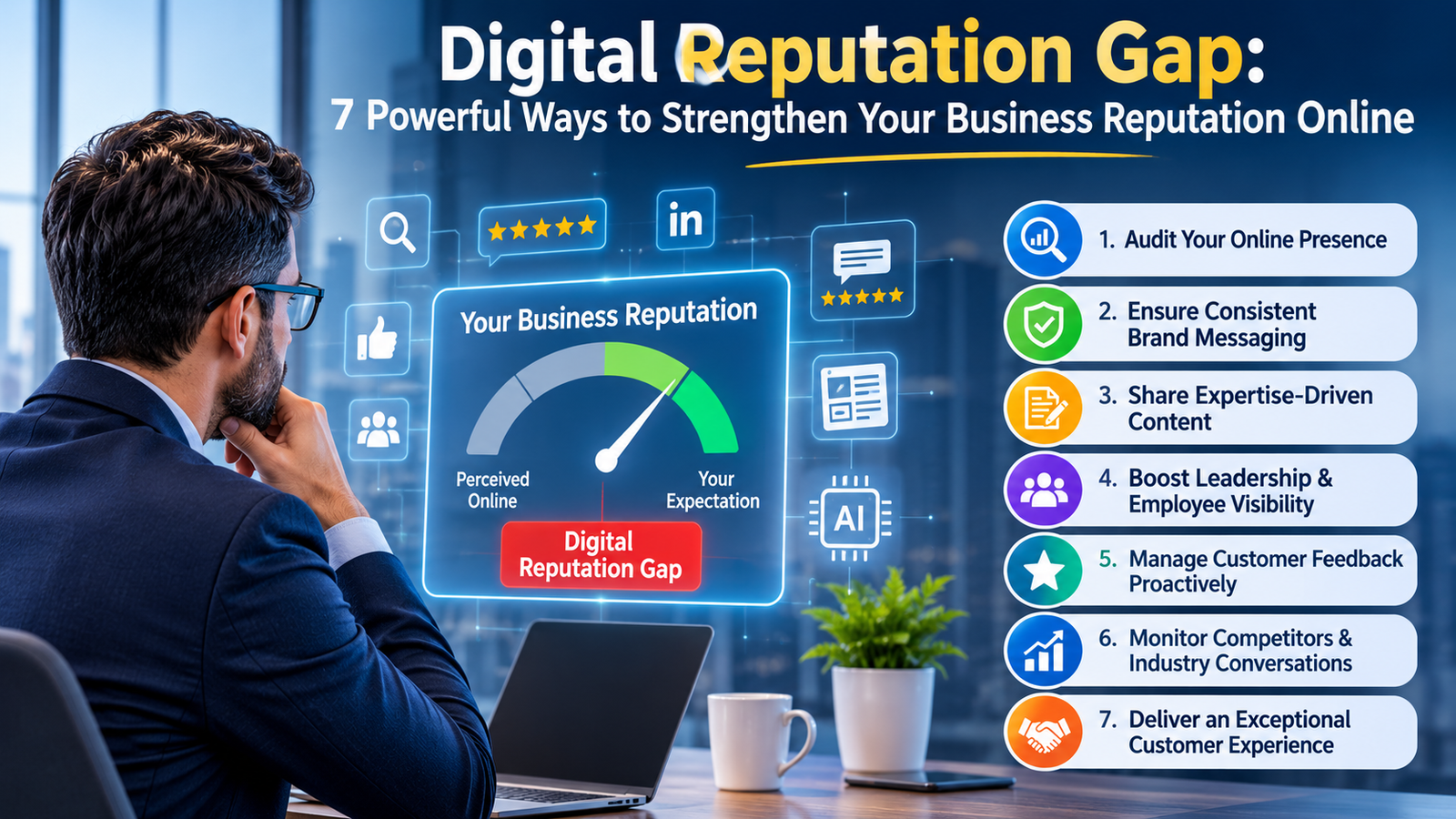

The digital reputation gap is becoming an increasingly important challenge for businesses operating in today’s connected marketplace. Before potential customers contact a company, schedule a meeting, or request a proposal, they may already have formed an opinion based on its online presence. Customer reviews, employee feedback, leadership profiles, industry publications, social media discussions, and AI-powered search results all influence how an organization is perceived. In many cases, these digital interactions shape purchasing decisions long before a business knows it is being evaluated. Understanding the digital reputation gap is essential for businesses that want to maintain credibility across search engines, professional networks, customer review platforms, and emerging AI-powered discovery channels.
Traditionally, organizations had greater control over their public image through advertising, official announcements, sales presentations, and direct customer communication. However, that control has changed. Today’s buyers independently research companies, compare competitors, examine public feedback, and use artificial intelligence to understand which businesses deserve their attention. This creates a disconnect between the reputation a company believes it has established and the impression people actually develop through independent digital sources. The digital reputation gap is particularly challenging for growing businesses because their market perception may not always keep pace with their actual expertise, achievements, and service capabilities.
This disconnect is what defines the digital reputation gap. It represents more than a marketing problem; it is a business challenge that can influence customer acquisition, sales opportunities, recruitment, partnerships, and long-term brand credibility. Organizations must therefore move beyond simply maintaining an online presence and start understanding how their entire digital identity influences the decisions of people who may never interact with them directly. Addressing the digital reputation gap requires organizations to understand how their online identity influences customer trust, purchasing decisions, and long-term business relationships.
1. Understanding the Digital Reputation Gap in Modern Business
The digital reputation gap emerges when an organization’s intended brand image differs from how external audiences perceive it online. A company may consider itself innovative, customer-focused, and technologically advanced, but potential customers may encounter outdated website information, inconsistent messaging, limited industry insights, or negative customer experiences.
The challenge is that businesses often evaluate their reputation through their own marketing activities. They measure website traffic, campaign performance, social media engagement, and lead generation. While these indicators are valuable, they do not necessarily explain how people perceive the organization when researching it independently. A growing digital reputation gap can prevent organizations from communicating their actual strengths effectively, particularly when their online presence does not reflect their operational capabilities and customer experience.
For example, consider a B2B technology company that promotes its expertise in cloud infrastructure management. Its website highlights advanced capabilities, experienced professionals, and enterprise-grade solutions. However, potential customers discover that its technical resources are outdated, its leadership team has little visible industry presence, and its public customer feedback raises questions about service responsiveness.
Although the company may have the technical capabilities to deliver excellent results, the information available online creates uncertainty.
Several factors contribute to this problem:
- Inconsistent brand messaging: Different platforms communicate different descriptions of the company’s services, capabilities, or values.
- Limited third-party credibility: The organization has few meaningful customer testimonials, industry references, or independent mentions.
- Outdated digital information: Website content, leadership profiles, service descriptions, and company details do not reflect current business capabilities.
- Unmanaged customer feedback: Reviews, complaints, and public discussions receive attention only when they begin affecting business opportunities.
- Weak leadership visibility: Senior executives and subject matter experts rarely contribute meaningful industry perspectives.
Identifying these inconsistencies is the first step toward reducing the digital reputation gap and creating a more reliable brand experience across digital channels.
The digital reputation gap becomes more significant when these issues appear across multiple platforms. Prospective customers rarely investigate only one source, so inconsistencies can accumulate and weaken confidence.
2. How AI-Powered Search Is Changing Business Reputation
Artificial intelligence is changing how buyers discover, research, and compare organizations. Instead of manually visiting multiple websites, decision-makers increasingly use AI-powered assistants and search experiences to summarize companies, identify service providers, understand industry capabilities, and explore potential alternatives. The digital reputation gap becomes more challenging in AI-driven environments because businesses must establish credibility through information available beyond their official websites and marketing campaigns.
This shift makes the digital reputation gap more complex because businesses must communicate their expertise in ways that are understandable across different discovery channels.

Imagine a procurement manager researching enterprise cybersecurity providers. Rather than starting with individual company websites, the manager may ask an AI assistant to identify providers with experience in cloud security, threat detection, and enterprise risk management.
The resulting evaluation may be influenced by publicly available information such as:
- Detailed service descriptions and technical documentation.
- Industry articles and expert contributions.
- Customer testimonials and independent reviews.
- Leadership interviews and professional profiles.
- Consistent information across corporate websites and professional platforms.
- Relevant discussions that demonstrate industry knowledge.
This does not mean that publishing more content automatically guarantees visibility in AI-generated answers. Content quality, clarity, relevance, source credibility, and the wider information ecosystem all matter.
Businesses should focus on making their expertise easier to understand and verify. Instead of publishing generic promotional statements, they should address specific industry challenges, explain their solutions, share practical knowledge, and maintain accurate information across their digital channels.
Why AI Visibility and Digital Reputation Are Connected
AI-powered discovery introduces another dimension to the digital reputation gap: businesses are increasingly evaluated through information they do not directly control.
An organization may have an attractive website, but if its wider digital footprint provides limited evidence of expertise, its positioning may be difficult to understand. Similarly, conflicting service descriptions across different sources can create confusion about what the company actually offers.
A stronger approach involves building a consistent information ecosystem in which corporate content, leadership insights, customer experiences, and credible third-party references reinforce the same business identity. Companies that actively address the digital reputation gap can improve the consistency of their business information and make their expertise easier for potential buyers to understand.
3. Your Website Is Only One Part of Your Digital Brand Reputation
Many organizations assume that their website represents their complete digital identity. In reality, a corporate website is only one component of the information ecosystem that influences how people evaluate a business.
A potential customer discovering a company through LinkedIn may subsequently visit its website, search for its executives, read customer reviews, explore employee experiences, and compare its services with competitors. Every interaction contributes to the overall perception of the organization. Closing the digital reputation gap requires businesses to examine every important customer touchpoint rather than concentrating exclusively on their corporate website.
This is why the digital reputation gap cannot be addressed through website improvements or social media campaigns alone. Businesses need to examine how their identity is represented across the entire digital environment.
For example, a technology consulting company may communicate its expertise through its website but have an inactive LinkedIn presence. Its competitors, meanwhile, regularly publish technical insights, discuss industry developments, and share practical implementation experiences. Even if both organizations have comparable technical capabilities, the second company may appear more engaged and knowledgeable to prospective customers. A consistent digital identity helps reduce the digital reputation gap by ensuring that customers receive a recognizable and accurate impression of the organization.
Businesses should evaluate the consistency of their digital presence across several important channels:
Corporate Website and Content
The website should clearly explain what the organization does, whom it serves, and what problems it solves. Service descriptions, case studies, technical resources, leadership information, and contact details should be accurate and regularly reviewed.
Professional and Social Media Platforms
Platforms such as LinkedIn provide opportunities to demonstrate industry knowledge, communicate business developments, and establish relationships with relevant audiences. An active presence should prioritize useful professional conversations rather than repetitive promotional updates.
Customer Reviews and Public Feedback
Customer experiences can influence purchasing decisions significantly. Businesses should monitor reviews, respond professionally to legitimate concerns, and identify recurring feedback that may indicate service or communication problems.
Third-Party Industry References
Industry publications, independent research, partner mentions, interviews, and credible customer references can provide external evidence of an organization’s expertise.
A consistent digital identity does not require identical content across every platform. It requires a recognizable and accurate representation of the same business capabilities, values, and expertise.
4. Leadership and Employee Visibility Are Becoming Reputation Drivers
Corporate reputation is no longer shaped exclusively by official marketing communication. The people associated with an organization also contribute to how its expertise, culture, and credibility are perceived. Leadership visibility and employee communication are important considerations when organizations develop strategies to address the digital reputation gap.
Customers frequently investigate company founders, senior executives, technical specialists, and other professionals before entering important business relationships. Their professional profiles, published opinions, industry contributions, and participation in relevant discussions can influence confidence in the organization.
For B2B businesses, this is particularly important because purchasing decisions often involve long evaluation cycles and multiple stakeholders. Buyers want to understand not only what a company provides but also whether the people behind it have the knowledge and experience required to deliver the promised results.

Consider an enterprise software company positioning itself as an expert in digital transformation. Its marketing department publishes articles about emerging technologies, but its technical leadership rarely participates in industry discussions. Its engineers do not share implementation insights, and its executives have limited professional visibility.
The organization may have considerable technical knowledge, but potential customers have fewer opportunities to recognize that expertise.
Employee and leadership visibility can help address this challenge through:
- Executive thought leadership: Senior leaders sharing informed perspectives on industry developments and business challenges.
- Subject matter expertise: Technical professionals explaining practical solutions, implementation experiences, and technology considerations.
- Employee advocacy: Employees sharing relevant company developments and professional knowledge through their networks.
- Consistent organizational communication: Leadership messaging, recruitment communication, and customer-facing content reflecting a coherent business identity.
When employee experiences and leadership communication reinforce the same organizational values, businesses can reduce the digital reputation gap and strengthen external confidence.
However, employee visibility should be encouraged authentically. Businesses should not expect employees to become promotional channels or publish scripted opinions. Genuine professional contributions are more valuable for establishing credibility.
Organizations should also recognize that employee experiences influence employer reputation. Recruitment platforms, professional communities, and employee discussions can affect how prospective candidates and business partners perceive the workplace.
The digital reputation gap often becomes visible when corporate messaging communicates one set of values while public employee experiences suggest another.
5. Why Reactive Reputation Management Is No Longer Enough
Many companies pay attention to their online reputation only after something goes wrong. A negative review, customer complaint, critical social media discussion, or outdated business listing may receive attention only when someone reports a potential problem.
By that stage, the organization may already have lost business opportunities. Organizations that ignore continuous monitoring may discover the digital reputation gap only after it begins affecting customer relationships, recruitment, or sales opportunities.
A prospect might have researched the company, discovered negative feedback, and shortlisted another provider without ever contacting the original organization. The sales team may never learn why the opportunity disappeared.
This illustrates why reputation management should be a continuous business activity rather than an emergency response process. Proactive reputation monitoring allows businesses to identify the digital reputation gap early and respond before inconsistencies become larger business concerns.
Businesses need a structured approach to understanding what customers, employees, partners, and industry audiences are saying about them.
Establish a Continuous Digital Reputation Monitoring Process
A practical monitoring strategy should cover several areas:
1. Brand mention monitoring
Track public references to the organization, its products, services, leadership team, and major business developments. This helps identify discussions that may influence public perception.
2. Customer review analysis
Regularly examine customer feedback across relevant review platforms. Look for recurring concerns about service quality, communication, delivery timelines, technical support, and customer experience.
3. Competitor reputation analysis
Understand how competitors position themselves, what customers appreciate about their services, and which weaknesses frequently appear in public feedback.
4. Leadership and employee visibility
Review the public professional presence of key executives and subject matter experts. Identify opportunities to communicate expertise and address inconsistencies in organizational messaging.
5. Digital information accuracy
Check whether company descriptions, service information, leadership details, contact information, and other business information remain accurate across important digital platforms.
These activities can generate useful business intelligence beyond reputation management.
For example, if multiple customers independently raise concerns about implementation delays, the issue may indicate an operational problem rather than simply a communication challenge. Similarly, recurring questions about a company’s service capabilities may suggest that its website does not explain its offerings clearly enough.
The digital reputation gap can therefore reveal weaknesses that internal performance reports might not immediately identify.
6. How the Digital Reputation Gap Affects B2B Sales and Business Growth
For B2B organizations, reputation has a direct connection with how potential customers evaluate business risk.
Enterprise purchasing decisions often involve substantial investments, technical evaluations, procurement requirements, and multiple stakeholders. Buyers need confidence that a prospective service provider understands their requirements and can deliver the expected outcomes. For enterprise decision-makers, the digital reputation gap can create uncertainty about a provider’s experience, reliability, service quality, and ability to deliver business outcomes.
Consequently, they rarely depend entirely on information provided during a sales presentation.
Before speaking with a sales representative, decision-makers may already have examined the company’s website, reviewed its industry experience, compared its services with competitors, and explored available customer feedback.
If these sources create uncertainty, sales teams may need to spend additional time establishing basic credibility instead of discussing business requirements and potential solutions. Reducing the digital reputation gap can therefore become an important part of improving B2B customer acquisition and strengthening competitive positioning.
Business Areas Influenced by Digital Reputation
| Business area | Potential impact of a reputation gap |
|---|---|
| Lead generation | Prospects may exclude the company during initial research. |
| Sales conversion | Inconsistent information can create doubts during evaluation. |
| Customer acquisition | Competitors with stronger credibility may receive preference. |
| Recruitment | Candidates may question the company’s workplace culture. |
| Partnerships | Potential partners may hesitate when expertise is difficult to verify. |
| Investor confidence | Inconsistent public information may create additional questions during due diligence. |
Consider a B2B IT services provider competing for an enterprise infrastructure management contract. Both shortlisted companies offer comparable technical capabilities and pricing.
However, one provider has detailed case studies, active technical leadership, credible industry contributions, and consistent customer feedback. The other has an outdated website and limited public evidence of its experience.
Even without a difference in actual delivery capabilities, the first organization may have an advantage in establishing initial confidence.
This is the commercial significance of the digital reputation gap: the perception of credibility can influence whether a business receives the opportunity to demonstrate its actual capabilities.
Organizations should therefore align marketing, sales, customer success, leadership communication, and public information around a consistent identity.
7. Practical Strategies to Close the Digital Reputation Gap
Closing the digital reputation gap requires more than improving brand visibility. It involves identifying differences between the company’s intended identity and its actual digital representation, then addressing those differences through measurable business activities. A structured digital reputation gap management strategy helps businesses identify weaknesses, prioritize improvements, and maintain consistent communication across their digital channels.
The following strategies provide a practical starting point for organizations.
1. Conduct a Digital Reputation Audit
Begin by researching the company as an external customer would.
Search for the business name, major services, leadership profiles, customer feedback, and relevant industry references. Examine what appears across search engines, professional platforms, review websites, and other relevant public sources.
Identify outdated information, inconsistent descriptions, negative feedback, and missing evidence of expertise.
2. Build a Consistent Brand Identity
Ensure that the organization communicates its services, capabilities, industry focus, and value proposition consistently.
This does not mean using identical messaging everywhere. Instead, the same underlying business identity should be recognizable across the website, social media, professional profiles, and external publications.
3. Invest in Expertise-Driven Content
Create content that demonstrates genuine knowledge rather than simply promoting products and services.
Useful content formats include:
- Technical articles addressing enterprise challenges.
- Industry-specific guides and implementation insights.
- Case studies demonstrating business outcomes.
- Expert interviews and leadership perspectives.
- Research-based reports and educational resources.
- Frequently asked questions addressing common buyer concerns.
Such content can help strengthen digital credibility while supporting organic search visibility and AI-powered discovery.
4. Encourage Authentic Leadership and Employee Participation
Give executives and subject matter experts opportunities to communicate their professional knowledge. Encourage employees to participate in relevant discussions when appropriate.
An organization that demonstrates expertise through multiple credible voices can develop a more complete digital identity than one relying exclusively on its corporate marketing account.
5. Strengthen Customer Experience and Feedback Management
A strong online reputation must reflect actual customer experiences.
Establish processes for collecting feedback, responding to concerns, resolving complaints, and identifying recurring service problems. Encourage genuine customer testimonials where appropriate and ensure that published case studies accurately represent delivered work.
6. Monitor Competitors and Industry Conversations
Reputation is also influenced by the alternatives customers consider.
Track competitor positioning, customer discussions, industry developments, and recurring questions within your market. This can help identify opportunities to improve service communication and differentiate the organization.
7. Measure Reputation Beyond Website Traffic
Website visitors and social engagement are useful indicators, but they do not provide a complete picture of business credibility.
Organizations should also evaluate:
- Accuracy and consistency of company information.
- Quality and sentiment of customer feedback.
- Frequency of relevant industry references.
- Engagement with leadership and expert content.
- Recurring customer concerns and reputation-related issues.
- Brand visibility across relevant search and AI discovery experiences.
- Feedback from sales teams about questions raised during prospect evaluations.
The objective is not to achieve a flawless online image. It is to make sure that the organization’s digital identity accurately reflects its capabilities and customer value. Businesses should regularly evaluate whether their initiatives are successfully closing the digital reputation gap and improving the credibility of their online presence.
8. Making Digital Reputation a Long-Term Business Strategy
The most effective way to address the digital reputation gap is to make reputation management part of the organization’s broader business strategy.
Instead of assigning responsibility exclusively to marketing teams, businesses should establish collaboration across departments that influence customer experience and public perception.
For example, marketing teams can manage brand communication and content consistency, sales teams can report recurring concerns raised during prospect conversations, customer success teams can identify service-related feedback, and leadership can contribute industry expertise and organizational direction.
Technology can also support this process. Organizations can use social listening platforms, brand monitoring solutions, customer feedback systems, analytics tools, and AI-powered content analysis to identify patterns across their digital presence.
However, technology should support human judgment rather than replace it. A negative customer comment requires context, and a sudden increase in brand mentions does not automatically indicate improved reputation.
A practical long-term framework should include:
- Clear ownership: Assign responsibility for monitoring and improving different aspects of the organization’s digital reputation.
- Regular assessments: Review important digital channels periodically and investigate significant changes in public perception.
- Cross-functional collaboration: Connect marketing, sales, customer support, HR, and leadership communication.
- Evidence-based improvements: Use customer feedback and reputation insights to improve business processes.
- Continuous measurement: Evaluate whether changes improve credibility, customer confidence, and the quality of business opportunities.
Ultimately, digital reputation should be treated as an ongoing business asset rather than a temporary marketing initiative. Organizations that consistently demonstrate their expertise, communicate transparently, and respond to customer expectations are better positioned to build lasting credibility.
Conclusion
The digital reputation gap represents a fundamental change in how businesses establish credibility and compete for opportunities. Organizations are no longer evaluated only through their advertisements, official announcements, or direct sales interactions. Their reputation is continuously shaped by customer experiences, employee conversations, leadership visibility, industry references, search results, and increasingly AI-powered discovery. Addressing the digital reputation gap should become a priority for organizations that want to remain competitive in an environment where customers independently research and evaluate potential business partners.
For B2B organizations, this shift has important commercial implications. A company may have excellent products, experienced professionals, and strong service capabilities, but those strengths may not translate into business opportunities if its digital presence fails to communicate them effectively.
Closing the digital reputation gap requires a more comprehensive approach to business communication. Organizations must ensure that their website, social media presence, leadership profiles, customer feedback, and third-party references present an accurate and consistent picture of their capabilities.
More importantly, businesses need to recognize that reputation is built through actual experiences, not promotional claims alone. Investing in customer satisfaction, meaningful industry contributions, transparent communication, and continuous reputation monitoring can help establish the credibility that modern buyers expect.
The most important question for business leaders is no longer whether their company is visible online. It is whether that visibility creates confidence. Businesses that continuously monitor and improve the digital reputation gap will be better positioned to establish trust and communicate their actual value to prospective customers.
In a marketplace where potential customers can evaluate an organization before initiating a conversation, the digital reputation gap can determine whether a business enters the consideration process or gets overlooked entirely. Companies that understand this reality will be better prepared to build trust, strengthen competitive positioning, and create sustainable business growth.
Frequently Asked Questions
1. What is the digital reputation gap?
The digital reputation gap is the difference between how a business believes it is perceived and how customers, employees, partners, and other audiences actually perceive it through online information. It often results from inconsistent messaging, outdated information, customer feedback, and limited external evidence of expertise.
2. Why is digital reputation important for B2B businesses?
Digital reputation influences how potential customers evaluate a company’s credibility before entering a sales conversation. A consistent and trustworthy online presence can strengthen buyer confidence, support lead generation, improve sales conversations, and help businesses differentiate themselves from competitors.
3. How does AI affect a company’s digital reputation?
AI-powered search and assistants can summarize publicly available information, explain company capabilities, and help users compare service providers. Clear business information, relevant expertise, credible references, and consistent digital communication can make an organization easier to understand during AI-powered research.
4. What causes a digital reputation gap?
Common causes include inconsistent brand messaging, outdated website information, negative customer feedback, limited leadership visibility, inactive professional profiles, weak third-party references, and differences between corporate promises and actual customer experiences.
5. How can businesses monitor their online reputation?
Businesses can monitor their reputation through brand mention tracking, customer review analysis, social listening, competitor monitoring, search engine research, and regular audits of corporate and leadership profiles. These activities help identify changes in public perception and opportunities for improvement.
6. What role does employee advocacy play in digital reputation?
Employee advocacy helps communicate an organization’s expertise, culture, and professional knowledge through authentic employee participation. Employees who share relevant industry insights and professional experiences can contribute to a more credible and recognizable corporate identity.
7. How can a business improve its reputation in AI-powered search results?
Businesses should maintain accurate company information, publish useful and authoritative content, explain their services clearly, demonstrate subject matter expertise, and develop credible industry references. There is no guaranteed method of securing AI-generated recommendations, but a consistent and informative digital presence supports better understanding of the organization.
8. How often should companies conduct a digital reputation audit?
Companies should establish continuous monitoring for important brand mentions and customer feedback, alongside periodic comprehensive audits. A quarterly review can be a practical starting point, with additional assessments following significant business changes, customer concerns, or reputation-related incidents.
9. Who should be responsible for managing a company’s digital reputation?
Digital reputation should be a shared organizational responsibility. Marketing, sales, customer support, HR, leadership, and communications teams all influence how the business is perceived. A designated team or owner should coordinate monitoring, communication, and improvement activities across departments.
