


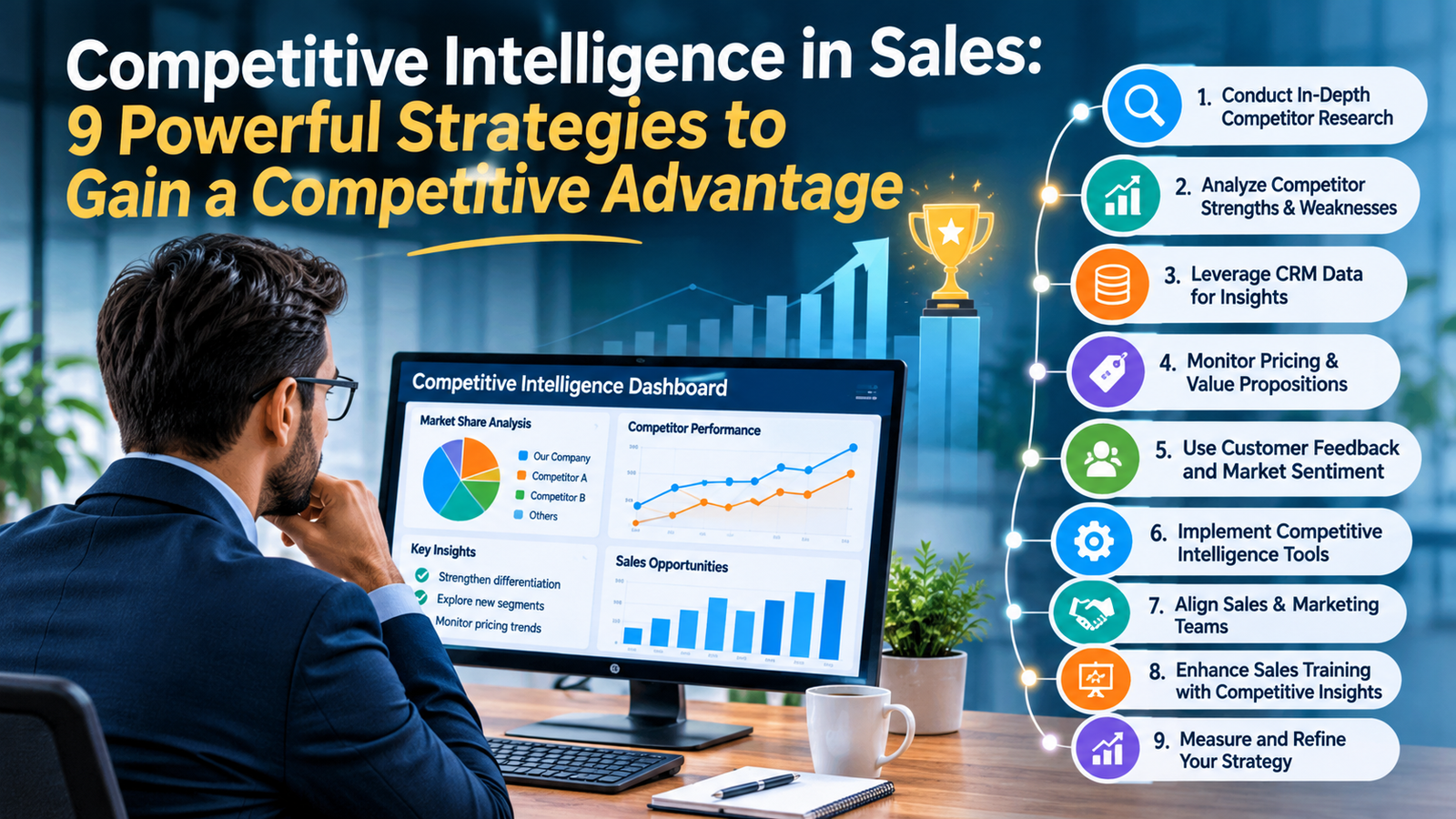

Competitive Intelligence in Sales has become an essential capability for B2B organizations operating in increasingly competitive markets. As businesses compete for customer attention, larger accounts, and long-term partnerships, understanding competitor activities is just as important as understanding customer requirements. Sales teams need more than product knowledge and relationship-building skills; they need accurate market insights to make informed decisions, communicate value, and position their solutions effectively. Competitive Intelligence in Sales enables organizations to understand competitor strategies, evaluate market positioning, and identify opportunities that can strengthen their overall sales performance.
Traditional sales strategies often focus on product features, pricing, and customer relationships. However, modern B2B buyers frequently evaluate multiple vendors before making purchasing decisions. They compare capabilities, implementation approaches, service quality, technology integrations, and long-term business value. Without a clear understanding of the competitive landscape, sales professionals may struggle to differentiate their offerings or respond confidently to competitor comparisons. Competitive Intelligence in Sales provides businesses with a structured way to evaluate competitor activities, understand changing market dynamics, and develop strategies that align with customer expectations.
This is where Competitive Intelligence in Sales makes a meaningful difference. By systematically collecting, analyzing, and applying information about competitors, market trends, and customer preferences, organizations can develop more effective sales strategies. When combined with CRM platforms, sales analytics, and business intelligence tools, competitive intelligence helps sales teams identify opportunities, improve positioning, anticipate objections, and support sustainable revenue growth. By making Competitive Intelligence in Sales a consistent part of business planning, companies can develop more informed sales approaches and respond effectively to changing customer expectations.
What Is Competitive Intelligence in Sales?
Competitive Intelligence in Sales refers to the structured process of gathering, evaluating, and using information about competitors, market conditions, industry developments, and customer expectations to improve sales decisions. An effective Competitive Intelligence in Sales approach connects competitor research with practical business decisions, helping sales professionals understand market expectations and communicate meaningful product differentiation.
Rather than relying on assumptions or occasional competitor research, organizations use competitive intelligence to develop a continuous understanding of their market environment. This information helps sales professionals understand where competitors perform well, where their offerings may fall short, and how their own solutions can deliver differentiated business value.
For example, consider an enterprise software company competing against several technology providers. A prospect may evaluate vendors based on pricing, cybersecurity capabilities, integration flexibility, implementation timelines, and customer support. If the sales team understands how competing solutions compare across these areas, it can build a more relevant proposal and address the prospect’s concerns with greater confidence. Organizations can use Competitive Intelligence in Sales to evaluate several dimensions of the competitive landscape, rather than focusing only on product features or pricing differences.
Competitive intelligence typically focuses on several important areas:
- Competitor positioning: Understanding how competing businesses communicate their value propositions and target customers.
- Product and service comparison: Evaluating features, capabilities, integrations, and service offerings.
- Pricing intelligence: Understanding publicly available pricing structures, packaging, and commercial approaches.
- Market trends: Identifying changes in customer expectations, industry requirements, and emerging technologies.
- Customer sentiment: Understanding common customer concerns, feedback, and competitor-related experiences.
- Sales strategy evaluation: Identifying how competitors approach customer acquisition, engagement, and retention.
The objective is not simply to know what competitors are doing. It is to translate relevant information into practical sales actions that improve customer conversations and business outcomes. A well-established Competitive Intelligence in Sales process also enables organizations to identify emerging competitors, evaluate alternative solutions, and understand the factors influencing customer purchasing decisions.
Why Competitive Intelligence Is Important for Modern Sales Strategies
Modern B2B sales environments involve complex purchasing decisions, multiple stakeholders, and longer evaluation cycles. Prospects often engage with several vendors before selecting a solution, making competitive differentiation a critical part of the sales process.
Competitive Intelligence in Sales helps organizations replace assumptions with informed decision-making. Instead of responding to competitors only when a prospect raises a concern, sales teams can proactively prepare for common comparisons and develop stronger value propositions. When implemented effectively, Competitive Intelligence in Sales gives organizations the context required to understand competitor movements, prepare stronger proposals, and improve customer engagement throughout the buying journey.
Several business advantages make competitive intelligence particularly valuable.
1. Strengthening Competitive Positioning
Understanding competitor strengths and weaknesses allows businesses to communicate their unique value more effectively.
For example, a technology provider may not offer the lowest price in the market, but it may provide better integration capabilities, implementation support, or scalability. Competitive intelligence helps sales professionals identify these differentiators and connect them to the prospect’s business priorities. Competitive Intelligence in Sales allows businesses to identify positioning gaps in the market and communicate their unique capabilities more effectively to prospective customers.
2. Improving Sales Conversations
Sales representatives frequently encounter questions such as:
- How does your solution compare with other providers?
- Why should we choose your platform over an established competitor?
- What makes your pricing different?
- Can your solution integrate with our existing technology environment?
With reliable competitive insights, sales professionals can respond with relevant information rather than generic promotional statements. Through Competitive Intelligence in Sales, organizations can prepare their representatives with relevant competitor insights, helping them deliver more informed responses during product demonstrations, negotiations, and proposal discussions.
3. Identifying Untapped Market Opportunities
Competitor research can reveal underserved customer segments, unmet business requirements, and emerging market needs.
For instance, if several competitors focus primarily on large enterprises, a technology company may identify an opportunity to serve mid-market organizations with flexible deployment options and simplified implementation. Using Competitive Intelligence in Sales, business development teams can recognize underserved customer segments and explore opportunities that competitors may not be addressing effectively.
4. Supporting Better Sales Decisions
Competitive intelligence gives sales leaders additional context when evaluating opportunities, allocating resources, and developing account strategies.
It can help organizations determine:
- Which market segments offer stronger growth opportunities.
- Which competitors frequently appear in enterprise deals.
- Which product capabilities require greater emphasis.
- Where sales teams need additional training or enablement.
Ultimately, Competitive Intelligence in Sales helps transform market information into actionable insights that support better sales planning and stronger competitive positioning.
9 Powerful Strategies for Using Competitive Intelligence in Sales
The following Competitive Intelligence in Sales strategies provide a practical foundation for integrating competitor insights into everyday sales activities and long-term business planning.
Competitive intelligence delivers the greatest value when it becomes part of everyday sales operations rather than remaining an isolated research activity.
The following strategies can help B2B organizations convert competitive information into practical sales advantages.
1. Conduct Structured Competitor Research
The foundation of Competitive Intelligence in Sales is consistent competitor research. Businesses need to understand who their competitors are, which markets they serve, how they position their offerings, and what differentiates their solutions. Through Competitive Intelligence in Sales, research findings become more valuable when they are connected to customer requirements, competitor positioning, and specific sales opportunities.
Sales and marketing teams should establish a structured process for monitoring relevant competitor information. This includes reviewing official websites, product documentation, public announcements, customer reviews, case studies, and industry publications.
Rather than collecting information without a clear purpose, organizations should focus on insights that directly influence sales decisions. Consistent Competitive Intelligence in Sales research helps businesses move beyond basic competitor observation and develop actionable insights that support strategic account planning.
Important areas to investigate include:
- Competitor product features and technical capabilities.
- Target industries and customer segments.
- Publicly available pricing and packaging.
- Customer support and implementation approaches.
- Partnerships, integrations, and technology ecosystems.
- New product announcements and market positioning.
For example, a cloud services provider may discover that a competitor recently introduced specialized services for financial institutions. This information could help its sales team prepare more relevant industry-specific messaging and identify opportunities to differentiate its own offering.
2. Develop Detailed Competitor Comparison Frameworks
A competitor comparison framework helps sales professionals evaluate competing solutions using consistent business and technical criteria. Competitive Intelligence in Sales frameworks also help organizations maintain consistency across sales presentations, product comparisons, and enterprise proposal development.
Without a standardized framework, different representatives may communicate inconsistent information or rely on outdated assumptions. A centralized comparison document ensures that sales teams have access to relevant and verified information.
For B2B technology organizations, comparison frameworks should consider more than product features. Enterprise buyers often evaluate how a solution fits into their broader technology environment.
A practical comparison framework may include:
| Evaluation Area | What to Analyze |
|---|---|
| Product capabilities | Features, functionality, and technical performance |
| Pricing structure | Subscription models, licensing, and commercial flexibility |
| Integration | Compatibility with existing enterprise systems |
| Security | Available security capabilities and compliance documentation |
| Implementation | Deployment complexity, onboarding, and migration |
| Customer support | Service availability and support structure |
| Scalability | Ability to support changing business requirements |
These frameworks should be reviewed regularly to maintain accuracy.
Sales representatives can use them during discovery calls, proposal development, and competitive sales presentations. However, comparisons should remain factual and avoid unsupported claims about competing products.
3. Leverage CRM Data for Competitive Insights
Customer Relationship Management (CRM) platforms can become valuable sources of competitive intelligence when organizations consistently capture information from sales interactions. Integrating Competitive Intelligence in Sales with CRM reporting allows sales managers to understand competitor involvement across opportunities and identify recurring patterns in customer decisions.
Every opportunity provides useful insights into buyer preferences, competitor involvement, pricing concerns, and reasons for selecting or rejecting a solution.
For example, when a prospect chooses another vendor, the sales representative can record the primary reason in the CRM system. Over time, this information may reveal patterns related to pricing, product capabilities, implementation requirements, or customer preferences.
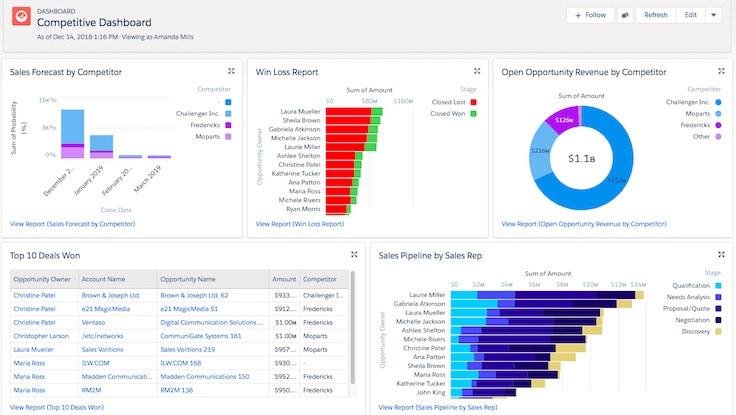
When Competitive Intelligence in Sales is integrated into CRM workflows, organizations can connect competitor observations with opportunity histories, customer interactions, and sales performance reports.
Organizations can strengthen CRM-based competitive intelligence by tracking:
- Competitors appearing in active sales opportunities.
- Reasons for winning or losing deals.
- Frequently raised competitor-related objections.
- Customer preferences and purchasing requirements.
- Deal outcomes across industries and account segments.
- Changes in competitive positioning over time.
When CRM data is combined with reporting and analytics platforms, sales managers can identify recurring patterns and make more informed decisions about sales enablement and market positioning.
4. Monitor Competitor Pricing and Value Propositions
Pricing is an important consideration in B2B purchasing decisions, but customers rarely evaluate cost in isolation. They also consider implementation expenses, operational efficiency, support quality, scalability, and expected business outcomes.
Competitive intelligence helps sales teams understand how competing providers communicate their pricing and value propositions. A structured Competitive Intelligence in Sales process helps representatives explain pricing differences through business value, service capabilities, and long-term operational benefits.
For example, one software provider may offer a lower subscription price but require additional implementation services or third-party integrations. Another provider may charge more but offer a broader set of capabilities within its standard package.
Understanding these differences allows sales professionals to explain the overall business value of their offerings rather than entering unnecessary price negotiations.
Sales teams should monitor:
- Publicly available subscription and licensing models.
- Product packaging and service tiers.
- Implementation and support options.
- Contract flexibility and commercial terms where disclosed.
- The business value emphasized in competitor messaging.
The objective is not to automatically match competitor pricing. Instead, businesses should understand how their commercial positioning compares and communicate the value behind their pricing decisions.
5. Use Customer Feedback and Market Sentiment
Customer feedback offers an important perspective on competitor performance. Public reviews, industry forums, case studies, customer testimonials, and feedback collected during sales conversations can help organizations understand what buyers value and where they experience challenges. Customer feedback strengthens Competitive Intelligence in Sales by revealing how buyers perceive competing solutions and which factors influence their vendor selection process.
For example, enterprise customers may appreciate a competitor’s product capabilities but express concerns about onboarding complexity or support responsiveness. Such insights can help another provider position its implementation services and customer support more effectively, provided those capabilities are genuinely stronger.

Organizations can gather customer sentiment through:
- Public review platforms and industry communities.
- Customer interviews and feedback sessions.
- Win-loss analysis.
- Sales discovery conversations.
- Customer success and support interactions.
- Industry-specific research publications.
It is important to distinguish between individual opinions and recurring patterns. One negative review does not necessarily indicate a widespread product issue. Sales teams should validate important findings before using them in customer conversations.
6. Implement Competitive Intelligence Tools and Automation
As organizations expand, manually collecting and analyzing competitor information becomes increasingly difficult. Competitive intelligence tools can help automate parts of the research process and make relevant information easier to access. Technology-driven Competitive Intelligence in Sales makes it easier to organize competitor information, monitor relevant market developments, and distribute actionable insights across sales teams.
Modern business intelligence and sales enablement platforms can support information gathering, monitoring, reporting, and internal knowledge sharing.
Depending on the organization’s requirements, useful technology capabilities may include:
- Competitor website and content monitoring.
- Industry news and announcement tracking.
- CRM-based competitive reporting.
- Sales intelligence and account research.
- AI-powered information summarization.
- Centralized competitor knowledge repositories.
For example, an enterprise sales team can maintain a shared competitive intelligence repository containing product comparisons, competitor announcements, frequently encountered objections, and approved response guidelines.
Automation can help identify changes and reduce repetitive research activities. However, human review remains important because automated systems may misinterpret competitor announcements or produce incomplete conclusions.
7. Align Sales and Marketing Teams Around Competitive Insights
Competitive intelligence becomes more effective when sales and marketing teams work with a shared understanding of the market. Competitive Intelligence in Sales becomes more effective when marketing research and frontline sales feedback are combined to create a consistent understanding of market opportunities.
Marketing teams often monitor competitor messaging, content strategies, positioning, and industry campaigns. Sales teams, meanwhile, receive direct feedback from prospects about competing solutions, pricing concerns, and purchasing preferences.
Combining these perspectives creates a more complete understanding of competitive market conditions.
For example, marketing may identify that a competitor is emphasizing AI-powered capabilities in its campaigns. Sales representatives may independently report that prospects are asking more questions about AI integration and automation.
Together, these insights can help the organization refine its messaging, develop educational content, and prepare sales representatives for emerging customer requirements.
A coordinated approach should include:
- Regular sales and marketing intelligence-sharing meetings.
- Centralized competitor research documentation.
- Consistent product positioning guidelines.
- Updated sales presentations and battlecards.
- Feedback loops between sales, marketing, and product teams.
This alignment helps ensure that external messaging reflects actual customer conversations and market developments.
8. Use Competitive Intelligence to Improve Sales Training
Even when organizations have access to detailed competitor research, sales representatives need the ability to interpret and communicate those insights effectively. Incorporating Competitive Intelligence in Sales into employee development programs helps representatives understand competitor positioning and communicate product differentiation with greater confidence.
Competitive intelligence should therefore become part of sales training and enablement programs.
Training should help representatives understand competitor positioning, recognize customer objections, communicate meaningful differentiation, and avoid making unsupported claims.
For example, a software sales team may receive training on how its platform compares with alternative solutions in terms of integration flexibility, deployment options, and scalability.
Practical training activities can include:
- Competitor comparison workshops.
- Simulated competitive sales conversations.
- Objection-handling exercises.
- Product differentiation presentations.
- Win-loss analysis discussions.
- Regular updates on competitor developments.
These activities help sales professionals move beyond memorized talking points and develop stronger consultative selling skills.
9. Continuously Measure and Refine Competitive Sales Strategies
Competitive intelligence should be treated as an ongoing business capability rather than a one-time research project. Measuring the impact of Competitive Intelligence in Sales helps organizations understand whether their research activities are contributing to improved opportunity management and competitive performance.
Markets change, competitors introduce new offerings, customer expectations evolve, and technology requirements become more sophisticated. Organizations must regularly review their competitive intelligence processes to ensure that insights remain relevant.
Sales leaders should evaluate whether competitive research is contributing to better sales execution and business decisions.
Useful performance indicators include:
- Competitive win and loss rates.
- Win rates against specific competitors.
- Sales cycle duration in competitive opportunities.
- Reasons for lost opportunities.
- Frequency of competitor-related objections.
- Adoption of competitive sales enablement materials.
- Revenue generated across targeted market segments.
These indicators should be interpreted in context. For instance, an improvement in competitive win rates may reflect better positioning, changes in deal selection, pricing adjustments, or other factors.
Regular performance reviews help organizations identify what is working and where their sales strategies require improvement.
How AI and Data Analytics Are Transforming Competitive Intelligence in Sales
Artificial intelligence and data analytics are expanding the possibilities of competitive intelligence by helping organizations process larger volumes of information and identify patterns that may be difficult to recognize manually. AI-powered Competitive Intelligence in Sales is helping organizations process market information more efficiently, identify relevant competitor developments, and support data-driven sales planning.
Traditional competitor research often involves reviewing websites, reports, customer feedback, and industry announcements individually. AI-powered systems can help organize this information, summarize developments, and highlight relevant changes for sales and marketing teams.
However, the real value comes from combining technology with human judgment and business expertise.
AI-Powered Competitor Monitoring
AI-enabled monitoring solutions can help businesses track publicly available competitor information, such as product announcements, website updates, content changes, and market developments.
These capabilities can help sales teams identify changes that may influence active opportunities or future customer conversations.
Predictive Analytics for Sales Planning
Predictive analytics can analyze historical sales information and opportunity data to identify patterns associated with successful or unsuccessful deals.
When combined with competitor-related CRM information, these insights may help sales managers understand where particular competitors frequently appear and which account segments require additional attention.
Natural Language Processing for Market Insights
Natural Language Processing (NLP) can help organizations analyze unstructured information from customer reviews, public discussions, and other text-based sources.
For example, an enterprise technology company may use text analysis to identify recurring customer concerns about implementation complexity, product usability, or technical support.
These patterns can inform sales messaging, product improvements, and customer engagement strategies.
Integrating Competitive Intelligence with Business Intelligence Platforms
Business Intelligence (BI) platforms can help consolidate competitive insights, CRM information, and sales performance data into centralized dashboards.
A sales leader may use these dashboards to review competitor activity across regions, identify frequently lost opportunities, and evaluate performance across different market segments.
Business Performance & Sales Dashboard | Tech Folio
The integration of AI, CRM, and BI technologies can make Competitive Intelligence in Sales more accessible and actionable across enterprise organizations.
Practical Business Use Cases of Competitive Intelligence in Sales
Competitive intelligence has applications across multiple industries and enterprise sales environments. Its value becomes clearer when organizations connect research findings to specific business challenges. Different industries can apply Competitive Intelligence in Sales according to their specific customer requirements, technology environments, and competitive market conditions.
Enterprise Software and SaaS
Software companies frequently compete on functionality, pricing, integration capabilities, security, and scalability.
Competitive intelligence helps sales teams understand how competing platforms address enterprise requirements and develop more relevant product demonstrations and proposals.
IT Infrastructure and Cloud Services
Cloud service providers and IT infrastructure companies operate in markets where technical capabilities, reliability, security, migration support, and operational costs influence purchasing decisions.
Competitor analysis helps sales teams understand market positioning and communicate the practical advantages of their infrastructure solutions.
Cybersecurity Solutions
Cybersecurity buyers evaluate vendors based on their security capabilities, risk management approaches, integrations, compliance requirements, and support services.
Competitive intelligence can help providers understand how competing solutions address these requirements and prepare more informed discussions with security and technology decision-makers.
Professional and Consulting Services
Consulting firms compete through expertise, industry experience, service delivery models, and measurable business outcomes.
By analyzing competitor service portfolios and market positioning, consulting organizations can identify underserved business needs and develop differentiated service offerings.
Common Challenges in Implementing Competitive Intelligence
Although competitive intelligence provides valuable insights, organizations may face several challenges when establishing a consistent process. Even with the growing importance of Competitive Intelligence in Sales, businesses must address information quality, research consistency, and internal collaboration to achieve meaningful results.
Inaccurate or Outdated Information
Competitor products, pricing, and market positioning can change frequently. Using outdated information may lead to incorrect comparisons and weaken customer conversations.
Practical approach: Establish regular research reviews, record information sources, and assign ownership for maintaining competitor profiles.
Information Overload
Collecting too much information without a clear objective can make competitive intelligence difficult to use.
Practical approach: Prioritize insights that directly influence sales opportunities, customer requirements, product positioning, and strategic decisions.
Lack of Internal Collaboration
When sales, marketing, and product teams maintain separate research repositories, important insights may remain disconnected.
Practical approach: Create a centralized knowledge repository and establish a consistent process for sharing relevant findings.
Misinterpreting Competitor Information
Public announcements and promotional materials may not provide a complete picture of a competitor’s actual product capabilities or customer experience.
Practical approach: Validate important findings using multiple reliable sources and distinguish verified information from assumptions.
Ethical and Legal Considerations
Competitive intelligence must be collected through legitimate and ethical methods. Organizations should avoid accessing confidential competitor information, misrepresenting their identity to obtain restricted information, or using unauthorized data.
Practical approach: Establish clear research guidelines that prioritize publicly available information, authorized customer feedback, and lawful business research practices.
Best Practices for Building a Sustainable Competitive Intelligence Framework
For competitive intelligence to deliver long-term business value, organizations need a repeatable framework that connects research activities with sales execution. A sustainable Competitive Intelligence in Sales framework should connect research, technology, sales enablement, and performance measurement through a clearly defined business process.
A practical framework should include the following components:
- Define business objectives: Determine whether the primary goal is improving win rates, understanding market positioning, supporting account planning, or identifying new opportunities.
- Identify key competitors: Categorize direct competitors, indirect competitors, and alternative solutions that influence purchasing decisions.
- Select reliable information sources: Use official company websites, public documentation, industry publications, customer reviews, and authorized market research.
- Centralize competitive information: Maintain a shared repository containing competitor profiles, product comparisons, pricing observations, and relevant market developments.
- Integrate insights into sales workflows: Make competitive information accessible through CRM systems, sales enablement platforms, and account planning processes.
- Train sales professionals: Help representatives interpret competitor information and communicate differentiated business value.
- Measure business impact: Review competitive win rates, opportunity outcomes, sales cycle patterns, and the practical adoption of competitive insights.
A well-designed framework ensures that competitive intelligence supports actual business decisions rather than becoming another disconnected reporting activity.
Conclusion
Competitive Intelligence in Sales is no longer just an additional research activity; it is an important component of modern B2B sales strategy. As enterprise buyers become more informed and purchasing decisions involve multiple stakeholders, organizations need a deeper understanding of competitors, market conditions, and evolving customer expectations. By adopting Competitive Intelligence in Sales as an ongoing business practice, organizations can improve their understanding of competitors, strengthen customer engagement, and develop more effective revenue strategies.
By combining structured competitor research, CRM analytics, customer feedback, AI-powered monitoring, and sales enablement, businesses can transform competitive information into meaningful commercial insights. These insights help sales professionals communicate stronger value propositions, address customer objections, identify market opportunities, and make more informed decisions throughout the sales cycle.
However, successful competitive intelligence requires more than collecting competitor information. It depends on accuracy, ethical research practices, cross-functional collaboration, and the ability to translate insights into practical sales actions.
Businesses that continuously invest in Competitive Intelligence in Sales can build a stronger foundation for informed decision-making, strategic differentiation, and long-term market competitiveness.
Organizations that make Competitive Intelligence in Sales a continuous part of their business operations can build more informed sales teams, strengthen market positioning, and create a foundation for sustainable competitive advantage.
Frequently Asked Questions
1. What is Competitive Intelligence in Sales?
Competitive Intelligence in Sales is the process of collecting and analyzing information about competitors, market trends, customer preferences, and industry developments to improve sales strategies and business decisions.
2. Why is competitive intelligence important for B2B sales?
It helps B2B organizations understand competitor positioning, identify market opportunities, prepare for customer objections, improve sales conversations, and communicate their business value more effectively.
3. What are the main sources of competitive intelligence?
Common sources include competitor websites, product documentation, public pricing information, customer reviews, industry reports, public announcements, CRM records, and authorized customer feedback.
4. How does CRM support competitive intelligence?
CRM platforms help sales teams capture competitor information during customer interactions, track win-loss reasons, identify recurring objections, and analyze competitive performance across sales opportunities.
5. How can AI improve competitive intelligence?
AI can help monitor public competitor information, summarize market developments, analyze customer sentiment, identify patterns in sales data, and organize competitive insights for sales teams.
6. What is the difference between market intelligence and competitive intelligence?
Market intelligence focuses on the broader business environment, including industry trends, customer demand, and market conditions. Competitive intelligence focuses specifically on competitors, their offerings, positioning, and market activities.
7. How can competitive intelligence improve sales win rates?
It helps sales representatives understand competing solutions, anticipate objections, highlight relevant differentiators, and create proposals that address customer priorities. Its impact should be evaluated through actual sales performance data.
8. What is a competitive intelligence framework?
A competitive intelligence framework is a structured process for identifying competitors, collecting reliable information, analyzing findings, sharing insights internally, and applying them to sales and business strategies.
9. How often should businesses update competitive intelligence?
Businesses should review competitive intelligence regularly, with the frequency depending on market dynamics and industry requirements. Significant competitor announcements, product launches, and pricing changes should be reviewed as they occur.
10. What are the ethical considerations in competitive intelligence?
Organizations should rely on lawful and ethical research methods, respect confidentiality, use authorized information sources, and avoid obtaining trade secrets or restricted competitor information.
