



Every organization depends on more than its employees, technology, financial resources, and documented business processes. Behind everyday business operations lies another valuable asset: organizational knowledge. This includes the experience, practical understanding, decision-making abilities, customer insights, and problem-solving skills that employees develop throughout their careers.
However, a significant amount of this knowledge is never recorded in official documents, manuals, or training materials. It remains within the minds of employees who understand how difficult customers behave, why particular business decisions were made, which processes regularly fail, and how unexpected operational challenges should be handled.
Consider an experienced employee who has spent several years managing important customer relationships. They understand each client’s expectations, communication preferences, previous concerns, and business requirements. Another employee may know exactly how to resolve recurring technical problems that are not explained in any official document. A department manager might understand why a particular process was introduced and which mistakes the organization should avoid repeating.
This knowledge develops gradually through practical experience, daily interactions, and years of working within an organization. Unfortunately, businesses often recognize its importance only when the people who possess it leave.
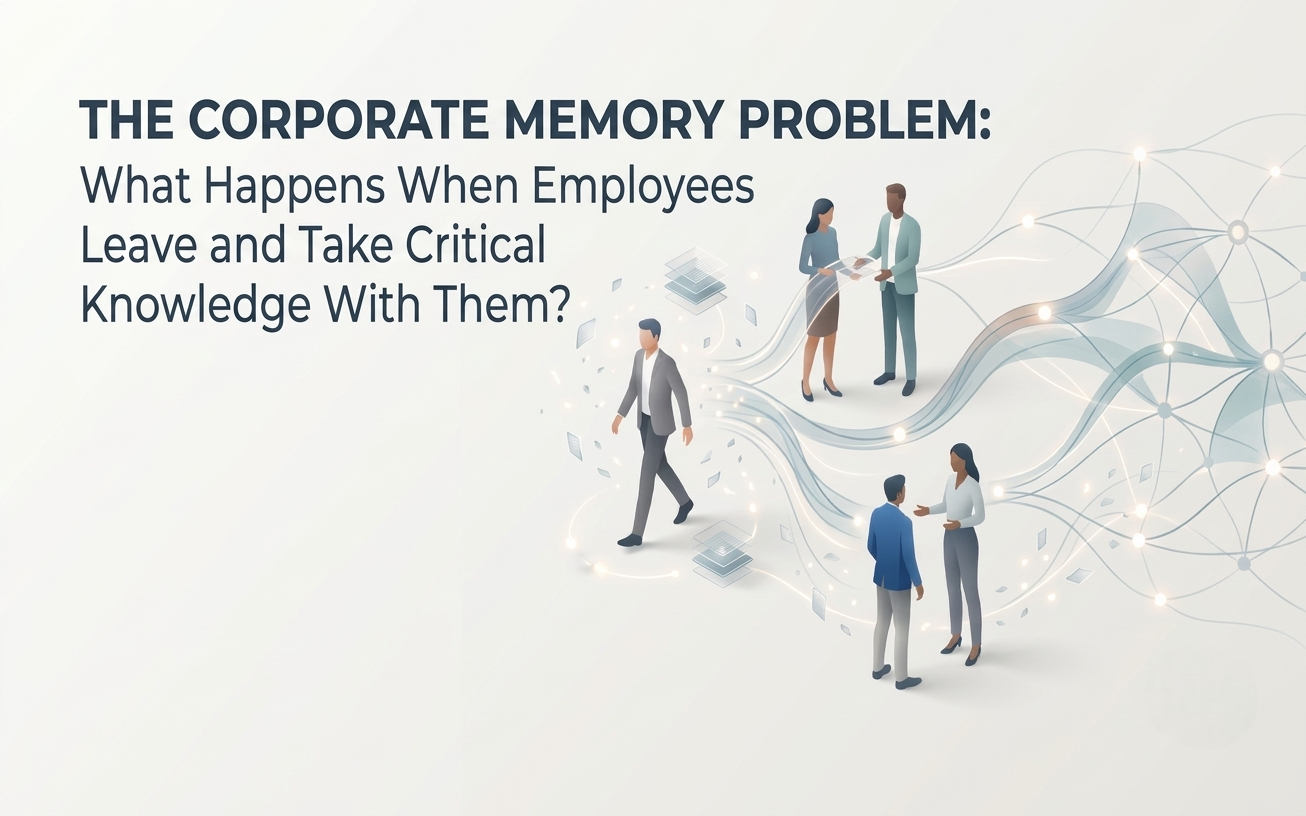
An experienced employee resigns, a senior manager joins another company, or a long-serving professional retires. Suddenly, the organization discovers that several important activities depend on information that was never properly documented or transferred.
Work slows down, decisions become uncertain, customer relationships require rebuilding, and remaining employees struggle to find answers to questions that previously had simple solutions.
This situation represents the Corporate Memory Problem. It occurs when organizations lose valuable institutional knowledge because essential experience, expertise, and operational understanding remain concentrated in individual employees rather than becoming accessible organizational assets.
In today’s competitive business environment, addressing the Corporate Memory Problem is essential for improving knowledge management, maintaining business continuity, reducing operational dependency, and supporting long-term organizational growth.
1. Understanding the Corporate Memory Problem and Why It Matters
Corporate memory refers to the collective knowledge, experience, decisions, processes, relationships, and lessons that an organization accumulates over time. It represents everything a business learns through employee experience, customer interactions, completed projects, operational activities, and previous business decisions.
The Corporate Memory Problem develops when this accumulated knowledge cannot be accessed or reused because it exists primarily within individual employees rather than organized company resources.
Unlike traditional business records, corporate memory includes both documented information and practical knowledge developed through experience.
For example, an organization may have a documented procedure for handling customer complaints. However, an experienced customer service representative may understand which communication approaches help resolve sensitive situations, when an issue should be escalated, and how to maintain a positive relationship with a frustrated customer.
These insights are valuable because they are based on real-world experience rather than theoretical instructions.
Corporate memory generally consists of two important forms of knowledge:
Explicit Knowledge: This includes information that can be documented, stored, organized, and shared easily. Examples include company policies, training manuals, project reports, technical documentation, customer records, and standard operating procedures.
Tacit Knowledge: This refers to personal experience, professional judgment, practical skills, and insights that employees develop through their work. It is often difficult to explain or document because it becomes part of how experienced employees understand and perform their responsibilities.
Both forms of knowledge are essential for business operations. Explicit knowledge provides employees with structured information, while tacit knowledge helps them apply that information effectively in real situations.
The challenge is that organizations generally find it easier to preserve explicit knowledge than tacit knowledge. They may have extensive documentation systems but still depend heavily on experienced employees to interpret information, solve problems, and make important decisions.
This is why the Corporate Memory Problem should be treated as a strategic business concern rather than simply an employee handover issue.
2. Why Critical Business Knowledge Remains With Individual Employees
One of the biggest reasons the Corporate Memory Problem develops is that companies tend to document employee responsibilities rather than the knowledge required to perform those responsibilities effectively.
A process document may explain how to generate a financial report, but it may not explain which figures require closer examination or why certain patterns indicate potential problems.
A customer relationship management (CRM) system may contain contact information, meeting notes, and sales records, but it may not capture the complete relationship history or communication preferences that an experienced account manager understands intuitively.
Similarly, an employee handbook may describe an approval process without explaining the practical exceptions that regularly occur when projects face unexpected circumstances.
This creates a significant difference between documented procedures and actual workplace knowledge.
Formal documentation usually explains what an organization believes should happen, whereas employee experience often reveals what actually happens in everyday business operations.
Several factors contribute to this knowledge gap:
Lack of structured knowledge-sharing practices: Many organizations expect employees to share information naturally through conversations and teamwork. Although this approach may work in smaller teams, it becomes unreliable as the organization grows.
Limited documentation of practical experience: Employees often complete their responsibilities without recording the lessons, challenges, and solutions they encounter. Important insights remain in personal notes, email conversations, or individual memory.
Dependence on experienced employees: When one employee becomes the primary source of information for a particular process, other team members may stop developing independent knowledge of that responsibility.
Time constraints: Employees frequently prioritize immediate business tasks over documenting their experience. Knowledge sharing is postponed because it does not appear as urgent as meeting deadlines or completing customer requirements.
Disconnected information systems: Important business information may be distributed across different applications, communication platforms, spreadsheets, and departmental databases. Employees may know that information exists but struggle to locate it when required.
Over time, these practices create an organization where employees understand their individual responsibilities but lack access to the wider knowledge required to work independently.
The Corporate Memory Problem becomes more serious when businesses continue relying on informal communication without developing a reliable knowledge management strategy.
3. The Hidden Business Risks of the Corporate Memory Problem
Employee turnover is a normal part of every organization’s lifecycle. People leave because of career opportunities, retirement, personal circumstances, organizational changes, or better professional prospects.
However, the departure of an experienced employee can create consequences that extend far beyond the immediate vacancy.
The real challenge is not simply losing an employee. It is losing the knowledge, experience, and organizational understanding that the employee developed over several years.
The Corporate Memory Problem can create several operational and financial challenges.
Delayed Business Operations
When experienced employees leave, routine activities can become unexpectedly complicated. Remaining employees may need additional time to understand existing processes, locate missing information, and identify the correct people to contact.
Tasks that previously took a few minutes may require several conversations and multiple levels of approval.
These delays can affect project timelines, internal coordination, customer responses, and overall productivity.
Loss of Customer Relationship Knowledge
Customer relationships are often built through repeated interactions and a detailed understanding of individual customer expectations.
An experienced account manager may know a customer’s purchasing patterns, previous concerns, preferred communication methods, and future business requirements.
If this knowledge is not transferred, a replacement employee may have access to the customer’s contact information but lack the context needed to maintain the relationship effectively.
Customers may need to repeat information, explain previous discussions, or wait longer for solutions.
This can reduce customer satisfaction and potentially affect long-term business relationships.
Increased Recruitment and Training Costs
When employees leave with important knowledge, new hires must learn more than their assigned responsibilities. They may also need to reconstruct processes, understand previous decisions, and identify solutions to problems that experienced employees had already resolved.
This increases onboarding time and creates additional pressure on existing team members.
Organizations may also spend money hiring external consultants or specialists to recover knowledge that was previously available internally.
Repeated Mistakes and Poor Decision-Making
Previous business decisions often contain valuable lessons about what works and what does not.
When organizations fail to preserve those lessons, new employees and managers may repeat earlier mistakes because they do not understand why previous approaches were unsuccessful.
For example, a company may repeat an unsuccessful marketing strategy simply because the original campaign results and the reasoning behind its failure were never properly documented.
Corporate memory helps organizations avoid repeating mistakes and make better decisions using accumulated experience.
Reduced Organizational Productivity
When employees repeatedly depend on a small number of experienced colleagues for answers, productivity becomes vulnerable to individual availability.
If those employees are on leave, handling other responsibilities, or have already left the organization, routine work can slow down.
This creates unnecessary dependency and makes it difficult for teams to operate independently.
According to APQC’s research on the cost of poor knowledge management, the median knowledge worker spends 35% of their time unproductively, with information and expertise gaps contributing to organizational inefficiency.
This highlights why solving the Corporate Memory Problem is not simply about preserving historical information. It is also about protecting productivity and reducing avoidable business costs.
4. Knowledge Silos: When Important Information Exists but Nobody Else Can Access It
Another major contributor to the Corporate Memory Problem is the development of knowledge silos.
A knowledge silo occurs when important information remains concentrated within a particular employee, department, or team instead of being shared across the organization.
For example, the sales department may understand customer expectations, while the product team understands technical limitations. The customer support team may recognize recurring complaints, while management has access to strategic decisions that explain why certain changes were introduced.
Although every department possesses useful information, that knowledge may not be accessible to other teams that need it.
This becomes particularly problematic when employees change roles, departments are restructured, or experienced team members leave.
A business may have all the necessary information somewhere within its systems, but employees cannot benefit from it because the information is scattered, disconnected, or poorly organized.
Knowledge silos can also develop when employees believe that retaining expertise gives them greater professional importance. When individuals become the only people capable of resolving specific problems, they may unintentionally create organizational dependencies.
To overcome this challenge, organizations must encourage cross-functional collaboration, shared documentation, mentoring, and transparent communication.
Knowledge should be treated as a collective business asset rather than something that belongs exclusively to the individual who developed it.
Businesses can also strengthen their internal knowledge-sharing practices by introducing a structured knowledge management strategy.
5. How Organizational Growth and Restructuring Increase Knowledge Loss
Employee resignation is not the only situation that exposes weaknesses in corporate memory. Business expansion, mergers, acquisitions, departmental restructuring, leadership transitions, and technology migrations can also disrupt organizational knowledge.
In smaller organizations, employees often communicate directly with one another. They know who handles particular responsibilities, where important information is stored, and whom to approach when problems occur.
However, as a business expands, these informal communication practices become increasingly difficult to maintain.
New employees join, departments become more specialized, management structures become complex, and information begins to move across multiple systems.
The knowledge-sharing methods that worked effectively for a team of ten people may no longer work for an organization with hundreds of employees.
Organizational restructuring can create similar challenges. When employees move into unfamiliar positions, they may inherit responsibilities without receiving the historical context behind existing processes and decisions.
A new manager might introduce changes without understanding why previous approaches were selected. A company migrating to a new CRM platform may successfully transfer customer contact records while losing important details about how those relationships developed.
Mergers and acquisitions can create even greater knowledge-management challenges because two organizations may have different systems, procedures, communication practices, and working cultures.
Without a structured approach to knowledge preservation, important information can disappear during these transitions.
This is why the Corporate Memory Problem should be addressed before employees leave or organizational changes take place.
Knowledge management should be an ongoing business practice that supports continuity during every stage of organizational growth and transformation.
6. The Role of Artificial Intelligence in Solving the Corporate Memory Problem
Artificial intelligence is creating new opportunities for organizations to capture, organize, retrieve, and reuse internal business knowledge.
Traditional knowledge management systems often require employees to search through multiple folders, databases, documents, and email conversations to locate specific information.
This process can be time-consuming, particularly in organizations where information has accumulated over several years.
AI-powered knowledge management tools can make this process more efficient by helping employees find relevant information through natural-language searches, summarize lengthy documents, identify recurring issues, and connect information from different sources.
For example, an employee joining the customer success department could ask an internal AI assistant about the history of a particular customer relationship.
Instead of manually reviewing hundreds of documents, the system could retrieve relevant meeting summaries, approved customer records, project updates, and previous support interactions.
Similarly, a new project manager could use an AI-powered knowledge platform to understand previous project challenges, identify recurring delays, and review decisions made by earlier teams.
Some important applications of artificial intelligence in corporate knowledge management include:
AI-Powered Enterprise Search
AI-assisted search tools help employees retrieve relevant information from different internal knowledge sources.
Rather than searching for exact document names or keywords, employees can ask questions using everyday language and receive results based on available organizational information.
Automated Knowledge Summarization
AI can summarize lengthy reports, meeting transcripts, project documents, and internal discussions.
This makes it easier for employees to understand important information without reviewing every document individually.
Intelligent Knowledge Repositories
Organizations can use AI to categorize information, identify related documents, organize internal resources, and improve the discoverability of business knowledge.
Employee Onboarding and Training
AI-powered internal assistants can help new employees understand company processes, locate training materials, and find answers to common workplace questions.
This can reduce the pressure on experienced employees who otherwise spend considerable time answering repetitive questions.
Capturing Institutional Knowledge
AI tools can help transform recorded interviews, training sessions, project discussions, and employee walkthroughs into searchable knowledge resources.
This is particularly useful when experienced employees are preparing to transition into new roles or leave the organization.
However, artificial intelligence is not a complete solution to the Corporate Memory Problem.
Technology cannot preserve knowledge that was never captured in the first place. It also cannot automatically understand every business decision, personal interaction, or situation-specific judgment without sufficient context.
Organizations must ensure that AI systems access reliable information, respect internal permissions, protect sensitive business data, and distinguish verified knowledge from incomplete or outdated information.
The objective should be to use AI to make organizational knowledge easier to preserve and access, not simply to introduce another technology platform.
For further reading, organizations can explore the ISO 30401 knowledge management systems standard, which provides requirements and guidance for establishing, implementing, maintaining, and improving knowledge management systems.
7. Why Human Experience Still Matters in Knowledge Management
Although technology plays an important role in preserving organizational knowledge, not every valuable business insight can be transferred through documents or digital systems.
Some forms of expertise develop through observation, judgment, professional relationships, and repeated exposure to complex situations.
An experienced sales professional may recognize when a potential customer is genuinely interested despite appearing hesitant. A project manager may identify early warning signs that a project deadline is at risk. A customer service specialist may understand how to resolve a sensitive complaint without damaging a long-standing business relationship.
These abilities are often developed through practical experience rather than formal training.
This is why organizations need to combine digital knowledge management with human-centered knowledge-sharing practices.
Some effective approaches include:
Employee mentoring: Experienced employees can guide newer team members by sharing practical insights, explaining difficult situations, and demonstrating effective approaches to everyday responsibilities.
Job shadowing: Employees can observe experienced colleagues performing important tasks, helping them understand practical details that may not appear in written procedures.
Cross-functional collaboration: Employees from different departments can work together on projects and share knowledge about their responsibilities, challenges, and decision-making processes.
Recorded walkthroughs: Experienced employees can record demonstrations explaining how specific systems, processes, or operational activities work.
Structured handovers: Employees preparing to leave or change roles can transfer important responsibilities, customer information, project histories, and unresolved issues to designated colleagues.
These practices help organizations preserve knowledge that cannot be captured effectively through traditional documentation alone.
Most importantly, knowledge transfer should begin well before an employee’s final working days. Waiting until someone submits a resignation creates unnecessary pressure and leaves little time to capture years of experience.
A structured employee onboarding and training process can also help new team members access existing organizational knowledge and reduce dependency on individual employees.
8. Building an Effective Corporate Knowledge Management Strategy
Preserving corporate memory requires more than purchasing a document management platform or introducing an AI-powered search tool.
Organizations need a structured knowledge management strategy that identifies critical information, establishes clear ownership, encourages employee participation, and ensures that knowledge remains accessible over time.
The following steps can help businesses address the Corporate Memory Problem systematically.
Identify Critical Knowledge and Key Employees
The first step is understanding which responsibilities depend heavily on individual employees.
Managers should identify employees who possess specialized technical expertise, important customer relationship knowledge, historical business information, or experience with critical operational processes.
The organization should also identify activities that would become difficult to perform if a particular employee were unavailable.
This helps businesses understand where knowledge-loss risks are highest.
APQC provides useful guidance on prioritizing critical knowledge for retention, including assessing the likelihood and consequences of losing important expertise.
Create a Centralized Knowledge Repository
Important organizational information should be stored in an accessible and well-organized knowledge management system.
This repository may include:
- Standard operating procedures and process documentation.
- Project histories and completed project reports.
- Customer relationship information and relevant interaction histories.
- Technical documentation and troubleshooting guides.
- Employee training materials and recorded walkthroughs.
- Important business decisions and their supporting reasoning.
- Frequently asked questions and solutions to recurring problems.
A centralized repository makes it easier for employees to locate information without depending entirely on individual colleagues.
Establish Clear Knowledge Ownership
Every important knowledge resource should have an assigned owner responsible for reviewing and maintaining its accuracy.
Without ownership, documentation can quickly become outdated, duplicated, or unreliable.
Organizations should establish regular review schedules and clear processes for updating information whenever business procedures, systems, or responsibilities change.
Document Decisions, Not Just Processes
One of the most valuable knowledge management practices is maintaining decision records.
These records should explain what was decided, why the decision was made, which alternatives were considered, and what outcomes were expected.
This information becomes particularly useful when future employees need to understand the reasoning behind earlier business decisions.
Without this context, teams may unintentionally repeat previous mistakes or reverse decisions without understanding their original purpose.
Introduce Structured Employee Handover Processes
Employee transitions should include a proper knowledge transfer plan.
Before an experienced employee leaves, managers should identify their critical responsibilities, ongoing projects, important relationships, recurring challenges, and undocumented expertise.
The employee should have sufficient time to explain these responsibilities and transfer relevant information to colleagues.
A structured handover should be treated as an important business continuity activity rather than a routine administrative requirement.
Encourage a Knowledge-Sharing Culture
Technology and documentation processes will only work when employees are encouraged to share what they know.
Managers should recognize employees who create useful resources, mentor colleagues, document lessons, and help others become more independent.
Knowledge sharing should be considered part of professional contribution and team performance.
When employees understand that sharing expertise strengthens the entire organization, they are more likely to participate actively.
For additional insights, see our related article on building an effective business continuity strategy.
9. Measuring the Success of Corporate Memory Preservation
Organizations should not assume that their knowledge management strategy is successful simply because they have created a repository or introduced new software.
The real measure of success is whether employees can access useful information, apply it effectively, and continue performing their responsibilities when experienced colleagues are unavailable.
Businesses can evaluate their knowledge preservation efforts through several indicators:
Employee onboarding time: How long does it take new employees to understand their responsibilities and perform tasks independently?
Knowledge retrieval time: How quickly can employees locate the information required to resolve a business problem?
Documentation coverage: What percentage of critical business processes have accurate and accessible documentation?
Employee dependency: How many important activities depend on a single employee?
Knowledge transfer completion: Are structured handovers completed when employees change roles or leave?
Repeated operational errors: Are teams avoiding mistakes that were previously encountered and resolved?
Customer service continuity: Can customer relationships and service quality be maintained when account managers or support employees change?
Tracking these indicators helps management identify knowledge gaps and understand where additional improvements are required.
It also allows organizations to treat knowledge management as a measurable business priority rather than an informal administrative activity.
10. Corporate Memory as a Long-Term Competitive Advantage
Corporate memory should not be viewed only as a way to prevent information loss when employees resign. It is also an important source of long-term competitive advantage.
Every organization accumulates valuable experience through completed projects, customer interactions, operational improvements, market changes, and business decisions.
When this experience is preserved and made accessible, employees can build upon previous knowledge instead of repeatedly starting from the beginning.
For example, a company with a strong corporate memory system can use previous project records to estimate timelines more accurately, understand common risks, and improve resource allocation.
Sales teams can use historical customer insights to develop more relevant communication strategies. Technical teams can review previously resolved problems rather than spending hours investigating the same issues again.
Management can make better strategic decisions by understanding the reasoning behind earlier business choices and learning from their outcomes.
This creates an organization that continuously learns from its own experience.
It also makes businesses more adaptable because knowledge remains available even when employees, management structures, and operational requirements change.
Companies that successfully address the Corporate Memory Problem can reduce unnecessary operational costs, improve employee productivity, maintain stronger customer relationships, and respond more effectively to changing business conditions.
The most successful organizations will not simply be those that hire talented employees. They will be those that create systems and cultures capable of preserving, sharing, and building upon the knowledge those employees develop.
Conclusion: Employees May Leave, but Organizational Knowledge Should Remain
Employee turnover is an unavoidable part of business growth. People will continue to change jobs, explore new opportunities, retire, and move into different professional responsibilities. Organizations cannot prevent every departure, nor should they expect employees to remain in the same position indefinitely.
However, businesses can control how much valuable knowledge disappears when those transitions occur.
The Corporate Memory Problem highlights an important weakness in traditional organizational practices: companies often invest heavily in hiring talented employees and developing their expertise but fail to create effective systems for preserving the knowledge those employees acquire.
When critical information remains concentrated in individual minds, businesses become vulnerable to operational delays, customer relationship disruptions, repeated mistakes, increased training costs, and unnecessary dependency on specific employees.
Addressing this challenge requires a combination of effective knowledge management practices, centralized documentation, structured employee handovers, mentoring, cross-functional collaboration, and AI-powered knowledge retrieval systems.
More importantly, organizations must build a culture where sharing knowledge is considered just as valuable as developing expertise.
Technology can help capture and organize information, while experienced employees can transfer the practical understanding and professional judgment that make that information useful. Together, these approaches can transform individual experience into a lasting organizational asset.
Ultimately, a company’s knowledge should not exist only in the minds of the people who currently work there. It should become part of the organization’s collective memory, supporting future employees, improving business decisions, and strengthening long-term operational resilience.
The solution to the Corporate Memory Problem is not to prevent employees from leaving. It is to ensure that their knowledge remains useful even after they move on.
Because when an employee leaves, their next professional journey begins somewhere else, but the knowledge, experience, and lessons they developed should continue contributing to the organization they leave behind.
