



Introduction
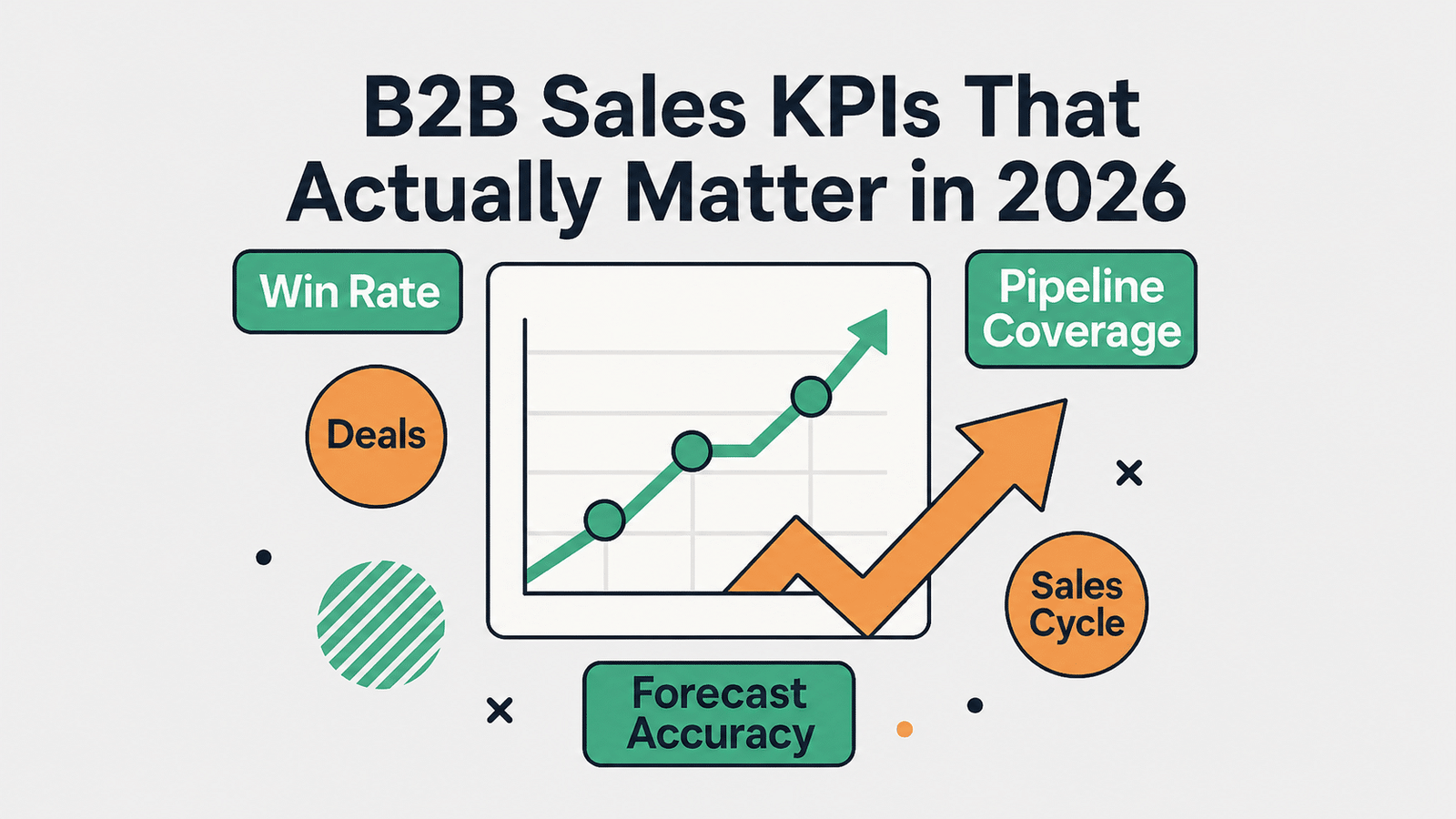
The B2B sales landscape in 2026 is evolving faster than ever before. Traditional sales methods that once relied heavily on cold calling and manual prospecting are now being replaced with data-driven strategies, AI-powered automation, and highly personalized customer engagement. As organizations continue investing in digital transformation, sales leaders are under increasing pressure to measure performance more accurately and optimize revenue generation processes.
In this rapidly changing environment, tracking the right Key Performance Indicators (KPIs) has become essential for sustainable business growth. Many companies still focus on outdated vanity metrics such as the number of calls made or emails sent, but modern B2B sales success depends on deeper insights into buyer behavior, pipeline efficiency, customer retention, and revenue predictability.
The most successful sales organizations in 2026 are those that align sales KPIs with business outcomes. Instead of simply measuring activity, they focus on metrics that reveal how efficiently sales teams convert opportunities into long-term customer relationships. Understanding these KPIs helps businesses improve forecasting accuracy, increase productivity, shorten sales cycles, and maximize return on investment.
Why Modern B2B Sales KPIs Matter
In today’s competitive market, buyers are more informed and selective than ever before. Decision-makers conduct extensive research before interacting with a sales representative, which means sales teams must provide value at every stage of the buyer journey. As a result, businesses need smarter KPIs that measure engagement quality, customer experience, and revenue impact rather than just surface-level activity.
Modern sales KPIs help organizations:
- Improve pipeline visibility
- Identify revenue bottlenecks
- Optimize sales performance
- Enhance customer retention
- Increase forecasting accuracy
- Align sales and marketing teams
- Drive scalable revenue growth
Companies that fail to adapt their KPI strategies often struggle with inefficient sales processes, inaccurate forecasts, and declining customer engagement.
Revenue Growth Rate
Revenue Growth Rate remains one of the most critical B2B sales KPIs in 2026 because it directly reflects a company’s ability to generate consistent business growth. This metric measures the percentage increase in revenue over a specific period, helping organizations evaluate the effectiveness of their sales strategies and market positioning.
Unlike vanity metrics, revenue growth provides a clear picture of overall business health. Sales leaders closely monitor monthly recurring revenue (MRR), annual recurring revenue (ARR), and quarter-over-quarter growth to determine whether their strategies are producing measurable results.
Businesses focusing on recurring revenue models, especially SaaS companies, use this KPI to understand long-term profitability and customer expansion opportunities. Strong revenue growth often indicates effective sales alignment, successful customer acquisition strategies, and high market demand.
Sales Pipeline Velocity
Pipeline velocity measures how quickly deals move through the sales funnel and generate revenue. In 2026, this KPI has become increasingly important because buyers expect faster responses, personalized communication, and seamless purchasing experiences.
Pipeline velocity combines several critical factors, including:
- Number of qualified opportunities
- Average deal size
- Win rate
- Length of sales cycle
A slow-moving pipeline may indicate process inefficiencies, weak lead qualification, or delays in customer decision-making. Businesses that optimize pipeline velocity can close deals faster and improve revenue predictability.
Modern CRM platforms powered by artificial intelligence now provide real-time pipeline insights, helping sales managers identify stalled deals and prioritize high-value opportunities more effectively.
Customer Acquisition Cost (CAC)
Customer Acquisition Cost measures the total expense involved in acquiring a new customer. This includes marketing costs, advertising expenses, sales salaries, software investments, and operational overhead.
As competition increases across industries, controlling acquisition costs has become a major priority for B2B organizations. In 2026, businesses are focusing heavily on balancing acquisition costs with customer lifetime value to ensure sustainable profitability.
A high CAC may signal inefficient marketing campaigns, poor targeting strategies, or low conversion rates. Companies are increasingly leveraging automation, AI-driven prospecting, and account-based marketing (ABM) to reduce acquisition expenses while improving lead quality.
Organizations that consistently optimize CAC gain a significant competitive advantage because they can scale operations more efficiently without overspending on customer acquisition.
Customer Lifetime Value (CLV)
Customer Lifetime Value has become one of the most valuable KPIs in modern B2B sales because retaining customers is often more profitable than acquiring new ones. CLV measures the total revenue a business can expect from a customer throughout the entire relationship.
In 2026, companies are placing greater emphasis on long-term customer relationships, upselling opportunities, and subscription renewals. Businesses that focus solely on acquisition without improving retention often experience unstable revenue growth.
A high CLV typically indicates:
- Strong customer satisfaction
- Effective onboarding
- High product adoption
- Successful customer support
- Consistent renewal rates
Sales and customer success teams now work more closely together to maximize customer value and improve long-term retention.
Win Rate
Win rate measures the percentage of sales opportunities that convert into paying customers. This KPI helps organizations understand how effectively their sales teams close deals and compete in the market.
In modern B2B sales environments, win rates are influenced by several factors, including personalization, solution relevance, response speed, and relationship building. AI-driven analytics tools now help businesses identify patterns in successful deals and replicate winning strategies.
A declining win rate may indicate:
- Poor lead qualification
- Weak sales messaging
- Increased market competition
- Ineffective follow-up processes
- Misalignment between sales and customer needs
Improving win rates requires a combination of better prospect targeting, stronger sales enablement, and data-driven decision-making.
Sales Cycle Length
The average sales cycle length measures how long it takes to convert a prospect into a paying customer. In 2026, buyers expect faster purchasing experiences, making this KPI more important than ever.
Long sales cycles can negatively impact revenue forecasting and operational efficiency. Businesses are increasingly using automation tools, digital proposal systems, and AI-powered communication platforms to accelerate deal progression.
Shorter sales cycles often result from:
- Better lead qualification
- Personalized outreach
- Faster response times
- Streamlined approval processes
- Effective customer engagement
Organizations that reduce friction during the buying journey often achieve higher conversion rates and improved customer satisfaction.
Lead-to-Customer Conversion Rate
This KPI measures the percentage of leads that eventually become customers. It is one of the clearest indicators of sales and marketing alignment.
In 2026, businesses generate leads through multiple digital channels, including LinkedIn, webinars, email marketing, paid advertising, and AI-driven outreach campaigns. However, generating leads alone is no longer enough. Companies must focus on attracting high-intent prospects who are more likely to convert.
A strong conversion rate indicates that:
- Marketing campaigns are well-targeted
- Sales teams are engaging effectively
- Customer pain points are clearly addressed
- The value proposition is compelling
Organizations with poor conversion rates often struggle with low-quality leads or ineffective nurturing strategies.
Customer Retention Rate
Customer retention is now considered just as important as customer acquisition. Retaining existing customers reduces churn, increases profitability, and strengthens brand loyalty.
In subscription-based industries, retention directly impacts recurring revenue growth. Companies are increasingly investing in customer success programs, proactive support, and personalized engagement strategies to improve retention rates.
High retention rates usually indicate:
- Strong product-market fit
- Excellent customer service
- Effective onboarding experiences
- Continuous value delivery
Businesses that prioritize customer relationships often achieve more stable and predictable revenue streams.
Forecast Accuracy
Accurate sales forecasting has become a critical requirement for strategic planning and resource allocation. Inaccurate forecasts can lead to poor budgeting decisions, missed revenue targets, and operational inefficiencies.
Modern forecasting tools use predictive analytics, machine learning, and real-time CRM data to improve forecast reliability. Sales leaders now rely heavily on data-driven forecasting models rather than intuition alone.
Improved forecast accuracy helps businesses:
- Allocate resources efficiently
- Plan hiring strategies
- Optimize inventory management
- Set realistic revenue expectations
- Improve investor confidence
Companies with highly accurate forecasting models are better positioned to adapt to market changes and economic uncertainty.
Sales Productivity
Sales productivity measures how effectively sales representatives use their time to generate revenue. In 2026, businesses are focusing on eliminating repetitive administrative tasks so sales teams can spend more time building customer relationships.
Automation technologies now handle many time-consuming activities such as:
- Data entry
- Email sequencing
- Lead scoring
- Meeting scheduling
- CRM updates
By improving productivity, organizations can increase revenue without significantly expanding headcount. Sales productivity is becoming a major competitive differentiator for fast-growing B2B companies.
The Role of AI in Tracking Sales KPIs
Artificial intelligence is transforming how businesses measure and optimize sales performance. AI-powered platforms can analyze massive amounts of customer data, identify buying signals, predict deal outcomes, and recommend next actions in real time.
In 2026, AI-driven sales analytics provide businesses with deeper insights into:
- Buyer intent
- Customer engagement patterns
- Revenue forecasting
- Pipeline risks
- Upselling opportunities
Organizations that leverage AI for KPI analysis gain faster insights and make more informed business decisions.
Common Mistakes Businesses Make When Tracking KPIs
Many companies still make the mistake of tracking too many metrics without focusing on actual business impact. Measuring every available data point often creates confusion and distracts teams from strategic priorities.
Some common KPI mistakes include:
- Focusing on activity instead of outcomes
- Ignoring customer retention metrics
- Using outdated reporting systems
- Failing to align KPIs with business goals
- Tracking metrics without actionable insights
Successful organizations prioritize a smaller set of high-impact KPIs that directly influence revenue growth and customer success.
Conclusion
The future of B2B sales in 2026 is increasingly data-driven, customer-focused, and powered by intelligent automation. As buyer expectations continue to evolve, businesses must move beyond outdated sales metrics and focus on KPIs that truly measure revenue impact, customer value, and operational efficiency.
Metrics such as revenue growth rate, pipeline velocity, customer acquisition cost, customer lifetime value, win rate, and retention rate provide meaningful insights that help organizations make smarter strategic decisions. These KPIs not only improve sales performance but also strengthen customer relationships and support long-term business growth.
Companies that successfully align their sales strategies with modern KPI frameworks will be better equipped to compete in rapidly changing markets. By leveraging AI-powered analytics, improving forecasting accuracy, and focusing on customer-centric performance indicators, B2B organizations can build scalable and sustainable revenue engines for the future.
