


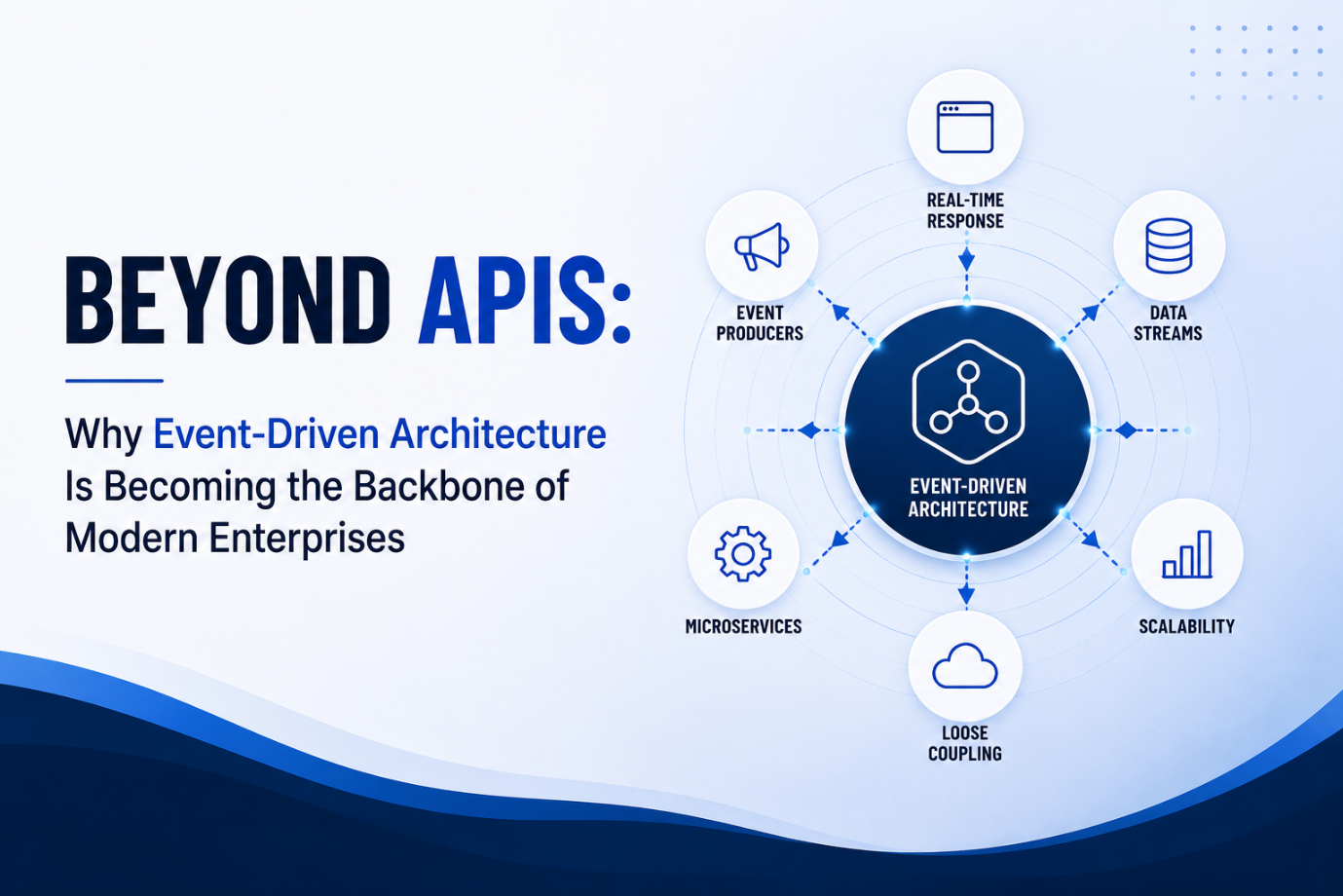

For more than a decade, APIs have been the foundation of digital transformation. They enabled applications to communicate, accelerated software development, created platform ecosystems, and became central to cloud adoption and enterprise modernization. Organizations invested heavily in API strategies because connectivity became synonymous with agility. Yet as enterprises continue expanding across cloud environments, AI systems, distributed applications, real-time customer expectations, and increasingly complex digital operations, many are discovering that traditional request-response architectures are no longer sufficient for the speed at which modern business must operate. Connectivity alone is not enough. Enterprises now need responsiveness. This is why event-driven architecture is emerging as one of the most important technology shifts shaping enterprise systems.
At its core, event-driven architecture changes how systems interact. Instead of applications continuously requesting information from one another and waiting for responses, systems react automatically when something meaningful happens. An event can be a payment completed, inventory updated, customer behaviour detected, sensor data generated, shipment delayed, application deployed, or security anomaly identified. Once the event occurs, all relevant systems receive and act upon that information immediately. Rather than building chains of dependencies, organizations create environments where applications become aware, adaptive, and capable of acting in real time.
This shift addresses one of the largest problems inside enterprise technology landscapes: excessive coupling. Traditional architectures often create rigid dependencies between systems, where one application must know when, where, and how to communicate with another. As environments scale, these dependencies become difficult to manage, increasing latency, reducing resilience, and slowing innovation. Every integration creates another operational burden. Event-driven models reduce this friction by decoupling producers from consumers. Systems publish events without needing awareness of who consumes them, allowing applications to evolve independently while remaining connected through shared event streams.
The importance of this model becomes clear when examining how enterprises now operate. Business environments are no longer predictable sequences of transactions. Organizations manage continuous streams of activity generated across digital channels, IoT devices, customer interactions, AI systems, supply chains, and internal platforms. Customers expect instant updates, personalized experiences, immediate issue resolution, and uninterrupted service. Delays measured in minutes increasingly create competitive disadvantages. Event-driven architecture allows enterprises to transition from batch processing and delayed synchronization toward real-time operational awareness.
One of the strongest drivers behind this movement is artificial intelligence. AI systems are fundamentally dependent on timely and dynamic information. Models become significantly more valuable when they react to live business conditions rather than historical snapshots. Fraud detection systems require immediate transaction signals. Recommendation engines need behavioural updates. Operational intelligence platforms depend on changing context. Autonomous workflows require triggers to activate decisions. Event-driven infrastructure creates the foundation that allows AI capabilities to operate continuously instead of periodically.
This architecture also transforms scalability. Traditional application scaling often means increasing computing resources for entire systems even when demand affects only specific components. Event-driven systems enable organizations to scale independently based on event volume and business requirements. Services process workloads asynchronously, reducing bottlenecks and improving efficiency. This becomes especially valuable in cloud-native environments where elasticity and resource optimization directly affect operational costs.
Developer productivity is another reason enterprises are accelerating adoption. In conventional environments, development teams spend substantial time managing integrations, maintaining dependencies, coordinating deployments, and reducing downstream impact. Event-based systems simplify this process by allowing teams to publish capabilities that others can consume independently. New applications can be introduced without restructuring entire ecosystems. Innovation becomes faster because teams are no longer constrained by centralized coordination.
However, event-driven transformation introduces new architectural responsibilities. Real-time systems require strong governance, event standardization, observability, monitoring, reliability engineering, and disciplined ownership models. Poorly designed event environments can create invisible complexity, event storms, duplicated processing, and operational blind spots. Enterprises must therefore think beyond implementation and establish architectural principles around event ownership, schema evolution, security controls, and lifecycle management.
Business leadership increasingly has a role in these decisions as well. Event-driven architecture is not simply an engineering preference, it shapes how organizations respond to markets, launch products, manage operations, and deliver customer outcomes. Technology architecture and business architecture are becoming inseparable. The ability to detect change and respond instantly is evolving into a strategic capability rather than a technical optimization.
The enterprises that will define the next generation of digital leadership are unlikely to be those with the largest number of APIs or the most integrations. They will be the organizations capable of creating systems that sense, react, and adapt continuously. Event-driven architecture represents a shift from connected enterprises to responsive enterprises. In a world increasingly shaped by real-time expectations, distributed intelligence, and AI-enabled operations, the future will not belong to businesses that communicate fastest, it will belong to those that respond first.
