



For years, enterprise technology strategy prioritized consolidation. Organizations invested heavily in large, centralized platforms designed to manage multiple business functions under a single architecture. These monolithic environments promised consistency, control, simplified governance, and operational standardization. Enterprises adopted comprehensive systems believing that larger platforms would naturally produce greater efficiency and stability. While this approach served businesses during periods of predictable growth and slower technological change, modern digital environments have exposed its limitations. Today’s enterprises operate in markets defined by continuous disruption, evolving customer expectations, accelerated innovation cycles, and rapidly changing business requirements. Under these conditions, monolithic systems increasingly struggle to deliver the flexibility, speed, and adaptability organizations require. As a result, composab
le architecture is emerging as the next enterprise standard.
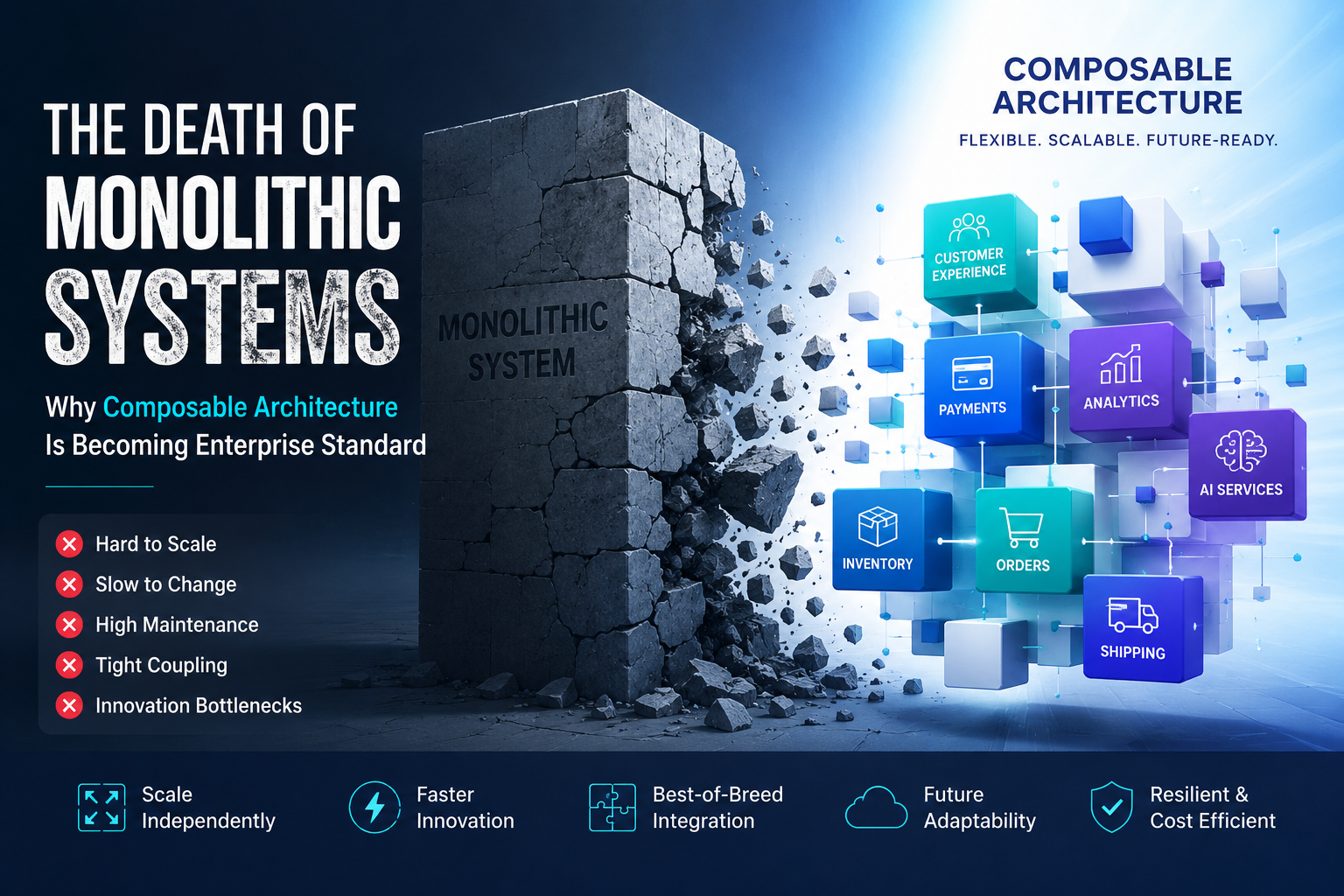
A monolithic architecture is built around tightly connected components that function as a unified system. Changes in one area often impact multiple dependent services, making updates complex and innovation slower. These environments can become increasingly difficult to scale as organizations expand operations, introduce new digital channels, acquire businesses, or respond to changing market demands. Technology teams frequently encounter situations where introducing a relatively small enhancement requires extensive testing, multiple approvals, and coordination across interconnected systems. Over time, technical debt accumulates and the architecture itself becomes a constraint on business agility.
Composable architecture approaches technology from a fundamentally different perspective. Instead of building large, interconnected systems designed to manage everything internally, composable environments consist of modular capabilities that can be assembled, integrated, replaced, and scaled independently. Business functions become flexible building blocks connected through APIs, integration layers, orchestration platforms, and shared governance principles. Rather than forcing the business to adapt to technology limitations, composable architecture allows technology to adapt to evolving business requirements.
This transition reflects a broader shift in how enterprises think about digital capability. Traditional technology decisions often prioritized ownership and consolidation. Modern enterprises increasingly prioritize interoperability and flexibility. Organizations no longer assume a single platform will solve every business challenge. Instead, they build ecosystems composed of specialized capabilities working together. Customer experience platforms connect with analytics engines, operational systems integrate with AI services, workflow tools exchange data in real time, and business applications evolve independently while remaining connected through standardized interfaces.
The rise of cloud-native infrastructure has accelerated this movement. Cloud environments introduced elasticity, distributed computing, and service-based delivery models that naturally align with composable principles. Enterprises can now deploy, scale, and update capabilities without redesigning entire environments. Infrastructure becomes programmable, enabling technology teams to respond to business opportunities with greater speed and lower operational friction. As cloud maturity increases, organizations are extending composability beyond infrastructure into application design, data architecture, and business operations.
Application development practices are also changing under this model. Microservices architecture has become a foundational enabler of composability by breaking large applications into independent services that perform specific functions. Teams gain greater autonomy because development cycles become isolated rather than dependent on synchronized release schedules. This creates faster experimentation, reduced deployment risk, and improved responsiveness to changing priorities. Combined with API-first strategies, organizations can expose capabilities across products, channels, and business units without duplicating systems.
Data architecture plays an equally important role in composable environments. Traditional enterprise systems often create isolated data environments that reduce visibility and limit innovation. Composable approaches emphasize accessible, governed, and interoperable data ecosystems capable of supporting real-time decision-making. Data becomes an organizational asset rather than an application dependency. This shift is becoming increasingly important as AI adoption expands, because intelligent systems require continuous access to connected and reliable information across the enterprise landscape.
Another major advantage of composable architecture is business resilience. Market conditions rarely remain stable, and organizations must adapt quickly to regulatory changes, customer expectations, operational disruptions, and competitive pressure. Monolithic environments often make change expensive and slow. Composable systems increase optionality by allowing organizations to modify capabilities incrementally rather than redesign entire environments. Enterprises become more capable of absorbing disruption without creating large-scale operational risk.
However, composability is not simply about adopting more tools or creating technical complexity. Successful implementation requires disciplined governance, strong integration strategies, standardized interfaces, architectural principles, and organizational alignment. Without clear operating models, composable environments risk becoming fragmented ecosystems that increase complexity rather than reducing it. Enterprises adopting this approach successfully balance flexibility with structure and decentralization with control.
Leadership expectations are evolving accordingly. Technology leaders are increasingly evaluated not by system ownership but by how effectively architecture enables business outcomes. Enterprise architecture is becoming less of a documentation function and more of a strategic growth capability. Decisions around modularity, interoperability, and scalability directly influence innovation speed, customer responsiveness, and operational performance.
The movement toward composable architecture signals a larger transformation in enterprise thinking. Businesses are moving away from designing systems for permanence and toward designing systems for continuous change. Competitive advantage no longer comes from building the biggest technology environment, it comes from building the most adaptable one.
The future enterprise will not operate as a collection of rigid systems connected through manual processes and periodic upgrades. It will function as an intelligent, modular ecosystem capable of evolving continuously. Monolithic systems are not disappearing overnight, but their dominance is fading. Composable architecture is becoming the foundation for enterprises that want to remain responsive, scalable, and ready for whatever comes next.
