


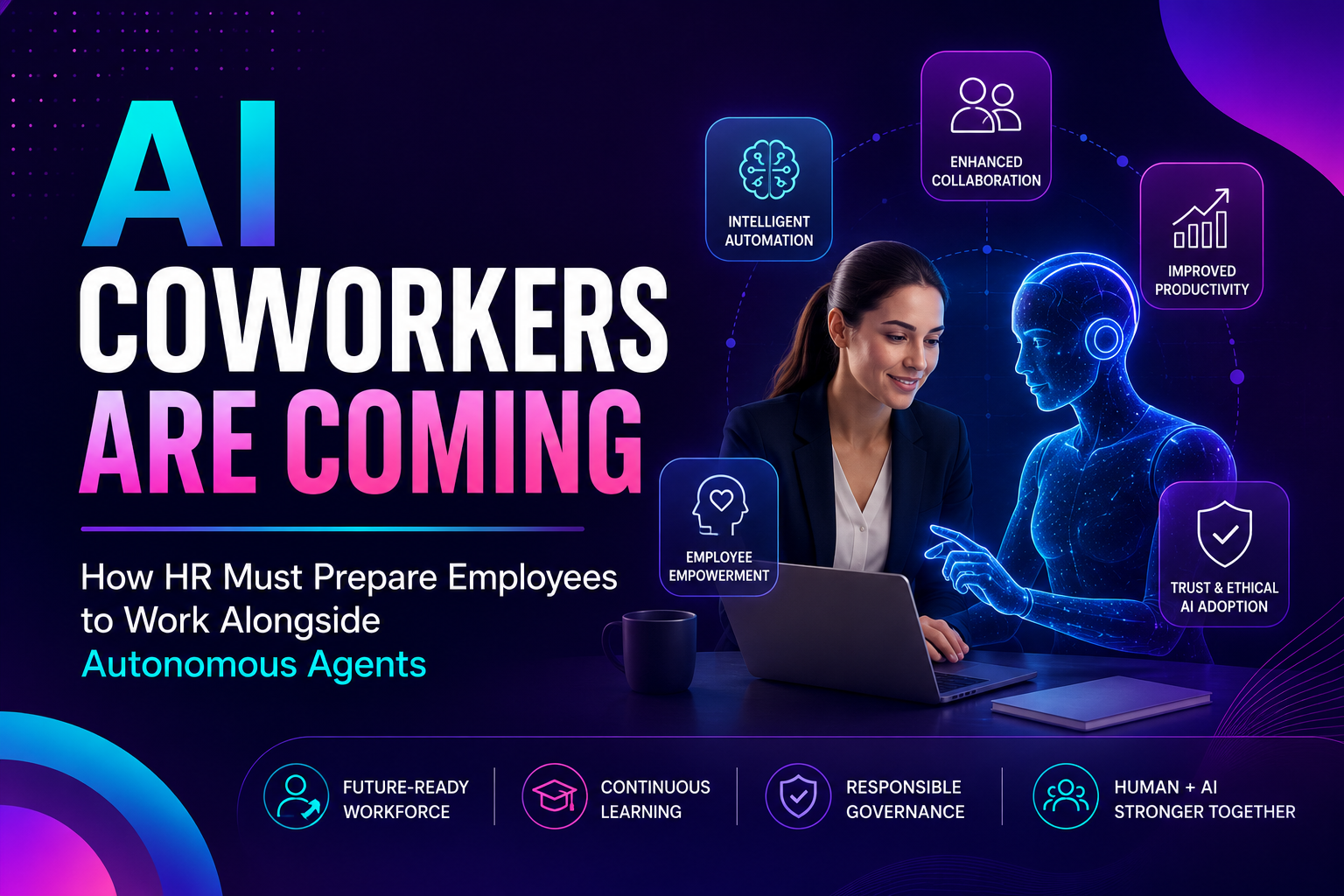

For decades, organizations have viewed technology as a tool that enhances employee productivity. From spreadsheets and enterprise resource planning systems to cloud computing and robotic process automation, each wave of innovation has enabled employees to perform their work faster, more accurately, and at greater scale. However, the next phase of enterprise transformation is fundamentally different. Artificial intelligence is no longer limited to supporting employees through automation or analytics. Instead, businesses are beginning to deploy autonomous AI agents capable of planning tasks, making decisions within defined boundaries, collaborating across systems, and executing workflows with minimal human intervention. These digital entities are no longer passive software applications waiting for instructions, they are rapidly evolving into active contributors to enterprise operations. As organizations embrace this transformation, Human Resources finds itself at the center of one of the most significant workforce shifts in modern business history.
The conversation surrounding AI has traditionally focused on automation and job displacement, often creating unnecessary fear among employees. While automation will undoubtedly reshape certain responsibilities, the reality emerging across global enterprises is far more nuanced. Most organizations are not replacing entire workforces with AI. Instead, they are creating hybrid teams where human employees and autonomous AI agents work together to achieve better business outcomes. These AI coworkers can schedule meetings, summarize documents, monitor compliance, analyze financial reports, generate software code, draft marketing campaigns, qualify leads, respond to customer inquiries, prepare presentations, and even coordinate routine project management activities. Their growing capabilities require organizations to rethink not only technology strategies but also workforce planning, employee development, organizational culture, and leadership practices. HR departments are no longer simply hiring talent; they are designing workplaces where humans and intelligent digital agents collaborate as part of the same operational ecosystem.
One of the most important responsibilities for HR leaders is helping employees understand what AI coworkers actually represent. Misconceptions remain widespread, with many employees assuming that AI is intended to replace their roles entirely. In reality, autonomous agents are designed to eliminate repetitive, time-consuming, and highly structured tasks, allowing employees to focus on strategic thinking, creative problem-solving, relationship building, innovation, and decision-making. Organizations that communicate this vision transparently are far more likely to achieve successful AI adoption than those introducing intelligent systems without adequate explanation. Change management becomes a critical HR function, ensuring employees recognize AI as a productivity partner rather than a workplace competitor.
The emergence of AI coworkers also requires HR to redefine the concept of productivity. Traditional performance measurement often emphasized hours worked, tasks completed, or manual output generated by employees. In AI-enabled organizations, these metrics become less meaningful because autonomous agents increasingly perform routine operational activities. Instead, organizations must evaluate employees based on their ability to solve complex business problems, interpret AI-generated insights, exercise sound judgment, collaborate across teams, and deliver measurable business value. Human contribution shifts from execution toward orchestration, where employees guide, supervise, validate, and improve the work performed by intelligent systems.
Reskilling and continuous learning have therefore become strategic priorities rather than optional development initiatives. Employees across every department, from finance and marketing to operations, legal, HR, customer success, and engineering, must develop AI literacy alongside their existing professional expertise. This does not necessarily require everyone to become data scientists or machine learning engineers. Instead, employees need practical skills such as writing effective prompts, evaluating AI-generated outputs, understanding model limitations, recognizing bias, verifying factual accuracy, protecting sensitive data, and integrating AI into daily workflows responsibly. HR departments play a central role in designing enterprise-wide learning programs that equip employees with these competencies while fostering confidence rather than anxiety about technological change.
Leadership development must also evolve. Managers who once supervised only human teams may soon oversee hybrid workforces consisting of employees and AI agents working together on shared objectives. Effective leadership in this environment requires new competencies, including AI governance, workflow orchestration, digital ethics, technology adoption, data-driven decision-making, and cross-functional collaboration. Managers must understand when to delegate tasks to AI, when human judgment remains essential, and how to balance efficiency with accountability. HR leaders should redesign leadership development programs to prepare managers for this entirely new management paradigm.
Recruitment strategies are undergoing equally significant transformation. As AI assumes responsibility for routine administrative work, organizations increasingly prioritize candidates possessing uniquely human capabilities that machines cannot easily replicate. Critical thinking, emotional intelligence, adaptability, communication, creativity, ethical reasoning, collaboration, negotiation, and leadership become more valuable than repetitive technical execution alone. Hiring processes themselves are also becoming more intelligent, with AI supporting resume screening, skills assessments, interview scheduling, candidate engagement, and workforce analytics. HR must ensure these systems remain transparent, unbiased, and aligned with organizational diversity and inclusion objectives while maintaining human oversight throughout critical hiring decisions.
Workforce planning enters a new era as AI coworkers become integrated into enterprise operations. Traditionally, organizations calculated staffing requirements based on projected workloads, departmental budgets, and employee availability. Future workforce planning will consider a blended workforce where digital agents perform specific categories of work alongside human employees. HR leaders must determine which responsibilities should remain human-driven, which can be partially automated, and which are suitable for complete AI execution under appropriate governance. This hybrid workforce model enables organizations to scale operations more efficiently while preserving human expertise for high-value activities requiring judgment, empathy, and strategic thinking.
Organizational culture represents another critical area requiring HR attention. Successful AI adoption depends not only on technology implementation but also on employee trust. Workers must believe that AI systems are introduced to enhance organizational effectiveness rather than eliminate careers. Transparent communication regarding implementation goals, expected benefits, governance frameworks, privacy protections, and future career opportunities helps reduce uncertainty and resistance. Companies that actively involve employees in AI adoption initiatives often experience stronger engagement because workers feel empowered rather than threatened by technological transformation.
Ethics and governance become indispensable HR responsibilities as autonomous AI agents gain broader decision-making capabilities. Organizations must establish clear policies governing acceptable AI use, data privacy, accountability, intellectual property protection, regulatory compliance, bias mitigation, and employee oversight. AI should never operate without defined governance structures, particularly when influencing hiring decisions, performance evaluations, promotions, compensation, or disciplinary actions. HR departments must collaborate closely with legal, compliance, IT, and executive leadership to develop comprehensive AI governance frameworks that ensure responsible innovation while protecting employee rights.
Employee well-being also takes on new dimensions within AI-enabled workplaces. While AI reduces repetitive workloads, it can simultaneously increase expectations for productivity, responsiveness, and continuous availability. Employees may experience pressure to match the speed and efficiency of intelligent systems, potentially leading to stress, burnout, or reduced job satisfaction. HR leaders must proactively monitor workload balance, encourage healthy technology usage, establish clear expectations regarding AI-assisted productivity, and reinforce the importance of human creativity, collaboration, and personal development. Sustainable AI adoption requires supporting employee well-being alongside operational efficiency.
Performance management systems require modernization to reflect evolving work environments. Traditional annual reviews often focus on individual task completion and output volume. Future performance evaluations should assess employees’ ability to collaborate effectively with AI systems, apply critical thinking, solve complex business challenges, innovate continuously, mentor colleagues, and contribute to organizational learning. Employees who leverage AI responsibly to enhance business outcomes should be recognized and rewarded, encouraging broader adoption of intelligent workplace practices.
Knowledge management becomes increasingly valuable as organizations integrate AI coworkers across departments. Autonomous agents rely heavily on organizational knowledge, including policies, procedures, documentation, customer histories, compliance guidelines, technical manuals, and operational workflows. HR can contribute significantly by ensuring institutional knowledge is captured, standardized, and accessible through centralized knowledge repositories. Employees who document expertise effectively not only support colleagues but also improve AI performance by providing accurate, structured information that intelligent systems can utilize.
Another emerging responsibility involves preparing employees for entirely new career paths created by AI adoption. Roles such as AI Operations Manager, Prompt Engineer, AI Ethics Officer, Human-AI Collaboration Specialist, AI Governance Lead, Digital Workforce Manager, and Enterprise Automation Strategist are becoming increasingly common across industries. HR must identify future skill requirements, redesign career progression frameworks, and provide employees with opportunities to transition into these high-value positions. Workforce transformation should be viewed as an opportunity for career growth rather than merely a response to technological disruption.
Perhaps the most significant realization for HR leaders is that AI coworkers will never replace the uniquely human qualities that drive organizational success. Innovation emerges from curiosity. Leadership depends on trust. Collaboration requires empathy. Customer relationships flourish through emotional intelligence. Ethical decisions demand moral reasoning. Organizational culture is built through shared experiences, purpose, and human connection. AI excels at processing information, recognizing patterns, executing workflows, and generating recommendations, but it cannot replicate the complex interpersonal dynamics that define successful businesses. HR therefore becomes the guardian of humanity within increasingly intelligent workplaces, ensuring technology amplifies rather than diminishes human potential.
The organizations that thrive over the next decade will not be those with the most advanced AI alone, nor those relying exclusively on traditional human workforces. Success will belong to enterprises that create balanced ecosystems where intelligent machines handle routine complexity while people focus on creativity, strategy, leadership, innovation, and relationship building. HR stands at the forefront of this transformation, responsible for preparing employees, developing leaders, establishing governance, fostering trust, and building cultures capable of embracing continuous technological evolution.
AI coworkers are no longer a distant vision of the future. They are already entering boardrooms, finance departments, customer service centers, marketing teams, software development organizations, and HR functions themselves. The question is no longer whether autonomous agents will become part of the enterprise workforce, but how effectively organizations prepare their people to work alongside them. Human Resources has a unique opportunity to lead this transition by ensuring that technology enhances human capability rather than replacing it. In the era of intelligent enterprises, the strongest competitive advantage will not be artificial intelligence alone, it will be organizations that successfully combine human ingenuity with autonomous digital intelligence to create workplaces that are more productive, innovative, resilient, and prepared for the future.
