


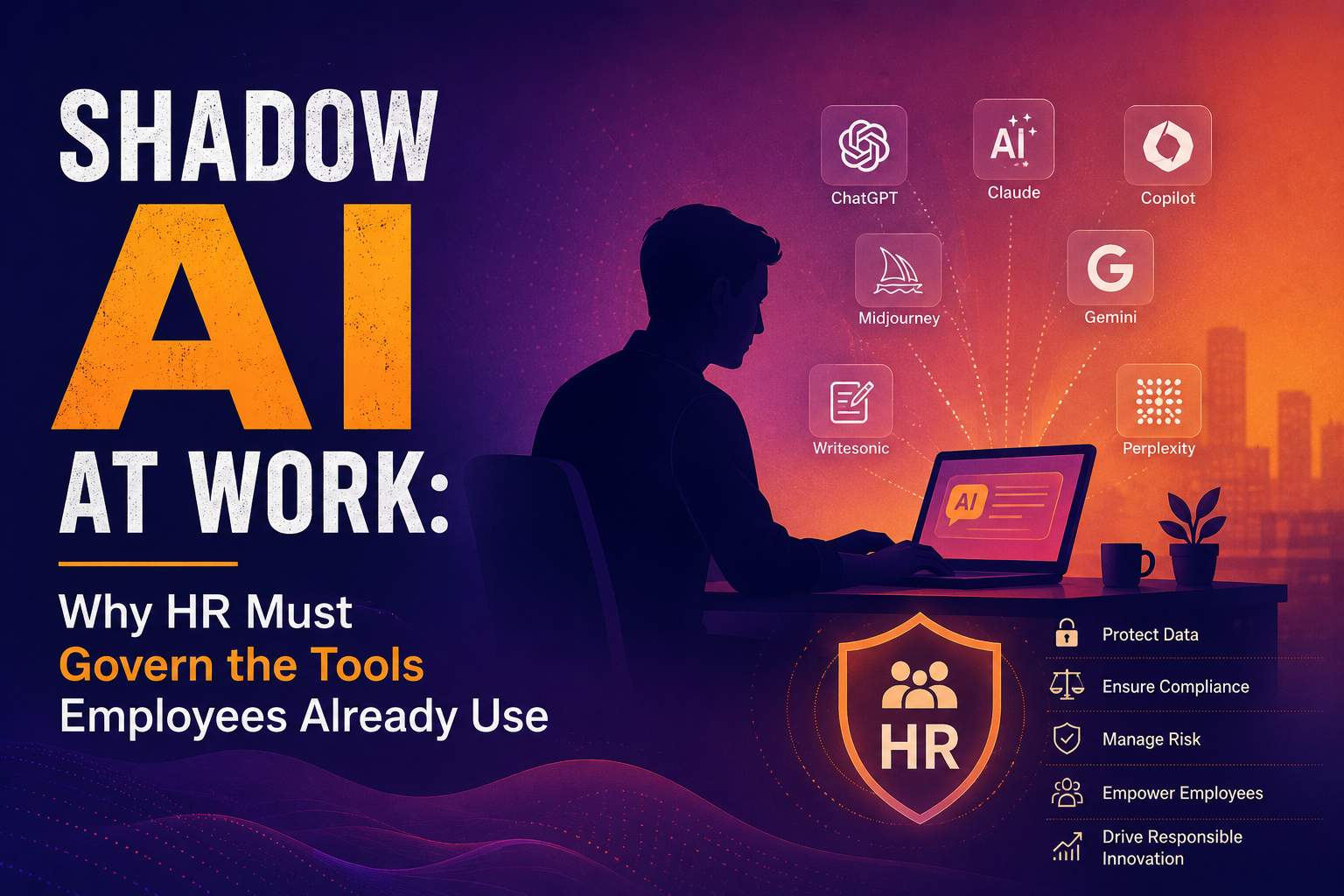

Artificial intelligence has entered the enterprise through an unexpected route. Unlike previous waves of digital transformation that began with executive sponsorship, formal technology roadmaps, and organization-wide implementation strategies, generative AI has been adopted from the bottom up. Employees across every department are independently using AI assistants to write emails, summarize meetings, generate presentations, analyse spreadsheets, draft code, create marketing content, conduct research, and solve everyday business problems without waiting for official approval. What started as individual experimentation has quietly evolved into a widespread workplace phenomenon commonly referred to as Shadow AI, the use of artificial intelligence tools that exist outside an organization’s approved technology ecosystem and governance framework. Much like Shadow IT emerged when employees began adopting unauthorized cloud applications to improve productivity, Shadow AI is developing because employees perceive immediate business value from generative AI tools that often evolve faster than enterprise approval processes. While many organizations continue debating long-term AI strategies, their workforce has already incorporated AI into daily operations. This creates a new challenge for Human Resources. The question is no longer whether employees will use AI but how organizations can govern, enable, and develop responsible AI adoption without suppressing the innovation that makes these technologies valuable in the first place.
The rapid emergence of Shadow AI reflects a broader shift in employee expectations regarding workplace technology. Modern professionals have become accustomed to consumer technologies evolving more quickly than enterprise software. Employees use sophisticated AI applications in their personal lives and naturally expect similar capabilities to improve productivity at work. When organizations fail to provide secure enterprise alternatives, employees often seek publicly available tools capable of completing repetitive tasks more efficiently. A recruiter may use AI to draft job descriptions, a financial analyst may summarize lengthy reports, a salesperson may generate client proposals, while a project manager may ask an AI assistant to organize meeting outcomes. Individually these decisions appear harmless, yet collectively they introduce organizational risks related to confidential information, regulatory compliance, intellectual property protection, data privacy, and inconsistent business practices. Employees rarely adopt Shadow AI with malicious intent. Instead, they are attempting to work faster, communicate more effectively, and reduce administrative workload. The gap between employee innovation and organizational governance is precisely where Human Resources must now play a strategic role.
Historically, HR has been responsible for managing workforce capability, organizational policies, learning and development, employee engagement, and cultural transformation. Artificial intelligence expands this responsibility significantly because AI adoption is no longer purely a technology issue. It directly influences workforce behaviour, job design, performance expectations, skills development, leadership capabilities, ethical decision-making, and organizational trust. Technology departments may evaluate AI platforms for security and infrastructure compatibility, but HR must determine how employees interact with those technologies responsibly and effectively. This requires moving beyond restrictive policies that simply prohibit unauthorized AI usage toward governance frameworks that encourage innovation while protecting organizational interests. Successful enterprises increasingly recognize that AI governance is fundamentally a people challenge supported by technology rather than a technology challenge managed by policy alone.
One of the most significant risks associated with Shadow AI involves organizational knowledge leaving controlled enterprise environments. Employees frequently paste confidential documents, customer information, financial reports, legal contracts, strategic planning materials, software code, or internal communications into publicly accessible AI systems without fully understanding how those systems process, retain, or learn from submitted information. Even when no malicious intent exists, these actions may expose sensitive business data beyond established governance controls. HR therefore plays a critical role in educating employees about responsible AI usage by establishing clear guidelines regarding acceptable use cases, prohibited information, regulatory obligations, and organizational expectations. Education becomes considerably more effective than fear-based restrictions because employees who understand the rationale behind governance policies are more likely to follow them consistently.
Another important dimension of Shadow AI concerns fairness and consistency across workforce practices. Generative AI is increasingly being used to support recruitment, interview preparation, performance evaluations, employee communications, training content, promotion recommendations, and internal decision-making. Without appropriate governance, employees may unknowingly introduce biased prompts, inconsistent evaluation criteria, or inaccurate information into critical HR processes. Artificial intelligence can significantly improve efficiency, but it should augment professional judgment rather than replace human accountability. HR leaders must therefore establish standards ensuring AI-generated recommendations remain transparent, explainable, and subject to meaningful human oversight. Governance should focus not only on what AI can accomplish but also on identifying decisions that require empathy, contextual understanding, ethical reasoning, or legal accountability beyond the capabilities of automated systems.
Learning and development represent another area undergoing substantial transformation because of Shadow AI. Traditional corporate training often struggles to keep pace with technological innovation. By the time formal AI courses are designed, approved, and delivered, new models, capabilities, and workplace applications have already emerged. Employees therefore learn through experimentation, peer collaboration, online communities, and practical experience rather than structured classroom instruction. HR has an opportunity to embrace this reality by shifting from static training programs toward continuous AI capability development. Instead of teaching employees how to use a specific platform, organizations should focus on transferable competencies including prompt design, critical thinking, information validation, responsible data handling, AI ethics, workflow integration, and human oversight. These foundational skills remain valuable even as individual AI technologies evolve rapidly, enabling organizations to develop adaptable workforces prepared for continuous technological change.
Shadow AI is also redefining the relationship between productivity and performance management. Historically, organizations evaluated employee output largely through visible effort, task completion, or hours invested. Artificial intelligence challenges these assumptions because routine administrative work can now be completed dramatically faster with AI assistance. Employees who effectively integrate AI into their workflows may produce significantly higher-quality outcomes in less time than colleagues relying entirely on manual processes. HR must therefore reconsider how performance is measured in AI-enabled workplaces. Future evaluation frameworks will increasingly emphasize business impact, creativity, strategic thinking, collaboration, customer outcomes, and problem-solving rather than purely operational activity. Organizations that continue rewarding effort over outcomes may inadvertently discourage productive AI adoption instead of encouraging innovation.
Leadership development also becomes increasingly important as managers begin supervising teams whose AI capabilities vary considerably. Some employees enthusiastically adopt intelligent tools while others remain cautious due to uncertainty, skill gaps, or concerns about job displacement. Effective leaders must bridge these differences by fostering experimentation without compromising accountability. HR plays a central role in preparing managers for these new responsibilities by providing guidance on AI coaching, ethical decision-making, technology adoption, organizational change, and workforce communication. Leadership in the AI era depends less on possessing all the answers and more on creating environments where employees feel confident experimenting responsibly while understanding organizational expectations regarding transparency, quality, and governance.
Another emerging challenge relates to workforce equity. Employees who possess stronger AI literacy often gain significant productivity advantages, potentially creating unequal career progression opportunities within the same organization. If AI capability develops purely through informal experimentation, disparities may widen between departments, locations, generations, or individual employees. HR therefore has a responsibility to ensure equitable access to approved AI tools, standardized learning resources, and capability-building opportunities. Democratizing AI skills strengthens organizational resilience while reducing the likelihood that only a small portion of the workforce benefits from technological advancement. Inclusive AI adoption becomes not only a learning objective but also a workforce strategy supporting long-term organizational competitiveness.
The concept of responsible AI culture is becoming equally significant. Policies alone cannot govern technologies evolving as rapidly as generative AI. Organizations require cultures where employees feel comfortable disclosing AI usage, discussing ethical concerns, reporting unexpected outcomes, and sharing successful practices openly. Fear of disciplinary action often drives Shadow AI further underground, making governance considerably more difficult. HR can foster psychological safety by encouraging transparency rather than secrecy, positioning AI as a collaborative workplace capability instead of an unauthorized shortcut. Employees who openly discuss how AI supports their work provide organizations with valuable insights into emerging productivity opportunities while enabling governance teams to identify risks before they become systemic.
Forward-looking organizations are already responding by establishing enterprise AI governance councils involving HR, information technology, legal, cybersecurity, compliance, operations, and executive leadership. HR’s contribution extends beyond policy documentation into workforce transformation. The function increasingly coordinates AI literacy initiatives, develops responsible use frameworks, updates competency models, redesigns job roles, supports organizational change, and ensures AI adoption aligns with company values. Rather than acting as gatekeepers, HR professionals become architects of AI-enabled work environments where innovation and governance evolve together. This collaborative approach recognizes that successful AI implementation depends as much on employee confidence and organizational culture as it does on technological sophistication.
Looking ahead, the distinction between approved AI and Shadow AI will gradually diminish as organizations integrate generative AI directly into enterprise software, collaboration platforms, productivity suites, recruitment systems, learning environments, and operational workflows. However, governance will remain essential because new AI capabilities will continue emerging faster than formal enterprise adoption cycles. HR must therefore develop governance models flexible enough to adapt continuously instead of relying on static policies updated once a year. Responsible AI will become an ongoing organizational capability supported by education, leadership, trust, transparency, and continuous improvement rather than compliance alone.
Shadow AI should not be viewed as evidence of organizational failure or employee misconduct. It is a powerful signal that the workforce is actively searching for more intelligent ways of working. Employees are demonstrating curiosity, adaptability, and a willingness to embrace technologies capable of improving performance. The organizations that respond by prohibiting experimentation may slow innovation while driving AI usage further outside governance structures. Those that respond with education, enablement, and thoughtful governance will transform individual experimentation into enterprise capability. Human Resources now stands at the center of this transformation. The future of work will not be determined solely by the sophistication of artificial intelligence but by an organization’s ability to help people use that intelligence responsibly, ethically, and strategically. In the years ahead, the most successful enterprises will not be those that eliminate Shadow AI entirely but those that successfully bring it into the light, turning informal adoption into a governed, trusted, and organization-wide competitive advantage.
