



In enterprise sales, proactive objection handling is becoming an increasingly important strategy for addressing buyer concerns before they become formal objections. Rather than waiting for prospects to raise concerns about price, implementation, risk, or switching costs, sales teams can anticipate these issues and address them earlier in the buying journey.
Effective proactive objection handling is not about creating unnecessary doubt. It is about identifying the concerns most likely to influence a buying decision and addressing them at the right moment.
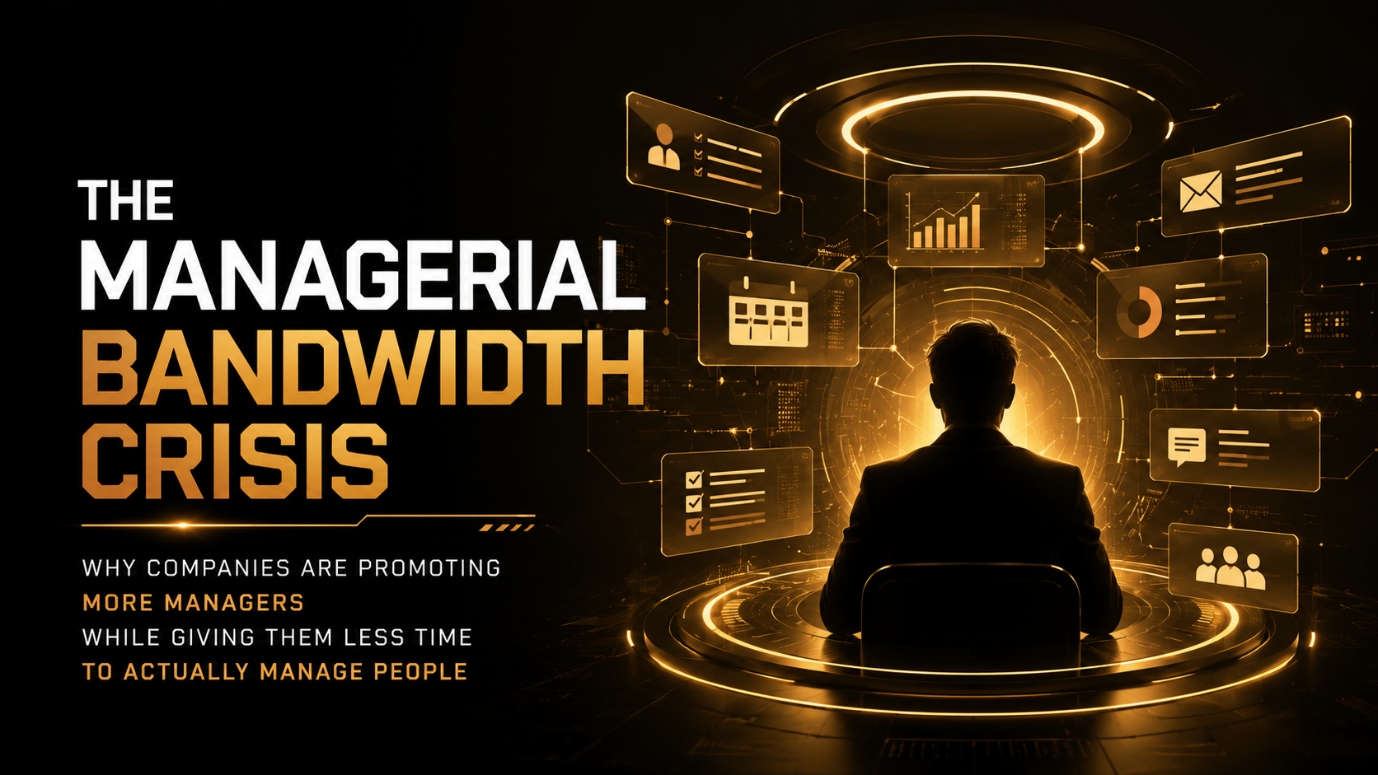
Management has always involved a contradiction: companies promote people into leadership because they are expected to help other people perform better, yet the moment they become managers, their own workload often expands faster than their ability to manage it. A manager who once spent most of the day solving problems, collaborating with colleagues, and delivering individual work is suddenly expected to conduct meetings, review reports, manage performance, handle escalations, complete administrative tasks, respond to messages, attend leadership calls, coordinate across departments, prepare dashboards, participate in planning, and still find enough time to coach the people who report to them. The organization may believe it has strengthened its leadership structure by adding another management layer, but the reality can be very different. Managerial bandwidth determines whether those leadership responsibilities can actually be handled effectively, because management requires more than authority; it requires sufficient time, attention, and cognitive capacity. This creates what can be called the Managerial Bandwidth Crisis: the growing gap between the amount of leadership responsibility managers are expected to carry and the amount of actual time, attention, and cognitive capacity available to perform meaningful people management.
The problem is easy to overlook because management activity is highly visible while management quality is often invisible. A manager who attends twelve meetings, responds to hundreds of messages, completes every report on time, approves requests quickly, and participates in every operational discussion can appear extremely productive. Yet none of those activities necessarily means the manager is developing employees, identifying hidden performance issues, providing useful feedback, understanding team dynamics, or helping people make better decisions. In fact, administrative busyness can create the illusion of effective management while gradually removing the conditions required for it. The manager is technically involved in everything but meaningfully present in very little.
This becomes especially problematic as organizations promote more employees into managerial roles to support growth. A rapidly expanding company needs additional layers of coordination, so high-performing employees are promoted into team-lead, manager, senior manager, or department-head positions. The assumption is straightforward: more managers should create more managerial capacity. But if each new manager inherits a workload that includes both their previous functional responsibilities and new leadership responsibilities, the organization may simply be creating more overloaded managers rather than more effective leaders. The title changes faster than the operating model.
Managerial Bandwidth and the Growing Manager Workload
The first sign of this problem is often the disappearance of one-on-one conversations. One-on-ones are frequently the first activity sacrificed when managers become overloaded because they do not always produce an immediate visible output. A missed client meeting has an obvious consequence. A delayed report can trigger an escalation. An unanswered operational request can block another team. But postponing a conversation with an employee may appear harmless, particularly when nothing seems urgent. Over time, however, these small cancellations accumulate. The employee receives less feedback, the manager develops less understanding of what is happening inside the team, and problems that could have been addressed early become larger and more difficult to solve. When managerial bandwidth becomes constrained, people development is often one of the first leadership responsibilities to suffer.
This is why managerial bandwidth should not be measured simply by the number of employees reporting to a manager. Two managers may each have ten direct reports but operate under completely different conditions. One may have clear processes, strong team autonomy, efficient systems, and limited cross-functional complexity. The other may spend half the day coordinating with multiple departments, handling escalations, fixing process gaps, managing inconsistent performance, and responding to leadership requests. Their organizational charts look identical while their actual management burden is dramatically different. Span of control measures structure; managerial bandwidth measures reality.
Technology has made this paradox more complicated. Organizations adopted collaboration platforms, project-management systems, dashboards, communication tools, HR platforms, analytics software, and automation with the expectation that these systems would reduce administrative burden. In many cases they have improved visibility and speed, but they have also increased the amount of information managers are expected to process. Managers now have access to more dashboards, more notifications, more performance metrics, more communication channels, and more real-time updates than previous generations of leaders. The problem is no longer simply a lack of information. It is the increasing demand to interpret all of it.
A manager can spend an entire morning moving between Slack or Teams conversations, project dashboards, email threads, HR systems, CRM updates, operational reports, and meeting invitations without doing anything that resembles leadership in the traditional sense. The technology has made information available but has not necessarily created the cognitive space required to understand it. This creates a new form of managerial overload: attention fragmentation. The result is a managerial bandwidth problem in which managers may have access to more information while having less capacity to process it meaningfully. The manager is constantly switching contexts, making small decisions, responding to interruptions, and moving between strategic and operational questions. By the time they have an opportunity to coach an employee, their cognitive capacity may already be depleted.
This matters because people management is fundamentally different from task management. A task can often be evaluated through completion, accuracy, speed, or measurable output. A person cannot be managed effectively through the same framework. Managers need to understand motivation, confidence, capability, interpersonal dynamics, career aspirations, uncertainty, stress, strengths, and development needs. These things rarely reveal themselves through dashboards. They emerge through conversations, observation, questions, and sustained attention. When managers lose time for these activities, organizations may continue to measure performance successfully while becoming worse at developing the people who generate that performance.
The issue becomes even more significant for middle managers because they often sit between competing demands. Senior leadership expects them to execute strategy, communicate priorities, report performance, and maintain accountability. Employees expect them to provide support, clarity, coaching, development, and protection from unnecessary organizational friction. Other departments expect coordination. Customers may expect responsiveness. The manager becomes a translation layer between different parts of the organization. Every additional responsibility adds another demand on the same limited resource: attention. For middle managers, protecting managerial bandwidth is therefore essential because their role requires them to translate priorities between leadership and employees while still making decisions and developing people.
This is why many management problems are actually capacity problems disguised as capability problems. An employee may complain that their manager does not provide enough feedback. Leadership may conclude that the manager needs better leadership training. Training may help, but the underlying issue could simply be that the manager has twenty meetings per week and no protected time for coaching. Another manager may struggle to delegate because they are constantly responding to operational emergencies. The organization may describe this as a leadership weakness when the real problem is that the operating model makes delegation difficult. Not every managerial failure can be solved through managerial development.
This distinction is important because organizations often respond to weak management by adding more frameworks. They introduce new leadership competencies, performance-management processes, coaching models, employee-engagement surveys, development plans, manager training programs, and reporting requirements. Each initiative may be valuable individually, but collectively they can increase the workload of the very managers they are trying to improve. A manager can end up spending more time documenting that they are managing employees than actually managing them.
The solution therefore requires organizations to rethink what managerial work should look like. Managers need fewer low-value coordination tasks, clearer decision rights, better escalation mechanisms, and stronger team autonomy. If employees require manager approval for dozens of routine decisions, the manager becomes a bottleneck. If every issue is escalated upward, managerial bandwidth disappears into exception handling. If meetings exist because nobody has clearly defined who owns a decision, managers spend time coordinating rather than leading. Improving managerial capacity often begins by removing unnecessary dependencies. Organizations can improve managerial bandwidth by reducing unnecessary approvals, simplifying escalation paths, clarifying ownership, and giving teams greater autonomy over routine decisions.
AI may become particularly useful here, but only if organizations use it to remove managerial friction rather than generate more information. AI systems can summarize meetings, identify recurring issues, prepare performance insights, organize employee feedback, highlight unusual changes in team metrics, and automate administrative reporting. But the objective should not be to give managers another dashboard. It should be to reduce the amount of time managers spend collecting and organizing information so they can spend more time interpreting it and acting on it.
For example, an AI system could summarize recurring operational problems across a team and identify which issues require managerial intervention. Instead of reading hundreds of messages, the manager could receive a concise picture of what is becoming a problem, where employees are repeatedly getting blocked, and which issues are isolated versus systemic. That creates managerial leverage because technology is performing information synthesis while the manager retains judgment. The goal is not automated management. It is augmented attention. Used correctly, AI can increase managerial bandwidth by reducing administrative work and helping managers focus their attention on coaching, judgment, decision-making, and team development.
Organizations also need to rethink how they evaluate managers. If managers are rewarded primarily for operational output, they will naturally prioritize tasks that produce immediate measurable results. But a manager’s long-term value also comes from developing independent employees, reducing dependency on themselves, building decision-making capability, retaining strong performers, resolving conflicts early, and creating a team that can operate effectively without constant intervention. These outcomes take time and are often difficult to attribute directly. Yet they determine whether an organization can scale without creating layers of managerial congestion.
One of the strongest indicators of managerial effectiveness may therefore be what happens when the manager is absent. If everything stops when the manager takes a day off, the organization may have created dependency rather than leadership. A strong manager does not become the centre of every decision. They create clarity, capability, and confidence throughout the team so that people can act independently within appropriate boundaries. This requires time because autonomy cannot simply be announced. It has to be developed through coaching, context-sharing, feedback, and trust.
The career structure of management also deserves examination. Companies often treat management as the natural reward for strong individual performance. Someone becomes an excellent salesperson, engineer, marketer, analyst, or operations professional and is then promoted because they have demonstrated competence. But being excellent at a function does not automatically mean someone will be excellent at developing other people. Organizations need to distinguish between functional excellence and managerial readiness. Some high performers may create more value by remaining individual contributors with greater expertise and influence rather than becoming managers simply because management is the next available career step.
This would also reduce unnecessary management layers. Not every organization needs more managers. Sometimes it needs better systems, clearer ownership, stronger individual contributors, better automation, or more distributed decision-making. Adding another manager can temporarily solve a coordination problem while creating a new communication layer that makes the organization slower. The right question is not, “Do we need another manager?” but “What work currently requires managerial capacity, and why?”
The Managerial Bandwidth Crisis is ultimately a question about what organizations believe management is for. If management is treated as administration, then more dashboards, meetings, approvals, and reports may appear reasonable. If management is understood as the process of increasing the capability of other people, then the economics change completely. A manager’s most valuable output is not the number of meetings attended or reports completed. It is the number of people who become more capable, more autonomous, and better aligned because that manager invested attention in them.
The companies that address this problem will not necessarily eliminate meetings or reduce every manager’s workload dramatically. Instead, they will become more deliberate about where managerial attention is spent. They will protect time for coaching, simplify decision structures, automate administrative work, reduce unnecessary approvals, and measure managers partly by the capability they create around themselves. They will recognize that attention is not an unlimited organizational resource.
The future of management will not be determined by how many managers a company has, but by how much meaningful attention each manager can actually give to people. When organizations keep adding responsibilities without creating bandwidth, they do not create stronger leadership, they create busier leaders. And a busy manager may keep the organization moving, while a focused manager makes the organization better.
