


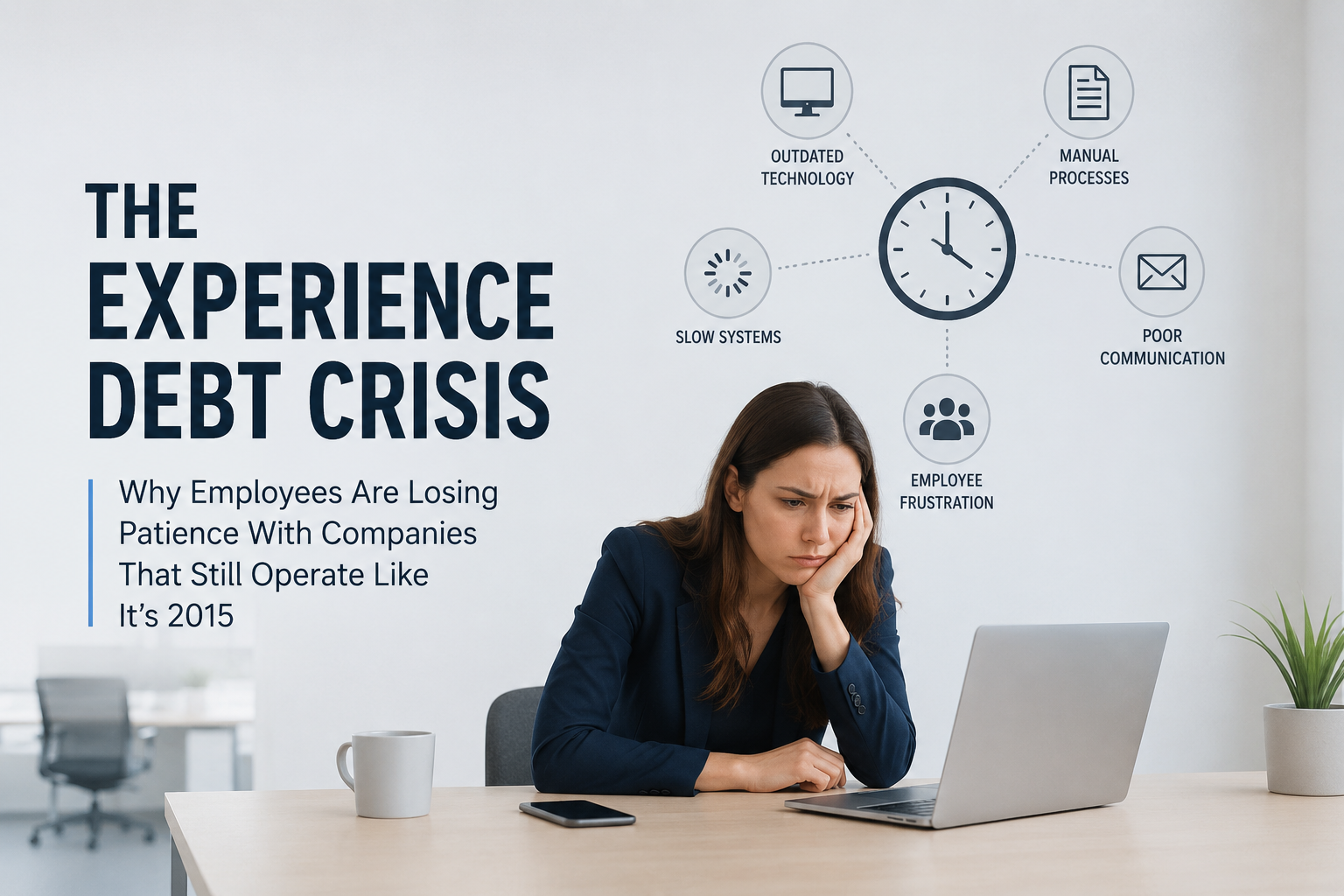

For years, organizations invested heavily in customer experience while treating employee experience as an internal matter that could be addressed gradually. Companies redesigned websites, simplified customer journeys, introduced mobile applications, deployed chatbots, personalized digital interactions, and continuously optimized every touchpoint between customers and the brand. Inside the organization, however, employees were often expected to work through fragmented systems, repetitive approval processes, outdated intranets, disconnected communication tools, manual reporting, inefficient HR processes, and applications that required employees to adapt their workflows around technology rather than the other way around. This created an increasingly visible contradiction: companies were building sophisticated digital experiences for customers while asking employees to operate inside systems that felt years behind. That accumulated gap can be described as Experience Debt, the organizational cost created when employee technology, processes, communication, and workplace experiences fail to evolve at the same pace as the expectations employees have developed in the outside world.
Experience debt does not usually appear as a single line item on a balance sheet. It accumulates gradually through thousands of small frustrations. An employee spends twenty minutes searching for a document that should take thirty seconds to find. A manager waits three days for an approval that could be automated. A new employee receives information from five different systems and has no idea which version is current. A salesperson manually transfers information between applications because two enterprise systems do not communicate properly. An employee submits the same information to multiple departments because internal platforms cannot share data. Individually, these problems appear insignificant. Collectively, they create enormous organizational friction. Employees may continue performing their jobs despite these obstacles, but every unnecessary interaction with a broken process consumes time, attention, and patience.
The expectations surrounding workplace technology have also changed dramatically. Employees do not experience technology only through their employer. They use intelligent search engines, instant messaging applications, digital banking, streaming platforms, ecommerce services, navigation systems, AI assistants, and highly personalized consumer applications every day. These systems have trained people to expect information to be searchable, interfaces to be intuitive, services to be fast, and digital experiences to adapt to individual needs. When employees enter the workplace and encounter systems that require multiple logins, confusing interfaces, manual approvals, duplicated data entry, and long waiting periods, the contrast becomes difficult to ignore. The employee is not comparing one enterprise application with another. They are comparing the workplace experience with the best digital experiences available anywhere.
This creates a significant challenge for Human Resources and business leaders because experience debt is often mistaken for an employee attitude problem. When employees complain about internal systems, organizations may interpret the frustration as resistance to change, lack of patience, or dissatisfaction with management. Sometimes the underlying issue is much simpler: the organization has designed an unnecessarily difficult way for people to complete basic tasks. Asking employees to work harder within inefficient systems does not solve the problem. It merely transfers the cost of poor design from the organization to the employee.
The consequences extend directly into productivity. Every inefficient workflow creates what could be called micro-friction. A single extra approval, unnecessary form, repeated login, manual data transfer, or confusing search process may consume only a few minutes. But when multiplied across thousands of employees and repeated hundreds of times each year, those minutes become significant operational costs. An organization with 10,000 employees does not need dramatic process failures to lose substantial productivity. It only needs ordinary processes that are slightly harder than they should be. Experience debt therefore behaves differently from traditional technology debt. Technology debt describes the cost of outdated infrastructure or software. Experience debt describes the cost of making people interact with that infrastructure inefficiently.
Artificial intelligence is beginning to expose this problem more clearly. AI can dramatically reduce the effort required to search information, summarize documents, generate reports, automate workflows, answer questions, and perform repetitive tasks. Employees who experience these capabilities in their personal lives increasingly expect similar capabilities at work. If an AI assistant can summarize a fifty-page document in seconds but an employee must spend an hour searching through an internal knowledge repository to find a policy, the organizational inefficiency becomes obvious. AI therefore does not merely create new productivity opportunities. It raises the standard by which employees judge workplace technology.
This creates an interesting feedback loop. As AI improves consumer and professional tools, employee expectations rise. As expectations rise, legacy workplace experiences become more noticeable. As those experiences become more frustrating, organizations face greater pressure to modernize. Modernization then becomes not simply a technology initiative but a talent strategy. Companies competing for skilled employees increasingly need to demonstrate that their working environment allows people to perform at their best. A strong salary may attract talent, but an unnecessarily frustrating work environment can quickly undermine retention.
The relationship between experience debt and employee retention is particularly important. Employees rarely leave organizations because of one inefficient application. However, repeated friction contributes to a broader perception that the company does not invest in enabling its people. When employees repeatedly encounter outdated systems, unclear processes, slow approvals, and fragmented communication, they may begin to interpret these problems as evidence of organizational dysfunction. Over time, this can influence engagement, motivation, and willingness to experiment. The issue becomes psychological as well as operational.
Experience debt also affects managers disproportionately. Managers often spend significant amounts of time compensating for broken organizational processes. They chase approvals, answer questions that should be handled through accessible knowledge systems, manually consolidate information, resolve workflow exceptions, and coordinate between departments when technology fails to connect them. This creates an interesting paradox: organizations hire highly capable managers to make strategic decisions, then consume their time with administrative coordination. AI and better enterprise design can eliminate much of this burden, allowing managers to focus on coaching, decision-making, problem-solving, and leadership.
The problem is particularly visible during on boarding. Companies frequently invest considerable effort in attracting employees but underestimate the importance of their first few weeks inside the organization. New employees may receive credentials for numerous applications, access multiple knowledge repositories, complete repetitive forms, attend meetings without clear context, and spend days figuring out where information lives. A company may describe itself as innovative during recruitment while providing a highly fragmented digital experience once the employee joins. That gap creates immediate credibility problems. The employee’s actual experience becomes more influential than the employer brand.
HR technology therefore needs to evolve from administration toward experience architecture. Instead of asking whether employees can complete a process, HR leaders should ask how much effort the process requires, how many systems are involved, how many steps are necessary, and whether the employee should be performing the task at all. AI can help identify repetitive patterns and recommend automation opportunities, but organizations must first understand the employee journey. Digital transformation becomes meaningful when it removes friction rather than simply adding another application.
There is also a cultural dimension to experience debt. Organizations sometimes believe that introducing a new tool automatically represents digital transformation. But adding another platform to an already fragmented technology environment can increase rather than reduce complexity. Employees do not necessarily want more applications. They want fewer obstacles. The objective should therefore be integration, simplicity, and contextual intelligence. A well-designed employee experience may involve multiple sophisticated technologies operating invisibly behind a single intuitive interface. Complexity should exist inside the infrastructure, not inside the employee’s daily workflow.
The future of work will make this distinction even more important. As AI agents become embedded into enterprise environments, employees will increasingly expect technology to anticipate needs rather than simply respond to instructions. An intelligent workplace could automatically surface relevant documents before meetings, summarize previous conversations, identify pending approvals, recommend next steps, prepare reports, and answer questions based on organizational context. Employees will spend less time navigating systems and more time interacting with intelligent interfaces. Organizations that fail to evolve toward this model risk creating an increasingly visible gap between employee expectations and workplace reality.
The measurement of employee experience will also need to become more sophisticated. Traditional engagement surveys capture how employees feel, but they do not always identify where organizational friction originates. Companies can increasingly combine employee feedback with workflow analytics to identify processes that generate excessive delays, repetitive actions, frequent escalations, or unusually high support requests. The goal is not to monitor employees but to monitor the systems employees are forced to navigate. Instead of asking why employees are struggling, organizations can ask which organizational processes are creating unnecessary struggle.
Ultimately, experience debt represents a hidden organizational liability. Companies can continue operating with outdated internal experiences for years, but the cost compounds through lost productivity, employee frustration, slower execution, managerial overload, poor on boarding, and difficulty attracting and retaining talent. The longer organizations postpone modernization, the more difficult it becomes to separate normal operational complexity from accumulated experience debt.
The companies that address this problem effectively will not simply digitize existing processes. They will redesign work around the expectations of an AI-enabled workforce. The future employee experience will not be judged by whether a company has modern software. It will be judged by how little effort employees have to spend fighting that software to get their jobs done. In an increasingly competitive talent market, the organizations that remove friction fastest may discover that employee experience is no longer an HR initiative, it is an operational advantage.
