



Introduction
In today’s competitive business environment, B2B marketing has evolved beyond traditional advertising, cold outreach, and lead generation campaigns. Businesses must develop a comprehensive digital marketing strategy that attracts the right audience, builds meaningful relationships, nurtures potential customers, and converts qualified prospects into long-term clients. This is where full-funnel B2B marketing plays a crucial role. By connecting awareness, engagement, and conversion, organizations can create a consistent customer journey that supports business growth and improves marketing performance.
Unlike traditional marketing approaches that focus primarily on generating leads, full-funnel B2B marketing considers every stage of the buyer’s journey. It helps businesses understand how potential customers discover a brand, evaluate its products or services, compare available solutions, and ultimately make purchasing decisions. By aligning content marketing, search engine optimization (SEO), email marketing, account-based marketing (ABM), marketing automation, and sales activities, companies can deliver relevant information at every stage of the decision-making process.
A well-structured full-funnel marketing strategy also improves collaboration between marketing and sales teams, strengthens customer relationships, and provides better visibility into campaign performance. For B2B organizations operating in industries such as information technology, software development, cloud computing, cybersecurity, and enterprise services, this approach can help build trust, improve lead quality, and generate sustainable revenue.
What Is Full-Funnel B2B Marketing?
Full-funnel B2B marketing is a strategic approach that connects marketing activities across the entire business-to-business customer journey, from initial brand awareness to lead engagement, sales conversion, and customer retention. Instead of treating individual marketing campaigns as separate activities, it brings them together within a coordinated framework designed to move potential customers toward a purchasing decision.
In B2B markets, buying decisions often involve multiple stakeholders, longer sales cycles, detailed research, and significant financial commitments. A potential customer might first discover a company through an organic Google search, read a blog post, download a whitepaper, attend a webinar, receive a targeted email, and eventually schedule a product demonstration. Each interaction contributes to the buyer’s understanding of the brand and its ability to solve a specific business problem.
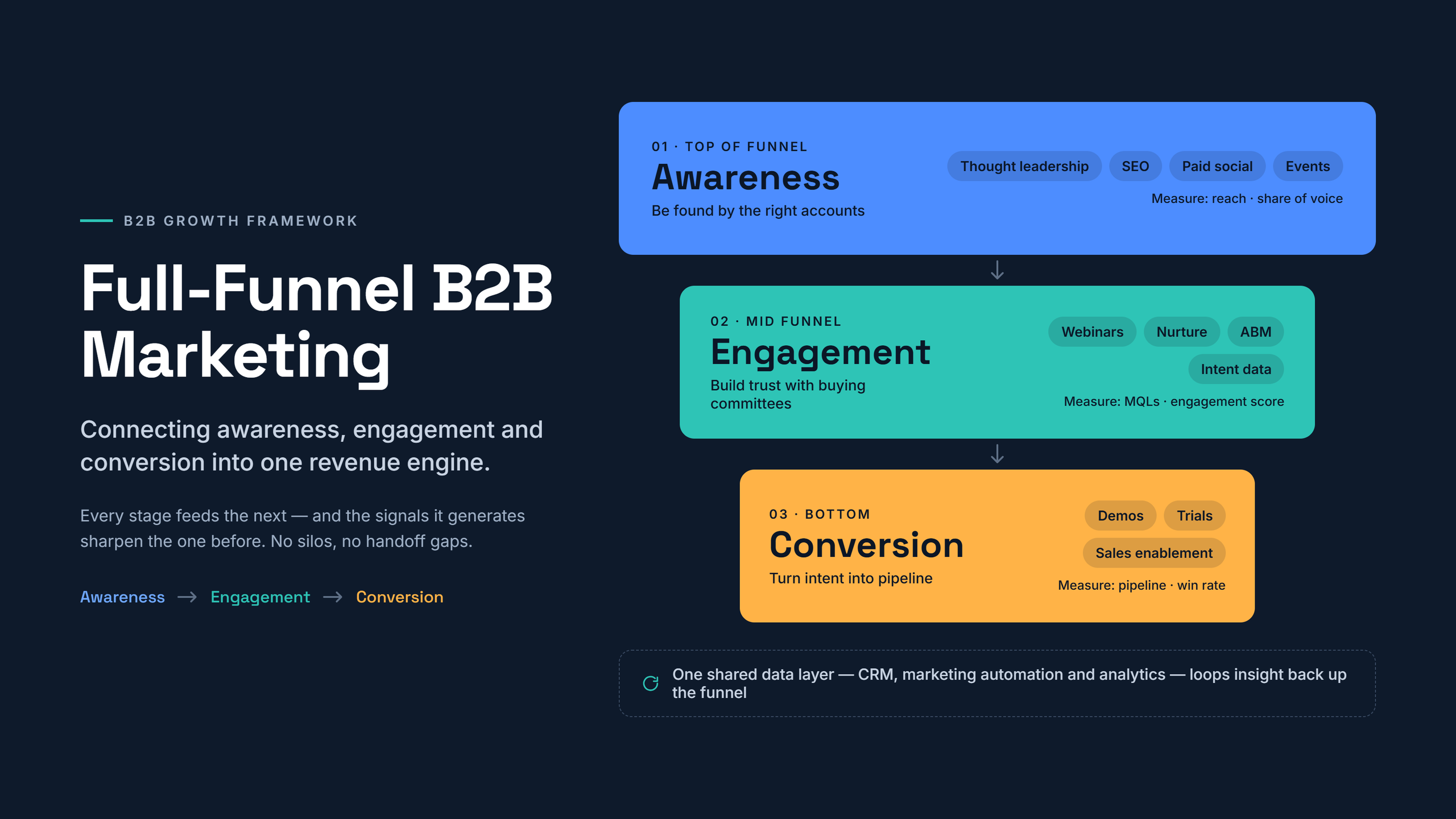
Full-funnel B2B marketing ensures that these interactions work together rather than operate independently. The awareness stage introduces the brand and educates the target audience. The engagement stage develops interest through useful content, personalized communication, and ongoing interactions. The conversion stage helps qualified prospects evaluate the solution, address concerns, and take the next step toward becoming customers.
By understanding and optimizing each stage, businesses can create a more predictable marketing pipeline, reduce friction in the buying process, and improve the overall effectiveness of their B2B digital marketing strategy.
Understanding the Three Core Stages of the B2B Marketing Funnel
An effective full-funnel B2B marketing strategy typically focuses on three interconnected stages: awareness, engagement, and conversion. Each stage serves a distinct purpose, but the greatest value comes from connecting them through consistent messaging, relevant content, and data-driven decision-making.
1. Awareness: Attracting the Right B2B Audience
The awareness stage is the first step in the B2B marketing funnel. At this stage, potential customers are discovering a business, researching industry challenges, or exploring possible solutions to their operational problems. They may not be ready to purchase a product or service, but they are beginning to recognize a need or identify an opportunity for improvement.
The primary objective of B2B brand awareness is to reach the right audience and establish credibility. Businesses should focus on helping potential buyers understand their challenges instead of immediately pushing a product or sales message. Educational content, informative blog posts, industry reports, search-optimized articles, social media updates, and expert insights can help organizations attract relevant prospects.
Search engine optimization is particularly important during the awareness stage because many B2B buyers begin their research online. By targeting relevant informational keywords and publishing useful content, companies can improve their visibility in search engine results and attract users actively researching industry-related questions. For example, an IT services company might publish articles about cloud migration challenges, cybersecurity best practices, infrastructure modernization, or enterprise automation.
Social media marketing, particularly LinkedIn marketing, can further expand brand visibility among business professionals, decision-makers, and industry specialists. Sharing original research, practical insights, company updates, and educational content helps businesses build recognition and establish a consistent presence in their target markets.
To measure awareness performance, organizations can monitor organic website traffic, search impressions, relevant keyword rankings, social media reach, branded search activity, and engagement with educational content. These metrics help determine whether marketing activities are reaching the intended audience and creating opportunities for further interaction.
2. Engagement: Building Trust and Nurturing Potential Customers
Once potential customers become aware of a business, the next objective is to maintain their interest and encourage meaningful engagement. The engagement stage is especially important in B2B marketing because buyers rarely make complex purchasing decisions after a single interaction. They typically need time to compare solutions, assess business requirements, consult colleagues, and evaluate potential suppliers.
During this stage, businesses should provide more detailed and relevant information that helps prospects understand their challenges and evaluate possible solutions. Content such as whitepapers, case studies, webinars, comparison guides, industry research, email newsletters, and product education resources can support this process.
For example, a company offering cloud infrastructure services might initially attract visitors through an SEO-focused article about cloud computing. Once visitors demonstrate interest, the company can offer a downloadable cloud migration checklist, a webinar about infrastructure optimization, or a case study demonstrating how a similar organization improved operational efficiency. These resources provide additional value while helping prospects understand the company’s expertise.
Email marketing and marketing automation can strengthen engagement by delivering relevant content based on a prospect’s interests and previous interactions. Instead of sending the same message to every contact, businesses can segment their audiences by industry, company size, job role, expressed interests, and stage in the buying journey. This makes communication more useful and helps maintain consistent engagement over time.
Account-based marketing can also play an important role when targeting high-value business accounts. Marketing and sales teams can collaborate to deliver personalized messaging, relevant industry insights, and tailored resources to specific organizations and decision-makers.
To evaluate engagement, businesses can track meaningful email interactions, webinar registrations and attendance, repeat website visits, content downloads, return visitor activity, and progression toward qualified sales conversations. These indicators should be interpreted in context rather than treated as automatic evidence of purchase intent.
3. Conversion: Turning Qualified Prospects into Customers
The conversion stage focuses on helping qualified prospects take a meaningful commercial action, such as requesting a consultation, scheduling a product demonstration, submitting a proposal request, or purchasing a service. At this point, potential buyers are generally evaluating specific solutions and determining which provider best meets their business requirements.
A successful B2B conversion strategy should address the questions and concerns that influence purchasing decisions. Prospects may want to understand pricing, implementation timelines, integration requirements, security standards, service quality, expected return on investment, and ongoing support. Businesses that provide clear and relevant answers can reduce uncertainty and make the evaluation process easier.
High-converting landing pages are an important component of this stage. A landing page should communicate the value proposition clearly, explain the benefits of the offering, establish credibility, and provide a straightforward next step. Customer testimonials, relevant case studies, product demonstrations, service descriptions, and clear calls to action can help qualified visitors make informed decisions.
Sales and marketing alignment is equally important. Marketing teams should provide sales representatives with useful information about a prospect’s content interactions, expressed interests, and campaign history where appropriate and permitted. Sales teams can then use these insights to personalize conversations, understand business requirements, and recommend relevant solutions.
Businesses should also reduce unnecessary friction in the conversion process. Complicated forms, unclear pricing information, inconsistent messaging, slow landing pages, and delayed follow-ups can discourage potential buyers from progressing. Simplifying the user experience and responding promptly to qualified inquiries can improve the likelihood of conversion.
Key conversion metrics include marketing-qualified leads (MQLs), sales-qualified leads (SQLs), demo requests, qualified opportunities, lead-to-opportunity conversion rates, opportunity-to-customer conversion rates, customer acquisition cost, and marketing-influenced revenue. Tracking these metrics helps organizations understand whether marketing efforts are contributing to measurable business outcomes.
Why Full-Funnel B2B Marketing Is Important for Business Growth
Full-funnel B2B marketing is important because it connects individual marketing activities to a broader business objective. Instead of measuring success through isolated metrics such as website traffic or the number of leads generated, businesses can evaluate how effectively their marketing programs attract suitable prospects, build relationships, support sales opportunities, and contribute to revenue.
One of the most significant advantages is improved lead quality. Generating a high volume of leads does not necessarily produce strong business results if those leads do not match the company’s target market or have little interest in the offering. By creating relevant content and engagement opportunities for different stages of the buyer journey, organizations can help prospects become better informed before they enter the sales process.
Another benefit is a more consistent customer experience. When advertising, website content, email campaigns, and sales conversations communicate different messages, potential customers may become confused or lose confidence. Full-funnel marketing encourages consistency across channels, ensuring that prospects receive relevant information as their needs evolve.
It can also improve marketing efficiency. Businesses can identify where prospects lose interest, which content contributes to meaningful engagement, and which campaigns generate qualified opportunities. These insights help marketing teams allocate budgets more effectively and prioritize activities that support long-term growth.
Finally, full-funnel B2B marketing encourages stronger collaboration between marketing and sales teams. By agreeing on target audiences, lead qualification criteria, follow-up processes, and performance metrics, both teams can work toward shared revenue objectives rather than focusing exclusively on separate departmental targets.
How to Build an Effective Full-Funnel B2B Marketing Strategy
Developing a successful full-funnel marketing strategy requires more than creating content for each stage. Businesses need a clear understanding of their audience, a connected channel strategy, relevant measurement practices, and a process for continuously improving performance.
Define Your Ideal Customer Profile and Buyer Personas
The first step is to identify the organizations most likely to benefit from your products or services. An ideal customer profile (ICP) describes the characteristics of a suitable business account, such as industry, company size, location, technology requirements, budget range, and business challenges. Buyer personas provide additional context about the individuals involved in the purchasing process, including their responsibilities, priorities, concerns, and decision-making criteria.
In B2B environments, the person researching a solution may not be the final decision-maker. A technology manager might investigate a new platform, while a department head evaluates operational benefits and a procurement team reviews contractual terms. Understanding these different perspectives helps businesses create content that supports the entire buying committee.
Map Content to Every Stage of the Buyer Journey
Content marketing should be planned around the questions prospects ask as they move through the funnel. Awareness-stage content should explain industry problems and introduce useful concepts. Engagement-stage resources should help buyers explore potential approaches, compare alternatives, and understand implementation considerations. Conversion-stage content should provide the specific information required to evaluate a solution and take the next step.
For example, an enterprise cybersecurity provider could publish an educational article about common security risks, followed by a detailed guide to evaluating security solutions and a case study demonstrating how its services helped a customer address similar challenges. This sequence creates a logical connection between educational discovery and commercial evaluation.
Businesses should also consider content formats and accessibility. Some audiences prefer short articles and checklists, while others respond to in-depth reports, webinars, technical documentation, or demonstrations. Offering different formats can help address diverse information needs without compromising the consistency of the overall message.
Integrate SEO With the Full-Funnel Marketing Process
Search engine optimization should support more than website traffic generation. An effective B2B SEO strategy considers the intent behind a search query and connects that intent to the most useful content or next step.
Informational keywords can help attract users researching industry challenges. Commercial investigation keywords can reach prospects comparing providers, services, and solutions. Transactional or high-intent keywords can help businesses connect with prospects who are ready to request a consultation or evaluate a specific offering.
Keyword research should therefore be combined with search intent analysis, topic clustering, internal linking, high-quality content creation, and relevant calls to action. For example, an article about IT infrastructure management can link to a more detailed guide, a relevant case study, or a service page where appropriate. These connections help users explore related information and allow search engines to better understand the relationship between pages.
Content should be written for people first, with accurate information, clear headings, natural keyword usage, and practical insights. Businesses should avoid keyword stuffing and repetitive content created solely to manipulate rankings. Consistently demonstrating relevant expertise and answering genuine audience questions provides a stronger foundation for sustainable organic visibility.
Use Marketing Automation to Nurture Leads
Marketing automation helps businesses manage repetitive marketing activities and deliver timely communications at scale. When integrated with a customer relationship management (CRM) system, automation can support lead segmentation, email nurturing, campaign tracking, lead assignment, and follow-up workflows.
For example, a prospect who downloads a technical guide may receive a follow-up email containing a related resource. If the prospect subsequently attends a webinar or requests a consultation, the communication strategy can adapt to reflect that new interaction. The objective is to provide useful information rather than overwhelm prospects with unnecessary messages.
Automation workflows should be designed around audience needs, consent requirements, and meaningful engagement signals. Businesses should also regularly review their workflows to ensure that messages remain accurate, relevant, and aligned with the current buying journey.
Align Sales and Marketing Teams
Sales and marketing alignment is essential for moving prospects through the funnel efficiently. Both teams should agree on the definition of a qualified lead, the information required for handoff, response expectations, and the criteria used to evaluate opportunities.
Marketing teams can share campaign insights, content engagement information, and lead qualification details with sales representatives. Sales teams can provide feedback about common objections, buyer questions, competitive challenges, and the reasons opportunities progress or fail to close. These insights can then inform content planning, lead nurturing, targeting, and campaign optimization.
Regular meetings and shared dashboards can help teams identify gaps in the buyer journey and resolve issues before they affect pipeline performance. This collaborative approach makes it easier to connect marketing activities with actual sales outcomes.
Measure Performance and Optimize Continuously
A full-funnel marketing strategy should be supported by measurement at every stage. Awareness metrics indicate whether the business is reaching its intended audience. Engagement metrics help reveal whether prospects find the content useful and continue interacting with the brand. Conversion and revenue metrics show whether marketing activities are helping generate qualified opportunities and business results.
Businesses should establish a consistent reporting framework that combines channel performance with pipeline progression. For example, a campaign may generate substantial website traffic but few qualified opportunities. Further analysis might reveal that the content attracts the wrong audience, the landing page lacks a relevant next step, or the offer does not match the needs of potential customers.
Testing can help identify practical improvements. Businesses can experiment with landing page messaging, calls to action, email subject lines, audience segmentation, content formats, and campaign targeting. Changes should be evaluated using suitable metrics and enough data to support meaningful conclusions.
Continuous optimization ensures that the marketing funnel evolves as buyer expectations, competitive conditions, and business priorities change.
The Role of Data and Analytics in Full-Funnel B2B Marketing
Data and analytics help businesses understand how potential customers interact with marketing campaigns and progress toward purchasing decisions. When information from website analytics, CRM platforms, email marketing systems, advertising platforms, and sales activities is connected appropriately, organizations can develop a more complete picture of campaign performance.
For example, a company may discover that organic search attracts a large number of relevant visitors, webinars generate strong engagement among target accounts, and product demonstrations contribute to qualified sales opportunities. These insights can guide budget allocation and help marketing teams prioritize the activities that support business objectives.
Attribution requires careful interpretation. B2B buying journeys often involve multiple people, channels, and interactions over an extended period. A prospect may discover a brand through an article, attend a webinar, interact with a sales representative, and later respond to a targeted campaign. Assigning the entire outcome to a single touchpoint may overlook the contribution of other activities.
Businesses can use a combination of first-touch, last-touch, multi-touch, and account-level analysis, depending on their data quality and reporting needs. These methods provide different perspectives rather than a single universally correct explanation of marketing influence.
Data governance is also important. Organizations should maintain accurate records, apply appropriate access controls, respect consent and privacy requirements, and document how marketing performance is measured. Reliable data supports better decisions and reduces the risk of drawing misleading conclusions from incomplete information.
Common Full-Funnel B2B Marketing Challenges and How to Overcome Them
Although full-funnel marketing offers significant benefits, businesses may encounter challenges when implementing it. One common issue is disconnected marketing channels. When SEO, paid advertising, email marketing, social media, and sales outreach operate without a shared strategy, prospects may receive inconsistent messages or experience gaps in communication. A documented customer journey and coordinated campaign planning can help address this problem.
Another challenge is focusing too heavily on lead volume rather than lead quality. Large numbers of form submissions may appear successful, but they do not necessarily translate into sales opportunities. Businesses should evaluate lead relevance, qualification rates, opportunity creation, and eventual revenue to understand the true value of their campaigns.
Long B2B sales cycles can also make performance difficult to assess. Some prospects may interact with a company for months before becoming customers. Organizations should therefore monitor both short-term engagement indicators and longer-term pipeline outcomes, using suitable timeframes for their sales process.
Limited collaboration between sales and marketing can create further obstacles. If teams use different qualification standards or do not share feedback, promising leads may be neglected and campaign investments may be misdirected. Shared definitions, consistent reporting, and regular communication can improve coordination.
Finally, businesses may struggle with incomplete or inconsistent data. Duplicate records, missing campaign information, inaccurate lead statuses, and disconnected platforms can undermine reporting. Establishing data quality standards and regularly reviewing CRM and marketing automation processes helps create a more reliable foundation for optimization.
Emerging Trends Shaping Full-Funnel B2B Marketing
The B2B marketing landscape continues to evolve as buyers change how they discover, evaluate, and purchase business solutions. Organizations should monitor emerging trends and assess how these developments affect their specific audiences and business goals.
Artificial intelligence is becoming increasingly relevant to marketing research, content development, audience analysis, campaign optimization, and workflow automation. AI tools can help teams identify patterns, accelerate repetitive tasks, and adapt communications to audience needs. However, human oversight remains essential for accuracy, originality, brand consistency, and strategic judgment.
AI-powered search and answer engines are also changing how buyers discover information. Businesses should create clear, trustworthy, well-structured content that directly addresses customer questions and demonstrates relevant expertise. Traditional SEO fundamentals remain important, while organizations can also evaluate how their brands appear across emerging search experiences.
Account-based marketing continues to offer a focused approach for businesses targeting high-value accounts. By combining account research, relevant content, sales collaboration, and coordinated outreach, companies can create more tailored experiences for important prospects.
First-party data and responsible personalization are additional priorities. As privacy expectations and data governance requirements evolve, businesses need transparent data practices and relevant communication strategies. Using information responsibly can help build trust while supporting more effective audience segmentation.
Finally, revenue-focused measurement is gaining importance. Rather than evaluating campaigns solely by impressions, clicks, or leads, businesses should examine their contribution to qualified pipeline, opportunity progression, customer acquisition, and long-term customer value. The most appropriate approach will depend on the organization’s sales model, available data, and commercial objectives.
Conclusion
Full-funnel B2B marketing provides a structured approach to connecting awareness, engagement, and conversion within a unified customer journey. By understanding how potential buyers discover a business, evaluate its expertise, compare solutions, and make purchasing decisions, organizations can create more relevant marketing experiences and improve the effectiveness of their digital campaigns.
A successful strategy combines search engine optimization, content marketing, email nurturing, marketing automation, account-based marketing, sales alignment, and performance analytics. Each activity should support a clear objective while contributing to the broader goal of moving suitable prospects toward a qualified sales opportunity and, ultimately, a lasting customer relationship.
Businesses should begin by defining their ideal customer profile, mapping content to buyer needs, establishing shared sales and marketing processes, and selecting meaningful performance indicators. They can then use reliable data and continuous testing to identify gaps, refine campaigns, and improve results over time.
Ultimately, full-funnel B2B marketing is not simply about generating more leads; it is about creating a connected, measurable, and customer-focused process that turns awareness into engagement, engagement into conversion, and successful conversions into long-term business growth. Organizations that consistently align their marketing efforts with buyer needs and commercial objectives can build stronger relationships, improve pipeline visibility, and establish a more sustainable foundation for growth in an increasingly competitive B2B marketplace.
