


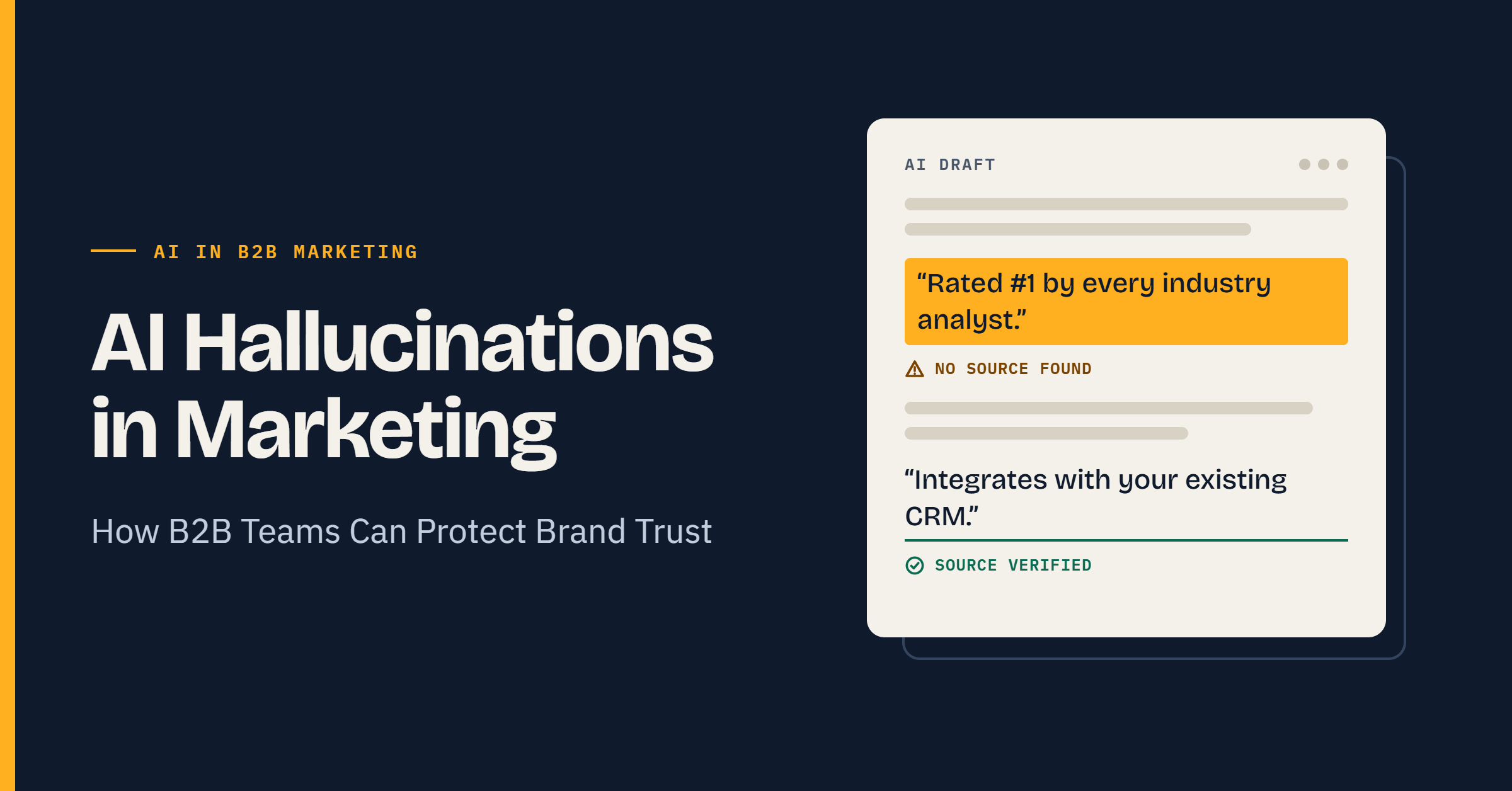

Artificial intelligence has become an important part of modern B2B marketing. Businesses are using generative AI to create blog posts, email campaigns, social media content, product descriptions, market research, sales enablement materials, customer communications, and advertising copy. AI helps marketing teams work faster, scale content production, personalize communication, and automate repetitive tasks. However, as businesses increasingly depend on AI-generated content, they also need to understand one of its biggest challenges: AI hallucinations in marketing.
AI hallucinations occur when an artificial intelligence system generates information that sounds accurate and convincing but is actually incorrect, misleading, outdated, or completely fabricated. In B2B marketing, this issue can become particularly serious because businesses depend heavily on credibility, expertise, data, and trust. An inaccurate statistic, fabricated research reference, incorrect product specification, or misleading customer claim can negatively affect a company’s reputation.
The challenge is not that businesses should stop using AI. Instead, organizations need to develop responsible processes for using AI while maintaining human oversight. By combining AI productivity with expert review, reliable sources, fact-checking, and content governance, B2B marketing teams can reduce the risks associated with AI hallucinations in marketing while still taking advantage of artificial intelligence.
What Are AI Hallucinations in Marketing?
AI hallucinations in marketing happen when generative AI creates information that appears factual but is not supported by reliable evidence. The information may be completely fabricated, partially incorrect, outdated, or presented without the context necessary to understand it correctly.
One of the biggest challenges is that AI-generated information can sound extremely confident. The language may be professional, the sentence structure may be accurate, and the response may contain statistics or references that appear legitimate. This can make it difficult for marketers to immediately recognize that the information is inaccurate.
For example, a B2B marketer may ask an AI tool to create an article about cloud computing trends. The tool might provide market statistics, adoption percentages, technology forecasts, company rankings, and research findings. While some of this information may be accurate, other claims could be unsupported or incorrectly presented.
This is why AI-generated content should not automatically be treated as verified information. AI is a powerful content creation assistant, but it should not replace research, professional judgment, or fact-checking.
Why AI Hallucinations Are a Serious B2B Marketing Risk
The impact of AI hallucinations in marketing can be particularly significant for B2B organizations. B2B purchasing decisions often involve multiple stakeholders, lengthy evaluation processes, technical assessments, procurement teams, financial approvals, and executive decision-makers.
Throughout this process, potential customers consume a wide range of marketing content. They may read blog articles, download whitepapers, review case studies, watch webinars, compare vendors, read research reports, and interact with sales teams before making a purchasing decision.
If this content contains inaccurate information, prospects may question the company’s expertise. A single incorrect statement may not destroy a relationship, but repeated inaccuracies can gradually weaken brand credibility.
For technology companies, SaaS providers, cybersecurity businesses, cloud service providers, financial technology companies, and enterprise software vendors, accuracy is especially important. Customers often depend on vendor information when making business-critical technology decisions.
How AI Hallucinations Can Damage B2B Brand Trust
Brand trust is one of the most valuable assets a B2B organization can build. Companies spend years establishing themselves as reliable sources of industry information. AI hallucinations in marketing can put that credibility at risk when inaccurate information is published without proper review.
Incorrect Statistics Can Reduce Credibility
Statistics are commonly used in B2B content to support arguments and demonstrate market trends. However, AI-generated statistics can sometimes be inaccurate or unsupported.
For example, an AI tool may state that a specific percentage of businesses have adopted a technology or that a particular market will reach a certain valuation. If the marketing team publishes that statistic without verifying the original research, the company may unintentionally publish false information.
Every important statistic should therefore be traced to a reliable source before it appears in a blog post, report, whitepaper, presentation, or social media campaign.
Fabricated Research and Sources
Another major concern associated with AI hallucinations in marketing is fabricated research. AI systems may sometimes generate references that appear legitimate but cannot be verified.
A marketing article may mention a research report, organization, author, publication date, or study that does not actually exist. This is particularly dangerous for thought leadership content because readers expect research-based articles to contain credible evidence.
Marketing teams should independently verify every important source rather than assuming that an AI-generated citation is authentic.
Incorrect Product Information
AI can also generate inaccurate product descriptions. It may claim that a software platform has a feature that it does not offer, describe an integration incorrectly, or confuse different versions of a product.
This can create serious problems for B2B businesses. Prospective customers may develop incorrect expectations before speaking with sales representatives. Sales teams may then have to correct information that was previously published by marketing.
Product-related content should therefore be reviewed by product marketers, product managers, technical experts, or other employees who understand the actual capabilities of the solution.
Misleading Customer Stories
Customer stories and case studies are among the most effective forms of B2B marketing. They provide real-world evidence and help prospects understand how a product or service delivers value.
However, AI should never be allowed to invent customer results, testimonials, quotes, implementation details, business outcomes, or challenges.
A fabricated customer story can damage trust and may also create legal and compliance concerns. Customer case studies should always be based on verified information and approved through the appropriate internal and customer-facing processes.
Why B2B Marketers Should Not Rely on AI Alone
Generative AI can be extremely useful for brainstorming, outlining, drafting, summarizing, editing, and repurposing content. However, AI-generated content should not automatically be considered final content.
One of the biggest mistakes organizations make is treating AI as an autonomous publishing system.
A better approach is to treat AI as a marketing assistant. AI can help marketers complete repetitive tasks faster, but human professionals should remain responsible for accuracy, context, strategy, brand voice, and final approval.
The most effective B2B marketing strategy combines AI efficiency with human expertise.
How B2B Marketing Teams Can Prevent AI Hallucinations
Preventing AI hallucinations in marketing requires a structured content workflow. Instead of publishing AI-generated content immediately, organizations should introduce several quality-control stages.
Establish a Human-in-the-Loop Content Process
Human review is one of the most effective ways to reduce AI content errors. AI can create an initial draft, suggest ideas, summarize information, or generate alternative versions of content. A human editor or subject matter expert can then review the material before publication.
The level of human review should depend on the potential risk associated with the content.
For example, a short social media post may require a basic editorial review, while a cybersecurity whitepaper or technical product guide may require detailed review by multiple subject matter experts.
Verify Every Important Claim
Marketing teams should verify important claims before publishing AI-assisted content. This includes statistics, market forecasts, product specifications, customer results, technical statements, regulatory information, and industry research.
The more significant the claim, the stronger the supporting source should be.
Marketers should avoid relying solely on AI-generated references. Instead, they should trace important claims back to original sources such as government organizations, recognized research firms, official company documentation, industry associations, or peer-reviewed research.
Create an Approved Source Library
Organizations can reduce the risk of AI hallucinations in marketing by maintaining a centralized library of trusted information.
This library can include official product documentation, approved brand messaging, customer research, industry reports, technical documentation, case studies, survey results, company statistics, and previously verified content.
Providing AI tools with reliable source material can help marketing teams create content that is more closely aligned with verified organizational information.
Develop AI Content Guidelines
Every B2B organization using generative AI should consider developing an internal AI content policy.
The policy can explain how employees should use AI tools, which information can be entered into AI systems, what types of content require expert review, how sources should be verified, and who is responsible for approving AI-assisted content.
Clear guidelines help marketing teams use AI consistently and responsibly.
Build a B2B AI Content Governance Framework
AI content governance is becoming an important part of modern marketing operations. Organizations should establish processes that define how AI-generated content is created, reviewed, approved, and monitored.
A simple governance process can include four stages: generate, verify, review, and publish.
During the generation stage, AI can help create an initial draft or content outline. During verification, marketers check statistics, sources, claims, and factual information. During the review stage, editors and subject matter experts evaluate accuracy, brand voice, relevance, and quality. Only after these steps should the content be published.
This framework can significantly reduce the likelihood of inaccurate AI-generated information reaching customers.
Use AI for Productivity, Not Unverified Authority
The most successful B2B marketers will not necessarily be the teams that use the most AI. They will be the teams that understand where AI can create value and where human expertise is essential.
AI can be highly effective for brainstorming campaign ideas, developing content outlines, summarizing internal documents, generating headline variations, repurposing long-form content, creating social media drafts, and supporting marketing research.
However, marketers should be more cautious when AI is used to create legal statements, financial information, technical specifications, cybersecurity recommendations, customer claims, regulatory content, or industry research.
The greater the potential impact of an error, the stronger the human review should be.
AI Hallucinations in Marketing and SEO
SEO is another important area affected by AI hallucinations in marketing. Businesses are increasingly using AI to produce large volumes of content, but publishing more articles does not automatically produce better search visibility.
Search engines aim to provide users with useful and reliable information. If a website consistently publishes inaccurate, low-quality, repetitive, or unsupported content, it can weaken the overall quality of the site’s content strategy.
B2B SEO should therefore focus on accuracy, expertise, originality, and usefulness.
Instead of producing dozens of generic AI-generated articles, companies should focus on creating authoritative content that answers real customer questions and demonstrates genuine industry expertise.
This is particularly important as search behavior continues to evolve toward AI-powered search experiences. B2B companies need content that is accurate enough to become a trusted source for both human readers and emerging AI-driven discovery systems.
How Fact-Checking Can Become a Competitive Advantage
Fact-checking is often considered an editorial task, but it can become a competitive advantage for B2B brands.
As more businesses use generative AI, the volume of generic AI-assisted content will continue to increase. This creates an opportunity for organizations that invest in original research, expert opinions, verified statistics, transparent sourcing, and practical insights.
Instead of asking only how quickly an article can be published, B2B marketing teams should ask whether the content provides information that customers can trust.
A commitment to accuracy can help a company differentiate itself in a crowded digital marketplace.
The Role of Subject Matter Experts in AI Marketing
AI can process large amounts of information and generate content quickly, but subject matter experts provide something different: experience, judgment, and context.
For example, an AI tool may produce a technically correct overview of cloud security. A cybersecurity expert can identify important limitations, explain real-world challenges, add industry-specific examples, and identify statements that require clarification.
This combination creates stronger content.
Marketing teams should therefore build relationships with internal subject matter experts and include them in the content review process, particularly for technical or highly specialized topics.
The Importance of First-Party Data
First-party data can provide a valuable foundation for AI-assisted B2B marketing. Company-owned research, customer surveys, product data, campaign insights, customer feedback, and internal documentation can help marketers create more relevant and accurate content.
However, first-party data should still be reviewed for accuracy and freshness.
Organizations should identify which internal documents are considered authoritative and ensure that outdated information is removed or updated.
Using verified internal information can help reduce the risk of unsupported claims and improve the relevance of AI-generated content.
Training Marketing Teams to Use AI Responsibly
Technology alone cannot eliminate AI hallucinations in marketing. Marketing professionals need to understand how AI systems work and where they can fail.
Organizations should provide training on AI limitations, prompt development, fact-checking, source verification, data privacy, intellectual property, content governance, and responsible AI usage.
Employees should understand an important principle: confident AI output does not necessarily mean accurate AI output.
AI-generated content can sound highly professional while containing factual errors. Training employees to question, verify, and validate AI output is therefore essential.
Create an AI Content Quality Checklist
Before publishing AI-assisted B2B content, marketing teams should review the content against a structured checklist.
The checklist should cover factual accuracy, statistics, sources, product information, customer claims, technical terminology, outdated information, brand consistency, readability, SEO quality, and originality.
Teams should also ask whether the content provides genuine value to the audience.
The goal should not be simply to publish more content. The goal should be to create content that helps potential customers make better business decisions.
How B2B Leaders Can Manage AI Marketing Risks
Marketing leaders should treat AI hallucinations in marketing as a business and brand governance issue rather than simply an editorial problem.
Organizations should establish clear AI usage policies, identify high-risk content categories, create approval workflows, train marketing employees, maintain trusted information sources, and regularly review AI-assisted content.
Leaders should also encourage employees to report AI errors instead of hiding them. When organizations openly identify mistakes, they can improve their processes and reduce the likelihood of similar errors occurring again.
The objective is not to eliminate every possible AI error. The objective is to create a marketing system that catches important errors before they reach customers.
AI Hallucinations and the Future of B2B Content Marketing
Generative AI will continue to transform B2B content marketing. Businesses will use AI to personalize campaigns, automate marketing workflows, analyze customer behavior, support sales teams, generate content, and improve customer experiences.
As AI becomes more common, trust will become an increasingly important competitive advantage.
Companies that simply produce large volumes of AI-generated content may struggle to differentiate themselves. Organizations that combine AI with original research, human expertise, verified data, and strong editorial standards will have a greater opportunity to establish long-term authority.
The future of B2B content marketing is therefore unlikely to be about humans versus AI. It will be about humans working with AI in a controlled and responsible way.
Best Practices for Preventing AI Hallucinations in Marketing
B2B organizations can follow several practical best practices to reduce the risk of inaccurate AI-generated content. First, AI-generated information should be treated as a draft rather than an established fact. Second, important claims should always be verified using reliable sources. Third, technical content should be reviewed by subject matter experts.
Organizations should also maintain approved content sources, establish clear AI usage policies, train marketing teams, and create a formal approval process for high-risk content.
Most importantly, companies should avoid measuring AI marketing success only by content volume. Quality, accuracy, engagement, customer trust, organic visibility, and business outcomes should also be considered.
Conclusion
AI hallucinations in marketing are becoming an important consideration for B2B organizations that use generative AI to create and distribute content. Incorrect statistics, fabricated sources, inaccurate product information, misleading customer stories, and unsupported industry claims can damage credibility and weaken the trust that companies have spent years building.
However, AI hallucinations do not mean that B2B companies should avoid artificial intelligence. Instead, organizations should create responsible AI marketing processes that combine automation with human expertise.
By implementing fact-checking procedures, maintaining trusted sources, involving subject matter experts, developing AI content governance, training employees, and reviewing AI-generated content before publication, businesses can significantly reduce the risks associated with AI-generated content.
The future of B2B marketing will not be about choosing between humans and AI. It will be about using AI to improve productivity while allowing humans to provide judgment, expertise, creativity, context, and accountability.
Ultimately, AI hallucinations in marketing are a reminder that speed should never come at the expense of accuracy. AI can help B2B companies create content faster, but trust, expertise, and reliable information are what build lasting brand authority.
