



AI in B2B Sales is transforming how businesses identify prospects, personalize customer interactions, analyze sales data, and manage their sales pipelines. As artificial intelligence becomes an increasingly important part of modern B2B sales strategies, businesses are also asking an important question: what role will human salespeople play in an AI-driven sales environment?
While AI can automate repetitive tasks, analyze large amounts of data, and provide valuable sales insights, human salespeople remain essential for building trust, understanding complex customer needs, managing negotiations, and providing strategic guidance. Rather than replacing human sales professionals, AI is changing how they work and allowing them to focus more on meaningful customer interactions.
The future of B2B sales will increasingly depend on the collaboration between human expertise and AI-powered technology. Sales organizations that effectively combine these capabilities can improve productivity while maintaining the relationships and human connection that are essential to successful B2B selling.
Artificial intelligence is rapidly transforming the B2B sales landscape. From automated prospecting and lead qualification to predictive analytics and personalized outreach, AI is helping sales teams work faster and make more data-driven decisions. However, the growing adoption of AI does not mean that human salespeople are becoming irrelevant. Instead, the role of the salesperson is evolving from being primarily an information provider to becoming a strategic advisor, relationship builder, and trusted partner throughout the buying journey.
As B2B buyers increasingly use digital channels, AI-powered search, and self-service tools to research products and vendors, sales professionals need to bring value that technology alone cannot easily replicate. The future of B2B sales is therefore less about humans competing with AI and more about humans and AI working together.
How AI in B2B Sales Is Changing the Sales Landscape
B2B buyers today have access to more information than ever before, and AI in B2B Sales is playing an increasingly important role in how businesses research vendors, evaluate solutions, and make purchasing decisions. They can research vendors, compare solutions, read customer reviews, analyze product specifications, and explore pricing information before speaking with a salesperson. AI is accelerating this behavior by making it easier for buyers to find, summarize, and evaluate large amounts of information.
This shift is changing the traditional sales process. Salespeople can no longer depend solely on product knowledge or basic information sharing to differentiate themselves. Instead, buyers increasingly expect sales representatives to understand their specific business challenges and provide meaningful guidance. Sales professionals who can connect a company’s solution to the buyer’s broader business objectives can create value beyond what automated tools provide.
AI Is Becoming a Sales Assistant, Not Just an Automation Tool
AI in B2B Sales can perform many repetitive sales activities that previously consumed significant amounts of a salesperson’s time. It can research accounts, identify potential prospects, summarize customer interactions, draft emails, analyze sales conversations, and prioritize opportunities based on available data.
These capabilities allow salespeople to spend less time on administrative work and more time engaging with customers. Rather than replacing the salesperson, AI can function as an intelligent sales assistant that helps representatives prepare for conversations and make better-informed decisions.
For example, an AI system can analyze a prospect’s company information, recent business developments, industry trends, previous interactions, and engagement behavior. A salesperson can then use those insights to prepare a more relevant conversation instead of spending hours manually collecting information.
Human Connection Remains Important in Complex B2B Sales
B2B purchases are often complex and involve multiple stakeholders, significant investments, long sales cycles, and considerable business risk. In these situations, buyers may need more than automated recommendations or product information. They may need someone who understands their concerns, asks the right questions, challenges assumptions, and helps them evaluate different options.
Human salespeople play an important role in these situations because they can understand context and respond dynamically. A customer may initially describe one problem, but a skilled salesperson can ask follow-up questions and uncover a deeper operational, financial, or strategic challenge.
This consultative aspect of selling is difficult to reduce to a simple automated interaction. Human conversations can help build confidence and establish the trust that is often necessary before organizations make significant purchasing decisions.
Trust and Relationship Building
Trust has always been an important component of B2B sales, and it remains relevant in an increasingly digital environment. Organizations are not simply purchasing products; they are often entering long-term relationships with vendors, technology providers, consultants, or service partners.
Salespeople can contribute to this relationship by understanding customer priorities, communicating transparently, managing expectations, and remaining engaged throughout the buying process. A trusted salesperson can also become an important point of contact when customers encounter challenges after the initial purchase.
AI can help salespeople understand customers better, but the relationship itself still depends heavily on communication, credibility, empathy, and consistency.
The Rise of Consultative Selling
As buyers become more capable of conducting independent research, salespeople need to move toward consultative selling. This means focusing less on presenting a standard product pitch and more on understanding the customer’s business environment.
A consultative salesperson asks questions such as what business problem the organization is trying to solve, why the problem matters, what limitations exist with the current approach, and what outcomes the organization expects from a new solution.
AI can support this process by providing customer insights and identifying relevant patterns. The salesperson can then use those insights to guide a conversation that is specific to the customer’s situation.
AI Can Improve Sales Personalization
AI in B2B Sales is making personalization more scalable for modern sales teams. Personalization has become an important part of modern B2B sales, but creating meaningful personalization at scale can be difficult for human teams alone. Salespeople may manage hundreds of accounts and thousands of customer interactions, making it challenging to research every prospect manually.
AI can help by analyzing customer data and generating relevant recommendations. It can identify industries, roles, business events, previous interactions, and engagement patterns that may influence a prospect’s needs.
However, AI-generated personalization should not become generic automation disguised as a personal message. Human salespeople still need to review and refine AI-generated content to ensure that it is relevant, accurate, and appropriate for the individual customer.
Human Judgment Becomes More Valuable
As AI takes over more routine analytical and administrative tasks, human judgment can become even more important. Sales professionals need to determine which opportunities deserve attention, how to approach different stakeholders, when to challenge a customer’s assumptions, and how to respond when circumstances change.
AI can provide recommendations based on historical data and predefined patterns, but business decisions often involve factors that are difficult to quantify. Organizational politics, changing priorities, leadership concerns, market uncertainty, and interpersonal dynamics can all influence a B2B purchasing decision.
Experienced salespeople can bring context and judgment to these situations. They can combine AI-generated insights with real-world experience to make more informed decisions.
Handling Complex Negotiations
Negotiation is another area where human involvement remains important. B2B negotiations can involve pricing, contract terms, implementation timelines, service-level agreements, security requirements, procurement policies, and stakeholder expectations.
AI can analyze previous negotiations, identify patterns, and provide data-driven recommendations. However, the actual conversation may require flexibility, empathy, persuasion, and an understanding of the customer’s priorities.
A salesperson may need to recognize when a customer is concerned about risk rather than price, for example. Understanding that distinction can influence the entire negotiation strategy. Human communication and relationship management remain valuable when multiple interests need to be balanced.
Salespeople as Strategic Advisors
The modern salesperson is increasingly expected to act as a strategic advisor rather than simply a vendor representative. Customers want sales professionals who understand their industry and can explain how a solution may affect their operations, revenue, customer experience, productivity, or long-term strategy.
This requires salespeople to develop deeper business knowledge. Product knowledge alone is no longer sufficient. Sales professionals need to understand market conditions, customer challenges, competitive dynamics, and the business outcomes associated with the solutions they sell.
AI can provide information quickly, but salespeople are responsible for turning that information into a useful business conversation.
The Importance of Emotional Intelligence
Emotional intelligence is another area where human salespeople can add significant value. B2B buying decisions are influenced by both rational and human factors. Buyers may have concerns about implementation, career risk, internal resistance, budget pressure, or organizational change.
A salesperson who can recognize these concerns and respond appropriately can improve the quality of the customer relationship. Listening carefully, demonstrating empathy, communicating clearly, and understanding different stakeholder perspectives can be particularly important during complex purchasing processes.
AI can analyze language and identify certain signals, but human emotional understanding remains an important part of relationship-driven selling.
The New Salesperson-AI Partnership
The most effective organizations using AI in B2B Sales are likely to treat AI as a productivity and intelligence layer rather than simply a replacement for human workers. AI can handle data-intensive and repetitive activities while salespeople focus on higher-value interactions.
For example, AI can help identify accounts, research prospects, summarize meetings, recommend next steps, and draft communications. The salesperson can then validate the information, personalize the approach, conduct the customer conversation, and build the relationship.
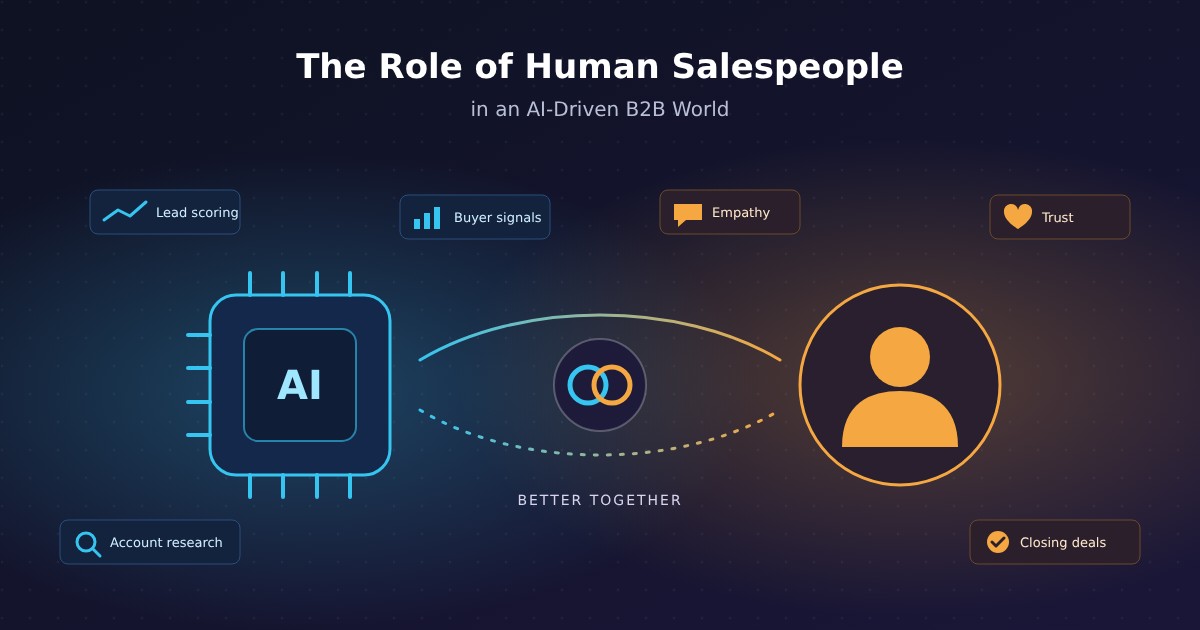
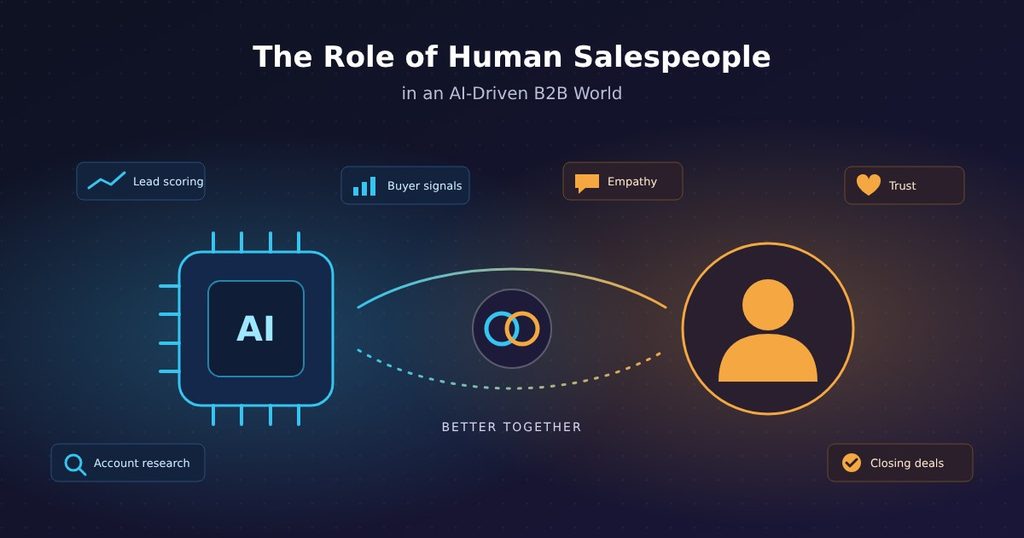
This creates a division of responsibilities in which machines handle scale and information processing while humans provide judgment, communication, creativity, and relationship management.
Skills Salespeople Need in an AI-Driven Future
As AI in B2B Sales becomes increasingly common, sales professionals need to develop a combination of technological knowledge and strong human skills. The evolution of AI means that sales professionals need to develop a broader set of skills. Digital literacy and the ability to work effectively with AI tools will become increasingly important. Salespeople need to understand how AI-generated insights are produced, how to validate them, and where human judgment is still required.
At the same time, traditional human skills remain essential. Communication, negotiation, active listening, strategic thinking, problem-solving, relationship building, and emotional intelligence can become even more valuable as routine sales activities become increasingly automated.
The successful salesperson of the future is therefore likely to be both technologically capable and highly relationship-oriented.
Measuring Sales Success Differently
AI may also change how organizations measure sales performance. Traditional metrics such as the number of calls made, emails sent, or meetings scheduled may become less meaningful when AI can automate many of these activities.
Organizations may increasingly focus on metrics related to pipeline quality, customer engagement, conversion efficiency, deal progression, customer retention, and revenue impact.
This shift can encourage salespeople to focus on meaningful customer outcomes rather than simply maximizing activity levels. AI can provide the data required to measure these outcomes, while sales leaders can use that information to improve sales strategies and coaching.
The Future of Human Salespeople
The future of AI in B2B Sales is unlikely to be a simple choice between human salespeople and artificial intelligence. Instead, the sales function is likely to become a combination of automation, intelligence, and human expertise.
AI will continue to improve the speed and scale of sales operations. It will help sales teams identify opportunities, process information, automate repetitive tasks, and deliver more personalized experiences. Human salespeople will continue to contribute where context, trust, judgment, creativity, negotiation, and relationship management are important.
This means the salesperson’s role may become smaller in terms of routine tasks but more significant in terms of strategic customer engagement.
Conclusion
AI in B2B Sales is changing how B2B sales teams find prospects, manage pipelines, analyze customer data, personalize communication, and forecast revenue. But technology does not eliminate the need for human interaction. Instead, it creates an opportunity for salespeople to focus on the activities where human expertise provides the greatest value.
The future of B2B sales will be defined by collaboration between humans and AI. AI can provide speed, data, automation, and intelligence, while human salespeople bring trust, empathy, strategic thinking, judgment, and relationship-building skills. Organizations that successfully combine these capabilities can create a sales model that is both technology-enabled and human-centered.
The key question for B2B organizations is therefore not whether AI will replace salespeople, but how salespeople can use AI to become more informed, more productive, and more valuable to their customers.
