



B2B signal intelligence is becoming one of the most important capabilities for modern B2B growth teams. Companies have spent years trying to solve one fundamental problem: how to find more potential customers. They invested in databases, lead-generation platforms, advertising, events, outbound campaigns, content marketing, account-based marketing, intent data, and increasingly sophisticated automation.
The goal was straightforward: find companies that might need what you sell, identify the right people, and create enough opportunities for sales to pursue.
But technology has changed the equation.
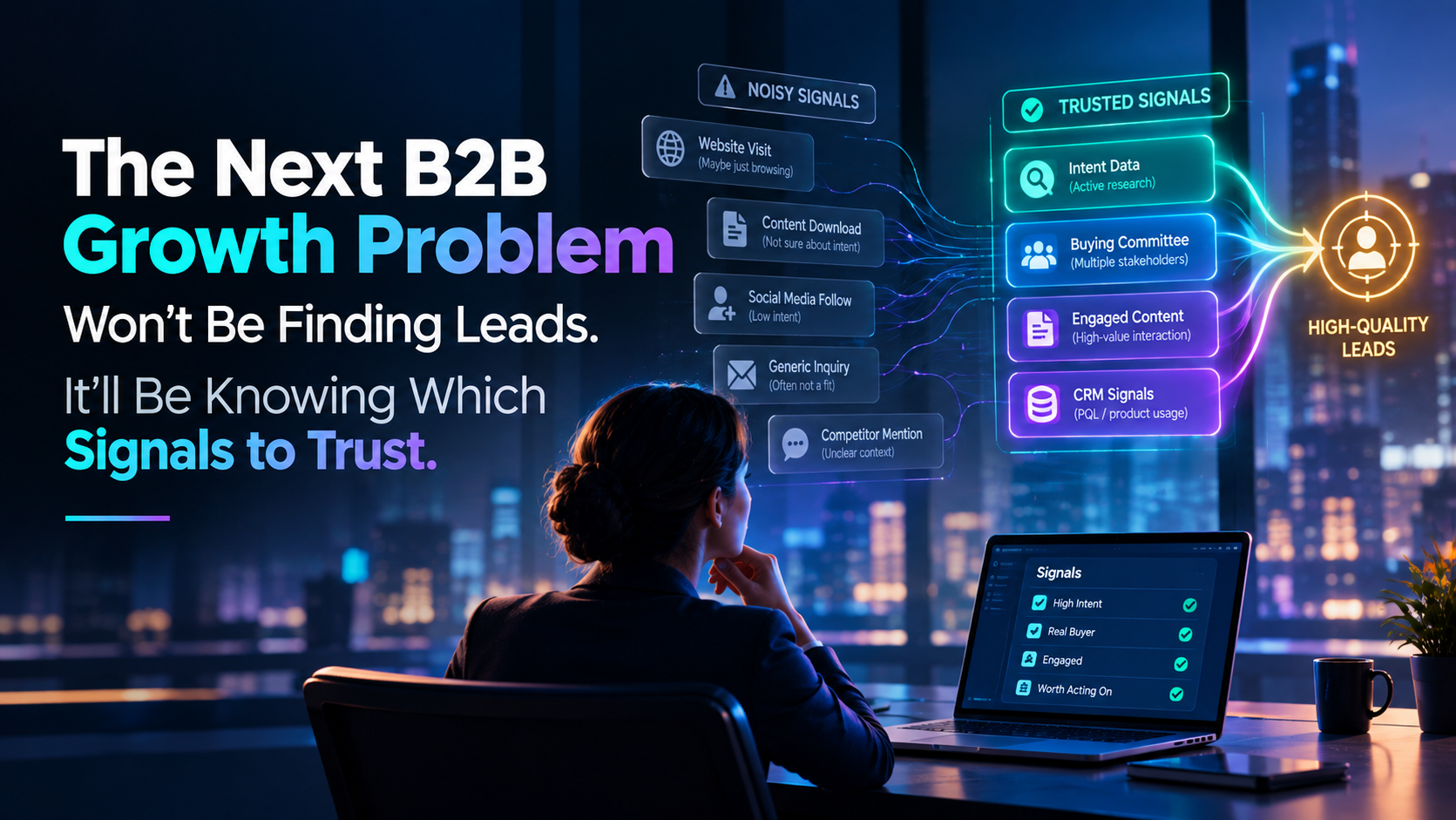
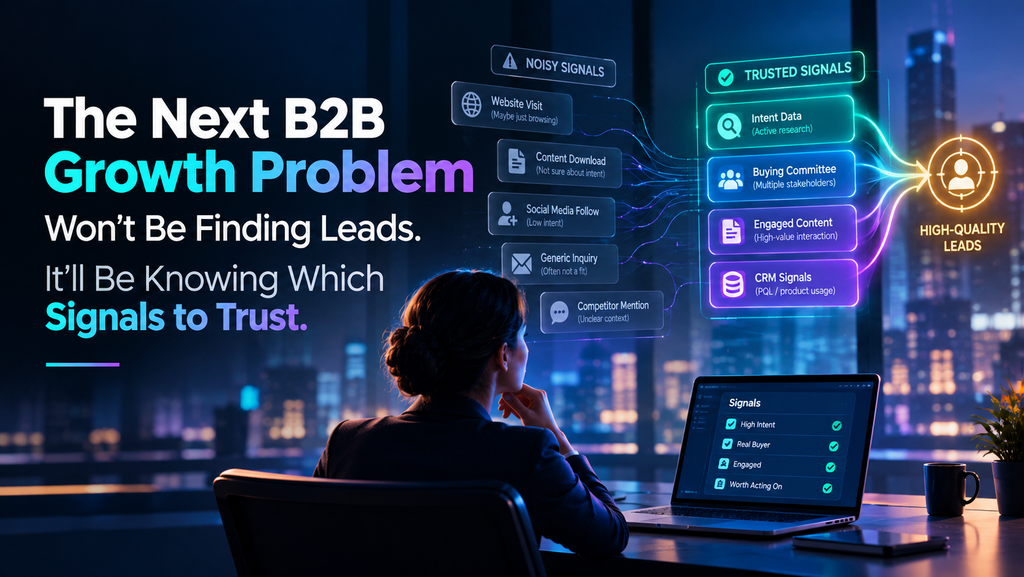
Finding potential buyers is no longer the only difficult part of B2B growth. In many organizations, the bigger challenge is figuring out which of the enormous number of available signals actually mean something.
B2B companies have spent years trying to solve one fundamental problem: how to find more potential customers. They invested in databases, lead-generation platforms, advertising, events, outbound campaigns, content marketing, account-based marketing, intent data, and increasingly sophisticated automation. The goal was straightforward. Find companies that might need what you sell, identify the right people, and create enough opportunities for sales to pursue.
But technology has changed the equation.
Finding potential buyers is no longer the only difficult part of B2B growth. In many organizations, the bigger challenge is figuring out which of the enormous number of available signals actually mean something.
A company can visit your website, open an email, download a report, attend a webinar, hire a new executive, launch a product, change its technology stack, increase its advertising activity, publish a new job, expand into a new market, engage with industry content, mention a relevant topic on social media, or suddenly increase activity around a particular business problem. Each event can look interesting in isolation.
But not every signal represents buying intent.
And when businesses begin treating every signal as important, they create a new problem: signal overload.
The modern B2B organization has more data than ever before. CRM platforms contain years of historical activity. Marketing automation systems capture engagement. Website analytics record behaviour. Sales platforms document conversations. Data providers continuously add company information. AI tools can generate additional insights from all of it.
The result sounds like an advantage.
Sometimes it becomes the opposite.
More signals can make it harder to distinguish meaningful change from ordinary digital noise.
Consider a company that downloads three pieces of content from your website. That might indicate research activity. Or it might simply mean someone is collecting information for a colleague. A prospect who visits your pricing page might be evaluating a purchase. Or they might be researching the market. A company that hires ten people in a particular department might be preparing for expansion. Or it might simply be replacing employees who left.
The signal itself is not the answer.
The context around the signal is what makes it useful.
This is becoming one of the most important challenges in modern B2B marketing and sales. Organizations are moving beyond basic data collection and entering an era where interpretation matters more than accumulation.
B2B signal intelligence is based on the idea that better data alone does not automatically lead to better decisions. For years, the assumption was that better data would automatically lead to better decisions. If companies could collect enough information about their customers and prospects, they would eventually be able to identify the right opportunities.
But data does not interpret itself.
A CRM can tell you that an account has increased engagement. It cannot automatically explain whether that increase is commercially meaningful without additional context. A database can tell you that a company has hired a new executive. It cannot guarantee that the executive is involved in the problem your business solves. An intent platform can show increased activity around a topic. It cannot necessarily tell you whether the organization is researching for immediate purchase, long-term planning, competitive analysis, or simple curiosity.
This distinction becomes even more important as AI increases the amount of information businesses can process.
AI can summarize thousands of signals quickly. It can identify patterns across datasets. It can classify accounts, extract themes from sales conversations, monitor changes, and surface relationships that humans may not notice immediately.
But speed does not automatically create accuracy.
If an organization feeds poor assumptions into an intelligent system, it can simply produce more sophisticated versions of those assumptions.
The real opportunity lies in combining multiple signals and understanding how they relate to one another.
One isolated action may mean very little.
Several connected changes can tell a much stronger story.
Imagine an organization that has recently entered a new geographic market. Around the same period, it begins hiring in sales and operations, changes its technology stack, increases activity around a particular category of content, and publishes information about its expansion strategy. None of these signals individually proves that the company is looking for a particular solution.
Together, however, they provide a much richer picture of what may be happening inside the organization.
This is the difference between collecting signals and understanding them.
The shift also changes how sales teams should think about prospecting.
Traditional prospecting often begins with a list. A salesperson receives a collection of companies and contacts that match certain criteria and begins outreach. The assumption is that the targeting model has already identified relevance.
But modern prospecting can begin somewhere else.
It can begin with change.
Which companies have recently entered a situation where the problem we solve may have become more important?
That question produces a different type of prospect list.
Instead of simply targeting companies because they belong to a particular industry or revenue range, sales teams can look for organizations experiencing specific business events. Growth. Expansion. Leadership changes. New technology adoption. Product launches. Acquisitions. Organizational restructuring. Regulatory changes. New strategic initiatives.
These events do not guarantee demand.
They create context in which demand may emerge.
That distinction is crucial.
The purpose of signal intelligence should not be to turn every event into a sales opportunity. It should be to help sales teams decide where further investigation is worthwhile.
This is why contextual signals are often more valuable than isolated engagement metrics.
A page visit tells you someone interacted with your website.
A combination of business change, repeated topic engagement, relevant stakeholder activity, and historical account information can tell you much more about why that interaction may matter.
The difference is not simply technological.
It is conceptual.
Companies need to stop thinking of signals as individual events and start thinking about them as pieces of a larger business narrative.
Every organization is constantly changing. People join and leave. Strategies evolve. Technologies are replaced. Markets shift. Budgets move. Competitors introduce new products. Leadership teams establish new priorities.
These changes create thousands of potential signals.
The challenge is determining which changes are commercially meaningful.
How B2B Signal Intelligence Uses AI to Interpret Buying Signals
This is where AI can become particularly valuable when used as an interpretation layer rather than simply a content-generation tool.
B2B signal intelligence can help organizations use AI as an interpretation layer rather than simply a content-generation tool. Instead of asking AI to produce another article or another outbound email, organizations can use it to examine complex information and ask questions such as: What has changed within this account? Which changes are unusual? Which changes are relevant to our offering? What evidence supports that interpretation? What additional information should a salesperson investigate before contacting the account?
Those questions are much closer to the real problem.
They transform AI from a production engine into a decision-support system.
But there is an important limitation that businesses should recognize. AI-generated interpretations are not automatically facts. A system may identify a plausible relationship between two events without having enough information to establish causality. It may misinterpret public information or overstate the importance of a signal.
Human judgment therefore remains essential.
The goal is not to remove humans from the process.
It is to give humans better information with which to make decisions.
This becomes particularly important when signals are used for prioritization. If an organization automatically routes every high-intent account to sales, the sales team can quickly become overwhelmed. Eventually, “high intent” stops meaning anything because too many accounts receive the label.
The same thing happens when every lead becomes “hot.”
When everything is urgent, nothing is prioritized.
A mature B2B signal intelligence strategy needs levels of confidence and context. Some signals may be weak indicators. Others may be stronger because they are supported by multiple independent sources. Some may be recent and highly relevant. Others may be old and no longer meaningful.
Recency matters.
Frequency matters.
Combination matters.
Business relevance matters.
The source of the signal matters.
And perhaps most importantly, the reason behind the signal matters.
This changes how marketing operations should be designed.
Instead of creating systems that simply collect more information, teams need systems that help reduce information into understandable patterns. The objective is not to give salespeople another dashboard with hundreds of metrics.
It is to help them answer a few important questions quickly.
Why this account?
Why now?
What changed?
Why might that change matter?
What evidence supports the assumption?
What should we investigate next?
These questions can dramatically improve the quality of sales prioritization.
They can also improve marketing strategy.
When marketers understand which signals consistently precede meaningful buying activity, they can design campaigns around those moments rather than relying exclusively on static audience definitions. They can identify emerging market conditions earlier, create content around newly important problems, and adjust messaging as buyer priorities change.
This is where the relationship between data and strategy becomes more important.
Data tells you what happened.
Context helps explain what it might mean.
Strategy determines what you should do about it.
Without the second layer, the first can become overwhelming.
There is another reason signal quality matters: buyers themselves are becoming more difficult to interpret through traditional engagement metrics.
Modern buyers research anonymously. They consume content without filling out forms. They use multiple devices. They ask colleagues for recommendations. They research through AI systems. They interact with communities and third-party platforms. Several people may participate in a buying process without any one person representing the entire decision.
The visible activity captured by a company’s marketing systems is therefore only part of the buyer journey.
This makes it dangerous to assume that the loudest signal is always the most important one.
Sometimes the most meaningful change happens outside your own channels.
A company might never visit your website but undergo a major business change that makes your category highly relevant. Another account might visit your website repeatedly but have no intention of purchasing.
The strongest signal may not be the one you can measure most easily.
That is a major challenge for the next generation of B2B growth teams.
They will need to become comfortable operating with incomplete information while simultaneously improving their ability to connect what information they do have.
The future of B2B signal intelligence is therefore unlikely to be about collecting every possible signal. It will be about building systems that know which signals deserve attention.
It will be about building systems that know which signals deserve attention.
That requires better data infrastructure, stronger analytical thinking, AI-assisted interpretation, and close collaboration between marketing, sales, operations, and leadership. It also requires discipline. Not every interesting event should become a campaign. Not every engagement should become a lead. Not every pattern deserves a sales call.
The purpose of intelligence is not to create more activity.
It is to improve the quality of decisions behind the activity.
B2B growth is entering a period where the competitive advantage may come less from who can find the most prospects and more from who can understand their market with greater clarity.
Because the problem was never simply a lack of signals.
The problem was knowing which ones mattered.
And as AI makes the volume of available information grow even faster, the ability to separate meaningful change from background noise may become one of the most valuable capabilities a B2B company can develop.
