



The Shift From B2B Contact Data to B2B Data Intelligence
For years, B2B organizations have treated contact databases as a critical competitive asset. More contacts meant larger addressable markets, while better data enrichment promised more accurate and complete prospect records. But the B2B data landscape is changing. As contact information becomes easier to acquire, verify, enrich, and automate, the competitive advantage is shifting from simply knowing who exists to understanding what has changed.
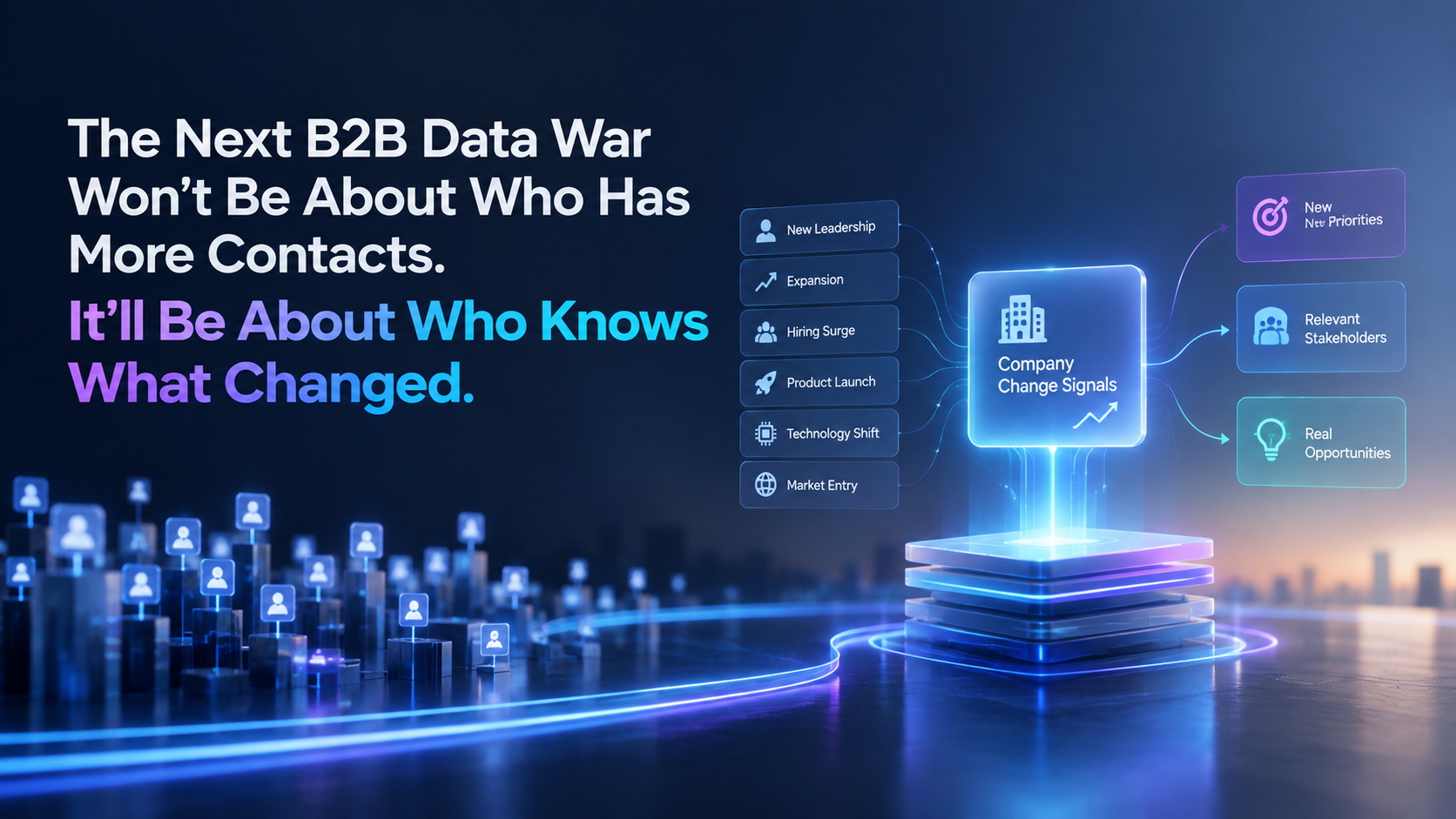
This is where B2B data intelligence becomes increasingly important. Modern sales and marketing teams need more than static contact information. They need real-time business signals, buyer intent data, company changes, leadership updates, hiring trends, technology shifts, product launches, expansions, and other events that can reveal when an account’s priorities are changing. The future of B2B sales intelligence is therefore moving from static records toward dynamic, event-driven intelligence.
A database can tell you that a company has a Chief Information Officer. It can tell you where that person works, their professional background, the company’s size, industry, location, and perhaps even technologies used across the organization. But those facts may not tell you why that company should be approached today.
What matters more is the change occurring around those facts. Has the company entered a new market? Has its technology environment changed? Has leadership changed? Has it announced an expansion? Is it restructuring? Has it launched a new product? Is it hiring aggressively in a particular function? Has a new regulatory requirement affected its operations? Has its existing strategy begun to shift? These changes can create new priorities, new problems, and new buying opportunities.
What Is Event-Driven B2B Data Intelligence?
This is why the next generation of B2B data intelligence will be increasingly event-driven rather than record-driven. A static database describes a company at a point in time. A dynamic intelligence system attempts to understand the movement around that company.
The difference is substantial. Knowing that an organization employs 2,000 people is useful. Knowing that it recently expanded into three new markets and significantly increased hiring in a function associated with that expansion may be much more actionable. Knowing that a company uses a particular technology is useful. Knowing that it is hiring specialists associated with migrating away from or expanding that technology can reveal a different kind of signal. The information becomes valuable because it has context and momentum.
Why Business Signals Matter in B2B Data Intelligence
The challenge is that change is difficult to capture. Businesses generate thousands of signals every day across websites, press releases, job postings, leadership announcements, product launches, financial disclosures, technology changes, social activity, events, procurement behaviour, and other public and private sources.
Most of these signals are individually weak. A single job posting does not necessarily indicate a major strategic shift. A leadership appointment does not automatically mean a new buying initiative. A website change may have no commercial significance at all. The value emerges when multiple signals begin pointing in the same direction. The real intelligence challenge is therefore not collecting every possible signal. It is distinguishing meaningful change from ordinary business noise.
The Role of AI in B2B Data Intelligence
This distinction is becoming increasingly important because AI has dramatically reduced the cost of generating and processing information. Organizations can now create enormous volumes of content, analyse large datasets, monitor thousands of accounts, and automate outreach at a scale that was previously difficult to achieve. But greater data availability does not automatically create greater intelligence. If every sales team has access to thousands of contacts and millions of signals, the raw data itself stops being a meaningful differentiator. The advantage moves to the organizations capable of interpreting that data faster and more accurately.
Consider two sales teams targeting the same market. Both have access to similar company databases. Both know the decision-makers. Both know the industry. Both have enrichment tools and automated workflows. One team, however, can identify that several target accounts have recently experienced a specific operational change and can connect that change to a relevant business problem. The other team continues sending generic messaging based on job title and company size. The difference is not access to data. Both teams have it. The difference is whether one team understands what has changed.
How B2B Data Intelligence Is Changing Personalization
This also changes how personalization should work. B2B personalization has often become synonymous with inserting a prospect’s name, company, industry, or recent achievement into an outreach message. But personalization based only on static information can feel superficial because it does not necessarily demonstrate understanding.
A more meaningful approach begins with change. Instead of saying, “I noticed your company is growing,” the question becomes, “What does that growth create?” Instead of simply recognizing that a new executive has joined a company, the more important question is what strategic priorities may now be emerging around that leadership change. The strongest commercial conversations are often built around a relevant business transition rather than a demographic attribute.
Why Speed Matters in B2B Data Intelligence
This creates a new requirement for sales and marketing teams: speed of interpretation. If a meaningful business change occurs today, its commercial relevance may decline rapidly if competitors identify it first. A leadership announcement, expansion, product launch, acquisition, funding event, technology shift, or major hiring initiative can create a window of relevance. The organizations capable of detecting the change, understanding its implications, identifying the stakeholders affected by it, and responding with useful context have an opportunity to enter the conversation earlier. Data becomes valuable not because it is stored, but because it enables timely decisions.
The concept of “freshness” therefore becomes as important as accuracy. A perfectly accurate database that describes what was true six months ago can be less useful than a slightly smaller dataset that captures important changes as they happen. Traditional data management often focuses on whether a record is correct. Modern B2B intelligence increasingly needs to ask whether the record is current, whether the surrounding context has changed, and whether that change alters the probability or relevance of a business conversation. The question is no longer simply, “Is this information accurate?” It becomes, “What is different now?”
Building a Real-Time B2B Data Intelligence Architecture
This has major implications for technology architecture. CRM systems remain valuable as systems of record, but they were not necessarily designed to function as real-time systems of change. Organizations will increasingly need layers that monitor external and internal signals, identify meaningful shifts, connect those shifts to accounts and stakeholders, and surface the changes that deserve human attention.
AI can help with this by processing large amounts of unstructured information and recognizing patterns across signals that would be difficult to evaluate manually. But the goal should not be to replace human judgment with an endless stream of alerts. The goal should be to reduce the distance between an important market change and the moment a business understands what that change means.
From B2B Contact Data to Real-Time Intelligence
The B2B data advantage is therefore moving from quantity to velocity, context, and interpretation. Having ten million contacts is not inherently more valuable than having one million if neither database tells a sales team which accounts are changing. Having thousands of intent signals is not inherently useful if the organization cannot distinguish meaningful movement from background noise. The real competitive asset is knowing which accounts are changing, what is changing, why it matters, and what should happen next.
The Future of B2B Data Intelligence
The next B2B data war will not simply be about who has the largest database. It will be about who can see movement before it becomes obvious, interpret that movement before it becomes crowded, and turn changing information into timely commercial action. In a market where static data is increasingly commoditized, the ability to understand change may become one of the most valuable forms of intelligence a sales and marketing organization can possess.
