


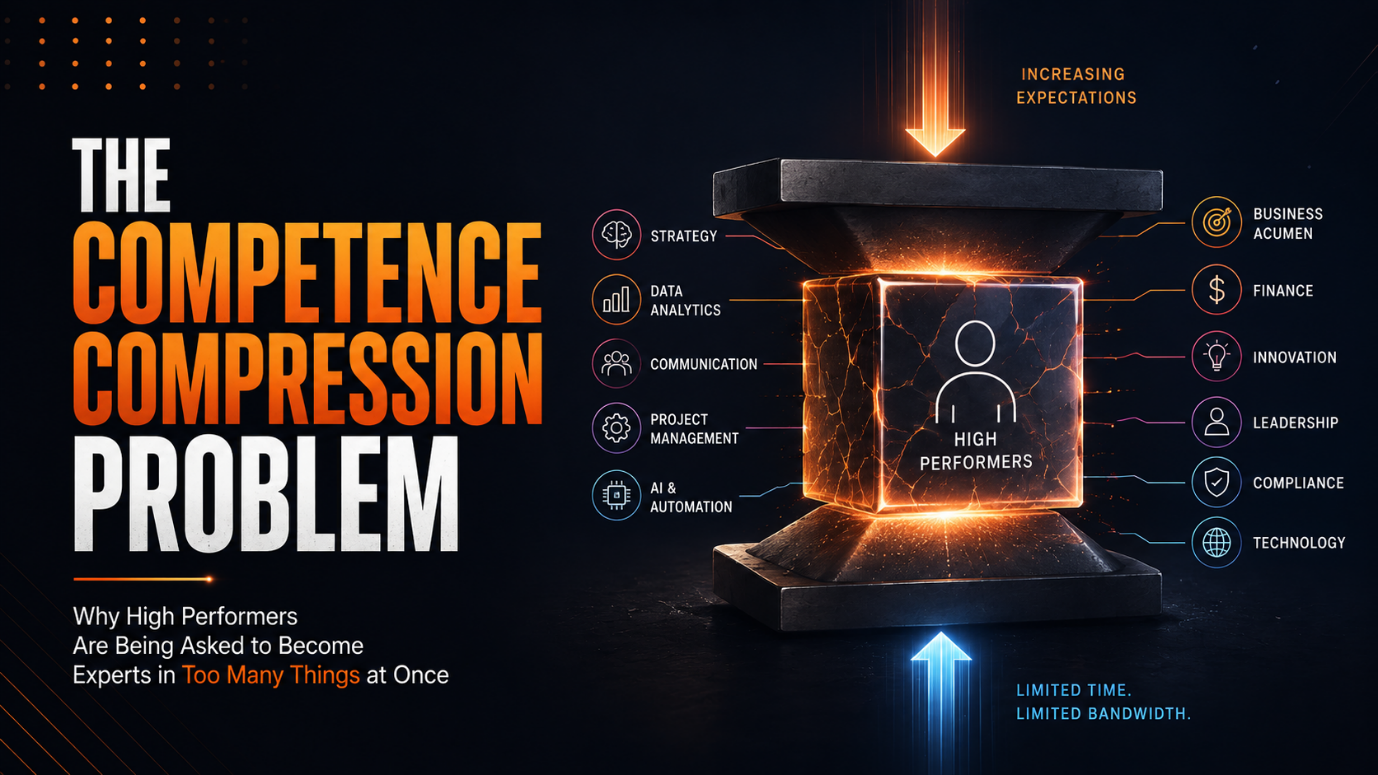

For decades, organizations have rewarded high performers by giving them greater responsibility. Someone who becomes exceptionally good at sales is asked to understand strategy. A strong marketer is expected to understand analytics, technology, revenue operations, customer psychology, AI, and finance.
A talented HR professional is increasingly expected to understand employee experience, data, technology, employer branding, compliance, business strategy, and organizational design. An engineer may be expected to understand product, security, customer behaviour, commercial priorities, communication, and management.
On the surface, this looks like professional growth. But there is a growing difference between expanding capability and expanding expectations. Companies are increasingly asking their strongest employees to become competent across an ever-wider range of disciplines while simultaneously expecting them to maintain deep expertise in their original field.
This creates what can be called the Competence Compression Problem: the gradual compression of multiple professional disciplines into individual roles, creating employees who are expected to know a little about everything while still being exceptional at something.
The pressure is being accelerated by technology.
This creates what can be called the Competence Compression Problem: the gradual compression of multiple professional disciplines into individual roles. The rise of AI is a particularly strong example. Marketers are now expected to understand AI-assisted content creation, automation, data analysis, prompting, customer intelligence, and emerging search behaviour. Sales professionals are expected to understand AI-driven prospecting, data enrichment, automation, intent signals, and increasingly sophisticated buying journeys.
HR professionals are expected to understand people analytics, AI recruitment tools, workforce platforms, automation, and digital employee experience. IT professionals are expected to understand cloud infrastructure, cybersecurity, AI systems, automation, data governance, and increasingly complex technology ecosystems. The problem is not that these capabilities are unnecessary. The problem is that the organization often adds them to existing responsibilities without removing anything.
Why Workplace Expectations Are Expanding
This creates a subtle but significant shift in how jobs are designed. Instead of a role becoming deeper, it becomes wider. Instead of an employee becoming an expert in one domain and collaborating with specialists in others, the employee is increasingly expected to understand enough of multiple domains to operate independently. The organization sees this as agility. The employee experiences it as capability overload. There is a fundamental difference between being cross-functional and being expected to personally carry the knowledge burden of multiple functions.
How the Competence Compression Problem Is Changing Professional Roles
The distinction matters because expertise takes time. Deep expertise is not simply the accumulation of information. It involves pattern recognition, judgment, experience, context, and the ability to distinguish important signals from irrelevant ones. A marketer who spends years understanding customer behaviour develops instincts that cannot be acquired through a few AI tutorials. An engineer who has worked through hundreds of system failures develops diagnostic intuition that cannot be replaced by a checklist.
A salesperson who has navigated complex negotiations develops an understanding of organizational dynamics that goes beyond sales methodology. When organizations continuously expand the expected skill set without protecting time for depth, they risk weakening the very expertise that created the employee’s value in the first place.
How AI Is Accelerating Capability Overload
This is where competence compression becomes dangerous. An employee may technically be able to perform many tasks, but the quality of judgment across those tasks may become uneven. They become capable enough to start many things but not necessarily deep enough to solve the hardest problems. The organization gains breadth while quietly losing depth. In the short term, this can look efficient because fewer specialists are required. In the long term, it can create expensive errors, slower decision-making, inconsistent quality, and increased dependence on external vendors.
Capability Inflation: When New Skills Become New Expectations
The rise of AI creates an interesting contradiction. AI should theoretically reduce the amount of knowledge employees need to personally hold because machines can assist with research, analysis, drafting, summarization, coding, forecasting, and routine decision support. Yet AI can also increase expectations because once a capability becomes easier to access, organizations may begin expecting everyone to use it. If an employee can use AI to generate a report in thirty minutes, the organization may expect them to produce more reports.
If AI can help a marketer analyse data, the marketer may be expected to perform deeper analytics. If AI can help a manager summarize employee feedback, the manager may be expected to conduct more sophisticated people analysis. Technology can therefore reduce the effort required for individual tasks while increasing the total number of capabilities expected from the employee.
Why High Performers Are Most Vulnerable
This creates a phenomenon that could be described as capability inflation. Every new tool appears to make a new skill accessible, and every accessible skill gradually becomes an expectation. Ten years ago, an employee might have been evaluated primarily on their functional expertise. Today, the same employee may be evaluated on their ability to collaborate cross-functionally, interpret data, use AI, communicate with executives, manage projects, understand commercial outcomes, and adapt to changing technologies. Each expectation is reasonable individually. Together, they can create an impossible professional profile.
The Hidden Risk of Hero Dependency
The strongest employees are particularly vulnerable because organizations naturally give important work to people who have demonstrated that they can handle complexity. High performers become the default problem solvers. When a new initiative appears, they are invited. When a project becomes difficult, they are assigned. When another department needs help, they are consulted. Over time, their role expands through accumulation rather than deliberate design. Nothing is formally added to their job description, but their actual responsibilities grow continuously. Eventually, the organization has created a role that depends on one person’s ability to understand an extraordinary number of things.
Why Deep Expertise Still Matters
This creates a hidden organizational risk: hero dependency. When a small number of highly capable employees become the connective tissue between departments, the organization may appear agile because problems get solved quickly. But the agility depends on individuals rather than systems. If those employees leave, the organization discovers that knowledge was never distributed. Their departure creates not just a hiring gap but a capability gap. The company loses the informal connections, context, judgment, and historical understanding that made cross-functional work possible.
Literacy vs. Expertise: A Better Model for Employee Development
The solution is not to discourage employees from developing broad skills. In fact, cross-functional understanding is increasingly valuable. The problem is failing to distinguish between literacy and expertise. An employee may need enough financial literacy to understand business implications without becoming a finance specialist. A marketer may need enough technical literacy to work effectively with engineers without becoming an engineer. A sales professional may need enough product knowledge to understand implementation without becoming a product architect. Organizations should define which capabilities require depth and which require working fluency.
The Deep Core, Flexible Perimeter Model
This suggests a new model for job design: deep core, flexible perimeter. Every role should have a small number of capabilities where deep expertise is expected. Around that core should be a broader set of capabilities where the employee needs enough understanding to collaborate, make informed decisions, and use technology effectively. This creates a more sustainable balance between specialization and adaptability. The employee does not need to become an expert in everything. They need to know what they must master, what they must understand, and what they should delegate.
The Competence Compression Problem and the Rise of AI
AI makes this distinction particularly powerful because it can become part of the flexible perimeter. Employees do not necessarily need to memorize every technical detail if they can effectively use tools that provide assistance. But this introduces another requirement: judgment about when to trust the tool. An employee who knows how to use AI but cannot evaluate its output is not necessarily more capable. They may simply become faster at producing incorrect or shallow work. As automation expands, expertise increasingly includes the ability to recognize when human judgment is necessary.
Rethinking Performance Management and Employee Development
This means the future of professional competence may become less about knowing everything and more about knowing where knowledge should reside. Some knowledge belongs in the employee’s expertise. Some belongs in systems. Some belongs in AI tools. Some belongs with specialists. Some belongs in organizational documentation. The high-performing organization will not attempt to make every employee self-sufficient. It will design a capability network in which people can quickly access the right expertise when needed.
How Organizations Can Balance Specialization and Adaptability
This has implications for leadership development as well. Companies often design development programs around adding more skills to employees. A better approach may involve helping employees become better at deciding which skills deserve investment. Not every employee needs to learn every new technology. Not every emerging capability will matter equally to every role. Organizations need a clearer understanding of which skills are strategically differentiating and which can be supported through tools or shared services.
Solving the Competence Compression Problem Through Better Job Design
Performance management must evolve accordingly. If employees are rewarded for continuously expanding their responsibilities, competence compression will continue. High performers will become increasingly overloaded because breadth is mistaken for growth. Organizations should instead recognize depth, judgment, leverage, collaboration, and the ability to build systems that allow others to operate effectively. A senior employee who solves every problem personally may appear more valuable than someone who creates a system that prevents those problems from recurring. In a scalable organization, the second person may actually be more valuable.
The Future of Workplace Skills
There is also a cultural dimension. Modern workplaces often celebrate the “Swiss Army knife” employee, the person who can write, analyse, sell, manage projects, understand technology, communicate with leadership, solve operational issues, and step into almost any role. These employees are valuable, but organizations should be careful not to turn versatility into an expectation of permanent availability. A person being capable of doing something does not mean they should own it. Capability should create optionality, not unlimited responsibility.
The problem is particularly visible in smaller companies, where resources are limited and employees naturally wear multiple hats. Cross-functional work is often necessary for survival. But as the company grows, the organization must decide which temporary combinations of responsibilities should become permanent roles and which should be separated into specialized functions. Failure to make that transition can create jobs that become increasingly impossible to perform well.
The Competence Compression Problem also changes the way companies should think about hiring. Instead of searching for candidates who claim to be experts in everything, organizations may benefit from hiring for learning velocity, judgment, and collaboration around a strong functional foundation. The goal is not to find an imaginary employee who already possesses every capability required by a rapidly changing organization. It is to find someone with enough depth to provide real value and enough adaptability to work effectively with emerging tools and adjacent disciplines.
Ultimately, the future of work will not require everyone to become a generalist. Nor will it allow organizations to operate entirely through narrow specialists. The challenge is building the right balance between the two. Employees need enough breadth to understand the systems around them and enough depth to remain genuinely valuable within their domain. Technology should expand that capability rather than erase specialization.
Conclusion: Building Organizations That Balance Breadth and Depth
The most capable employee of the future will not be the person who knows the most things. It will be the person who knows what they need to know deeply, what they need to understand broadly, what technology can handle, and when another human should take over. The competitive advantage will come not from compressing every capability into every employee, but from designing organizations where expertise can move quickly to where it creates the most value.
