



Introduction
Search is changing faster than ever. For years, businesses focused on ranking their websites on traditional search engines such as Google and Bing. Today, users are increasingly turning to AI-powered search experiences to find information, compare products, research services, and answer complex questions. Instead of displaying only a list of links, AI-powered search can understand a question, combine information from different sources, and provide a direct conversational response.
This shift has created an important question for marketers and SEO professionals: Does website performance affect AI search visibility?
The answer is yes, but not in the sense that a website becomes visible in AI search simply because it loads quickly. AI search visibility depends on several factors, including content quality, relevance, authority, crawlability, technical accessibility, website structure, and trust. Website performance is one important part of this larger ecosystem.
A website that loads efficiently, responds reliably, works well on mobile devices, and makes its content accessible provides a stronger foundation for search engines and AI-powered systems. At the same time, businesses should understand that technical performance must work together with a strong content and SEO strategy.
What Is AI Search?
AI search refers to search experiences that use artificial intelligence to understand user questions and provide generated answers, summaries, recommendations, or explanations. Instead of requiring users to open several search results and combine information themselves, AI search systems can retrieve information from multiple sources and present it in a conversational format.
For example, a traditional search might be based on a query such as “benefits of cloud computing.” An AI search query could be much more specific: “What are the benefits of cloud computing for a growing enterprise, and what security challenges should the IT team consider?”
The second query requires a deeper understanding of context and intent. AI systems need to identify relevant information, understand relationships between concepts, and generate a useful response. This makes it increasingly important for businesses to create websites that are easy for both users and intelligent search systems to understand.
Understanding AI Search Visibility
AI search visibility refers to how often a brand, website, product, service, or piece of content appears within AI-generated answers and recommendations.
Traditional SEO typically focuses on keyword rankings, impressions, clicks, and organic traffic. AI search introduces additional considerations. A business may want to know whether its brand is mentioned in AI-generated responses, whether its website is cited as a source, whether its products are included in recommendations, and whether its content is being surfaced for relevant questions.
This is where concepts such as AI SEO and Generative Engine Optimization (GEO) are becoming increasingly relevant. Rather than optimizing only for individual keywords, marketers need to think about how their content can become a useful and trustworthy source for AI-powered search systems.
How Does Website Performance Affect AI Search Visibility?
Website performance can influence AI search visibility indirectly through accessibility, crawlability, usability, and technical website health. AI systems need to retrieve information from websites, and technical problems can make that process more difficult.
A slow or unreliable website does not automatically disappear from AI search results. However, if important pages consistently take too long to respond, return errors, rely heavily on complex scripts, or make important information difficult to access, the website may create unnecessary barriers for search systems.
This is why website performance should be viewed as part of a broader technical SEO strategy. The objective is not simply to make a website faster for the sake of achieving a better score. The goal is to create a website that efficiently delivers valuable information to users and search systems.
Website Speed and User Experience
The most direct benefit of website performance is improved user experience. Visitors expect websites to respond quickly, particularly when accessing content from smartphones or slower networks. When pages take too long to load, users may leave before reading the content or completing an action.
A fast website can make navigation easier, improve engagement, and create a more professional digital experience. For businesses, this can influence lead generation, conversions, customer satisfaction, and overall website performance.
Although AI search systems do not simply select websites because they are fast, a technically strong website supports a better overall digital experience. Website speed should therefore be treated as both an SEO consideration and a business-performance consideration.
Core Web Vitals and AI Search
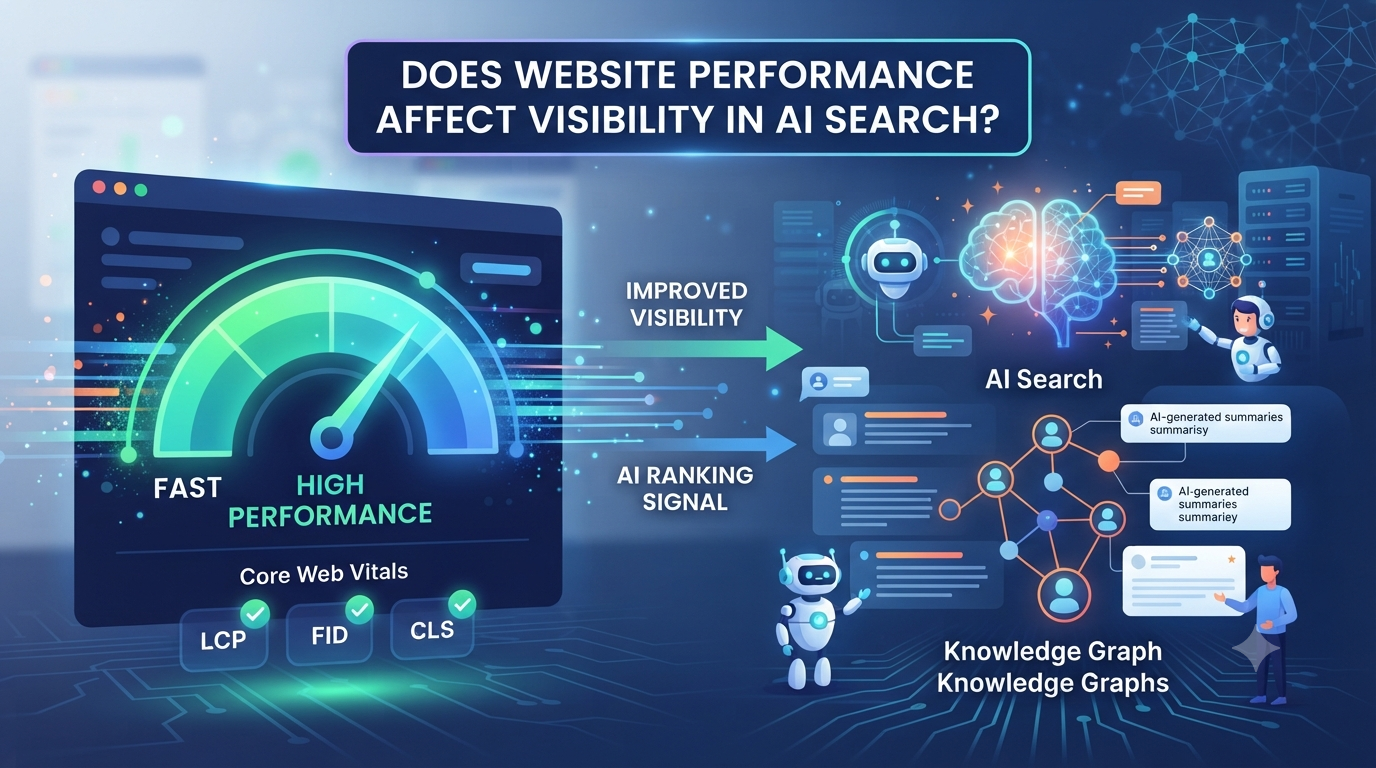
Core Web Vitals are commonly used to evaluate important aspects of website user experience. The key metrics include Largest Contentful Paint (LCP), Interaction to Next Paint (INP), and Cumulative Layout Shift (CLS).
LCP measures how quickly the main content of a page becomes visible. INP focuses on how quickly a webpage responds when users interact with it, while CLS measures unexpected movement of page elements during loading.
These metrics are not a direct formula for determining whether a website will appear in an AI-generated response. However, they provide useful information about technical quality and user experience. Improving Core Web Vitals can also encourage businesses to address problems such as oversized images, inefficient JavaScript, poor resource loading, and unstable page layouts.
Crawlability Is Important for AI Search
One of the most important technical considerations for AI search is whether important information can be discovered and accessed.
Search engines and AI-powered systems rely on automated processes to discover and retrieve information from websites. If important pages are accidentally blocked, incorrectly configured, or difficult to reach through the website’s architecture, their discoverability can suffer.
Businesses should therefore pay attention to technical SEO fundamentals such as robots.txt, XML sitemaps, canonical URLs, indexing directives, redirects, internal linking, and server errors.
A website may contain excellent content, but that content cannot contribute much to search visibility if search systems cannot efficiently discover and process it.
Server Performance and Content Accessibility
Server performance is another important part of website health. Before a webpage can be processed, a request needs to reach the server and the server needs to return the appropriate content.
Slow hosting, inefficient database queries, poor caching, overloaded servers, and poorly optimized APIs can increase response times. For larger websites, these issues can become more noticeable because thousands or millions of pages may need to be served consistently.
Improving server performance can make websites more reliable and responsive. Technologies such as caching, content delivery networks, optimized databases, and scalable hosting infrastructure can help businesses maintain consistent performance.
The objective should not simply be to achieve a faster homepage. Businesses should focus on making the entire website reliable and accessible, particularly the pages that contain important business and informational content.
JavaScript and AI Search
JavaScript has become a fundamental part of modern web development. Frameworks such as React, Angular, and Vue allow developers to create highly interactive websites and applications.
However, excessive dependence on client-side JavaScript can introduce additional complexity. If important content is not immediately available and requires extensive JavaScript processing before it can be displayed, automated systems may face additional challenges when interpreting the page.
This does not mean that businesses should avoid JavaScript. Instead, the focus should be on ensuring that critical information remains accessible and efficiently rendered. Product descriptions, service information, documentation, FAQs, company information, and other important content should not unnecessarily depend on complicated interactions.
Website Architecture Helps AI Understand Content
Website structure is just as important as website speed.
A well-organized website makes it easier for users and search systems to understand how different pages relate to one another. For example, a digital marketing website could have a structure that moves from broad topics such as digital marketing to more specific areas such as SEO, AI SEO, Generative Engine Optimization, and AI search visibility.
Internal links reinforce these relationships. When relevant pages are connected using descriptive anchor text, visitors can navigate between related resources while search systems receive additional context about the website’s subject matter.
This is particularly important for large websites where valuable content can otherwise become isolated or difficult to discover.
Structured Data and Machine Understanding
Structured data provides additional information about the content of a webpage in a machine-readable format. Depending on the type of website, businesses can use structured data to describe organizations, products, services, articles, events, authors, software, and other entities.
Structured data does not guarantee higher rankings or AI citations. However, accurate structured data can help search systems understand what a page represents and how different entities are related.
For businesses focusing on AI SEO, structured data should therefore be considered one component of a larger technical strategy that includes good website architecture, crawlability, content quality, and clear entity information.
Content Quality Still Matters More Than Speed Alone
One of the biggest mistakes businesses can make is assuming that website speed is the primary factor in AI search visibility.
Imagine a website that loads extremely quickly but contains generic and repetitive articles. Now compare it with a technically sound website that publishes original research, detailed explanations, expert insights, case studies, and practical recommendations.
The second website has much more valuable information for users and potentially for AI-powered retrieval systems.
This demonstrates an important principle: website performance supports discoverability, but content gives search systems a reason to discover and surface a website.
Businesses should therefore avoid treating performance optimization as a replacement for content strategy.
Original Content and AI Search
AI-powered search systems have access to enormous quantities of online information. Because of this, generic articles that repeat information already available across thousands of websites may have difficulty standing out.
Original content gives businesses an opportunity to differentiate themselves. Companies can publish proprietary research, customer insights, technical benchmarks, surveys, case studies, expert interviews, and first-hand experiences.
For example, instead of publishing a generic article about cloud migration, a technology company could publish a detailed analysis of lessons learned while migrating enterprise workloads to a multi-cloud environment.
The second approach provides specific experience and information that cannot easily be reproduced by simply rewriting existing online content.
Topical Authority and AI Search
Topical authority refers to the depth and breadth of knowledge a website demonstrates around a particular subject.
A company that publishes one article about AI marketing provides limited evidence of expertise. A company that develops an interconnected content library covering AI SEO, GEO, AI content optimization, AI search visibility, AI advertising, AI personalization, and AI analytics demonstrates much broader topical coverage.
This is why businesses should think beyond individual keywords.
Instead of creating separate articles simply because they contain different keyword variations, marketers should build comprehensive topic clusters that answer the questions their target audience is actually asking.
This approach can also create opportunities for internal linking and improve the overall organization of the website.
Mobile Performance and AI Search
Mobile performance remains an important part of website quality. A website that performs well on a desktop computer may still provide a poor experience on smartphones.
Large images, excessive JavaScript, third-party scripts, slow fonts, and poorly optimized layouts can make mobile pages considerably slower.
Businesses should test important pages across different devices and connection speeds. Mobile optimization is particularly important for content websites, ecommerce businesses, local businesses, and service providers where users may discover a company through search and immediately visit its website from a smartphone.
Website Reliability Matters Too
Performance is not only about speed.
A website also needs to be reliable. Frequent server errors, broken pages, timeouts, database failures, or infrastructure problems can prevent users and automated systems from accessing content.
For this reason, businesses should monitor website availability and server performance alongside page-speed metrics.
A reliable website provides a more consistent experience and reduces the possibility that important content becomes temporarily inaccessible.
AI SEO Requires a Broader Approach
Traditional SEO often starts with a keyword and works backward toward a webpage.
AI search requires marketers to think more broadly about questions, entities, context, expertise, and information.
Instead of asking only, “What keyword should we rank for?”, businesses should also ask whether their website clearly explains what they do, whether their content answers important customer questions, whether their expertise is demonstrated, and whether search systems can access and understand their information.
This represents a move from purely keyword-focused SEO toward a broader approach involving content quality, technical accessibility, topical authority, structured information, and brand credibility.
How to Optimize Your Website for AI Search
The first step is to conduct a comprehensive technical audit. Businesses should review website speed, Core Web Vitals, server response time, mobile performance, crawlability, indexability, internal links, redirects, and technical errors.
The next step is to improve the quality and structure of the content. Important topics should have comprehensive coverage rather than relying on short articles written around isolated keywords. Related articles should be connected through internal links, and important information should be easy to locate.
Businesses should also make their expertise clear. Author information, case studies, original research, expert commentary, customer experiences, and credible references can help establish authority.
Finally, organizations should monitor both traditional SEO performance and AI search visibility. This means looking beyond organic traffic and keyword rankings to understand how frequently a brand is mentioned, cited, or recommended in AI-powered search experiences.
Common Mistakes to Avoid
One of the most common mistakes is focusing entirely on page speed while ignoring content quality. Another is creating large amounts of generic AI-generated content without adding original insights or meaningful editorial value.
Businesses should also avoid making important information dependent on complex JavaScript interactions when simpler and more accessible approaches are available.
Another common problem is poor website architecture. Even a fast website can struggle to communicate topical relationships when pages are poorly organized and internal linking is weak.
The best approach is to treat technical performance, content, structure, and authority as interconnected components of the same SEO strategy.
The Future of Website Performance and AI Search
AI-powered search is changing how users discover information. As search experiences become more conversational and increasingly capable of understanding complex questions, websites will need to become more than collections of keyword-optimized pages.
Successful websites will need to provide useful information in a technically accessible environment. They will need strong performance, clear architecture, authoritative content, structured information, and reliable infrastructure.
Website performance will continue to be important because a website must first be accessible and usable before its information can provide value.
However, the future of AI search optimization is unlikely to be determined by one metric. Businesses that combine technical excellence with strong content and genuine expertise will have a stronger foundation for long-term visibility.
Frequently Asked Questions
Does website speed affect AI search visibility?
Website speed can contribute to overall technical website quality and accessibility, but it does not guarantee AI search visibility. AI systems consider many factors, including relevance, content quality, authority, accessibility, and context.
Is Core Web Vitals important for AI SEO?
Core Web Vitals are useful measures of user experience and technical performance. They should be included in a broader SEO strategy, although they should not be treated as the sole factor determining whether content appears in AI-generated answers.
Does JavaScript affect AI search visibility?
JavaScript does not automatically prevent a website from appearing in search. However, excessive client-side rendering can create additional complexity. Important content should be efficiently accessible and rendered so that search systems can process it effectively.
What is AI SEO?
AI SEO is the practice of optimizing websites and content for AI-powered search experiences. It combines traditional SEO principles with a greater focus on context, entities, content quality, accessibility, authority, and machine understanding.
What is Generative Engine Optimization?
Generative Engine Optimization, or GEO, focuses on improving the likelihood that a brand or its information will be represented in AI-generated answers and recommendations.
How can businesses improve AI search visibility?
Businesses should focus on technical website health, high-quality content, topical authority, structured data, internal linking, original research, expertise, and a reliable user experience. No single optimization guarantees AI search visibility.
Is website performance more important than content quality?
No. Website performance provides a technical foundation, but content quality is critical. A fast website with generic or low-value content may have less visibility potential than a technically healthy website that provides authoritative and original information.
Suggested Internal Links
This article can become a strong pillar page for an AI SEO content cluster. Add contextual internal links rather than placing all links in a separate list.
For example, when discussing AI search optimization, link to your article on “What Is Generative Engine Optimization (GEO)?” using the anchor text “complete guide to Generative Engine Optimization.”
When discussing website architecture, crawlability, and indexing, link to an article about “Technical SEO Best Practices.” When discussing website speed and Core Web Vitals, link to “How to Improve Website Speed” or “A Complete Guide to Core Web Vitals.”
The content-quality section can naturally link to an article about “SEO Content Writing Best Practices,” while the discussion of topic clusters can link to your “Content Marketing Strategy” guide.
For the broader AI-search discussion, create and link to supporting articles such as “SEO vs. GEO: What’s the Difference?”, “How to Optimize Content for AI Search Engines,” “How to Measure AI Search Visibility,” and “How AI Search Is Changing Traditional SEO.”
These internal links can create a connected content ecosystem around AI search and help establish stronger topical depth.
Recommended SEO Content Cluster
A strong content cluster for this topic could be structured around the main pillar:
AI Search Optimization
Supporting articles can cover AI SEO, Generative Engine Optimization, AI search visibility, technical SEO for AI search, website performance, structured data, content optimization, topical authority, and AI search analytics.
This approach allows individual articles to target specific long-tail search queries while internally linking back to the main pillar page.
Conclusion
Website performance does affect AI search visibility, but it is not a standalone ranking formula. A faster website does not automatically mean that an AI search system will cite or recommend that website.
Instead, performance contributes to the technical foundation that allows users and search systems to access information efficiently. Fast loading times, strong Core Web Vitals, reliable servers, mobile optimization, efficient JavaScript, crawlability, and clear website architecture can all contribute to a healthier digital presence.
However, technical performance is only one part of the equation. Content quality, relevance, originality, authority, expertise, structured information, and trust remain essential.
Businesses should therefore avoid thinking of AI SEO as simply another version of traditional keyword optimization. The objective is to create a website that is easy to access, easy to understand, and genuinely valuable.
As AI-powered search continues to evolve, the brands most likely to succeed will be those that combine technical excellence with authoritative content and strong digital credibility.
The key takeaway is simple: website speed can support AI search visibility, but valuable and trustworthy information gives AI systems a reason to surface your brand.
