



Introduction
A well-structured sales funnel is one of the most important components of a successful B2B sales strategy. It guides potential customers from the moment they become aware of your business to the point where they make a purchase and eventually become loyal advocates. However, many organizations unknowingly make critical mistakes within their sales funnel that reduce conversion rates, increase customer acquisition costs, and ultimately result in lost revenue.
Even businesses that invest heavily in marketing, lead generation, and sales technology often struggle because their funnel contains gaps that prevent prospects from moving smoothly through the buying journey. Identifying and correcting these mistakes can significantly improve sales performance, customer experience, and long-term business growth.
This article explores the most common sales funnel mistakes that negatively impact revenue and provides actionable insights to help businesses build a more efficient and profitable sales process.
Focusing on Quantity Instead of Lead Quality
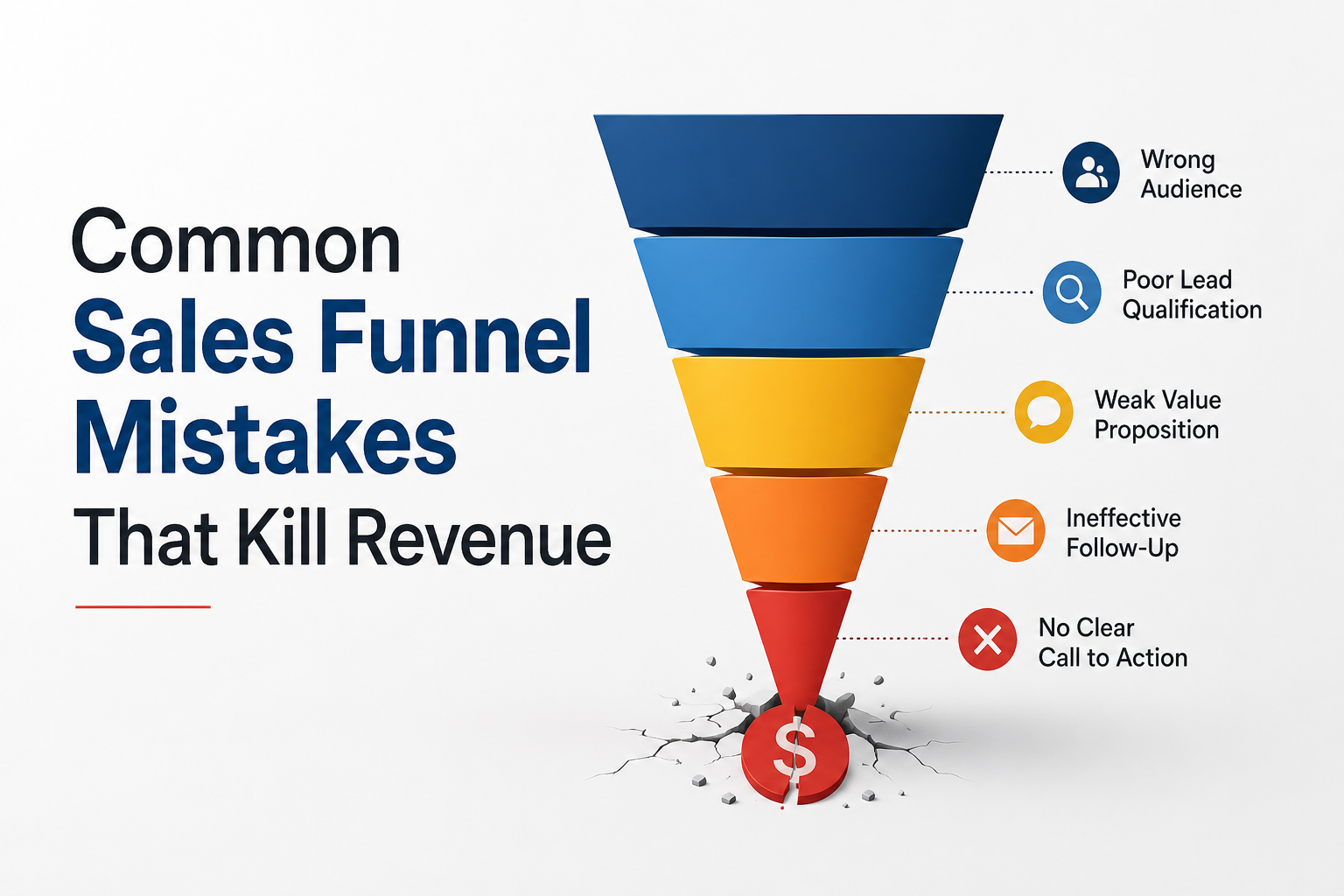
One of the biggest mistakes businesses make is prioritizing the number of leads over the quality of those leads. While generating thousands of leads may seem impressive, it means very little if those prospects are unlikely to become paying customers.
Sales teams often waste valuable time chasing unqualified prospects who have little interest, insufficient budgets, or no authority to make purchasing decisions. This not only lowers productivity but also delays engagement with high-value prospects who are genuinely ready to buy.
Instead of measuring success solely by lead volume, businesses should implement a strong lead qualification process. Understanding buyer intent, company size, industry, pain points, and purchasing authority helps ensure that sales representatives spend their time on opportunities with the highest potential.
Some indicators of high-quality leads include:
- Clear interest in your product or service
- Budget availability
- Decision-making authority
- Immediate business need
- Good alignment with your ideal customer profile (ICP)
Prioritizing lead quality over quantity leads to higher conversion rates and more predictable revenue growth.
Ignoring Customer Pain Points
Many sales teams become so focused on explaining product features that they forget to address the actual problems customers are trying to solve.
Today’s B2B buyers are looking for solutions, not product demonstrations. If your messaging revolves solely around technical specifications, prospects may fail to see the real business value your solution provides.
Successful sales conversations begin with understanding the customer’s challenges. Sales representatives should ask thoughtful questions, actively listen, and position their product as a solution to measurable business problems.
When customers feel understood, they develop greater trust in your company, making them far more likely to continue moving through the sales funnel.
Poor Follow-Up Strategy
Many sales opportunities are lost simply because businesses fail to follow up consistently.
Research consistently shows that most prospects do not make purchasing decisions after the first interaction. Complex B2B purchases often require multiple conversations, internal approvals, and extensive evaluation before a buying decision is made.
Unfortunately, many sales representatives either stop following up too early or send generic emails that provide little value.
An effective follow-up strategy should include personalized communication that offers additional insights, relevant case studies, educational resources, or answers to common objections. Every interaction should move the conversation forward instead of simply asking whether the prospect is ready to buy.
Consistency and relevance are the keys to successful follow-up.
Lack of Sales and Marketing Alignment
Sales and marketing teams often work toward the same revenue goals but operate independently. This disconnect creates confusion, inconsistent messaging, and poor lead quality.
Marketing may generate leads that sales considers unqualified, while sales teams may fail to provide valuable feedback about customer conversations that could improve marketing campaigns.
When both departments collaborate effectively, they create a seamless customer journey.
Alignment should include:
- Shared revenue goals
- Common lead qualification criteria
- Regular communication between teams
- Unified messaging
- Shared performance metrics
Organizations with strong sales and marketing alignment typically experience higher conversion rates, shorter sales cycles, and increased revenue.
Making the Buying Process Too Complicated
Modern buyers expect a simple and efficient purchasing experience. If your sales process involves too many forms, excessive meetings, unclear pricing, or unnecessary approval steps, prospects may lose interest before completing the purchase.
Every additional barrier increases the likelihood that potential customers will abandon the buying process and explore alternative solutions.
Businesses should regularly review every stage of their sales funnel and remove unnecessary complexity. Simplifying proposals, improving website navigation, reducing paperwork, and providing transparent pricing can dramatically improve conversions.
A frictionless buying experience creates confidence and encourages faster decision-making.
Not Using Data to Improve Sales Performance
Many organizations rely on assumptions instead of data when evaluating their sales funnel.
Without tracking key performance indicators, businesses cannot identify where prospects are dropping out or which stages require improvement.
Important metrics include:
- Lead-to-opportunity conversion rate
- Opportunity-to-customer conversion rate
- Sales cycle length
- Customer acquisition cost (CAC)
- Customer lifetime value (CLV)
- Win rate
- Average deal size
Regularly reviewing these metrics enables businesses to identify bottlenecks and make informed decisions that improve revenue performance.
Failing to Nurture Leads
Not every prospect is ready to buy immediately. Some buyers may spend weeks or even months researching before making a purchasing decision.
Businesses that stop communicating after the initial interaction often lose future opportunities.
Lead nurturing involves maintaining regular contact through valuable content, educational resources, webinars, newsletters, product updates, and personalized communication. This keeps your brand top of mind while helping prospects build confidence in your expertise.
Effective lead nurturing strengthens relationships and increases the likelihood of future conversions.
Ignoring Existing Customers
Many businesses devote most of their resources to acquiring new customers while overlooking their existing customer base.
However, retaining customers is often more cost-effective than acquiring new ones. Existing customers are also more likely to purchase additional products, upgrade their subscriptions, or recommend your business to others.
Customer retention strategies include:
- Regular account reviews
- Personalized customer support
- Cross-selling relevant solutions
- Upselling premium services
- Customer success programs
- Loyalty initiatives
A strong post-sale experience generates recurring revenue and long-term business growth.
Not Addressing Customer Objections Early
Every buyer has concerns before making a purchasing decision. These concerns may relate to pricing, implementation, integration, security, return on investment, or vendor credibility.
Some sales teams avoid discussing objections until late in the sales process, allowing uncertainty to build over time.
Successful sales professionals proactively identify and address concerns early. By providing clear answers, customer success stories, product demonstrations, and measurable outcomes, they reduce hesitation and build trust throughout the buying journey.
Transparency creates confidence and accelerates purchasing decisions.
Failing to Continuously Optimize the Sales Funnel
Markets evolve, customer expectations change, and competitors continuously improve their offerings. A sales funnel that performed well last year may no longer deliver the same results today.
Businesses should regularly evaluate every stage of their funnel to identify opportunities for improvement. Small optimizations can lead to significant gains in conversion rates and revenue.
Continuous optimization may include:
- Testing different landing pages
- Improving email sequences
- Updating sales messaging
- Refining lead qualification criteria
- Analyzing customer feedback
- Training sales teams on new selling techniques
Sales funnel optimization should be an ongoing process rather than a one-time project.
Best Practices for Building a High-Converting Sales Funnel
To maximize revenue and improve customer experience, businesses should adopt several best practices:
- Focus on attracting high-quality leads.
- Personalize every customer interaction.
- Align sales and marketing teams around shared goals.
- Use CRM and analytics tools to monitor performance.
- Nurture prospects with valuable content.
- Simplify the purchasing journey.
- Measure key sales metrics regularly.
- Continuously test and optimize every funnel stage.
These practices create a more efficient sales process while improving customer satisfaction and long-term profitability.
Conclusion
A sales funnel is much more than a sequence of marketing and sales activities—it is the foundation of sustainable revenue growth. Even small mistakes at different stages of the funnel can accumulate over time, leading to lost opportunities, longer sales cycles, lower conversion rates, and reduced profitability.
By focusing on lead quality, understanding customer needs, maintaining consistent follow-up, aligning sales and marketing efforts, simplifying the buying experience, and continuously optimizing the funnel using data, businesses can significantly improve their sales performance. Companies that treat their sales funnel as a dynamic process rather than a static system are better positioned to adapt to changing buyer behaviors, outperform competitors, and achieve consistent, long-term revenue growth.
Investing time in identifying and fixing these common sales funnel mistakes is not just about increasing conversions—it is about creating a customer-centric sales process that delivers value at every stage of the buyer’s journey and supports sustainable business success.
