



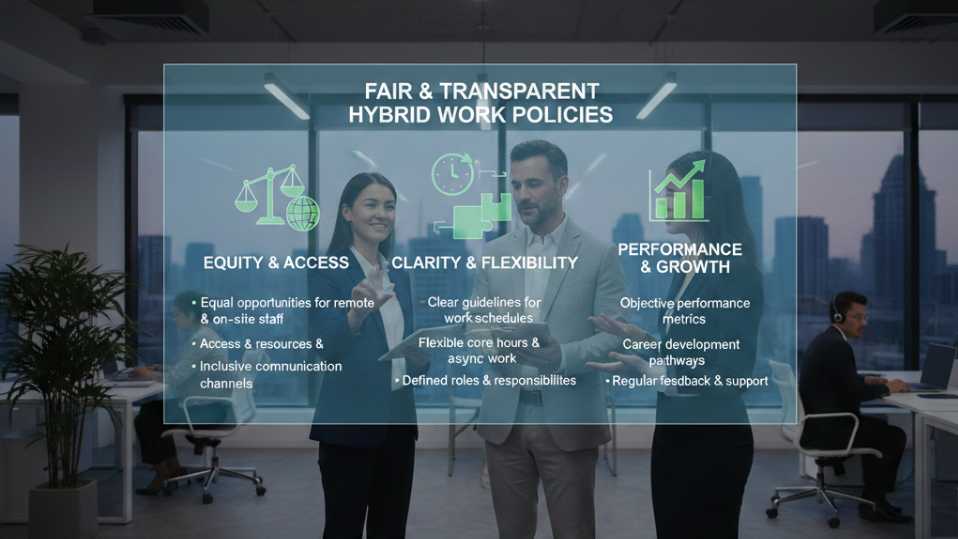
How to Create Fair and Transparent Hybrid Work Policies
Hybrid work has become a defining feature of the modern workplace. What started as a response to global disruption has now evolved into a preferred working model for many employees and organizations. While hybrid work offers flexibility and autonomy, it also introduces new challenges around fairness, communication, and consistency. Without a well-structured approach, hybrid policies can unintentionally create inequality, confusion, and mistrust.
Creating fair and transparent hybrid work policies is not just a human resources task—it is a leadership responsibility. A thoughtfully designed policy ensures that employees feel supported, valued, and treated equitably, regardless of whether they work from home, the office, or a mix of both.
Establish a Clear Purpose for Hybrid Work
The foundation of any effective hybrid work policy lies in clearly defining its purpose. Organizations must articulate why they are adopting a hybrid model and what they aim to achieve through it. Whether the focus is improving employee well-being, maintaining productivity, expanding talent pools, or fostering collaboration, clarity of intent guides better decision-making.
When the purpose is clearly communicated, employees are less likely to view hybrid work as arbitrary or exclusive. Transparency around the “why” helps align expectations across teams and reinforces the idea that the policy exists to support both business goals and employee needs.
Design Role-Based, Not Person-Based, Policies
Fairness in hybrid work depends heavily on objectivity. Policies should be based on job roles and operational requirements rather than individual preferences or informal agreements. Some roles may require physical presence due to the nature of the work, while others can be performed effectively from anywhere. Explaining these distinctions openly helps reduce resentment and misunderstanding.
Rather than offering blanket flexibility or leaving decisions entirely to managers, organizations should outline clear criteria for hybrid eligibility. This approach ensures that employees understand how decisions are made and trust that the system is consistent and equitable.
Clearly Define Expectations and Boundaries
Hybrid work can blur the lines between work and personal life if expectations are not clearly defined. A transparent policy sets boundaries around working hours, availability, communication norms, and performance standards. Employees should know when they are expected to be reachable, how collaboration will happen, and how their performance will be measured.
Important areas to clarify include:
- Expected in-office and remote work schedules
- Core hours for meetings and collaboration
- Guidelines for communication and response times
- Performance metrics focused on outcomes rather than physical presence
Clear expectations reduce uncertainty and empower employees to manage their time effectively while maintaining accountability.
Ensure Consistency in Policy Application
Even the most well-written hybrid policy can fail if it is applied inconsistently. When managers interpret rules differently or make exceptions without explanation, employees may perceive favoritism or bias. To avoid this, organizations should train managers on how to apply hybrid work guidelines fairly and uniformly.
Regular audits or check-ins can help identify inconsistencies across departments. Consistent application not only strengthens fairness but also reinforces trust in leadership and organizational values.
Address Bias and Promote Equal Opportunities
Hybrid work environments can unintentionally disadvantage remote employees if organizations are not proactive. Proximity bias—favoring employees who are physically present—can influence promotions, project assignments, and recognition. Fair hybrid policies must actively counter this risk.
Organizations should ensure that opportunities for growth, visibility, and advancement are equally accessible. This means standardizing evaluation processes, documenting decisions, and ensuring that meetings and discussions are inclusive of remote participants. Fairness is achieved not by assuming equality, but by intentionally designing systems that support it.
Foster Open Communication and Feedback
Transparency thrives in an environment where communication flows both ways. Employees should have access to clear documentation and regular updates about hybrid work policies. More importantly, they should feel safe sharing feedback and raising concerns.
Open forums, surveys, and check-ins provide valuable insights into how the policy is working in practice. A willingness to listen and adapt demonstrates respect for employee experiences and reinforces trust. Hybrid work policies should be treated as evolving frameworks rather than fixed rules.
Use Data and Evidence to Guide Decisions
Fair and transparent policies are rooted in data, not assumptions. Organizations should regularly assess productivity, engagement, collaboration, and employee satisfaction across different work arrangements. This data can reveal patterns, highlight challenges, and inform necessary adjustments.
Sharing high-level findings with employees further enhances transparency. When people see that decisions are backed by evidence, they are more likely to trust leadership and support ongoing improvements.
Document Policies Clearly and Accessibly
A hybrid work policy should be formally documented, easy to understand, and accessible to all employees. Clear documentation eliminates ambiguity and ensures that everyone has the same reference point. This is particularly important for onboarding new hires and managing cross-functional teams.
Well-documented policies also provide structure during times of change, helping organizations adapt without losing consistency or fairness.
Conclusion
Creating fair and transparent hybrid work policies requires intention, consistency, and continuous communication. It is not enough to offer flexibility—organizations must ensure that flexibility is applied equitably, supported by clear expectations, and reinforced by inclusive practices. By defining purpose, setting objective criteria, promoting equal opportunities, and listening to employee feedback, organizations can build hybrid work environments rooted in trust and accountability. In doing so, they not only support employee well-being but also create resilient, high-performing workplaces prepared for the future of work.
