


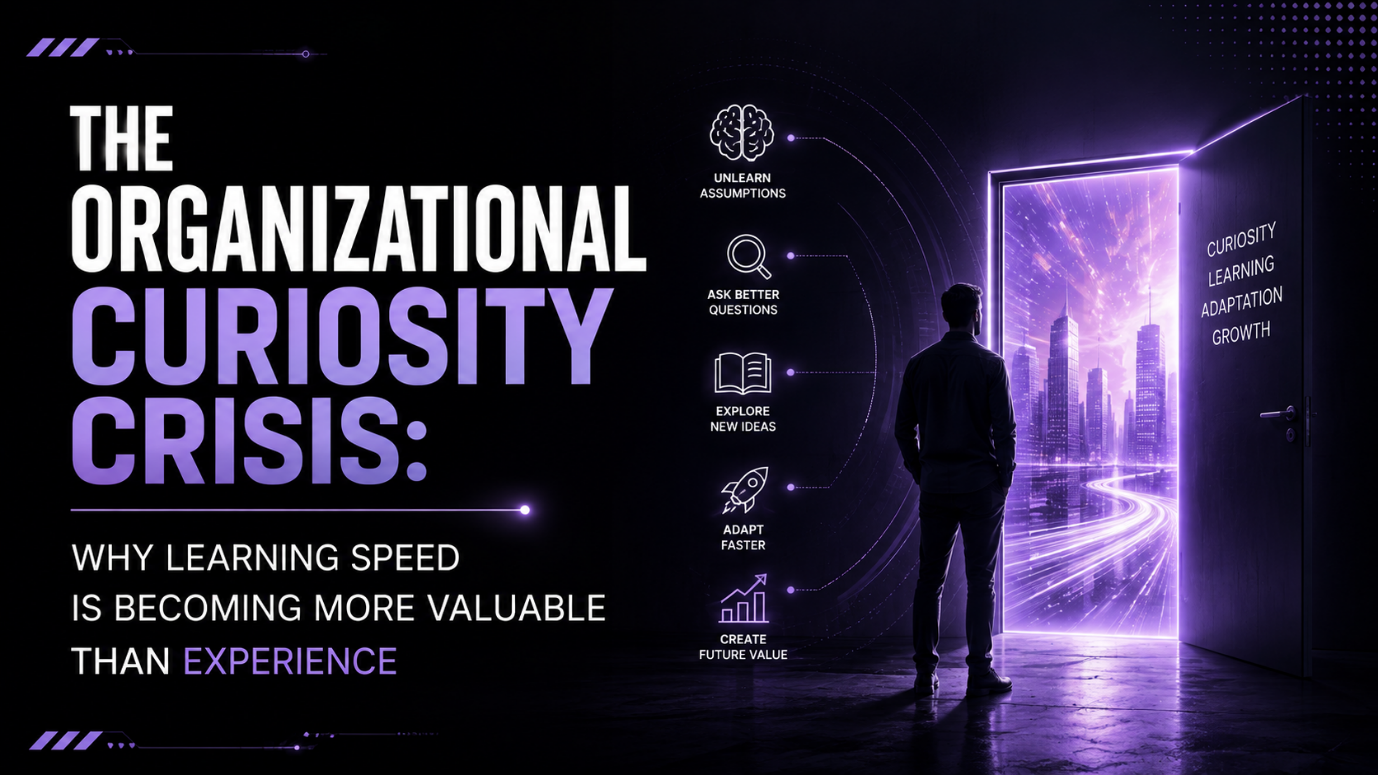

For decades, organizations evaluated talent using a remarkably consistent formula. Years of experience, industry expertise, technical certifications, domain knowledge, and proven professional accomplishments were considered the strongest indicators of future success. Recruitment strategies prioritized candidates who had already solved similar problems, leadership pipelines rewarded employees with long tenures, and organizational stability was built upon accumulated institutional knowledge. Experience represented predictability, and predictability reduced business risk. While this approach served enterprises well during periods of gradual technological change, today’s business environment operates according to entirely different rules. Artificial intelligence is transforming job responsibilities faster than organizations can redesign them. New software platforms emerge every month, business models evolve continuously, regulations shift rapidly, and entirely new skill categories appear almost overnight. In such an environment, yesterday’s expertise can become tomorrow’s legacy knowledge far more quickly than ever before. This transformation is creating what can be described as the Organizational Curiosity Crisis, where the ability to learn continuously is becoming more strategically valuable than the knowledge employees already possess.
The changing nature of work lies at the heart of this crisis. Modern professionals are no longer expected to perform the same responsibilities throughout their careers. Marketing teams now collaborate with AI systems to generate campaigns, sales organizations rely on predictive analytics and buying intelligence, HR departments implement skills-based workforce strategies, finance professionals increasingly use automation for forecasting, and software engineers continuously adapt to new frameworks, architectures, and development tools. The pace of change has become so rapid that expertise acquired only a few years earlier often requires significant updating. Organizations therefore face a difficult reality: hiring exclusively for existing knowledge no longer guarantees future performance because the knowledge itself may evolve before employees have fully mastered it.
Artificial intelligence accelerates this transformation by dramatically lowering the barriers to acquiring information. Employees can instantly access explanations, tutorials, technical documentation, coding assistance, market analysis, research summaries, and personalized learning experiences through intelligent systems. Information itself is becoming increasingly accessible to everyone. Consequently, competitive advantage shifts away from possessing knowledge toward acquiring new knowledge faster than competitors. Organizations capable of learning rapidly adapt more effectively because they respond to technological disruption while others continue relying on outdated assumptions. Curiosity becomes an operational capability rather than merely a desirable personality trait.
Historically, professional experience provided businesses with confidence because it reflected years of practical exposure to similar challenges. However, experience is inherently retrospective. It demonstrates what someone has successfully accomplished within previous environments. Curiosity, by contrast, is future-oriented. It reflects an individual’s willingness to question assumptions, explore unfamiliar technologies, experiment with emerging approaches, and continuously redefine existing expertise. As technological disruption accelerates, organizations increasingly require professionals capable of navigating uncertainty rather than simply repeating established best practices. Experience explains how work was performed yesterday. Curiosity determines how work will evolve tomorrow.
One of the clearest examples of this shift can be observed in enterprise AI adoption. Organizations introducing generative AI frequently discover that the employees embracing these technologies are not always the most experienced specialists. Instead, early adopters are often individuals naturally inclined to experiment, test new workflows, challenge conventional processes, and integrate unfamiliar tools into their daily responsibilities. These employees rarely possess perfect knowledge at the beginning. Their competitive advantage lies in learning rapidly through exploration. Over time, they become organizational leaders not because they started with superior expertise but because they consistently acquired new capabilities ahead of everyone else.
This emerging reality challenges traditional hiring philosophies. Job descriptions have historically emphasized years of experience, specific software proficiency, industry exposure, and predefined technical qualifications. While these criteria remain relevant, they increasingly fail to predict long-term adaptability. A candidate with ten years of experience using technologies approaching obsolescence may contribute less future value than someone with fewer years of experience but exceptional learning agility. Forward-looking organizations therefore expand recruitment beyond technical competence to evaluate curiosity, experimentation, problem-solving, adaptability, and intellectual flexibility. Interviews increasingly explore how candidates learn unfamiliar concepts rather than simply measuring what they already know.
The Organizational Curiosity Crisis also influences leadership development. Senior executives traditionally earned influence through accumulated expertise and deep functional specialization. Modern leaders, however, frequently oversee technologies and business models evolving faster than any individual can master personally. Leadership therefore becomes less about possessing every answer and more about cultivating organizations capable of discovering answers collectively. Curious leaders openly ask questions, encourage experimentation, support continuous learning, and remain comfortable acknowledging uncertainty. They create cultures where exploration is rewarded rather than perceived as a sign of insufficient expertise.
Learning itself is undergoing a significant transformation because of AI. Traditional corporate training often followed structured schedules involving annual workshops, classroom sessions, certification programs, and predefined learning paths. Artificial intelligence enables continuous, personalized learning integrated directly into daily work. Employees can receive contextual guidance while completing tasks, ask intelligent assistants for explanations, generate customized practice scenarios, summarize complex documentation, and immediately apply new concepts to real business problems. Learning becomes an ongoing operational process instead of an occasional organizational event. Curiosity flourishes because acquiring knowledge becomes significantly more convenient than waiting for formal training opportunities.
This evolution also changes performance management. Conventional appraisal systems often evaluate employees according to productivity, efficiency, quality, and achievement of predefined objectives. Future organizations increasingly recognize learning behaviour itself as a strategic performance indicator. Employees demonstrating consistent experimentation, rapid capability development, cross-functional knowledge sharing, and proactive exploration contribute value extending beyond immediate operational outcomes. Organizations therefore begin rewarding not only successful execution but also successful adaptation. The willingness to learn becomes measurable business performance rather than an intangible personal quality.
One of the greatest risks facing enterprises is the emergence of organizational complacency. Companies experiencing sustained success often develop confidence in existing processes, technologies, and operating models. Over time, this confidence gradually discourages questioning established assumptions because current approaches continue producing acceptable results. Yet technological disruption rarely announces itself dramatically. Competitive advantages erode gradually until entirely new business models redefine market expectations. Organizations lacking curiosity frequently recognize transformation only after competitors have already adapted. Curiosity functions as an early warning system because curious employees continually monitor emerging trends before disruption becomes unavoidable.
The Organizational Curiosity Crisis is equally relevant to knowledge retention. Experienced employees possess valuable institutional understanding accumulated through years of practical work. However, organizations sometimes unintentionally encourage these professionals to protect expertise rather than expand it. Continuous learning cultures instead position experienced employees as mentors who combine historical perspective with ongoing exploration. Their value lies not only in what they know but also in their ability to model lifelong learning for the broader workforce. Experience and curiosity become complementary rather than competing strengths.
Technology leaders increasingly recognize curiosity as essential for innovation. Breakthrough ideas rarely emerge from repeatedly applying familiar methods to familiar problems. Innovation occurs when individuals connect unrelated disciplines, question conventional assumptions, explore emerging technologies, and remain intellectually open to alternative possibilities. AI itself amplifies these opportunities by enabling employees to prototype concepts, test hypotheses, analyse market data, and generate creative solutions with unprecedented speed. Curious organizations therefore innovate faster because experimentation becomes operationally affordable rather than prohibitively expensive.
Perhaps the most significant implication of the Organizational Curiosity Crisis concerns organizational resilience. Businesses can no longer accurately predict every technological development likely to influence their industries over the next decade. Attempting to prepare employees for every future scenario individually is impossible. Instead, organizations create resilience by cultivating workforces capable of learning continuously regardless of which technologies emerge next. Curiosity becomes the capability enabling adaptation when certainty disappears. Rather than preparing employees for one specific future, organizations prepare them to succeed across many possible futures.
Artificial intelligence will only increase the importance of this transformation. As routine tasks become increasingly automated, uniquely human value shifts toward creativity, judgment, critical thinking, collaboration, strategic interpretation, and continuous learning. Employees will increasingly differentiate themselves not through memorized knowledge but through their ability to acquire, evaluate, and apply new knowledge faster than changing business environments demand. The half-life of professional expertise will continue shrinking, making curiosity one of the most valuable long-term investments any organization can cultivate.
Ultimately, the Organizational Curiosity Crisis reminds business leaders that the future belongs neither to the most experienced organizations nor to the companies adopting the newest technologies first. It belongs to the organizations whose people remain intellectually restless, continuously questioning assumptions, embracing uncertainty, and expanding their capabilities faster than the world changes around them. Because in an economy where knowledge expires faster than ever before, curiosity is no longer simply the beginning of learning, it is becoming the foundation of competitive advantage itself.
