



The Rise of AI Co-Selling in Modern B2B Sales
AI co-selling is no longer a futuristic concept—it is actively reshaping how B2B organizations approach prospecting, qualification, follow-ups, and forecasting. Instead of replacing sales representatives, AI is increasingly acting as a digital teammate. Advanced tools integrated into platforms like Salesforce and HubSpot now assist with lead scoring, automated outreach, pipeline insights, and real-time recommendations during sales conversations.
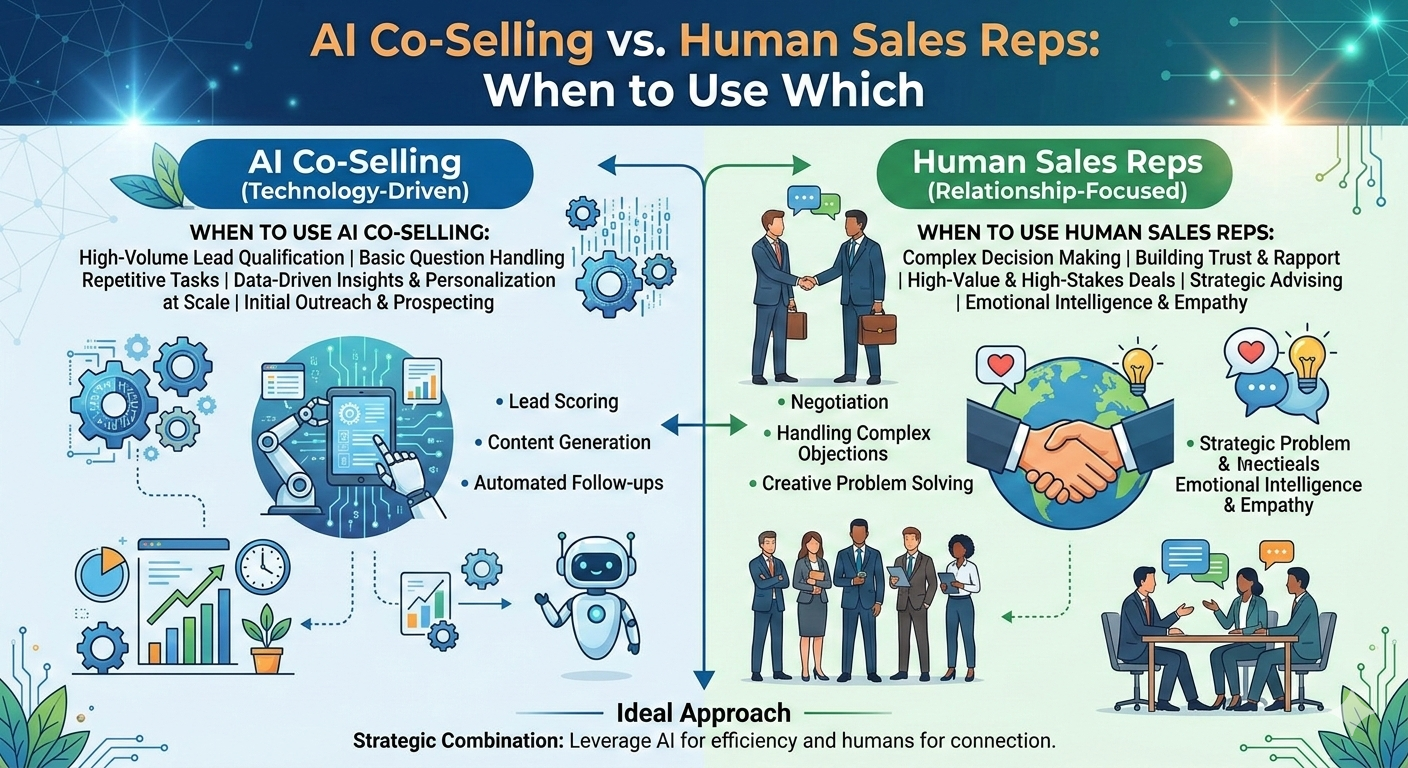
AI co-selling refers to a hybrid approach where artificial intelligence handles data-driven, repetitive, and predictive tasks while human sales reps focus on relationship building and strategic selling. This partnership enables companies to scale outreach without proportionally increasing headcount. However, the critical question remains: when should AI lead, and when should humans take over?
Understanding this distinction is essential for organizations that want to improve efficiency without sacrificing trust and deal quality.
What AI Does Best in the Sales Process
AI excels in areas where speed, data processing, and pattern recognition matter more than emotional intelligence. It can analyze thousands of buying signals, engagement metrics, and historical deal outcomes in seconds—something no human rep can realistically do.
AI co-selling performs best in:
- Lead scoring and prioritization based on behavioral and firmographic data
- Automated prospecting and cold outreach sequencing
- Email personalization at scale using dynamic content
- Pipeline forecasting and risk detection
- Real-time conversation intelligence during sales calls
Because AI can continuously learn from CRM data, it improves targeting accuracy over time. For example, AI tools can identify which prospects are most likely to convert based on past wins, allowing sales teams to focus on high-value opportunities instead of guessing.
In early-stage sales activities—especially high-volume outbound campaigns—AI often outperforms manual methods in both efficiency and consistency.
Where Human Sales Reps Create Irreplaceable Value
Despite the power of automation, human sales reps remain essential—particularly in complex B2B environments. Enterprise sales cycles often involve multiple stakeholders, political dynamics, budget constraints, and emotional considerations. AI can surface insights, but it cannot fully replicate empathy, persuasion, or strategic negotiation.
Human sales reps are most valuable when:
- Navigating multi-stakeholder decision processes
- Handling objections that require nuanced understanding
- Building executive-level relationships
- Negotiating pricing and contract terms
- Managing long-term strategic accounts
Trust plays a major role in high-ticket B2B deals. Buyers often choose vendors based not only on product features but on confidence in the people behind the solution. Human intuition, adaptability, and emotional intelligence are critical in these situations.
When the deal value increases, the need for human involvement typically increases as well.
The Ideal Sales Funnel: Where AI vs. Humans Fit
The most effective B2B teams do not choose between AI and humans—they strategically assign responsibilities throughout the sales funnel.
Top of Funnel (Awareness & Prospecting):
AI should take the lead. Automated outreach, data enrichment, behavioral tracking, and predictive scoring help generate and qualify leads efficiently.
Middle of Funnel (Qualification & Education):
AI and humans collaborate. AI provides insights, tracks engagement, and suggests next actions, while reps conduct discovery calls and tailor conversations.
Bottom of Funnel (Negotiation & Closing):
Human reps take control. This stage requires relationship management, custom solutions, and trust-based persuasion.
Post-Sale & Expansion:
AI monitors customer health scores and renewal risks, while account managers strengthen relationships and identify upsell opportunities.
This hybrid model ensures efficiency without sacrificing personalization.
When to Prioritize AI Co-Selling
There are clear scenarios where AI should be the dominant force in the sales workflow.
Organizations should lean heavily on AI when:
- Sales cycles are short and transactional
- The product offering is standardized
- Outreach volume is high
- Data availability is strong and structured
- The team needs scalability without increasing payroll costs
In SaaS companies with mid-market or SMB audiences, AI-driven automation can dramatically increase productivity. Instead of manually sending hundreds of emails, sales reps can focus only on prospects showing real buying intent.
In these environments, AI becomes a revenue multiplier.
When Human Sales Reps Should Lead
AI should support—but not dominate—situations that demand strategic thinking and deep collaboration. Complex enterprise deals often involve custom pricing, compliance considerations, and long sales cycles. These scenarios demand trust, adaptability, and political awareness inside the buyer’s organization.
Human-led selling is critical when:
- Deal sizes are large and risk exposure is high
- Buying committees are involved
- Solutions require customization
- Brand reputation and long-term partnerships matter
- Emotional assurance influences decision-making
In these cases, AI provides intelligence and preparation, but the human rep carries the relationship forward.
The Risk of Over-Automation in Sales
While automation increases efficiency, over-reliance on AI can create robotic buyer experiences. Prospects can quickly detect generic messaging or automated sequences that lack authenticity. This erodes trust and damages brand perception.
Sales organizations that automate without strategy often face:
- Reduced response rates due to message fatigue
- Impersonal buyer interactions
- Over-qualification errors from imperfect data
- Dependence on algorithms without strategic oversight
AI should enhance personalization—not eliminate it. When automation replaces empathy, conversion rates often decline despite higher activity levels.
Building a Balanced AI + Human Sales Strategy
The key to successful AI co-selling is integration, not replacement. Leadership must clearly define which tasks belong to AI and which require human intervention. Training sales reps to interpret AI insights is just as important as implementing the technology itself.
A balanced strategy involves:
- Integrating AI into CRM workflows
- Training reps to use data insights effectively
- Continuously auditing automation quality
- Aligning sales and marketing data systems
- Measuring both efficiency metrics and relationship quality
When implemented thoughtfully, AI increases productivity while allowing human reps to operate at a higher strategic level.
The Future of AI Co-Selling
As machine learning models grow more advanced, AI will continue evolving from a support tool into a collaborative partner. Real-time deal coaching, predictive buying signals, and autonomous outreach agents will become standard features in B2B sales ecosystems.
However, even as technology advances, B2B sales will remain fundamentally human. Decisions involving budgets, reputations, and long-term strategy require trust. AI may accelerate insights, but humans close complex deals.
The future does not belong to AI alone or human reps alone—it belongs to teams that combine both intelligently.
Conclusion
AI co-selling and human sales reps are not competitors; they are complementary forces in modern B2B sales. AI excels at speed, scale, and data processing, making it ideal for prospecting, scoring, and forecasting. Human sales reps excel at trust, negotiation, and strategic relationship management, making them indispensable in complex and high-value deals.
Organizations that clearly define when to use AI and when to rely on human expertise will outperform those that treat automation as a replacement rather than an enhancement. The winning formula lies in a hybrid approach—where AI drives efficiency and humans drive connection.
In the end, technology may open the door, but people still close the deal.
