



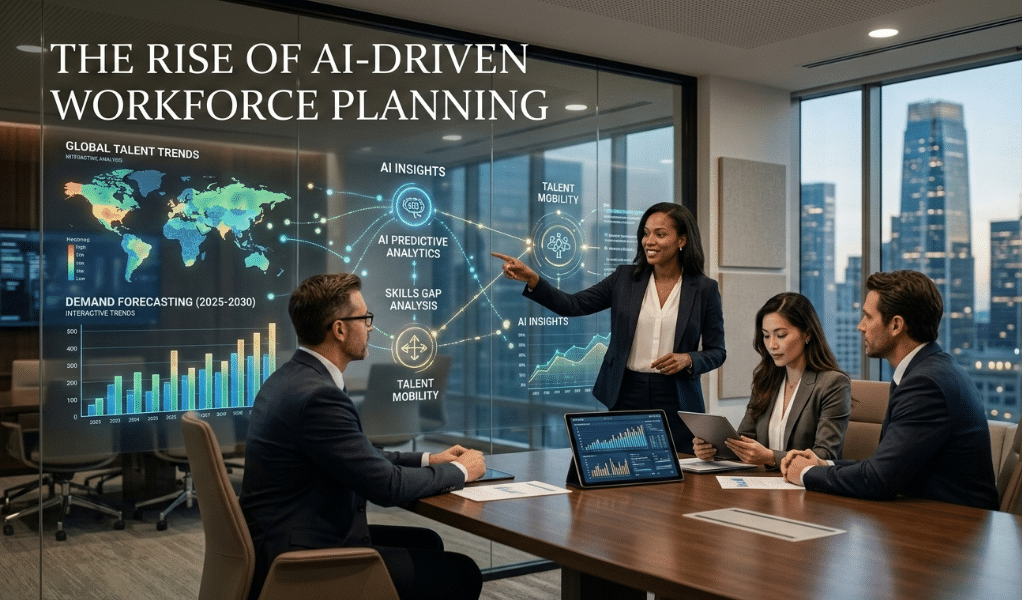
Introduction: A New Era of Workforce Strategy
Workforce planning has always been a critical responsibility for human resource leaders, but the complexity of modern workplaces has made traditional approaches increasingly insufficient. Organizations today operate in rapidly changing environments shaped by technological advancement, global competition, and evolving employee expectations. As businesses strive to remain competitive, workforce planning must become more proactive, predictive, and data-driven rather than reactive. This is where artificial intelligence (AI) is transforming how companies plan, manage, and optimize their workforce.
AI-driven workforce planning uses advanced analytics, machine learning, and intelligent automation to analyze workforce data, forecast talent needs, and support strategic decision-making. Instead of relying solely on historical reports or manual forecasting, organizations can now use AI tools to anticipate future skill requirements, identify workforce gaps, and make more informed hiring and development decisions. As a result, HR teams are moving from administrative roles toward strategic partners that help drive business growth.
Understanding AI-Driven Workforce Planning
AI-driven workforce planning refers to the use of artificial intelligence technologies to analyze workforce data and support better talent planning decisions. These technologies examine large datasets, including employee performance, productivity trends, market conditions, and organizational goals, to generate insights that guide HR strategies.
Traditional workforce planning often depended on spreadsheets, historical trends, and managerial assumptions. While these methods provided some guidance, they lacked the ability to account for complex variables or rapidly changing conditions. AI systems, on the other hand, can process massive volumes of data in real time and uncover patterns that human analysis might overlook.
For example, AI algorithms can identify which departments are likely to face skill shortages in the future or predict the probability of employee turnover. By providing these insights early, organizations can take proactive measures such as reskilling employees, adjusting hiring strategies, or reorganizing teams. In this way, AI enables workforce planning to become both strategic and forward-looking.
Why AI Is Transforming Workforce Planning
Several factors have contributed to the growing adoption of AI in workforce planning. Organizations are dealing with increased workforce complexity, rapid technological change, and greater pressure to align talent strategies with business objectives. AI provides the tools needed to manage these challenges more effectively.
One of the primary reasons for AI’s rise in workforce planning is its ability to convert raw data into actionable insights. HR departments collect vast amounts of information about employees, but without advanced analytics, much of this data remains underutilized. AI technologies help unlock the value of this data by identifying patterns, predicting trends, and supporting strategic decisions.
Another important factor is the growing importance of skills-based workforce strategies. As industries evolve, the demand for new skills increases while some existing roles become obsolete. AI helps organizations map employee skills, identify gaps, and plan targeted training programs. This allows companies to prepare their workforce for future demands rather than reacting to skill shortages after they occur.
Key Benefits of AI-Driven Workforce Planning
AI brings several powerful advantages to workforce planning, enabling HR teams to operate with greater precision and efficiency. By leveraging predictive analytics and automation, organizations can make smarter decisions about talent acquisition, development, and retention.
Some of the most important benefits include:
- Improved workforce forecasting: AI can predict future talent needs based on business growth, market trends, and historical workforce data.
- Better talent allocation: Intelligent systems help identify the best employees for specific roles or projects based on skills and performance data.
- Reduced employee turnover: AI tools can detect patterns that indicate potential employee disengagement or resignation risks.
- Enhanced productivity: Organizations can optimize team structures and workloads to maximize efficiency.
- Data-driven decision making: HR leaders can base workforce strategies on analytics rather than intuition alone.
These benefits allow companies to align their workforce strategies more closely with long-term business objectives, ensuring that the right people with the right skills are available at the right time.
Predictive Analytics and Workforce Forecasting
One of the most powerful capabilities of AI in workforce planning is predictive analytics. Predictive models analyze historical and real-time data to forecast future workforce needs, allowing organizations to prepare for upcoming changes.
For instance, AI systems can examine employee turnover patterns and predict which roles are most vulnerable to attrition. If a company identifies a department with high turnover risk, it can implement retention initiatives, improve employee engagement programs, or begin recruiting replacements early. Similarly, predictive models can estimate the number of employees required to support business expansion in new markets or product lines.
Predictive workforce forecasting also helps organizations avoid overstaffing or understaffing. By understanding future workforce requirements, HR teams can maintain optimal staffing levels and reduce unnecessary labor costs while ensuring that critical roles are filled.
AI and Skills-Based Workforce Planning
Modern organizations are shifting from traditional job-based structures to skills-based workforce models. Instead of focusing solely on job titles, companies are increasingly prioritizing the specific skills employees possess and how those skills contribute to organizational goals.
AI plays a crucial role in this transformation by analyzing employee skills data across the organization. Intelligent systems can create detailed skill inventories, mapping the capabilities of individual employees and teams. These insights help organizations identify existing strengths and pinpoint areas where additional skills are needed.
With AI-driven skill mapping, HR leaders can also design targeted learning and development programs. Employees can be recommended personalized training opportunities based on their career goals and the organization’s future skill requirements. This approach not only strengthens the workforce but also improves employee engagement by supporting career growth and internal mobility.
Enhancing Talent Acquisition with AI Insights
AI-driven workforce planning also significantly improves talent acquisition strategies. Instead of simply reacting to hiring needs as they arise, organizations can use AI insights to plan recruitment efforts more strategically.
By analyzing business growth projections, workforce demographics, and market trends, AI systems can identify future hiring requirements well in advance. This allows HR teams to build talent pipelines, develop employer branding strategies, and attract candidates with the necessary skills before demand becomes urgent.
AI can also assist recruiters in evaluating candidates more effectively by analyzing resumes, identifying relevant skills, and predicting candidate success based on historical hiring data. This reduces hiring bias and improves the quality of recruitment decisions. As a result, organizations can build stronger teams while reducing the time and cost associated with hiring.
Challenges in Implementing AI-Driven Workforce Planning
Despite its many advantages, implementing AI-driven workforce planning is not without challenges. Organizations must address several obstacles to ensure successful adoption and maximize the value of AI technologies.
Some common challenges include:
- Data quality issues: AI systems rely heavily on accurate and comprehensive workforce data. Incomplete or outdated information can reduce the effectiveness of AI insights.
- Privacy and ethical concerns: Workforce data includes sensitive employee information, requiring strong data governance and ethical guidelines.
- Technology integration: Integrating AI tools with existing HR systems can be complex and time-consuming.
- Skills gap within HR teams: HR professionals may need additional training to effectively use AI tools and interpret advanced analytics.
Addressing these challenges requires careful planning, strong leadership support, and collaboration between HR, IT, and data analytics teams.
The Future of Workforce Planning with AI
As AI technology continues to evolve, its role in workforce planning will become even more significant. Future AI systems are expected to provide deeper insights into workforce behavior, productivity, and collaboration patterns. Advanced AI models may even simulate different workforce scenarios, allowing organizations to test the potential impact of strategic decisions before implementing them.
Additionally, AI will likely become more integrated with other workplace technologies such as employee experience platforms, learning management systems, and performance management tools. This integration will create a more holistic view of the workforce, enabling organizations to manage talent more effectively.
In the coming years, HR leaders will increasingly rely on AI to guide workforce strategies, making talent management more predictive, agile, and aligned with business goals.
Conclusion
The rise of AI-driven workforce planning marks a major shift in how organizations manage and develop their talent. By leveraging artificial intelligence, companies can move beyond traditional workforce planning methods and adopt a more strategic, data-driven approach. AI enables HR leaders to forecast talent needs, identify skill gaps, optimize workforce allocation, and make better hiring decisions.
While challenges such as data quality, ethical considerations, and technology integration remain, the benefits of AI-powered workforce planning far outweigh the obstacles. Organizations that successfully adopt AI in their HR strategies will be better positioned to adapt to changing market conditions, support employee development, and achieve long-term business success.
Ultimately, AI-driven workforce planning is not about replacing human judgment but enhancing it. By combining advanced technology with human expertise, organizations can build more resilient, agile, and future-ready workforces.
