



Introduction
Every organisation has a vision for where it wants to go. Leadership teams spend considerable time developing business strategies, establishing organisational objectives, identifying growth opportunities, and defining long-term priorities. These strategic decisions are intended to provide direction to the entire workforce, ensuring that every department, manager, and employee contributes towards achieving common business goals. However, despite the effort invested in strategic planning, many organisations struggle with a fundamental challenge: translating leadership’s vision into practical actions that employees can understand and implement.
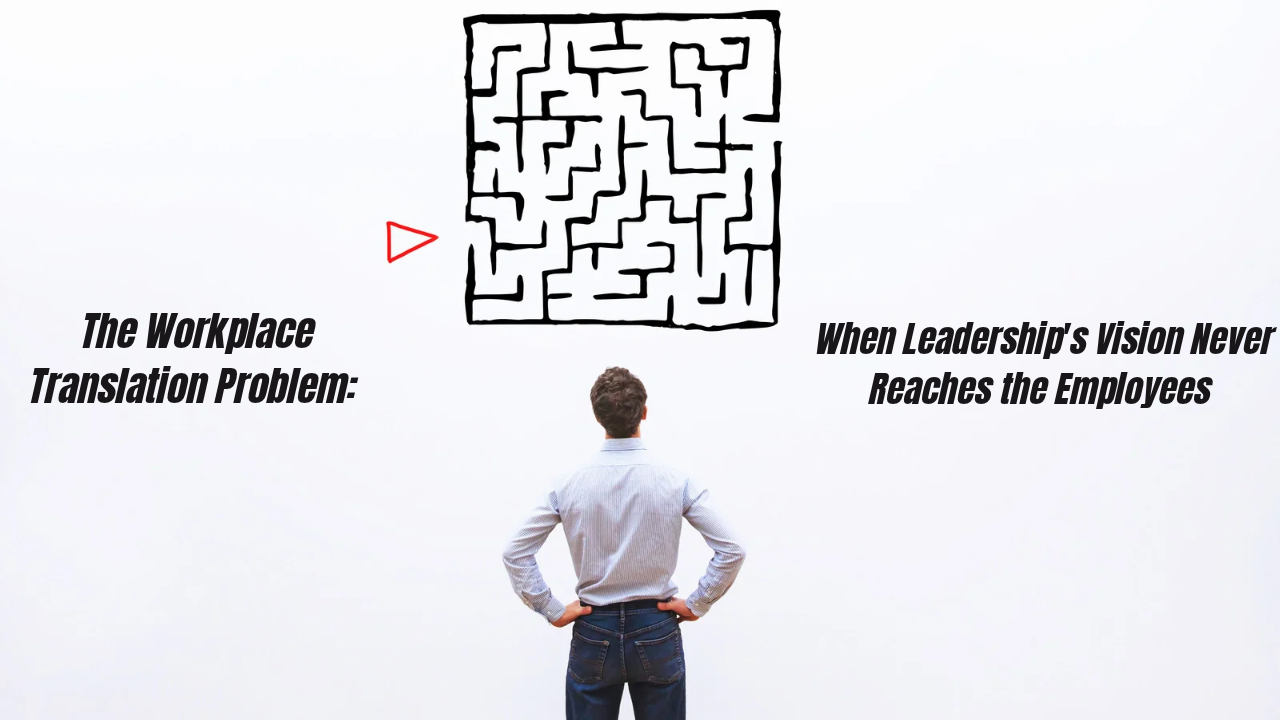
This is where the Workplace Translation Problem begins. Senior executives may communicate ambitious objectives such as business transformation, revenue growth, digital innovation, operational excellence, and improved customer experience. While these priorities may be clear to leadership, employees responsible for executing them may not understand what they mean for their everyday responsibilities. A company may announce an expansion strategy, but employees may interpret it as an expectation to handle additional workloads. Management may introduce a customer-centric business model, but individual departments may continue following the same processes they have used for years.
The issue is not always a failure to communicate information. In many situations, employees receive announcements, attend meetings, read internal newsletters, and acknowledge management instructions. The real problem emerges when the meaning, relevance, and practical application of those messages become unclear as they move through different organisational levels.
The Workplace Translation Problem highlights the disconnect between organisational vision and the daily activities through which employees are expected to achieve it. Businesses may have well-defined strategies, experienced leadership teams, and capable employees, but these elements cannot work together effectively without a shared understanding of organisational priorities.
To overcome this challenge, organisations must move beyond simply communicating business objectives. They need to translate strategic decisions into clear departmental goals, measurable employee responsibilities, and actionable expectations. Understanding this communication gap is essential for improving employee engagement, strengthening organisational alignment, and ensuring that business strategies produce meaningful results.
1. Understanding the Workplace Translation Problem in Modern Organisations
The Workplace Translation Problem refers to the gap between what organisational leadership intends to achieve and what employees actually understand about their responsibilities in achieving those objectives. It develops when strategic messages are communicated at a high level without being translated into practical expectations for different teams and individuals.
Leadership teams generally approach business decisions from a broader perspective. They focus on profitability, market expansion, competitive positioning, customer retention, business sustainability, and organisational growth. Employees, however, are more closely connected to immediate operational responsibilities, such as completing assignments, managing customer requests, coordinating projects, meeting deadlines, and maintaining productivity.
Both perspectives are necessary, but they do not automatically connect. When leadership announces a new strategic direction, employees need to understand how that direction influences their existing responsibilities and future priorities.
For example, consider an organisation that introduces a strategy to improve customer retention. Senior management may expect every department to contribute towards creating a better customer experience. However, the sales team may interpret the objective as increasing client communication, while marketing focuses on personalised campaigns. Operations may prioritise faster delivery, and finance may concentrate on improving invoicing procedures.
Although all these activities may contribute to customer retention, they can become disconnected if departments do not share a common understanding of the expected outcome.
This is one of the most important aspects of the Workplace Translation Problem: employees can work hard, achieve their individual targets, and complete assigned responsibilities while the organisation still struggles to achieve its broader objectives.
Businesses must therefore establish a clear relationship between strategic vision, departmental priorities, team responsibilities, and individual performance. When employees understand this relationship, organisational strategy becomes more than a management announcement. It becomes a practical framework for everyday decision-making.
2. The Language Gap Between Leadership Strategy and Employee Responsibilities
One of the primary causes of the Workplace Translation Problem is the difference between the language used by senior leadership and the language employees need to perform their work effectively.
Leadership teams frequently communicate through strategic terminology such as business transformation, operational excellence, digital acceleration, customer-centricity, organisational agility, and revenue optimisation. These expressions may provide a clear strategic direction to senior executives, but they do not always explain what employees should do differently.
For instance, announcing an objective to improve operational excellence does not explain whether employees should reduce processing time, automate repetitive activities, minimise errors, improve communication, or redesign existing workflows.
Different departments may interpret the same business objective according to their own responsibilities and priorities. The marketing team might associate business transformation with new digital campaigns, while the technology department may understand it as implementing new software. Human resources may focus on workforce development, and operations may prioritise process automation.
The problem is not that these interpretations are necessarily incorrect. The problem is that employees may be working towards different versions of the same organisational objective.
To overcome this challenge, leadership must translate broad strategic language into practical instructions. Instead of simply asking employees to support innovation, management should explain how innovation applies to individual departments. This could involve identifying inefficient processes, encouraging employees to suggest improvements, introducing opportunities for experimentation, or reducing unnecessary approval requirements.
Effective leadership communication should answer three important questions:
- What is the organisation trying to achieve?
- Why is this objective important to the business?
- What specific actions are employees expected to take?
Addressing these questions makes strategic priorities easier to understand and reduces the likelihood of conflicting interpretations. It also helps employees recognise how their everyday activities contribute to organisational success.
3. How Multiple Management Layers Create Communication Gaps
In large organisations, strategic decisions rarely move directly from senior executives to individual employees. Information typically passes through several management levels, including department heads, middle managers, team leaders, and supervisors.
Each management layer is responsible for interpreting the information and communicating it to the people they manage. While this structure helps businesses coordinate large workforces, it can also create communication gaps.
As messages move through different levels, their meaning may gradually change. Managers may simplify instructions, remove important context, prioritise certain aspects, or reinterpret leadership decisions according to departmental requirements.
For example, senior leadership may introduce an initiative designed to encourage innovation and employee ownership. The objective is to give employees greater freedom to identify problems and recommend improvements. However, when the message reaches departmental managers, it may be converted into additional reporting requirements and approval procedures.
Employees then experience the initiative as another administrative responsibility rather than an opportunity to contribute ideas.
Similarly, a company-wide strategy intended to improve cross-functional collaboration may become another mandatory meeting or reporting exercise. The original purpose of improving cooperation gets replaced by additional administrative work.
This demonstrates how the Workplace Translation Problem can develop even when communication takes place at every organisational level.
The solution is to establish a consistent communication framework. Senior leadership should clearly explain the purpose of strategic decisions, their expected outcomes, and the changes required across the organisation. Managers should then adapt these messages to their teams without changing the underlying business objective.
Organisations should also encourage managers to ask questions before communicating major changes. This ensures that they understand the original decision and can explain it accurately to their employees.
4. The Role of Middle Management in Bridging the Leadership-Employee Gap
Middle management plays a critical role in connecting leadership vision with employee execution. Department heads, managers, and team leaders understand both organisational expectations and the practical challenges employees experience.
Senior executives may define where the organisation needs to go, but middle managers often have a better understanding of what their teams need to do to reach that destination. They are familiar with operational workflows, employee capabilities, resource limitations, project dependencies, and customer requirements.
This makes managers essential translators of business strategy.
However, organisations frequently underestimate the communication responsibilities placed on middle management. Managers are expected to handle performance reviews, reporting, project delivery, employee development, conflict resolution, team coordination, and administrative work. Consequently, explaining strategic priorities can become another task during an already crowded team meeting.
Effective managers must do more than repeat announcements from senior leadership. They should explain how business objectives affect their departments, identify which existing activities need to change, clarify employee responsibilities, and establish measurable expectations.
For example, if leadership introduces a customer experience improvement strategy, the sales manager should explain how the team can strengthen client relationships. The operations manager should identify opportunities to reduce delivery delays, while the customer support manager should establish expectations around response times and issue resolution.
Managers should also create opportunities for employees to discuss implementation challenges. This helps identify misunderstandings before they affect productivity or business performance.
Organisations can strengthen this process by investing in management development programmes, leadership communication training, and regular strategy discussions. These initiatives help managers communicate confidently and maintain consistency between leadership expectations and employee activities.
5. Why Employees Often Interpret New Business Strategies as Additional Workload
Another important factor contributing to the Workplace Translation Problem is the way employees perceive organisational change.
When leadership introduces a new strategic initiative without explaining its practical implications, employees may immediately associate it with additional tasks, more meetings, increased reporting, new performance targets, or greater administrative responsibilities.
This reaction is particularly common in organisations where employees already manage demanding workloads and limited resources.
Consider a business that announces an initiative to improve data-driven decision-making by introducing new performance dashboards. Leadership expects the dashboards to provide better visibility into business operations and help managers make informed decisions.
However, employees may view the new system as another reporting requirement that takes time away from their existing responsibilities. If they do not understand how the dashboard simplifies their work or improves decision-making, they may not recognise its business value.
The same challenge can occur during automation projects, digital transformation programmes, organisational restructuring, and new performance management initiatives.
Employees may not necessarily disagree with the strategic objective. They may simply struggle to understand how the proposed changes benefit their work or how they are expected to implement them.
To address this issue, leadership should explain what will change, why the change is necessary, and how existing responsibilities will be affected. If a new process is introduced, employees should understand whether an existing activity will be eliminated, simplified, automated, or replaced.
Businesses should also evaluate workload distribution and provide sufficient resources and training. New strategic expectations should not automatically become additional responsibilities without considering the practical capacity of the workforce.
6. Digital Transformation and the Challenge of Employee Adoption
Digital transformation has become an important priority for organisations seeking to improve productivity, streamline operations, and strengthen their competitive position. Businesses are investing in artificial intelligence, cloud computing, workflow automation, enterprise software, customer relationship management platforms, and advanced analytics.
However, purchasing and implementing new technology does not automatically create organisational transformation.
A digital transformation initiative can be technically successful while remaining operationally ineffective if employees do not understand how to use the new systems or incorporate them into their everyday responsibilities.
For example, an organisation may implement a customer relationship management platform to improve customer visibility and streamline sales activities. Leadership expects the platform to provide accurate information, improve collaboration, and strengthen customer relationships.
However, employees may continue maintaining customer information in spreadsheets or using familiar communication methods because they do not understand the benefits of the new system.
In some cases, employees receive technical training that explains how to operate the software but does not explain why the organisation introduced it or how it supports wider business objectives.
Technical knowledge and strategic understanding are two different requirements. Employees need both to adopt new technologies successfully.
Organisations should therefore connect technology implementation with effective change management and employee communication. Training programmes should demonstrate how new tools reduce repetitive work, improve information accuracy, simplify collaboration, and support better decisions.
Employee feedback should also be collected during implementation. People who work with operational systems regularly may identify usability problems, process limitations, and improvement opportunities that were not considered during initial planning.
For additional guidance, organisations can explore Prosci’s change management communication resources, which discuss the importance of structured communication when introducing organisational change.
7. Departmental Silos and the Absence of Shared Business Objectives
Departmental silos are another major contributor to the Workplace Translation Problem. In many organisations, individual departments operate with separate budgets, performance indicators, reporting structures, and operational priorities.
Although these arrangements help establish accountability, they can also encourage departments to focus on their individual performance rather than overall organisational success.
For example, the sales department may be evaluated on the number of new customers acquired, while customer support is measured through response times and complaint resolution. Marketing may focus on lead generation, whereas operations prioritises cost reduction and delivery efficiency.
These targets may appear reasonable individually, but they can create conflicting priorities when departments do not understand how their activities influence one another.
The sales team may promise delivery timelines that operations cannot realistically meet. Marketing may generate leads that do not match the sales team’s target customer profile. Customer support may repeatedly resolve complaints without communicating recurring product problems to the relevant internal departments.
As a result, individual teams may achieve their performance targets while the organisation continues to struggle with customer satisfaction and business efficiency.
Breaking down departmental silos requires shared organisational objectives and stronger cross-functional collaboration.
Leadership should explain how departmental responsibilities contribute to wider business priorities. For example, if customer retention is a major strategic objective, sales, marketing, finance, operations, and customer support should work towards connected outcomes.
Instead of measuring each department exclusively through isolated targets, organisations can also evaluate shared indicators such as customer satisfaction, renewal rates, service quality, and customer retention.
This encourages employees to look beyond their immediate departmental responsibilities and recognise their contribution to overall organisational performance.
8. Seven Practical Ways to Solve the Workplace Translation Problem
Solving the Workplace Translation Problem requires a structured approach that connects business strategy with employee understanding and operational execution. Organisations should treat communication as an ongoing management responsibility rather than a one-time announcement.
1. Simplify organisational objectives.
Leadership should communicate strategic priorities using clear, straightforward language. Broad business statements should be supported by practical examples, measurable outcomes, and specific expectations. Employees should understand what the organisation wants to achieve without needing to interpret complex management terminology.
2. Translate business strategy into departmental action plans.
Every department should understand how its responsibilities contribute to the organisation’s larger objectives. Managers should identify the activities, processes, and performance targets that need to change to support the strategic direction.
3. Equip managers with effective communication skills.
Middle managers need access to clear strategic information, communication resources, and leadership guidance. They should understand the purpose of major business decisions before explaining them to their teams.
4. Connect employee responsibilities with business outcomes.
Employees should understand how their daily tasks influence organisational performance. Individual performance objectives should reflect wider business priorities wherever appropriate.
5. Provide practical training and implementation support.
When a strategy requires new technology, processes, or working methods, employees should receive relevant training. Organisations must provide sufficient time and resources for employees to adapt.
6. Encourage two-way communication.
Employees should have opportunities to ask questions, raise concerns, and suggest improvements. Feedback should reach management and influence implementation decisions where appropriate.
7. Measure communication effectiveness continuously.
Businesses should evaluate whether employees understand organisational priorities, whether departments are aligned, and whether strategic initiatives are producing the expected results.
Implementing these seven practices can help organisations create a stronger connection between leadership decisions and employee actions.
9. Why Announcing a Strategy Is Not the Same as Achieving Organisational Alignment
Many businesses consider a message successfully communicated once it has been announced during a town hall meeting, distributed through email, or published on an internal communication platform.
However, the distribution of information does not necessarily mean that employees understand the message.
An employee may attend a leadership presentation, acknowledge a policy update, or read an internal announcement without knowing what action is expected. Communication visibility and communication effectiveness are therefore two different things.
The Workplace Translation Problem cannot be solved simply by increasing the number of announcements or repeating the same message across multiple channels. Organisations need to evaluate whether employees understand the purpose and practical implications of the information they receive.
A more effective approach is to introduce regular discussions about business priorities. Managers can ask employees how their current projects support organisational objectives and whether they have encountered any difficulties implementing new initiatives.
Leadership should also encourage departments to share progress updates and identify areas where different teams need to collaborate.
According to Gallup’s research on internal communication and strategy execution, organisations should connect internal communication with their mission and strategic priorities rather than evaluating messages in isolation.
This reinforces the importance of creating shared understanding instead of focusing exclusively on information distribution.
10. Connecting Individual Performance Goals with Organisational Vision
Employees are more likely to understand organisational priorities when they can see how their individual responsibilities contribute to the company’s broader objectives.
In many organisations, performance management systems focus heavily on individual targets, productivity measurements, and departmental results. While these indicators are important, they may not explain how an employee’s work contributes to long-term business success.
For example, a marketing employee may be evaluated on campaign delivery and lead generation, while a software developer may be measured on project completion and technical performance.
However, if the organisation’s strategic priority is improving customer experience, employees should also understand how their activities influence customer satisfaction and business value.
Leadership should establish a clear relationship between strategic goals, departmental priorities, team responsibilities, and individual performance expectations.
A useful approach is to translate every major organisational objective into measurable outcomes at different levels. Senior leadership defines the overall objective, departments identify supporting activities, managers establish team-level priorities, and employees understand the specific contributions expected from their roles.
For instance, an organisation aiming to improve operational efficiency could establish departmental targets such as reducing processing delays, minimising manual data entry, improving resource utilisation, and reducing repetitive administrative work.
Individual employees would then understand which activities they should prioritise and how their performance contributes to the larger business objective.
When performance management is connected with organisational strategy, employees gain a stronger sense of purpose, while leadership receives better visibility into strategic progress.
11. Building a Workplace Culture That Encourages Two-Way Communication
Traditional organisational communication often follows a top-down structure. Senior leadership develops messages, managers communicate instructions, and employees are expected to receive and implement them.
Although this approach is useful for communicating formal decisions and policies, it is not sufficient for building long-term organisational alignment.
Employees have valuable knowledge about the practical realities of their work. They understand customer concerns, operational difficulties, inefficient processes, resource limitations, and opportunities for improvement.
If organisations do not create opportunities for employees to share this information, leadership may develop strategies based on an incomplete understanding of workplace conditions.
Two-way communication helps close this gap by allowing information to move from leadership to employees and from employees back to management.
Organisations can support this approach through regular team meetings, leadership town halls, employee feedback sessions, cross-functional workshops, internal discussion platforms, and structured manager-employee conversations.
However, creating communication channels alone is not enough. Employees must feel comfortable expressing concerns without fearing negative consequences.
Leadership should demonstrate that employee feedback is taken seriously by responding to suggestions, explaining decisions, and communicating actions taken as a result.
For example, when a new performance measurement system is introduced, employees should have the opportunity to discuss whether the selected indicators accurately reflect their responsibilities. Their feedback may reveal that certain measurements encourage unnecessary activities or fail to capture important aspects of performance.
A workplace culture that supports transparent communication enables organisations to identify misunderstandings earlier, improve decision-making, and create stronger employee ownership of business objectives.
12. Measuring the Effectiveness of Strategic Communication and Employee Alignment
Organisations cannot improve communication effectively if they do not evaluate whether employees understand the messages being communicated.
Measuring communication effectiveness should extend beyond tracking email delivery, meeting attendance, or the number of internal announcements.
One useful indicator is employee understanding of organisational priorities. Businesses can assess whether employees know the company’s major objectives and understand how their roles contribute to achieving them. Regular employee surveys and structured discussions can help identify gaps in strategic awareness.
Another important indicator is departmental alignment. Leadership should evaluate whether different teams are working towards compatible objectives or whether conflicting priorities are affecting collaboration.
Employee adoption of new processes and technologies is another valuable measurement. If an organisation introduces a new platform or workflow, it should evaluate whether employees are using it consistently and whether the change is producing the expected operational benefits.
Businesses should also examine whether strategic initiatives are generating measurable improvements in performance. Depending on the objective, relevant indicators may include customer satisfaction, employee productivity, process efficiency, project completion rates, customer retention, operational costs, and revenue growth.
However, these measurements should be interpreted carefully. A lack of progress does not automatically mean that employees have failed to understand the strategy. Resource limitations, unrealistic deadlines, insufficient training, conflicting priorities, and ineffective processes may also prevent successful execution.
The purpose of measurement should be to identify where the connection between strategic intention and operational reality is breaking down. This enables leadership to address the underlying problem rather than simply repeating the original announcement.
13. The Long-Term Business Impact of Solving the Workplace Translation Problem
Addressing the Workplace Translation Problem can create meaningful improvements across different areas of organisational performance.
One of the most important benefits is stronger employee engagement. People are more likely to feel connected to their work when they understand why their responsibilities matter and how their contributions influence organisational success. This sense of purpose can strengthen motivation, accountability, and professional commitment.
Improved strategic alignment can also increase operational efficiency. When employees understand organisational priorities, they can make more informed decisions, avoid unnecessary activities, and focus their efforts on work that contributes to business objectives.
Another benefit is more effective change management. Organisations regularly introduce new technologies, processes, structures, and business models. When employees understand the reasons behind these changes and receive practical guidance, they are more likely to participate constructively in implementation.
Strong organisational alignment also supports cross-functional collaboration. Departments that understand shared business objectives are more likely to coordinate their efforts, exchange relevant information, and resolve conflicting priorities.
Furthermore, clear communication can help strengthen employee trust in leadership. When management explains business decisions transparently and provides opportunities for employee feedback, people are more likely to understand the direction of the organisation.
Research from McKinsey on organisational health in Indian companies highlights the importance of uniting an organisation around a common vision, executing its strategy, and developing the ability to innovate and renew itself.
Over time, these improvements can contribute to better customer experiences, more consistent execution, stronger organisational resilience, and sustainable business growth.
The ability to translate strategy into everyday employee action is therefore not simply an internal communication advantage. It is an important organisational capability that influences how successfully a business adapts, competes, and performs.
Conclusion: Turning Leadership Vision into Everyday Employee Action
The Workplace Translation Problem is a reminder that developing a business strategy and successfully implementing it are two very different challenges. An organisation may have a clearly defined vision, ambitious growth targets, advanced technologies, and experienced leadership, but these elements cannot deliver their full value unless employees understand what they mean and how they are expected to contribute.
The disconnect between leadership expectations and employee actions is not always caused by a lack of talent, motivation, or commitment. In many cases, it exists because strategic priorities are communicated without sufficient context, departmental responsibilities remain unclear, and managers are not adequately equipped to translate leadership decisions into practical expectations.
Businesses must recognise that effective organisational communication involves more than distributing information. It requires a continuous process of translating strategic priorities into departmental goals, connecting individual performance with business outcomes, supporting managers, encouraging employee feedback, and measuring actual understanding.
Leadership teams must take responsibility for making their vision understandable and actionable. Middle managers must ensure that strategic messages are communicated consistently. Employees must have opportunities to understand, question, and contribute to the implementation of organisational priorities.
Ultimately, organisations that successfully address the Workplace Translation Problem will be better positioned to build stronger employee engagement, improve collaboration, manage change, and achieve long-term business objectives.
A successful organisation is not simply one where leadership knows where the business needs to go. It is one where every employee understands the direction, recognises their contribution, and knows what actions are required to move the organisation forward.
A vision has no organisational value until the people responsible for executing it understand what it means.
