



Introduction
In today’s competitive business environment, shortening the enterprise sales cycle is a major priority for B2B organizations looking to accelerate revenue growth, improve sales productivity, and close high-value deals. Enterprise sales often involve multiple decision-makers, complex approval processes, detailed product evaluations, and significant financial commitments. These factors can extend the sales cycle for weeks or even months, making it challenging for sales teams to achieve their revenue targets consistently.
Many organizations attempt to accelerate purchasing decisions by offering discounts, special pricing, or temporary incentives. While these approaches may help close individual deals, they can also reduce profit margins, weaken perceived product value, and create an expectation among customers that further discounts will be available. Instead of relying on price reductions, businesses need a more strategic approach to shorten enterprise sales cycles without discounting by improving buyer engagement, addressing objections early, demonstrating business value, and simplifying the purchasing process.
A well-defined B2B sales strategy enables sales teams to identify qualified prospects, understand customer requirements, engage key stakeholders, and communicate a compelling value proposition throughout the buying journey. By combining data-driven sales processes, personalized communication, sales enablement, and effective deal management, enterprises can accelerate decision-making while protecting profitability and building stronger customer relationships.
Understanding the Enterprise Sales Cycle
The enterprise sales cycle refers to the complete process a business follows to convert a prospective customer into a paying client. Unlike transactional sales, enterprise sales typically involve higher contract values, longer evaluation periods, multiple stakeholders, and more detailed negotiations. Buyers often need to assess technical compatibility, business impact, security requirements, implementation complexity, and long-term return on investment before making a final decision.
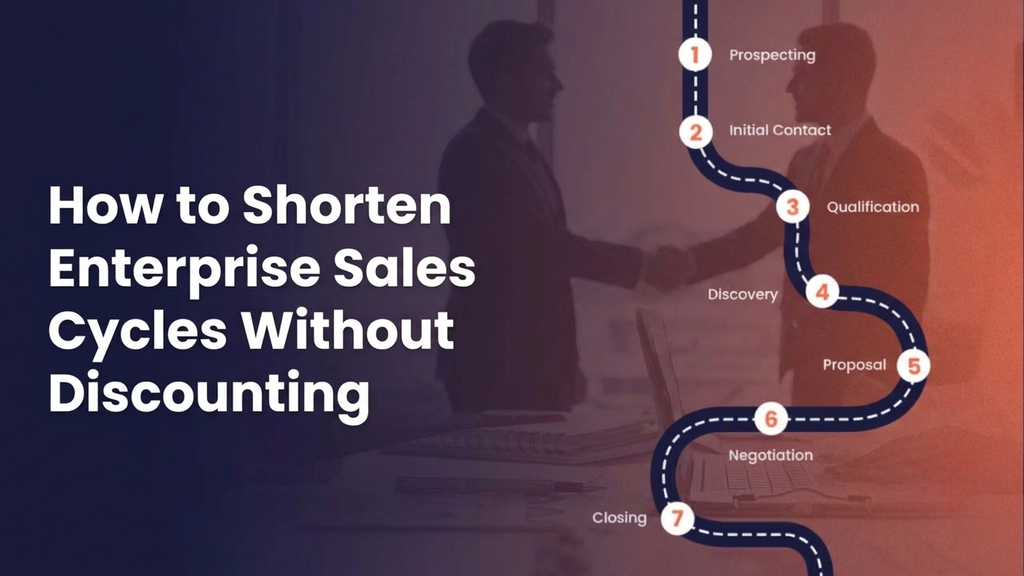
A typical enterprise sales cycle includes prospect identification, lead qualification, discovery meetings, solution presentations, product demonstrations, proposal development, stakeholder alignment, negotiations, procurement, and contract approval. Each stage requires effective coordination between the sales team and the prospective customer. Delays can occur when decision-makers are unavailable, business requirements remain unclear, proposals fail to address customer priorities, or internal approvals take longer than expected.
For B2B organizations, understanding the causes of sales cycle delays is the first step toward improving sales performance. Instead of focusing exclusively on closing deals faster, businesses should identify the specific stages where opportunities lose momentum. This allows sales leaders to eliminate unnecessary steps, improve communication, and help prospects make informed decisions with greater confidence.
Why Enterprise Sales Cycles Become Longer
Enterprise sales cycles become longer when buyers face uncertainty, competing priorities, or difficulty reaching a consensus. In large organizations, purchasing decisions rarely depend on a single individual. A department head may support a solution, while finance teams evaluate costs, IT departments review technical requirements, procurement teams negotiate contractual terms, and senior executives assess strategic value. When these stakeholders have different expectations, reaching a final decision can take considerable time.
Another common challenge is the lack of a clearly defined business problem. Prospects may express interest in a product or service without fully understanding the operational challenges they want to solve. When the business need is unclear, buyers struggle to prioritize the purchase, making it easier for the opportunity to remain inactive.
Insufficient product information can also slow the sales process. If prospects cannot easily understand the solution’s capabilities, implementation requirements, security standards, or expected business outcomes, they may request additional meetings, demonstrations, and documentation. Similarly, generic proposals that fail to reflect the customer’s requirements can create unnecessary revisions and delay approvals.
Budget uncertainty, lengthy procurement procedures, competing vendors, and changes in organizational priorities can further extend the enterprise sales cycle. To address these challenges, sales teams must focus on removing obstacles that prevent buyers from moving forward rather than attempting to influence decisions through discounts alone.
1. Focus on High-Quality Lead Qualification
One of the most effective ways to shorten the enterprise sales cycle is to improve lead qualification before investing significant time and resources in an opportunity. Not every prospect who expresses interest is ready to purchase. Some may be researching potential solutions, while others may lack the budget, decision-making authority, or immediate business need required to move forward.
A structured lead qualification process helps B2B sales teams determine whether a prospect represents a realistic sales opportunity. Sales representatives should evaluate the prospect’s business challenges, organizational priorities, budget availability, decision-making process, implementation timeline, and willingness to take the next step. Understanding these factors early helps teams distinguish between active opportunities and prospects that require long-term nurturing.
Organizations can use qualification frameworks such as BANT, which evaluates Budget, Authority, Need, and Timeline, or MEDDICC, which examines metrics, economic buyers, decision criteria, decision processes, identified pain, champions, and competition. These frameworks provide a consistent approach to assessing opportunities and identifying potential risks before they affect the sales pipeline.
Effective lead qualification also improves resource allocation. Instead of spending weeks following up with prospects who are unlikely to purchase, sales representatives can prioritize accounts with clear business needs, engaged stakeholders, and realistic buying timelines. This creates a healthier sales pipeline, improves conversion efficiency, and helps organizations shorten enterprise sales cycles without compromising pricing or profitability.
2. Identify and Engage All Key Decision-Makers Early
Enterprise purchasing decisions frequently involve several stakeholders with different priorities. A technical buyer may focus on integration and security, a finance leader may evaluate total cost of ownership, and an executive sponsor may prioritize strategic outcomes and revenue growth. Engaging only one contact can leave critical questions unanswered and create delays when additional stakeholders become involved late in the process.
To accelerate B2B sales, sales representatives should identify the complete buying committee early in the discovery stage. They should understand who evaluates the solution, who controls the budget, who approves the purchase, who manages procurement, and who will use the product or service. Mapping these roles helps sales teams develop targeted communication for each stakeholder and address potential concerns before they become obstacles.
Building relationships with multiple stakeholders also reduces dependency on a single contact. If the primary contact becomes unavailable, changes roles, or loses internal support, the opportunity does not necessarily lose momentum. A broader network of engaged stakeholders can help maintain communication and move the purchasing process forward.
Sales teams should also help internal champions communicate the business case to their colleagues. Providing concise presentations, financial justification, technical documentation, and implementation plans makes it easier for champions to explain the solution internally. When decision-makers have the information they need to evaluate the opportunity, organizations can reduce approval delays and improve the likelihood of reaching consensus.
3. Communicate Business Value Instead of Competing on Price
Discounting is often used to overcome purchasing hesitation, but price reductions do not necessarily address the underlying reason a prospect is delaying a decision. In many enterprise sales situations, buyers are more concerned about implementation risk, operational disruption, measurable business outcomes, or the uncertainty of choosing the right solution than the purchase price itself.
A value-based selling strategy helps sales representatives shift the conversation from cost to business impact. Rather than focusing exclusively on product features or pricing, sales teams should demonstrate how their solution addresses specific customer challenges, improves operational efficiency, reduces risk, increases productivity, or supports long-term growth.
For example, a company evaluating an enterprise automation platform may initially focus on the subscription cost. However, the more important consideration may be how the platform reduces manual work, improves process consistency, and enables employees to concentrate on higher-value activities. By presenting a credible business case that connects the investment to measurable operational outcomes, the sales team gives decision-makers a stronger reason to proceed.
Sales representatives should quantify potential benefits wherever reliable data is available. Relevant measures may include time saved, process costs reduced, revenue opportunities created, error rates lowered, or productivity improved. Any financial projections should be transparent, realistic, and based on defensible assumptions rather than exaggerated promises.
A strong value proposition helps buyers justify the investment internally and reduces the pressure to negotiate solely on price. When customers understand the business outcomes associated with a solution, purchasing decisions can become more straightforward while the seller protects profit margins.
4. Personalize Sales Conversations and Proposals
Generic sales presentations rarely address the specific challenges faced by enterprise buyers. Large organizations operate in different industries, have distinct technology environments, and follow unique purchasing processes. A standardized pitch may communicate product capabilities, but it often fails to explain why the solution is particularly relevant to the prospect’s business.
Personalized B2B sales communication makes the buying process more efficient by connecting the proposed solution to the customer’s priorities. Before a discovery meeting, sales representatives should research the prospect’s industry, company objectives, operational challenges, existing technology, and potential growth opportunities. This preparation enables more meaningful conversations and helps sales teams ask relevant questions rather than relying on generic sales scripts.
Proposals should reflect the information gathered during discovery. They should explain the customer’s current challenge, the recommended solution, expected business outcomes, implementation approach, required resources, and measures of success. Relevant case studies and examples from similar organizations can further demonstrate how the solution addresses comparable business problems.
Personalization should also extend to follow-up communication. Instead of sending repetitive messages asking whether the prospect has made a decision, sales representatives should share information that helps move the evaluation forward. This may include a technical clarification, a relevant customer example, a revised implementation plan, or an answer to a stakeholder’s specific concern.
When every interaction provides relevant information, buyers have fewer reasons to request repeated explanations or additional introductory meetings. This improves engagement, builds credibility, and helps shorten the enterprise sales cycle without requiring financial concessions.
5. Use Data and CRM Automation to Improve Sales Efficiency
Sales teams often lose valuable time managing administrative tasks, updating records, preparing follow-up messages, and manually tracking opportunities. When these activities are inconsistent, important next steps can be missed, customer interactions may become fragmented, and promising deals can remain inactive for extended periods.
A customer relationship management (CRM) system helps organizations centralize prospect information, record interactions, track opportunity stages, and monitor upcoming activities. By maintaining accurate sales records, teams can understand where each deal stands, identify outstanding requirements, and coordinate follow-ups more effectively.
CRM automation can further reduce administrative delays. Automated reminders, task assignments, meeting notifications, and follow-up workflows help ensure that sales representatives take timely action. Sales managers can also use pipeline dashboards to identify opportunities that have remained in the same stage for too long or lack a clearly defined next step.
Data analytics provides additional insight into the factors affecting sales cycle length. By examining historical opportunities, organizations can identify which lead sources generate qualified prospects, which stages experience the most delays, and which objections frequently prevent deals from progressing. This information enables sales leaders to improve qualification criteria, refine sales processes, and allocate resources more effectively.
AI-powered sales tools can support these activities by summarizing customer interactions, prioritizing opportunities, identifying potential deal risks, and helping representatives prepare for meetings. However, automation should support informed decision-making rather than replace human judgment. Sales teams must maintain data quality, review AI-generated insights, and ensure that customer communication remains accurate and relevant.
By combining CRM automation, sales analytics, and disciplined pipeline management, businesses can eliminate avoidable delays and give sales representatives more time to engage with buyers.
6. Simplify Product Demonstrations and Solution Evaluations
Product demonstrations are an important part of enterprise sales, particularly when buyers need to understand technical capabilities, integration requirements, or practical business applications. However, demonstrations can become counterproductive when they focus on every available feature rather than the specific challenges the prospect wants to solve.
An effective demonstration should begin with the business problem identified during discovery. Sales representatives should show how the proposed solution addresses that problem, explain the relevant workflows, and demonstrate the outcomes that matter to the buyer. This approach keeps the discussion focused and helps stakeholders understand the solution’s practical value.
For complex enterprise products, organizations should also establish clear evaluation criteria before beginning a proof of concept or pilot program. The sales team and prospect should agree on the objectives, scope, success metrics, responsibilities, required data, and expected completion date. Without these parameters, evaluations can expand beyond their original purpose and delay purchasing decisions.
For example, an enterprise software provider might agree to demonstrate whether its platform can integrate with an existing business system, automate a specific workflow, and meet defined performance requirements. Once these criteria are satisfied, stakeholders can use the results to support their decision rather than extending the evaluation indefinitely.
Sales teams should make it easy for prospects to access supporting resources, such as technical documentation, implementation guides, security information, and frequently asked questions. Providing these materials proactively reduces repeated requests and helps technical and business stakeholders complete their assessments more efficiently.
A structured evaluation process gives buyers the confidence to make informed decisions while helping sellers maintain momentum and avoid unnecessary extensions.
7. Address Sales Objections Before They Become Roadblocks
Unresolved objections are one of the most common reasons enterprise deals stall. Prospects may be concerned about implementation costs, integration challenges, security risks, vendor reliability, employee adoption, or the possibility that the solution will not deliver the expected results. If these concerns are discovered late in the sales process, they can trigger additional meetings, internal reviews, and lengthy negotiations.
Sales representatives should identify potential objections during the discovery stage rather than waiting until the proposal or contract discussion. Asking thoughtful questions about previous vendor experiences, technical constraints, internal approval requirements, and perceived implementation risks helps uncover concerns while there is still time to address them.
Responses should be supported by relevant evidence. Security documentation can help address compliance concerns, implementation roadmaps can clarify deployment requirements, customer references can demonstrate experience, and transparent service-level agreements can explain support commitments. Where appropriate, a carefully scoped pilot or proof of concept can provide additional confidence.
It is equally important to distinguish genuine objections from requests for more information. A prospect who asks for additional technical details may still be interested in purchasing, while a prospect who cannot identify a business priority may need further qualification. Understanding this distinction prevents sales teams from spending excessive time responding to concerns that are not the actual cause of the delay.
Proactive objection handling improves buyer confidence, reduces uncertainty, and helps sales representatives maintain a productive dialogue throughout the enterprise sales process.
8. Align Sales, Marketing, Finance, and Technical Teams
Enterprise deals often depend on several internal teams working together. Sales representatives may need marketing materials to support the business case, technical specialists to answer integration questions, finance teams to validate commercial terms, and legal or procurement teams to review contractual requirements. When these functions operate in isolation, internal coordination can become a major source of delay.
Organizations can reduce these delays by establishing clear responsibilities and collaboration processes. Sales teams should have access to approved proposals, relevant case studies, product documentation, pricing guidelines, security information, and implementation resources. Technical and commercial specialists should also understand how to respond to requests within agreed timeframes.
Cross-functional alignment is particularly important for complex opportunities. For example, bringing a technical specialist into a discovery meeting may resolve integration concerns immediately instead of requiring several additional meetings. Similarly, involving legal or procurement experts early can help identify contractual requirements before the deal reaches the final approval stage.
Regular deal reviews can further improve coordination. Rather than discussing only expected revenue, sales managers should review outstanding customer questions, missing approvals, unresolved risks, and the next action required from each team. This creates accountability and helps prevent opportunities from becoming stalled because of internal dependencies.
A coordinated revenue process enables organizations to respond to buyers more quickly, provide consistent information, and reduce unnecessary handoffs throughout the sales cycle.
9. Create a Clear Mutual Action Plan with Every Qualified Prospect
A mutual action plan is a shared roadmap that outlines the steps required for the buyer and seller to complete the purchasing process. It is particularly valuable in enterprise sales because complex deals often involve multiple stakeholders, technical assessments, financial approvals, procurement reviews, and implementation planning.
Instead of relying on informal follow-ups, sales representatives can work with the prospect to define important milestones, responsible individuals, target dates, and dependencies. These milestones might include completing a technical assessment, obtaining executive approval, reviewing contract terms, finalizing security requirements, and agreeing on an implementation schedule.
The plan should reflect the customer’s actual purchasing process rather than simply imposing the seller’s preferred closing date. This makes the timeline more realistic and encourages both parties to take ownership of the next steps.
A mutual action plan also improves transparency. If a milestone is delayed, the buyer and seller can identify the reason, determine whether other activities are affected, and agree on an appropriate response. This is more productive than sending repeated messages asking for a purchasing decision without understanding what remains unresolved.
For the seller, the plan provides a practical method of tracking deal progress and identifying risks early. For the buyer, it clarifies what is required to move forward and helps coordinate internal stakeholders. When both parties work toward a shared objective, enterprise sales opportunities are less likely to lose momentum.
10. Reduce Procurement and Contract Approval Delays
Even when a prospect has selected a solution, the enterprise sales cycle may continue for weeks because of procurement requirements, legal reviews, vendor onboarding, or internal financial approvals. These activities are often necessary, but poor preparation can make them take longer than expected.
Sales teams should understand the customer’s procurement process as early as possible. Important questions include whether the organization requires multiple vendor quotations, security assessments, data-processing agreements, insurance documentation, purchase orders, or specific contract terms. Identifying these requirements during qualification allows the seller to prepare the necessary materials before the deal reaches the final stage.
Maintaining a library of current, approved documentation can also improve efficiency. Standard contract templates, security questionnaires, compliance documents, implementation schedules, and vendor information help reduce the time required to respond to routine requests. For complex requirements, sales representatives should involve the appropriate internal specialists before making commitments to the customer.
Clear communication is equally important. Both parties should understand which approvals remain outstanding, who is responsible for completing them, and whether any requirements depend on other activities. This makes the process more predictable and reduces last-minute surprises.
Organizations should avoid attempting to bypass legitimate security, legal, or procurement controls merely to close a deal faster. The objective is to remove unnecessary waiting and administrative confusion while maintaining appropriate governance.
By preparing early and coordinating approval requirements, B2B sales teams can reduce delays during the final stages of enterprise purchasing without relying on discounts to secure a signature.
11. Use Social Proof and Customer Success Stories to Build Confidence
Enterprise buyers are making decisions that can affect budgets, operations, employees, and long-term business performance. As a result, they often seek evidence that a potential vendor can deliver the promised results and support their organization after implementation.
Social proof helps reduce this uncertainty by demonstrating how other customers have addressed similar challenges. Relevant customer success stories, case studies, testimonials, industry references, and independently verifiable performance data can strengthen a vendor’s credibility.
The most effective case studies go beyond describing a successful implementation. They explain the customer’s original challenge, the solution selected, the implementation approach, and the measurable outcomes achieved. For example, a case study might describe how an organization reduced a particular process time, improved service consistency, or increased operational visibility. Any numerical claims should be accurate and supported by reliable evidence.
Relevance is particularly important in enterprise sales. A prospect in financial services may be more interested in a case study involving security, compliance, and data governance, while a manufacturing company may prioritize operational efficiency and system integration. Sales teams should therefore select proof points that reflect the prospect’s industry, business model, and priorities.
Customer references can also help address concerns that are difficult to resolve through a presentation alone. When buyers can speak with an existing customer who has experienced a similar implementation, they may gain a clearer understanding of the vendor’s capabilities and limitations.
By using credible evidence to support the value proposition, organizations can reduce perceived risk, strengthen buyer confidence, and help stakeholders reach decisions without requiring price concessions.
12. Improve Follow-Up Strategies to Maintain Deal Momentum
Inconsistent follow-up can cause enterprise opportunities to lose momentum, especially when buyers are managing several competing priorities. However, frequent messages that provide no new information may frustrate prospects and weaken the relationship. Effective follow-up requires a balance between consistency, relevance, and respect for the buyer’s time.
Sales representatives should agree on the next steps at the end of each meeting. This includes confirming what information will be shared, who will complete each action, and when the next discussion should take place. A clear commitment creates accountability and reduces the uncertainty associated with open-ended conversations.
Follow-up communication should also provide tangible value. Representatives can share answers to unresolved questions, summarize agreed requirements, provide relevant case studies, explain implementation options, or clarify the expected business outcomes. This makes every interaction useful and reinforces the vendor’s role as a trusted advisor rather than simply a seller pursuing a signature.
CRM reminders and automated task management can help teams maintain a consistent follow-up schedule. Nevertheless, communication should remain personalized, particularly when addressing senior decision-makers or complex business concerns.
When a deal stops progressing, sales representatives should investigate the underlying reason rather than assuming the prospect has lost interest. The opportunity may be waiting for budget approval, an executive decision, or the completion of another project. Understanding the obstacle enables the seller to recommend a realistic next step or adjust the opportunity’s status accordingly.
A disciplined follow-up process keeps opportunities organized, maintains engagement, and helps prevent avoidable delays in the B2B sales pipeline.
13. Measure Sales Cycle Performance and Continuously Improve
Shortening enterprise sales cycles requires more than introducing new tools or changing communication practices. Organizations must measure performance consistently to understand whether their sales strategies are producing meaningful improvements.
Average sales cycle length is an important starting point, but it should not be the only metric used to evaluate performance. Businesses should also monitor conversion rates between sales stages, time spent in each stage, proposal-to-close rates, opportunity win rates, pipeline velocity, discount levels, and average deal value. Together, these metrics provide a more complete picture of sales efficiency and commercial performance.
For example, a business may discover that opportunities progress quickly through product demonstrations but experience significant delays during procurement. This insight suggests that the organization should focus on earlier procurement engagement and better documentation rather than investing additional resources in demonstrations.
Another company may find that deals involving multiple engaged stakeholders close more consistently than opportunities managed through a single contact. This could indicate that stakeholder mapping and multi-threaded relationship building deserve greater attention.
Sales teams should also review lost and stalled opportunities to identify recurring patterns. Common issues may include poor qualification, weak business cases, unclear decision criteria, missing technical information, or unrealistic timelines. Addressing these root causes can improve future sales performance more effectively than applying a universal closing tactic to every opportunity.
Continuous improvement allows organizations to adapt their sales processes to changing buyer expectations while maintaining a focus on sustainable revenue growth.
The Role of AI in Shortening Enterprise Sales Cycles Without Discounting
Artificial intelligence is creating new opportunities for B2B organizations to improve sales efficiency and accelerate decision-making. AI-powered sales tools can help representatives research target accounts, summarize discovery calls, identify relevant stakeholders, prioritize opportunities, prepare personalized communication, and recognize potential deal risks.
Predictive analytics can also help sales managers identify opportunities that may be losing momentum. By analyzing historical sales data and current engagement signals, these systems can highlight deals that require additional attention. Representatives can then investigate the underlying issue, whether it involves a missing decision-maker, an unresolved objection, or an unclear purchasing timeline.
Generative AI can support the creation of personalized proposals, meeting summaries, follow-up messages, and customer-specific presentations. When used with appropriate review and reliable source information, these capabilities can reduce administrative work and give sales teams more time to focus on buyer relationships.
However, AI should not be treated as an automatic solution to every sales challenge. Poor CRM data, inaccurate assumptions, generic messaging, and excessive automation can reduce effectiveness. Organizations should maintain human oversight, protect customer information, and ensure that AI-generated content accurately reflects the customer’s requirements and the company’s capabilities.
The greatest value comes when AI is integrated into a well-defined sales process. By combining automation with strong discovery, clear value communication, stakeholder alignment, and disciplined deal management, enterprises can improve sales productivity without using discounts as their primary closing strategy.
Best Practices for Shortening Enterprise Sales Cycles While Protecting Profit Margins
Businesses that want to accelerate enterprise sales should focus on removing friction from the buying process while preserving the perceived value of their products and services. This begins with targeting qualified accounts and understanding the customer’s business priorities before investing significant resources in an opportunity.
Sales teams should develop a compelling business case that demonstrates the expected value of the proposed solution. This includes explaining how the solution addresses operational challenges, supports strategic objectives, reduces risk, or improves measurable outcomes. A clear value proposition makes it easier for buyers to justify the investment to internal stakeholders.
Organizations should also standardize repeatable activities wherever appropriate. Approved proposal templates, discovery frameworks, security documentation, case studies, CRM workflows, and mutual action plans can reduce administrative delays and improve consistency across the sales organization.
At the same time, sales representatives should maintain flexibility in their approach. Every enterprise customer has different decision-making structures, technical requirements, and procurement processes. The goal is not to force every prospect through an identical timeline but to identify and remove the obstacles that unnecessarily delay each opportunity.
Finally, sales leaders should evaluate success using both speed and profitability. A shorter sales cycle is valuable when it helps the organization close suitable deals efficiently, maintain strong margins, and deliver lasting customer value. If sales cycle length improves only because representatives are accepting unprofitable terms or pursuing poorly qualified opportunities, the organization may be creating long-term commercial problems rather than improving performance.
Conclusion
Shortening enterprise sales cycles without discounting requires a strategic approach that prioritizes buyer confidence, business value, operational efficiency, and effective stakeholder engagement. Rather than relying on price reductions to accelerate purchasing decisions, B2B organizations should focus on understanding customer needs, qualifying opportunities accurately, engaging decision-makers early, and communicating a compelling return on investment.
By personalizing proposals, simplifying product evaluations, addressing objections proactively, and aligning sales with technical, finance, legal, and procurement teams, businesses can remove common obstacles that delay enterprise purchases. CRM automation, AI-powered sales tools, customer success stories, and mutual action plans can further improve visibility and maintain deal momentum throughout the sales process.
Equally important, organizations must measure sales performance continuously to identify bottlenecks and refine their approach. Tracking sales cycle length alongside conversion rates, win rates, deal value, and profit margins helps businesses determine which improvements create sustainable results.
Ultimately, the key to shortening enterprise sales cycles is to make it easier for qualified buyers to understand the value of a solution, evaluate it confidently, and secure the approvals needed to move forward. By focusing on value-based selling rather than discount-driven closing tactics, B2B companies can accelerate revenue growth, protect profitability, strengthen customer relationships, and build a more predictable enterprise sales pipeline.
