


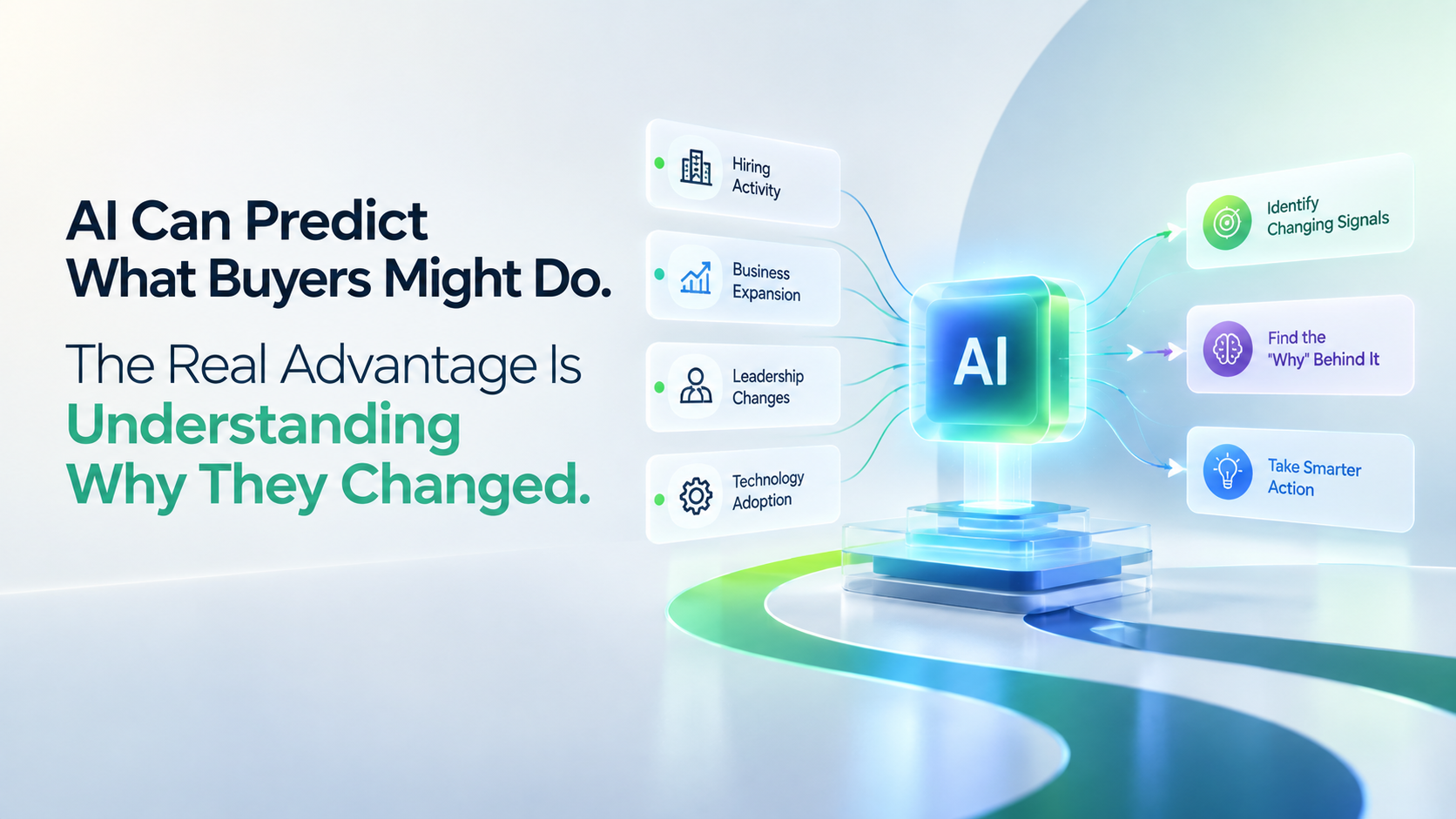

AI buyer prediction is changing how B2B companies identify potential customers, prioritize accounts, and anticipate purchasing behaviour. Businesses have always wanted to know what a buyer will do next: Will the prospect respond to an email? Will the account request a demo? Will the opportunity move forward? Will the customer renew or expand its relationship? For years, companies have attempted to answer these questions through lead scoring, predictive analytics, intent data, behavioural tracking, and marketing automation.
AI has accelerated these capabilities by making it possible to process enormous amounts of information and identify patterns that would be difficult for humans to recognize manually. But as AI buyer prediction becomes increasingly accessible, a more important question is emerging: what if predicting what a buyer might do is less valuable than understanding why the buyer’s behaviour changed in the first place?
The difference may seem subtle, but it represents a major shift in how B2B organizations should think about intelligence. Prediction can indicate what may happen next, while understanding change can provide the context needed to determine why an account’s priorities may have shifted and how sales and marketing teams should respond.
B2B companies have always wanted to know what a buyer will do next. Will the prospect respond to the email? Will the account request a demo? Will the opportunity move forward? Will the customer renew? Will the company expand its relationship? For years, businesses have attempted to answer these questions through lead scoring, predictive analytics, intent data, behavioural tracking, and increasingly sophisticated marketing automation.
AI has accelerated these capabilities by making it possible to process enormous amounts of information and identify patterns that would be difficult for humans to recognize manually. But as predictive technology becomes more accessible, a more important question is emerging: what if predicting what a buyer might do is less valuable than understanding why the buyer’s behaviour changed in the first place? The difference may seem subtle, but it represents a major shift in how B2B organizations should think about intelligence.
AI Buyer Prediction Is Changing B2B Sales
Prediction is attractive because it promises certainty in an environment where uncertainty is expensive. If a company could reliably identify which accounts are about to enter a buying cycle, sales teams could prioritize those accounts, marketing could personalize engagement, and leadership could allocate resources more efficiently. AI can help identify patterns across website behaviour, engagement history, company attributes, business events, sales interactions, and other signals.
A model might determine that certain combinations of activities are associated with future commercial activity. That can be useful, but a prediction still describes what the system believes may happen. It does not necessarily explain what is happening inside the organization or why the observed behaviour matters. In B2B, where buying decisions are influenced by organizational changes, budgets, strategic priorities, internal stakeholders, competitive pressure, and timing, the “why” can be more actionable than the prediction itself.
Why AI Buyer Prediction Is Not Enough
Consider an account that suddenly increases its engagement with content about automation. A predictive model may identify the account as having a higher probability of entering a buying process. That information can help prioritize the account, but it leaves an important question unanswered: why did the engagement increase? Perhaps the company is actively evaluating automation technologies. Perhaps a new executive has joined and is pushing a transformation initiative. Perhaps an employee is simply conducting research for a presentation.
Perhaps the company is responding to a competitor. Perhaps the organization has already selected a solution and is researching implementation. The same visible behaviour can have completely different meanings depending on the context. Prediction can identify the pattern; understanding the change requires interpretation.
Understanding the Context Behind Buyer Behaviour
This is becoming increasingly important because B2B buying signals are rarely isolated. A company’s behaviour exists within a larger business environment. A sudden increase in hiring may coincide with geographic expansion. A leadership change may precede a strategic shift. A new product launch may create operational requirements. A technology migration may create demand for complementary solutions.
An acquisition may lead to systems consolidation. A regulatory change may alter priorities. These events can create conditions in which certain problems become more urgent. If an AI system can connect those events with changes in buyer behaviour, it can move beyond simply predicting activity and begin helping teams understand the business context behind it.
That distinction matters because the best sales action is not always determined by the predicted outcome. Suppose an account is identified as highly likely to purchase a particular solution within the next six months. That prediction alone does not tell a salesperson how to approach the account.
The salesperson still needs to understand what problem the organization may be trying to solve, who is likely involved, what has changed, whether the company has an existing solution, and what stage of evaluation it may be in. A prediction can tell the salesperson where to look. Context helps determine what to say once they get there. Without context, predictive intelligence can simply produce a more sophisticated list of accounts for traditional outreach.
This is one reason the idea of “change intelligence” is becoming increasingly relevant. Instead of asking only which companies match an ideal customer profile or which accounts show high intent, organizations can ask which accounts have changed in ways that may affect their business priorities. The change itself becomes the signal.
A company that has remained stable for two years may suddenly announce expansion into new markets, hire a new leadership team, restructure its operations, adopt a different technology stack, launch a new product, or acquire another business. These changes do not guarantee a buying opportunity, but they provide a reason to investigate. They create context that static account data cannot provide.
Static Data vs. Dynamic B2B Intelligence
The difference between static data and dynamic intelligence is becoming increasingly important. Static data tells a company what an account is: its industry, size, location, revenue, technologies, and organizational structure. Dynamic intelligence helps explain what is changing: leadership, strategy, hiring, expansion, product development, technology adoption, market activity, and other business events.
Both are useful, but dynamic information can be particularly valuable for understanding timing. A company may have been an excellent target for years, but if nothing has changed that makes the problem urgent, outreach may still be poorly timed. Another company may have looked only moderately relevant until a significant business event suddenly changed its priorities.
How AI Can Interpret Changes in Buyer Behaviour
This is where AI can become more powerful when it is used as an interpretation layer rather than simply a prediction engine. AI can analyse large volumes of information and identify relationships between events that humans might not have time to examine manually. It can compare current account behaviour with historical patterns, summarize recent company developments, identify unusual changes, and connect external events with internal engagement.
More importantly, it can help formulate hypotheses about why a change may matter. The critical word is “hypotheses.” AI-generated interpretation should not be treated as unquestionable fact. It should provide a starting point for human investigation and decision-making rather than replacing judgment.
The Role of Context in B2B Buyer Intent
The quality of those interpretations depends heavily on the quality of the underlying information. If a system sees only website activity, it may produce one type of conclusion. If it can combine website engagement with CRM history, company announcements, hiring activity, technology changes, sales notes, customer information, and other relevant signals, it can develop a much richer picture. This is why the future of B2B intelligence is unlikely to depend on a single data source. The valuable insight often appears at the intersection of multiple signals. One event can be noise. Several connected changes can become a meaningful pattern.
This also changes how organizations should think about intent. Intent is often treated as a measurable score, but intent is not a physical object that exists independently of context. It is an interpretation of behaviour. A buyer reading five articles about a topic may be interested, but interest is not necessarily commercial intent. A company researching a solution may be planning a purchase next month, next year, or never. A senior executive visiting a website may be a strong signal, but the meaning depends on what else is happening inside the organization. Instead of asking whether an account has intent, organizations may need to ask what evidence suggests that a particular business problem has become more important to that account.
AI Buyer Prediction and Account-Based Marketing
That shift has significant implications for account-based marketing. Traditional ABM often begins by identifying a set of target accounts that match predefined criteria. The next step is to create personalized campaigns for those accounts. But personalization without timing can still produce irrelevant communication. An account may fit perfectly on paper and still have no reason to engage today. Change intelligence introduces another dimension: which target accounts are experiencing circumstances that make the message more relevant now? This creates the possibility of dynamic ABM, where account priorities are monitored continuously and messaging changes according to what is happening rather than remaining fixed for an entire campaign cycle.
Using Change Intelligence for Sales Prospecting
Sales prospecting can benefit from the same approach. Instead of giving sales representatives a list of accounts and asking them to contact everyone, organizations can provide a more contextual view of why particular accounts deserve attention. A salesperson could see that an account has recently expanded, hired several people in a relevant department, announced a strategic initiative, and increased engagement around a related business topic. None of those signals proves that the company is ready to buy. But together they provide a reason for research. The salesperson can investigate further and potentially approach the account with a relevant hypothesis rather than a generic pitch.
This is where the quality of outreach can change significantly. Traditional outbound messages often begin with what the seller wants to communicate: a product, service, capability, or meeting request. Context-aware outreach begins with what may have changed for the buyer. The difference is not merely stylistic. A message grounded in a real business event can create a more credible reason for contact. Instead of saying, “We help companies improve X,” the conversation can begin with an observation about a recent development and a relevant question about how the organization is approaching it. The goal is not to pretend certainty. It is to demonstrate that the salesperson has a reason for reaching out.
Why AI Interpretations Need Evidence and Context
However, there is a danger in over interpreting signals. AI systems can identify patterns that appear meaningful but are actually coincidental. A company may hire employees for reasons unrelated to the solution being sold. A website visit may come from a student, researcher, consultant, or existing customer rather than a new buyer. A leadership announcement may not result in any change to the relevant function. If sales teams treat every inferred signal as fact, they can quickly damage credibility. This is why evidence and confidence need to remain central to AI-assisted intelligence. The system should help users understand not only what it believes, but why it believes it, what evidence supports the interpretation, and what remains uncertain.
The strongest AI systems for B2B decision-making will therefore not simply produce answers. They will provide explainable context. They will help users see which signals contributed to an interpretation, how recent those signals are, how strongly they relate to the business problem, and what additional information might confirm or challenge the assumption. This makes the system more useful because it supports human judgment instead of attempting to hide uncertainty behind a numerical score.
How Change Intelligence Can Reveal Market Trends
There is also an important organizational benefit to understanding why buyers change. Patterns of change can reveal market trends before traditional reporting catches up. If multiple accounts suddenly begin showing similar changes, that may indicate an emerging market shift. If organizations across an industry begin adopting a particular technology, changing leadership structures, or investing in a specific capability, those patterns can inform marketing strategy, product development, sales planning, and executive decision-making. The intelligence is no longer limited to deciding which lead to contact. It can help the company understand where the market itself is moving.
Applying AI Buyer Prediction to Customer Retention and Expansion
This is particularly valuable in industries where customer needs evolve quickly. A company may have built its marketing strategy around a particular problem, only to discover that buyers are beginning to frame the problem differently. Their language changes. Their priorities shift. New stakeholders become involved. New alternatives appear. If an organization monitors only historical conversion data, it may respond slowly because historical data describes what worked yesterday. If it monitors changes in buyer behaviour and business context, it has an opportunity to identify emerging needs earlier.
The distinction between prediction and understanding also matters for customer expansion and retention. AI may predict that a customer is likely to renew, but understanding why the customer’s engagement has changed can provide more actionable information. A sudden decrease in product usage, a change in leadership, a restructuring, or a shift in strategic priorities may create risk even if historical behaviour suggests a strong renewal probability.
Conversely, increased usage combined with organizational growth and new business initiatives may indicate an expansion opportunity. The important information is not simply the predicted outcome. It is the change in the circumstances that could influence the outcome.
The Future of B2B Intelligence
This suggests a broader evolution in B2B intelligence. The first phase was data collection. Companies built databases to know who their prospects and customers were. The second phase was automation. Companies used technology to act on that data faster. The next phase is interpretation. Organizations need systems capable of understanding what has changed, why the change may matter, and what decisions should be considered in response. AI is particularly suited to this layer because it can process large quantities of unstructured information, connect signals across systems, and summarize complex situations for human decision-makers.
But the objective should not be to create an organization that blindly follows AI predictions. The objective should be to create an organization that sees the market more clearly. Prediction can be one component of that process, but understanding provides the context required to use prediction responsibly. A probability without an explanation can prioritize an account. A meaningful explanation can help a team decide how to respond.
The future of AI buyer prediction may therefore depend not only on improving prediction accuracy, but on helping organizations understand the evidence and business changes behind those predictions. The future of B2B growth will therefore depend less on asking AI to tell companies exactly what buyers will do and more on using AI to identify what has changed around those buyers. The most valuable question may not be, “Which account is most likely to buy?” It may be, “Which accounts have changed in ways that could make our solution more relevant, and what evidence supports that interpretation?” That question moves intelligence away from passive prediction and toward active understanding.
It helps marketing teams identify emerging demand, helps sales teams prioritize meaningful conversations, helps account-based teams respond to changing circumstances, and gives leadership a clearer view of how markets are evolving. In a world where AI can increasingly predict behaviour, the real competitive advantage may belong to the organizations that can understand the reasons behind the behaviour, and act on that understanding with better timing, better context, and better judgment.
