


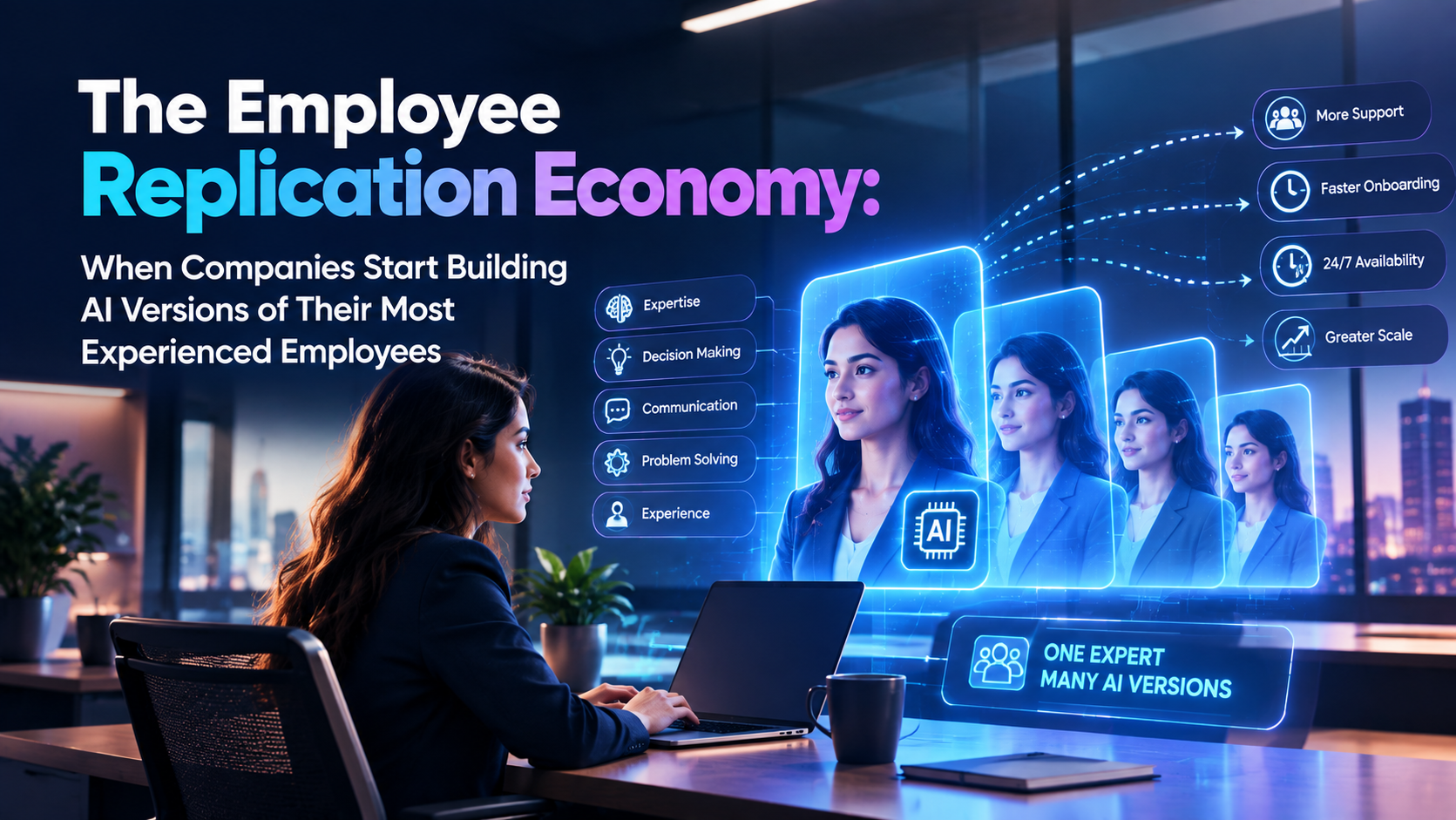

For decades, organisations have worried about what happens when experienced employees leave. The concern has usually been described as a knowledge-transfer problem: a senior employee retires, changes companies or moves into another role, and years of practical knowledge leave with them. Organisations attempt to reduce this risk through documentation, standard operating procedures, training programmes, mentoring and succession planning, but much of the most valuable knowledge remains difficult to document because it is embedded in judgement rather than instructions. An experienced sales leader knows when a prospect is genuinely interested even when the CRM says otherwise. A senior operations manager knows which process exception requires immediate attention and which one can safely wait. An experienced HR professional knows how to approach a sensitive employee conversation that cannot be handled through a standard policy. A veteran engineer can recognise an unusual technical pattern before a system generates an obvious alert. This knowledge is often accumulated over years of exposure to situations that cannot easily be captured in manuals. Artificial intelligence is now creating a new possibility: instead of simply documenting experienced employees’ knowledge, organisations may attempt to create AI systems that replicate parts of how those employees think, decide and operate.
The emerging employee replication economy is not necessarily about creating digital copies of people. In practical terms, it involves capturing patterns of expertise and embedding them into AI systems that can assist other employees with tasks previously dependent on a small number of experienced individuals. An organisation might train an AI system on approved process documentation, historical decisions, anonymised case records, customer interactions, technical resolutions and expert-created frameworks. The resulting system could help employees understand how experienced professionals approach particular situations. A new account manager could ask how a complex customer escalation should be structured. A junior operations employee could receive guidance based on previously resolved cases. An engineer could use an AI system to investigate patterns associated with historical incidents. A new manager could access institutional knowledge without having to locate the one person who has been with the company for fifteen years. The promise is significant: expertise could become more accessible, scalable and persistent.
But the moment an organisation attempts to turn employee expertise into an AI system, it encounters a difficult question: who owns the knowledge? A company may argue that employees develop expertise while performing work using company resources, systems and information. Employees may view their judgement, experience and problem-solving ability as part of their professional identity. The distinction becomes particularly complicated when expertise consists of information that is partly organisational and partly personal. A senior employee may know a company’s internal process, but they may also possess negotiation techniques, industry relationships, communication skills and accumulated judgement developed throughout their career. An AI system trained on their work could potentially reproduce some of these patterns, but determining what belongs to the company, what belongs to the individual and what can ethically be replicated is not straightforward.
This issue becomes especially important when the employee is still working for the organisation. An experienced employee may willingly participate in building an AI knowledge system because it can reduce repetitive questions and allow them to focus on more complex work. However, the same system could eventually reduce the organisation’s dependence on that employee. A senior specialist who previously trained dozens of colleagues may become less central once an AI assistant can answer routine questions based on their accumulated expertise. The organisation may describe this as knowledge scalability, while the employee may see it as the automation of part of their professional value. The technology therefore creates an unusual workplace dynamic in which employees are potentially contributing to systems that could make parts of their own roles less dependent on human expertise.
This does not mean that organisations will simply replace senior employees with AI versions of them. Expertise is far more complicated than information. Experienced professionals often make decisions using context that is difficult to capture in structured data. They understand organisational history, relationships, informal constraints, customer personalities and exceptions that may not appear in official records. An AI system can identify patterns in previous decisions, but it may not understand why a particular decision was made. If an experienced account manager gave a customer an unusual concession five years ago, the historical record may show the concession but not the strategic relationship that justified it. If an engineer chose an unconventional technical solution during an incident, the documentation may record the solution without capturing the subtle observations that led to it. Replicating outputs without replicating context can produce an AI system that appears knowledgeable while lacking the judgement that made the original expertise valuable.
This creates a major risk of what could be called expertise compression. When complex human judgement is converted into datasets, organisations may unintentionally reduce nuanced decision-making into simplified patterns. An AI system trained on successful outcomes may learn that certain actions are frequently associated with positive results without understanding the circumstances under which those actions worked. A sales expert may know that a particular objection should sometimes be challenged and sometimes accepted depending on the customer’s organisational politics. An AI system may instead identify the most common response and recommend it broadly. A human expert understands exceptions because they have experienced them. An AI system may reproduce the dominant pattern and underrepresent the rare cases where judgement matters most.
The quality of an employee replication system therefore depends heavily on the quality and diversity of the knowledge used to create it. Training an AI assistant exclusively on one expert’s historical decisions can reproduce that person’s biases, assumptions and blind spots. If the employee consistently preferred one type of customer, communication style or technical approach, the AI may treat those preferences as universal best practices. This is particularly important in HR, sales and management contexts where decisions involve people rather than purely technical variables. A system built around the judgement of one highly successful manager may reproduce practices that worked within that manager’s specific team but may not be appropriate across different teams, geographies or organisational cultures.
There is also the problem of changing expertise. What made an employee highly effective five years ago may not remain relevant today. Markets change, technologies evolve, customer expectations shift and regulations are updated. An AI system trained on historical employee behaviour can become outdated while continuing to sound confident. This creates a new form of organisational risk: knowledge that is preserved too well. Traditional knowledge loss occurs when important information disappears when an employee leaves. AI creates the opposite possibility, where outdated information remains permanently available and is repeatedly presented to new employees as if it were current. An organisation could therefore preserve the wrong lessons with greater efficiency than ever before.
To avoid this, employee replication systems need knowledge expiration and review mechanisms. Expertise should not be treated as a static asset that is captured once and stored indefinitely. The system should distinguish between enduring principles and time-sensitive practices. A senior employee’s approach to customer communication may remain valuable, while a specific process used three years ago may no longer apply. AI systems need mechanisms for identifying outdated knowledge, connecting recommendations to current policies and escalating situations where historical patterns conflict with current organisational standards. Human experts should remain involved in reviewing and updating high-impact knowledge rather than allowing historical behaviour to become an unquestioned organisational memory.
Another challenge involves the emotional and cultural meaning of expertise. Employees often gain professional status not only because they know something but because colleagues trust them to make decisions under uncertainty. Their value may come from mentoring, relationship-building, accountability and the ability to take responsibility when outcomes are uncertain. An AI system can provide information, but it does not automatically reproduce those human dimensions. If organisations attempt to reduce expertise entirely to an AI knowledge layer, they may underestimate why people seek experienced colleagues in the first place. A junior employee may ask a senior colleague a question not simply because they need an answer, but because they need confidence that someone understands the consequences of the decision. AI can support that process, but it does not automatically replace the human relationship surrounding expertise.
The employee replication economy could nevertheless have major benefits for on boarding. New employees traditionally require months or even years to build organisational knowledge. They learn through training, observation, mistakes, conversations and exposure to different situations. An AI knowledge assistant could reduce some of this learning curve by providing contextual guidance when questions arise. Instead of searching through hundreds of documents, employees could ask an AI system how a particular workflow operates, what common exceptions exist and where to find the relevant policy. The system could also explain historical examples, provided the information is appropriately governed. This could make organisational knowledge more accessible and reduce the dependency on informal networks.
It could also transform internal mobility. Employees moving from one department to another often struggle because they understand the company generally but lack knowledge of the new team’s processes and decision patterns. An AI system containing structured organisational knowledge could help them navigate the transition. A finance employee moving into operations, for example, could receive guidance on the workflows, terminology and common issues associated with the new function. Similarly, a new manager could access historical information about recurring team processes without relying entirely on the previous manager’s personal handover. This could make organisations more resilient when roles change frequently.
However, there is a danger that excessive reliance on AI knowledge systems could weaken the human networks through which organisational knowledge traditionally spreads. Some knowledge is valuable precisely because it is exchanged through conversations. Informal discussions allow employees to ask follow-up questions, challenge assumptions and understand context. If organisations encourage employees to ask AI instead of colleagues, they may inadvertently reduce collaboration. A junior employee might receive a technically correct answer without learning how to evaluate it. A new manager might obtain a historical recommendation without understanding why the team changed its approach. Knowledge becomes easier to access but potentially harder to interrogate. This is why AI should complement mentoring and collaboration rather than eliminate them.
The employee replication economy also raises questions about performance evaluation. If an employee contributes extensively to an organisational AI system by documenting decisions, training colleagues and creating reusable knowledge, how should that contribution be measured? Traditional performance metrics may capture immediate outputs but not the long-term value of making expertise scalable. Conversely, employees whose knowledge is heavily incorporated into AI systems may become difficult to evaluate because their contribution continues after the original work is completed. Organisations may need new approaches to recognise knowledge creation, knowledge transfer and AI-assisted capability building as legitimate forms of professional contribution.
Compensation could become another complex issue. If a company’s AI system generates significant commercial value using patterns derived from an employee’s expertise, should that employee receive additional recognition or compensation? There is no universal answer because employment arrangements, intellectual-property rules and organisational practices differ. But the question will increasingly emerge as companies move from using AI for generic productivity to building systems around specialised human expertise. The more directly an AI system is derived from an identifiable employee’s unique professional contribution, the harder it may be to treat that contribution as indistinguishable from ordinary organisational data.
Privacy is equally important. Employees may not expect their emails, decisions, conversations, work products or communication styles to become training material for an AI system. Organisations therefore need clear policies explaining what information can be used, for what purposes, who can access the resulting system and how long the data will be retained. Sensitive employee information should not automatically become part of a corporate knowledge model simply because an AI platform can process it. Consent, purpose limitation, access controls and appropriate anonymization may become increasingly important as companies build internal AI systems around workforce knowledge.
The technology also creates a new form of organisational dependency. Companies have traditionally been concerned about key-person risk: the business becomes vulnerable because one employee possesses knowledge that nobody else has. Employee replication appears to solve this problem by distributing that knowledge through AI. But organisations could create a new dependency if the AI system becomes the only accessible representation of that expertise. If the system is poorly maintained, employees may lose access to both the original expert and the institutional knowledge derived from them. The organisation may move from depending on one person to depending on one model, one data pipeline or one AI platform. Resilience therefore requires multiple forms of knowledge preservation rather than simply transferring dependency from human to machine.
The best approach may be to treat AI replication as capability multiplication rather than employee duplication. The goal should not be to create a digital replacement for an individual. Instead, organisations can identify specific areas of expertise that are valuable, document the principles behind them, validate those principles with multiple experts and build AI systems that help employees apply them. This approach reduces dependence on a single person’s historical behaviour and creates a more balanced knowledge base. A sales AI could incorporate approaches from several experienced sales leaders rather than attempting to replicate one person. An engineering assistant could combine documented incident patterns with current architecture standards. An HR knowledge system could provide policy guidance while escalating sensitive cases to human professionals.
Governance will be central to making this model work. Organisations will need clear rules about which forms of expertise can be captured, which data can be used, how AI recommendations are validated and when human intervention is required. They will also need mechanisms for employees to correct the system when it misrepresents their expertise. If an AI assistant repeatedly attributes a particular approach to an employee when that approach is outdated or inaccurate, the employee should have a way to challenge the representation. Expertise should not become permanently frozen simply because it has been converted into machine-readable form.
Ultimately, the employee replication economy represents a significant change in how organisations think about knowledge. For years, companies treated employee expertise as something that existed primarily inside individuals and had to be transferred through training or documentation. AI introduces the possibility of making parts of that expertise accessible through intelligent systems at organisational scale. The opportunity is substantial: faster on boarding, stronger knowledge continuity, reduced key-person dependency and wider access to specialised expertise. But the risks are equally significant because expertise is not simply a database of correct answers. It contains context, judgement, experience, uncertainty and human relationships.
The organisations that benefit most from employee replication will therefore be those that resist the temptation to treat people as datasets. AI can capture patterns of expertise, but it cannot automatically capture the full meaning of professional experience. Human experts should remain participants in deciding what knowledge is preserved, how it is represented and where it should be applied. The objective should be to make human capability more transferable without making human contribution invisible. In the emerging workplace, the most valuable AI systems may not be those that attempt to replace the most experienced employees, but those that allow their hard-earned knowledge to help thousands of others make better-informed decisions while preserving the human judgement that gave that knowledge its value in the first place.
