


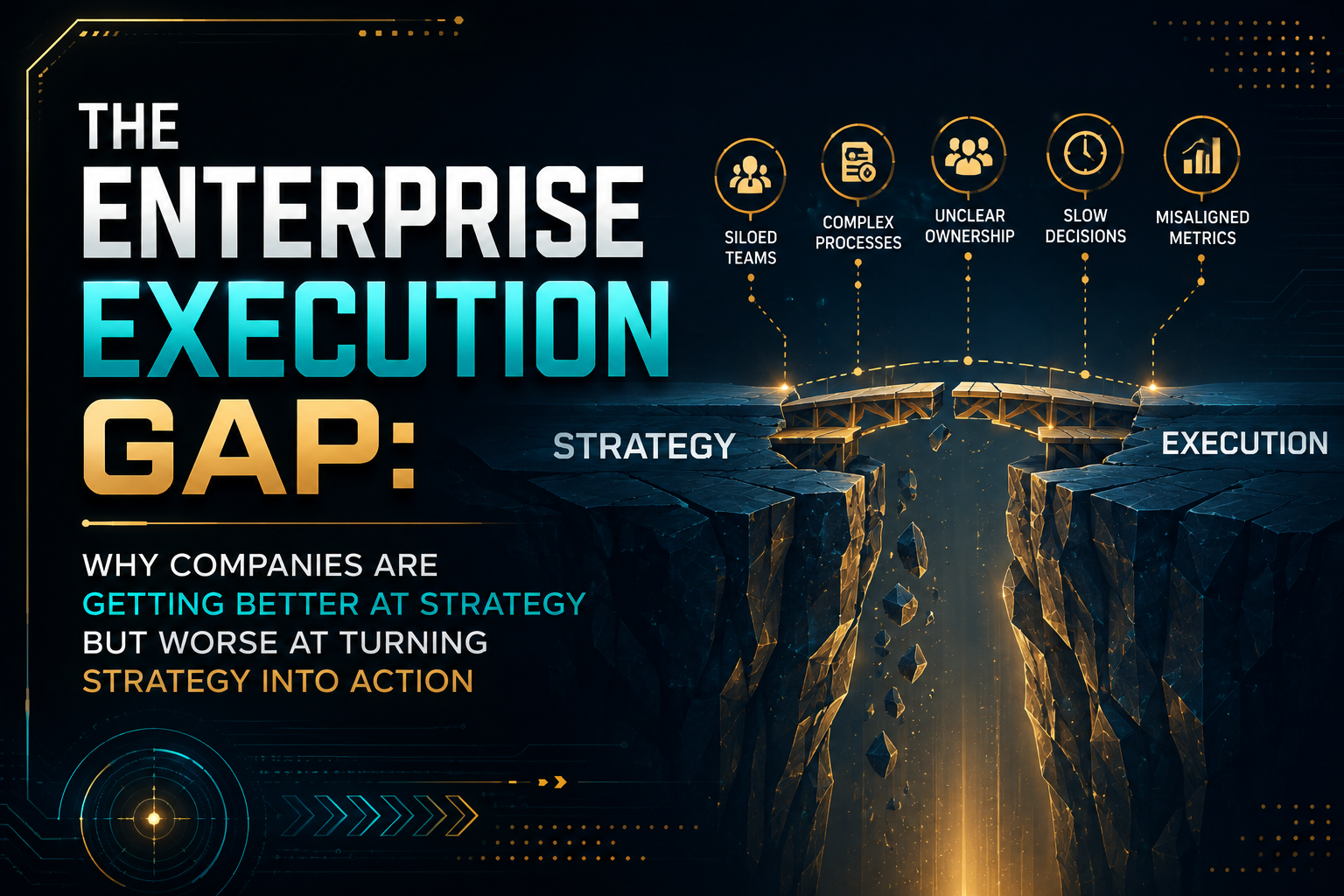

Enterprises have never invested more heavily in strategy, planning, forecasting and business intelligence, yet many organisations continue to struggle with one of the oldest problems in management: turning a good decision into consistent execution. Leadership teams can now access sophisticated market intelligence, real-time performance data, predictive analytics and AI-generated recommendations that allow them to identify opportunities and risks much earlier than before. Strategic planning has become more analytical, scenario modelling has become more sophisticated and organisations can evaluate potential outcomes faster than ever.
Yet the existence of a clear strategy does not guarantee that the organisation will move in the direction that strategy requires. Between the moment a leadership team decides what should happen and the moment the organisation actually changes its behaviour lies a complex network of processes, incentives, dependencies, approvals, priorities and individual decisions. This space is becoming the Enterprise Execution Gap, and it may become one of the most important barriers to growth in increasingly technology-driven organisations.
Companies are becoming better at understanding what they should do while remaining surprisingly slow at making the thousands of small operational changes required to actually do it. The result is a dangerous form of organisational disconnect in which strategy exists at the leadership level, technology exists at the infrastructure level and execution remains trapped somewhere in the middle.
What Is the Enterprise Execution Gap?
The enterprise execution gap is the disconnect between a company’s strategic decisions and its ability to turn those decisions into consistent organizational action. It occurs when strategy, processes, technology, incentives, decision rights and accountability are not aligned. An organization may know exactly what it wants to achieve, yet still struggle to translate that strategic intent into measurable business outcomes. Understanding the enterprise execution gap is therefore essential for companies seeking to improve strategy execution, accelerate transformation and create stronger organizational alignment.
The problem becomes easier to understand when strategy is viewed not as a document but as a sequence of behavioural changes. A leadership team can decide to become more customer-centric, but that decision only becomes real when salespeople change how they qualify opportunities, customer-success teams change how they manage accounts, product teams change what they prioritise and operations change how customer issues are handled.
A company can decide to become more data-driven, but that requires employees to change how they evaluate performance, managers to change how they make decisions and leadership to change which information receives attention. An organisation can announce an AI strategy, but that strategy has limited meaning if employees continue performing the same workflows, approvals remain unchanged and decision rights remain concentrated in the same places. Strategy therefore fails not necessarily because the strategic decision was wrong, but because the organisation treats strategy as communication rather than as an operating-system change.
The leadership team announces the direction, creates a presentation, establishes targets and assumes the organisation will naturally move toward the new destination. In reality, organisations do not change simply because people have been told what the new strategy is. They change when the systems surrounding people’s behaviour make the new strategy easier, more logical and more rewarding to execute than the old one.
Technology has made this gap more visible because the speed of strategic insight has increased dramatically. In the past, leadership teams might wait weeks for information before identifying a market change. Today, AI can surface emerging patterns almost immediately. A company can identify customer dissatisfaction, changing demand, competitor activity or operational inefficiency far faster than before. But faster detection does not automatically create faster execution.
An organisation may know that customers are moving toward a new preference while its product roadmap remains fixed for the next two quarters. It may know that a particular sales segment is becoming less profitable while compensation structures continue encouraging salespeople to pursue it. It may identify a major operational bottleneck through real-time analytics while the teams responsible for fixing the bottleneck remain separated by departmental boundaries.
Technology therefore creates a new paradox: the faster an organisation becomes at seeing change, the more obvious its inability to respond to that change becomes. This is why digital transformation can sometimes increase organisational frustration. Employees begin seeing problems earlier, but the systems around them remain too slow to address those problems.
AI will make this contradiction even more pronounced because AI increasingly reduces the distance between observation and recommendation. A traditional analytics system might tell a company that customer churn has increased. An AI system can potentially identify the accounts most likely to churn, explain the factors associated with the risk and recommend possible interventions. The organisation may therefore receive not only information but an apparent action plan. Yet the recommendation still has to pass through the human and organisational systems responsible for execution.
This is where the enterprise execution gap becomes particularly important. AI can reduce the time required to identify problems and recommend actions, but it cannot automatically remove organizational barriers that prevent those actions from being implemented. Enterprises must therefore connect AI insights with clear ownership, decision rights, workflows and accountability. Someone has to decide whether the recommendation should be accepted, someone has to own the action, someone has to allocate resources, someone has to communicate the change and someone has to measure the outcome. If those mechanisms are unclear, AI simply creates better recommendations that move slowly through an old operating model.
This is why the future value of enterprise AI will depend heavily on whether organisations redesign execution around intelligence. A company that generates superior recommendations but cannot act on them quickly has not necessarily created a competitive advantage. It has created a faster source of strategic frustration.
How the Enterprise Execution Gap Is Created by Fragmented Responsibility
One of the biggest causes of the execution gap is the fragmentation of responsibility. In many enterprises, strategy belongs to leadership, processes belong to operations, technology belongs to IT, customer relationships belong to sales and performance belongs to finance. Each function has legitimate responsibilities, but the customer and the business do not experience these responsibilities separately.
A customer experiences one company. Revenue is created through a chain of activities that crosses departments. When strategy changes, therefore, execution requires coordination across multiple functional boundaries. If those boundaries are rigid, even a relatively simple strategic shift can become difficult to implement. A leadership team may want to improve customer retention, for example, but retention may depend simultaneously on product quality, service response, pricing, account management, on boarding and communication.
If each area measures success independently, no single team may feel responsible for the entire outcome. The organisation then develops what can be called execution fragmentation: everyone performs their part of the process, but nobody owns the complete result. Strategy exists centrally while execution is distributed, creating a gap between intention and outcome.
Another major contributor is the persistence of legacy performance metrics. Organisations often announce strategic priorities without changing the metrics through which employees are evaluated. This creates a fundamental contradiction. If leadership says that customer quality is more important than volume but sales teams are still rewarded primarily for the number of opportunities generated, employees will logically optimise for volume.
If leadership says that long-term customer value matters but account managers are measured heavily on short-term revenue, the strategy will lose to the incentive system. If an organisation wants employees to adopt AI to improve decision quality but measures productivity only through the number of tasks completed, employees may use AI primarily to increase output rather than improve outcomes. People tend to follow the system they are measured by, not the strategy they are told about.
This means execution is often less about motivation and more about alignment. When objectives, incentives, processes and decision rights point in different directions, the organisation creates friction that no strategy document can overcome. When this fragmentation persists, the enterprise execution gap becomes larger because strategic priorities move across organizational boundaries without a clearly accountable owner.
The execution gap also grows when organisations treat transformation as a series of projects rather than as a continuous redesign of how work gets done. A new CRM is implemented, then a new analytics platform, then an AI assistant, then a new workflow automation system. Each project has a beginning and an end, with success often defined by whether the implementation was completed. But the organisation itself does not operate through projects. It operates through interconnected processes that continue after the project team has disappeared.
If each transformation initiative introduces a new capability without examining its impact on the broader operating model, the enterprise can accumulate layers of technology without creating corresponding improvements in execution. Employees may have more tools but more complicated workflows. Managers may have more dashboards but more competing priorities. Leadership may have more information but less clarity about who owns the resulting actions.
Transformation therefore needs to move beyond implementation milestones and focus more heavily on behavioural and operational outcomes. The critical question should not be whether a new capability has been deployed, but whether the organisation can now execute something meaningfully better than it could before.
This is where enterprise leaders need to reconsider the relationship between strategy, execution and operating design. Closing the enterprise execution gap requires more than defining better strategic priorities; it requires organizations to redesign the operating mechanisms that turn those priorities into action. A strategy should ideally answer not only where the company wants to go but what must change for the organisation to get there. If the strategic objective is faster customer response, the organisation must examine decision rights, staffing, automation, escalation processes and data accessibility.
If the objective is expansion into a new market, it must consider whether sales capabilities, product positioning, compliance processes and customer support can support that market. If the objective is AI-driven productivity, it must determine which tasks should be automated, which roles should be redesigned, what skills employees need and how accountability will work when humans and AI share responsibility. Strategy becomes executable when these operational questions are addressed explicitly. Without that translation layer, strategy remains an aspiration. The enterprise knows where it wants to go but has not redesigned the road that takes it there.
How Enterprises Can Close the Enterprise Execution Gap
Companies that successfully close the enterprise execution gap will increasingly behave differently from those that simply produce better strategic plans. They will shorten the distance between decision and ownership. When a strategic priority is established, they will identify exactly which processes, metrics, systems and behaviours need to change. They will give teams enough authority to act without unnecessary escalation while maintaining appropriate governance.
They will create feedback loops that allow leadership to see whether the strategy is producing the intended operational outcomes and adjust quickly when it is not. They will also recognise that execution is not a final stage that happens after strategy. Execution is where strategy becomes visible. The quality of a strategy can therefore be evaluated by how clearly it translates into decisions, behaviours and measurable outcomes throughout the organisation. A strategy that requires excessive explanation at every organisational layer may be a sign that the operating model is not aligned with the strategic objective.
Key Steps to Improve Enterprise Strategy Execution
Organizations can reduce the enterprise execution gap by connecting strategic priorities with the systems that control everyday work. This includes assigning clear ownership for strategic outcomes, aligning incentives with business objectives, simplifying decision rights, redesigning processes around strategic priorities, using AI to accelerate decision-making, and measuring execution through business outcomes rather than implementation milestones alone. These actions help transform strategy from a leadership communication exercise into an operating discipline.
Ultimately, closing the enterprise execution gap will become an important source of competitive advantage. The future competitive advantage will not belong only to enterprises that can predict change or formulate intelligent strategies. It will belong to enterprises that can translate intelligence into coordinated action faster than competitors can. As AI continues to improve forecasting, analysis and recommendation, strategic insight itself will become less scarce.
Many companies will have access to similar models, similar data and similar analytical capabilities. The differentiator will increasingly be what happens after the insight appears. Can the organisation make a decision quickly? Can it identify who owns the response? Can the relevant process change without months of internal negotiation? Can employees see how the strategic priority affects their daily work? Can the organisation measure whether the change produced the intended result and adjust when reality differs from the plan? These questions define the execution gap.
In the coming enterprise landscape, strategy will increasingly become a commodity of intelligence, while execution will remain a capability of organisational design. The companies that understand this distinction will stop treating execution as the final step after strategy and start treating it as the mechanism through which strategy creates value. The real advantage will not be having the smartest plan in the room. It will be having an organisation capable of turning that plan into reality before the market changes again.
