


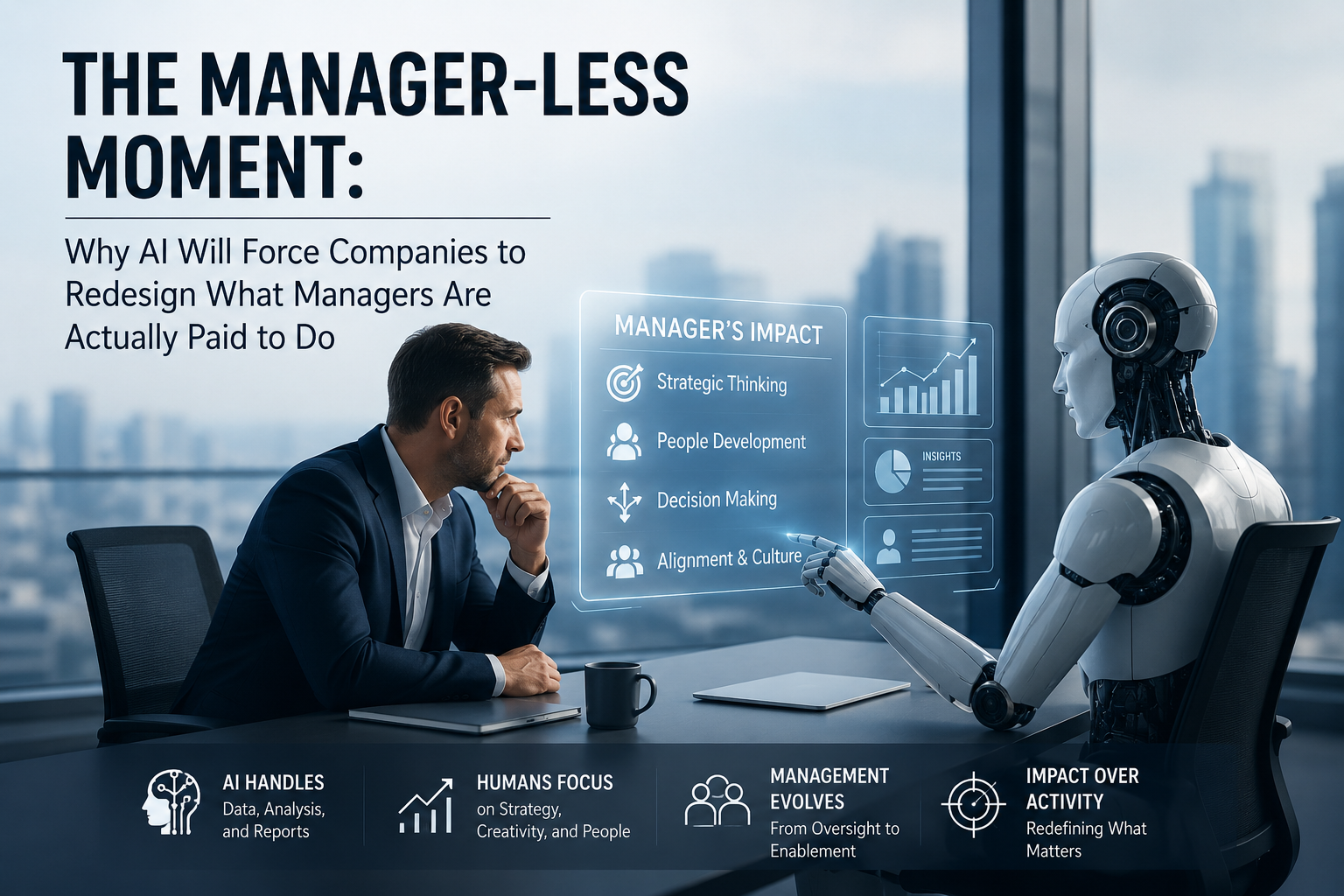

For decades, management has been one of the most recognizable structures inside the modern enterprise. Organizations created layers of managers to coordinate employees, monitor performance, distribute information, approve decisions, solve operational problems, conduct meetings, manage schedules, track progress, and ensure that work moved from one department to another. Much of management therefore evolved around coordination rather than leadership. Managers became the human infrastructure connecting employees to processes, information, and organizational priorities. But artificial intelligence is beginning to remove many of the activities that historically justified managerial layers. AI can summarize meetings, track project progress, identify workflow bottlenecks, generate reports, monitor performance indicators, answer routine employee questions, coordinate schedules, distribute information, and increasingly recommend or execute operational decisions. As these responsibilities become automated, organizations are approaching what can be described as the Manager-less Moment, a period in which companies will be forced to reconsider what managers are actually supposed to contribute when technology can perform much of the coordination work that previously occupied their time.
The transformation is not necessarily about eliminating managers. The more important question is whether organizations will continue defining management around activities that technology can now perform better, faster, and continuously. For decades, managers spent enormous amounts of time collecting updates from employees, preparing reports, checking task completion, organizing meetings, reviewing performance data, communicating status information, and escalating issues between departments. These activities were necessary because information moved slowly and organizational systems were fragmented. Managers acted as translators and coordinators because there were few alternatives. AI is changing that equation. Modern systems can gather information directly from enterprise applications, identify deviations from expected performance, summarize developments, recommend actions, and communicate relevant information to the people who need it. The manager’s traditional role as the organizational information hub is therefore becoming increasingly unnecessary.
This creates a significant challenge for companies because management structures often become deeply embedded in organizational culture. Promotions are designed around managerial progression, departments are structured around reporting relationships, compensation increases frequently accompany larger teams, and leadership development programs often assume that becoming a manager represents the natural next step in a successful career. Yet if AI reduces the amount of coordination required between people, organizations may discover that simply adding management layers no longer creates proportional value. In some cases, additional management can even slow decision-making by introducing more approval points into processes that technology could coordinate automatically. The future enterprise may therefore require fewer coordinators and more strategic leaders.
The distinction between management and leadership becomes critical here. Management traditionally focuses on organizing resources to achieve defined objectives. Leadership focuses on creating direction, building trust, developing people, making difficult judgments, and navigating uncertainty. AI is increasingly capable of supporting the first category while remaining far less capable of replacing the second. An AI system can tell a manager that a project is behind schedule, but it cannot fully understand the interpersonal dynamics causing the delay. It can identify that an employee’s productivity has changed, but it cannot automatically determine whether the person needs coaching, greater autonomy, psychological safety, or a completely different role. It can recommend resource allocation, but it cannot fully understand the cultural consequences of moving a high-performing employee away from a team. Human leadership becomes more important precisely because operational management becomes increasingly automated.
This creates a new expectation for managers: their value will be measured by the quality of human outcomes they create rather than the amount of work they coordinate. A manager who spends most of the day distributing tasks, requesting updates, preparing reports, and forwarding information may become increasingly difficult to justify. A manager who develops exceptional talent, resolves complex conflicts, creates strategic clarity, builds organizational trust, challenges flawed assumptions, and helps employees navigate ambiguity becomes significantly more valuable. The shift is therefore not from managers to no managers. It is from administrative management toward high-value leadership.
Artificial intelligence will accelerate this transition because it can create unprecedented visibility into organizational activity. Managers historically relied upon periodic updates to understand what was happening inside their teams. Employees prepared status reports, attended meetings, updated spreadsheets, and communicated progress manually. AI-enabled enterprise systems can continuously monitor project activity, customer interactions, operational metrics, resource allocation, and workflow performance. Managers receive a real-time picture of organizational activity without requiring employees to repeatedly report it. This eliminates one of the most time-consuming elements of management: collecting information that already exists somewhere inside the organization.
Performance management will be particularly affected. Traditional performance reviews often depend upon subjective observations gathered by managers over months. AI can increasingly provide continuous evidence about project outcomes, customer interactions, collaboration patterns, learning progress, and goal achievement. This does not mean performance evaluation should become fully automated; doing so could introduce significant bias and create unhealthy workplace surveillance. Instead, AI can provide better evidence while managers focus on interpreting that evidence within human context. The manager’s role shifts from being the primary source of performance information to being the person responsible for turning information into constructive development.
Employee development may become one of the most important responsibilities left to managers. AI can recommend courses, identify skill gaps, generate personalized learning plans, simulate conversations, and provide immediate feedback. But professional development is not simply an information problem. Employees often need someone who understands their ambitions, recognizes potential they cannot yet see themselves, challenges them appropriately, and creates opportunities for growth. Managers who become genuine talent developers will create disproportionate organizational value because AI can provide information about what someone should learn, while humans can help determine what someone should become.
Decision-making will also change. In highly structured environments, AI can increasingly recommend decisions based on historical data, current conditions, and predefined organizational priorities. Managers therefore spend less time making routine operational decisions and more time handling ambiguous situations where there is no obvious answer. This could actually improve the quality of management because it allows leaders to focus on questions involving strategy, ethics, organizational culture, customer relationships, competitive positioning, and long-term consequences. The manager becomes the final interpreter of complexity rather than the administrator of routine processes.
The transformation will also challenge traditional career structures. If organizations require fewer people managers, not every high-performing employee can follow the traditional path from specialist to team leader to department head. Companies will need to create alternative career paths that reward expertise, influence, innovation, mentoring, and strategic contribution without requiring formal managerial responsibility. This could ultimately create healthier organizations because employees will no longer feel pressured to become managers simply to advance professionally. Leadership becomes a capability rather than a mandatory promotion.
The Manager-less Moment also creates an opportunity for flatter organizational structures. If AI can handle much of the coordination previously performed by middle management, organizations may be able to reduce unnecessary layers between executives and frontline teams. Information can move faster, decisions can be made closer to customers, and employees can access organizational knowledge without relying on multiple managerial intermediaries. However, flattening an organization without strengthening leadership capabilities could create confusion rather than efficiency. Companies must replace lost coordination with clear objectives, transparent decision rights, strong communication systems, and highly capable leaders.
There is also an important cultural risk. If companies interpret AI-driven management transformation simply as an opportunity to remove managers and reduce costs, they may accidentally eliminate critical human support systems. Employees do not only need instructions and performance tracking. They need coaching, recognition, conflict resolution, advocacy, context, and someone capable of helping them navigate uncertainty. A workplace with fewer managers can succeed only if the remaining leaders are significantly better equipped to provide these forms of human value. The goal should therefore not be fewer managers at any cost but better management with less administrative overhead.
Human Resources will play a central role in this transition. HR departments will need to redefine managerial competencies, redesign leadership development programs, rethink promotion structures, and create new metrics for managerial effectiveness. Instead of rewarding managers primarily for team size, operational control, or reporting efficiency, organizations may increasingly evaluate leadership through employee growth, retention of high performers, innovation, cross-functional collaboration, psychological safety, strategic contribution, and organizational resilience. Management becomes an outcome-oriented capability rather than a position of authority.
The most successful managers of the AI era may therefore look very different from traditional managers. They will spend less time asking for updates and more time asking better questions. They will spend less time distributing information and more time creating meaning from it. They will spend less time monitoring employees and more time developing them. They will use AI to understand what is happening but rely on human judgment to determine what should happen next. Their competitive advantage will not come from controlling information but from creating an environment where people can use information intelligently. Ultimately, the Manager-less Moment is not really about the disappearance of managers. It is about the disappearance of the old reasons for having managers. AI is steadily removing the administrative friction that once required layers of human coordination, creating an opportunity to rebuild management around leadership, judgment, coaching, trust, and strategic thinking. The future workplace may have fewer managers, but the managers who remain will matter more, because when AI can coordinate the work, the true value of leadership will be helping people understand why the work matters.
