



Introduction: The Evolution of Account-Based Marketing in the AI Era
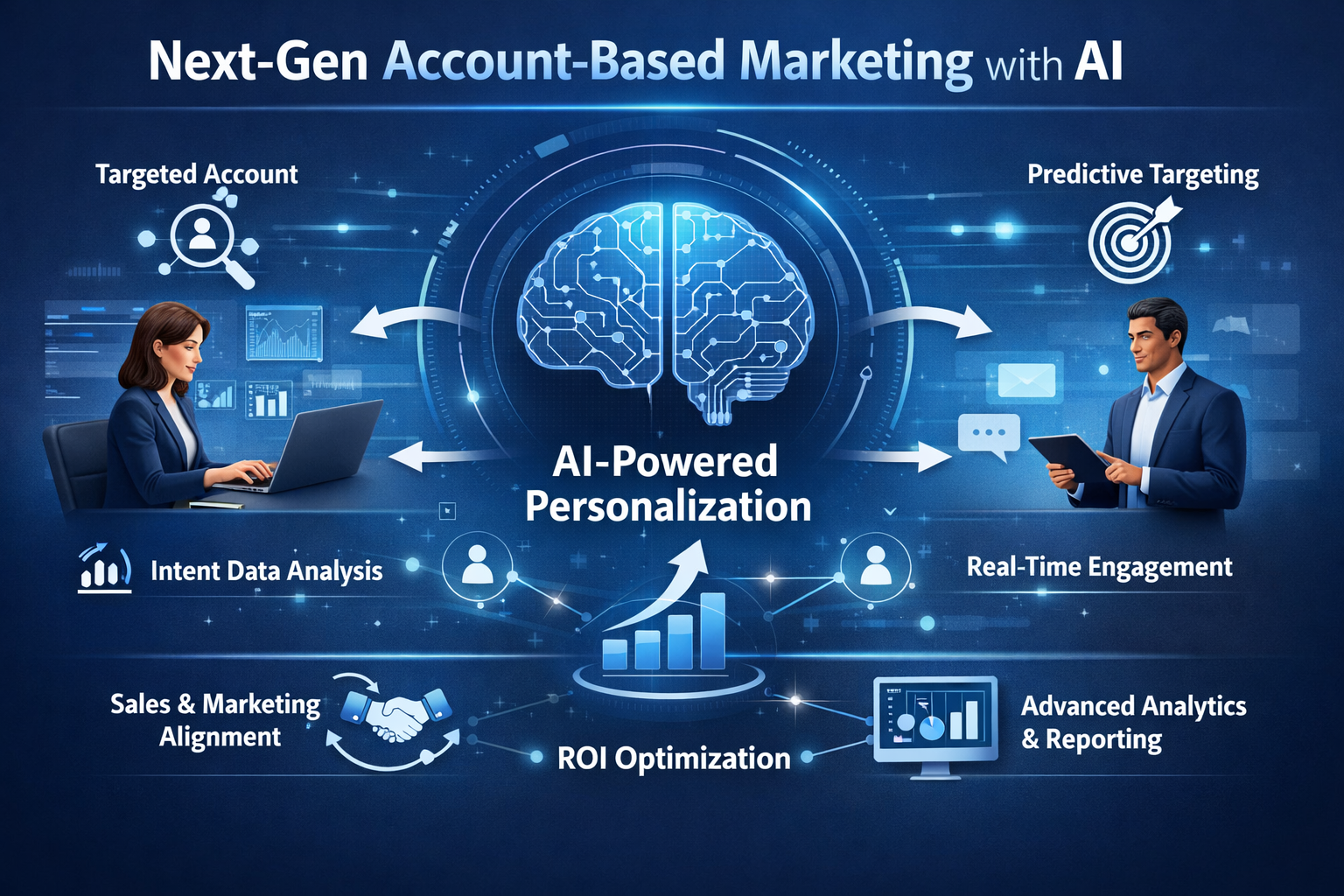
Account-Based Marketing (ABM) has long been a strategic approach for B2B organizations seeking to target high-value accounts with personalized campaigns. Traditionally, ABM relied heavily on manual research, segmented outreach, and close coordination between marketing and sales teams. However, with the rapid advancement of Artificial Intelligence (AI), ABM is undergoing a transformative shift. Next-Gen ABM powered by AI is not just about targeting accounts—it’s about predicting intent, automating personalization, and optimizing engagement at scale.
In today’s competitive B2B IT landscape, decision-makers expect relevance, speed, and value-driven interactions. AI makes this possible by turning vast volumes of data into actionable intelligence, enabling companies to engage the right accounts at the right time with precision messaging.
What Is Next-Gen ABM with AI?
Next-Gen ABM with AI integrates machine learning, predictive analytics, natural language processing, and automation into the traditional ABM framework. Instead of manually selecting target accounts and crafting static campaigns, AI systems continuously analyze behavioral data, firmographics, technographics, and engagement signals to refine targeting strategies in real time.
This evolution transforms ABM from a reactive marketing strategy into a proactive growth engine. AI identifies patterns that human teams may overlook, uncovering buying signals, mapping stakeholder networks within target accounts, and predicting conversion probabilities with greater accuracy.
AI-Powered Account Identification and Prioritization
One of the most powerful advantages of AI in ABM is intelligent account selection. In traditional ABM, account selection often relies on ICP (Ideal Customer Profile) assumptions and static data. AI enhances this process by analyzing historical deal data, CRM interactions, website behavior, and third-party intent signals to rank accounts based on revenue potential and likelihood to convert.
Key improvements AI brings to account targeting include:
- Predictive lead and account scoring
- Real-time intent monitoring
- Automated ICP refinement
- Identification of lookalike high-value accounts
This data-driven prioritization ensures marketing and sales teams focus their efforts on accounts that are most likely to generate meaningful ROI.
Hyper-Personalization at Scale
Personalization has always been central to ABM, but AI enables hyper-personalization across multiple channels without overwhelming marketing teams. By analyzing buyer behavior, engagement patterns, industry trends, and past interactions, AI tools dynamically adjust messaging, content recommendations, and outreach timing.
For example, AI can tailor website experiences for specific accounts, customize email sequences based on user activity, and even generate personalized content suggestions for decision-makers within a company. This level of automation ensures that each stakeholder feels individually addressed, strengthening engagement and trust.
Rather than generic messaging, AI allows businesses to deliver context-aware communication that resonates with specific roles such as CIOs, IT Directors, or Procurement Heads.
Intent Data and Predictive Buying Signals
AI-driven ABM platforms leverage intent data to identify when an account is actively researching relevant solutions. By analyzing search patterns, content consumption, and engagement across digital touchpoints, AI can detect early buying signals before competitors even recognize an opportunity.
This predictive capability allows marketing teams to align outreach with the buyer’s journey stage. Instead of cold outreach, organizations can initiate conversations when prospects are already evaluating similar products or services. This strategic timing significantly increases response rates and shortens sales cycles.
AI and Sales-Marketing Alignment
A major challenge in traditional ABM is maintaining alignment between marketing and sales teams. AI enhances collaboration by providing shared dashboards, predictive insights, and real-time engagement tracking.
Important alignment benefits include:
- Unified visibility into account engagement metrics
- Automated lead handoff based on engagement thresholds
- Clear attribution modeling for revenue impact
- Predictive pipeline forecasting
With AI-generated insights, sales teams can approach prospects with deeper context, while marketing teams can continuously optimize campaigns based on performance data.
Automation Without Losing the Human Touch
While automation is a core advantage of AI-driven ABM, successful implementation balances efficiency with authenticity. AI can draft emails, suggest content, and recommend follow-ups, but human oversight ensures tone, relationship-building, and strategic nuance remain intact.
The goal is not to replace human interaction but to enhance it. AI handles data analysis, segmentation, and repetitive processes, allowing marketing and sales professionals to focus on relationship development and high-level strategy.
Measuring ROI with Advanced Analytics
Next-Gen ABM powered by AI provides granular measurement capabilities. Unlike traditional marketing metrics that focus on individual leads, AI-based ABM tracks engagement across entire buying committees within target accounts.
Advanced analytics allow businesses to measure:
- Account engagement scores
- Multi-touch attribution impact
- Revenue influenced by campaigns
- Sales cycle acceleration
These insights help organizations refine strategies continuously, ensuring long-term performance improvement.
Challenges and Considerations
Despite its advantages, implementing AI-driven ABM requires careful planning. Data quality plays a critical role—AI systems are only as effective as the data they analyze. Companies must ensure CRM hygiene, integration between platforms, and compliance with data privacy regulations.
Additionally, organizations should invest in training teams to interpret AI insights correctly. Technology alone does not guarantee success; strategic alignment and operational readiness are equally important.
The Future of AI-Driven ABM
As AI technology continues to evolve, ABM strategies will become even more intelligent and autonomous. We can expect advancements in conversational AI, automated content generation, real-time personalization engines, and predictive deal-closing models.
In the near future, AI may enable dynamic account-based experiences that adapt instantly based on stakeholder behavior, market conditions, and competitive movements. Organizations that embrace this transformation early will gain a significant competitive advantage in the B2B IT space.
Conclusion
Next-Gen Account-Based Marketing with AI represents a fundamental shift in how B2B IT organizations identify, engage, and convert high-value accounts. By combining predictive intelligence, hyper-personalization, real-time intent monitoring, and automated analytics, AI transforms ABM from a selective targeting strategy into a scalable revenue engine.
While challenges around data quality and implementation exist, the long-term benefits far outweigh the initial investment. Companies that leverage AI strategically within their ABM frameworks will not only improve marketing efficiency but also build stronger, more meaningful relationships with enterprise buyers.
In an era where precision and personalization define success, AI-powered ABM is no longer optional—it is the future of B2B growth.
