



The Growing Role of AI in Modern IT Operations
AI automation has rapidly become a core component of IT operations, helping organizations manage complex infrastructures, massive data volumes, and real-time system demands. From automated incident detection to predictive maintenance, AI enables IT teams to operate faster and more efficiently than ever before. Machine learning algorithms can analyze logs, performance metrics, and usage patterns continuously, identifying anomalies that would be difficult for humans to catch manually. However, as AI becomes more embedded in IT workflows, organizations are realizing that automation alone is not enough. The challenge lies in ensuring that AI enhances human decision-making rather than replacing it blindly.
Why Human Judgment Still Matters in IT Decision-Making
Despite AI’s analytical strength, human judgment remains essential in IT operations because technology operates within predefined models and rules. IT environments often involve ambiguous situations, unexpected business impacts, and ethical considerations that AI cannot fully understand. Humans bring contextual awareness, strategic thinking, and experience-based intuition to decisions such as prioritizing incidents, approving major changes, or handling sensitive security breaches. While AI may recommend an action, it is human judgment that evaluates business risk, customer impact, and long-term consequences before implementation.
Understanding the Risks of Over-Automation
Over-reliance on AI automation can introduce significant operational risks if not carefully managed. Automated systems may misinterpret data, amplify biases in training models, or execute actions without fully understanding their downstream effects. For example, an AI-driven remediation tool might automatically shut down services to resolve a perceived threat, causing unnecessary downtime. When IT teams trust automation without verification, they risk losing visibility and control over critical systems. Balancing automation with human oversight ensures that AI recommendations are reviewed, validated, and aligned with organizational priorities.
AI as a Decision Support Tool, Not a Decision Maker
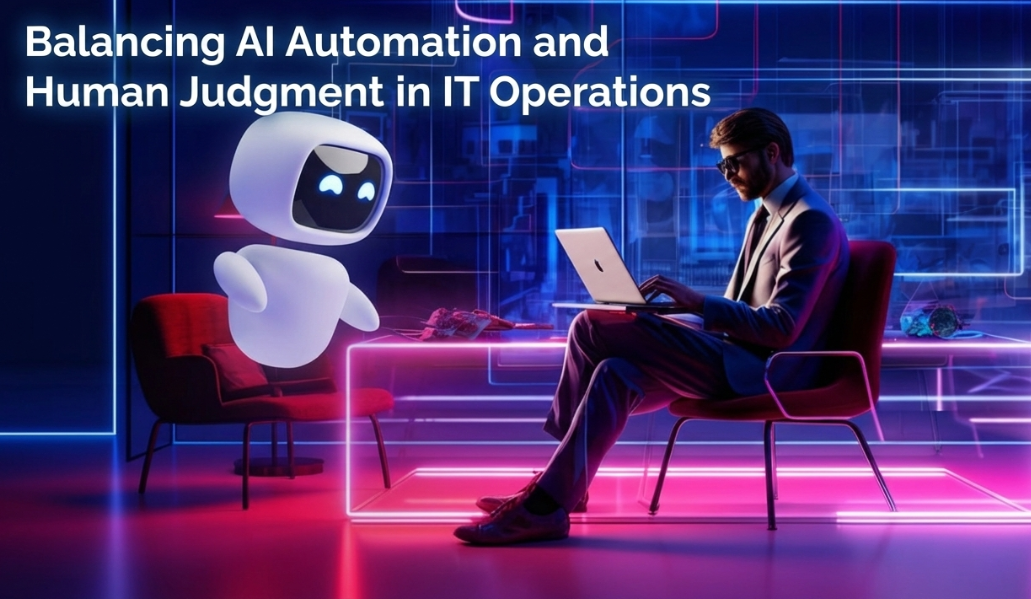
The most effective use of AI in IT operations positions it as a decision support system rather than a final authority. AI excels at gathering insights, ranking risks, and suggesting optimal responses based on historical data. Human operators then assess these insights and decide whether to act, modify, or override recommendations. This collaborative model allows IT teams to leverage the speed and scalability of AI while maintaining accountability and strategic control. When AI and humans work together, decision quality improves without sacrificing trust or transparency.
Building Trust Between IT Teams and AI Systems
For AI-driven automation to succeed, IT professionals must trust the systems they use. Trust is built through transparency, explainability, and consistent performance. AI tools should clearly explain why certain alerts or actions are recommended, enabling humans to understand the logic behind decisions. Training IT teams to work alongside AI is equally important, as it reduces fear of job displacement and promotes adoption. When teams understand AI’s strengths and limitations, they are more likely to use it responsibly and effectively.
Governance and Accountability in AI-Driven Operations
Strong governance frameworks are critical when integrating AI into IT operations. Organizations must define clear policies outlining where AI can act autonomously and where human approval is required. Accountability should always remain with human decision-makers, even when actions are AI-initiated. Regular audits, model evaluations, and compliance checks help ensure that AI systems operate within ethical, legal, and business boundaries. Governance ensures that AI automation supports organizational goals without introducing uncontrolled risks.
Skills IT Professionals Need in an AI-Augmented Environment
As AI becomes a permanent part of IT operations, the role of IT professionals is evolving. Technical skills alone are no longer sufficient; teams must also develop analytical thinking, AI literacy, and decision-making capabilities. Understanding how AI models work, interpreting outputs, and knowing when to challenge recommendations are critical skills. Rather than replacing IT jobs, AI shifts the focus toward higher-value activities such as strategy, innovation, and complex problem resolution.
Practical Scenarios Where Human Oversight Is Essential
There are specific IT scenarios where human judgment must always remain in control. Security incidents involving potential data breaches require nuanced responses that consider legal, regulatory, and reputational risks. Major infrastructure changes, system migrations, or cost-optimization decisions also demand human evaluation. AI can provide valuable insights in these situations, but final decisions should be made by experienced professionals who understand broader business implications and stakeholder expectations.
Creating a Sustainable Human-AI Operating Model
A sustainable IT operations model blends automation efficiency with human intelligence. Organizations should design workflows that clearly define handoffs between AI systems and human teams. Continuous feedback loops help improve AI accuracy while keeping humans engaged in oversight roles. This balanced approach not only improves operational resilience but also ensures long-term scalability as IT environments grow more complex. The goal is not to choose between AI and humans, but to create a system where each complements the other.
Key Principles for Balancing AI and Human Judgment
- Use AI for speed, scale, and pattern recognition
- Keep humans responsible for final decisions and accountability
- Implement clear governance and approval workflows
- Ensure AI systems are transparent and explainable
- Continuously train IT teams to work alongside AI tools
Conclusion
Balancing AI automation and human judgment in IT operations is no longer optional—it is a strategic necessity. AI brings unmatched efficiency and analytical power, but human insight provides context, ethics, and accountability. Organizations that successfully integrate both will achieve more resilient, intelligent, and trustworthy IT operations. By treating AI as a collaborative partner rather than a replacement, IT leaders can unlock innovation while maintaining control, confidence, and long-term business value.
