



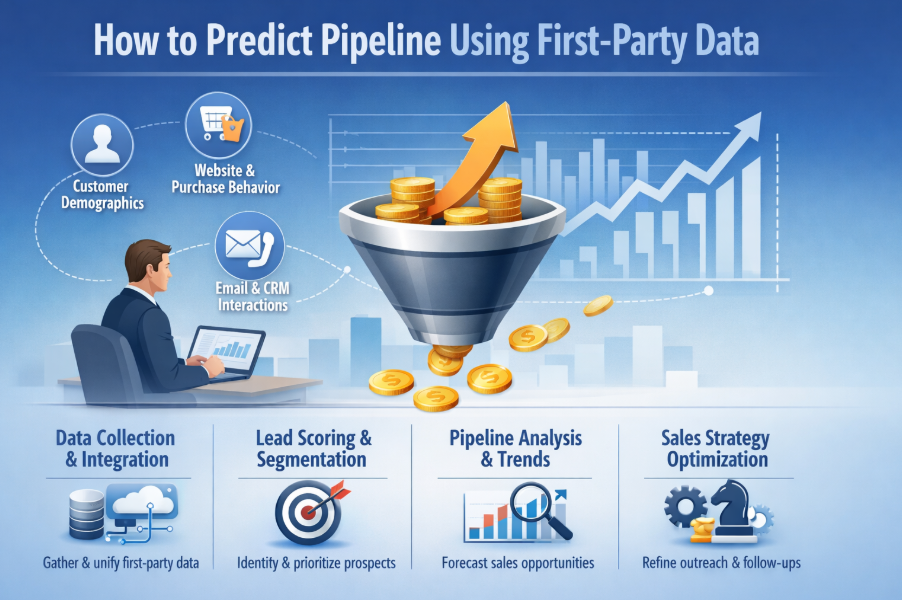
In modern B2B organizations, revenue predictability is one of the most critical drivers of sustainable growth. Leaders are expected to forecast accurately, allocate budgets strategically, and scale teams confidently. Yet many pipeline predictions still rely heavily on rep intuition, incomplete CRM updates, or surface-level metrics. The most reliable way to improve forecasting accuracy is by leveraging first-party data—data your organization directly collects from prospects and customers across marketing, sales, and product touchpoints.
First-party data reflects real behavior. It captures how prospects interact with your website, how often they engage with content, how quickly they respond to outreach, how deeply they explore pricing pages, and how actively they use a trial product. Unlike third-party data, which may be generalized or delayed, first-party data shows clear, direct buying signals. When properly unified and analyzed, this data becomes the foundation for accurate pipeline prediction.
Understanding First-Party Data in a B2B Sales Model
First-party data includes every interaction that occurs within your owned systems. In a B2B environment, this spans marketing automation platforms, CRM systems, website analytics, sales engagement tools, and product usage platforms. It includes behavioral signals such as repeat visits, demo requests, webinar attendance, trial engagement, and sales call frequency.
The value of this data lies in its specificity. For example, when multiple stakeholders from the same company visit your pricing page within a short timeframe, that behavior carries far more predictive weight than a single anonymous website visit. When a prospect attends a webinar, downloads a case study, and books a meeting within two weeks, that sequence reveals momentum in the buying journey. Pipeline prediction is ultimately about identifying these behavioral patterns and understanding which combinations most often lead to opportunity creation and closed revenue.
The Foundation: Data Centralization and Clean Infrastructure
Before any predictive modeling can begin, data must be centralized and reliable. Many organizations struggle with fragmented systems where marketing, sales, and product data exist in silos. Without integration, insights remain incomplete, and forecasting becomes inconsistent.
Accurate pipeline prediction requires:
- A clean and updated CRM with clearly defined stages
- Integrated marketing engagement data
- Website behavior tracking connected to accounts
- Sales activity logs properly recorded
- Consistent opportunity naming and close date tracking
Data hygiene plays a crucial role here. If sales representatives delay updating stages or misclassify opportunities, predictive models lose reliability. Forecasting accuracy depends not just on data volume but on data discipline.
Identifying Leading Indicators Instead of Lagging Metrics
One of the biggest mistakes in pipeline prediction is relying on lagging indicators such as closed deals or revenue booked. These metrics tell you what has already happened. To predict future pipeline accurately, you must focus on leading indicators—behaviors that typically occur before an opportunity is created.
Leading indicators often include strong engagement patterns such as multiple decision-makers interacting with high-intent pages, rapid follow-up after marketing campaigns, or consistent email engagement combined with meeting bookings. These signals often emerge weeks before an opportunity is formally created in the CRM.
When organizations analyze historical data, they frequently discover that certain behaviors consistently precede opportunity creation. For example, accounts that revisit pricing pages multiple times within a short period may convert at significantly higher rates. Prospects who complete product onboarding milestones during a trial often show stronger buying intent. Identifying these trends transforms forecasting from guesswork into probability-based modeling.
Analyzing Historical Conversion Patterns for Predictive Accuracy
Predicting pipeline growth requires looking backward before looking forward. Historical conversion analysis reveals how prospects move from one stage to another and how long that journey typically takes. By examining patterns over several quarters or years, companies can determine stage-to-stage conversion rates, average deal size by segment, and typical sales cycle length.
This analysis often reveals insights such as differences in close rates across industries or variations in cycle length by company size. For example, enterprise deals may take longer to close but yield higher contract values, while mid-market deals might move faster but require higher lead volume. Understanding these nuances allows for segmented forecasting rather than broad, generalized assumptions.
When historical patterns are clearly mapped, organizations can assign probability values to active opportunities. Instead of labeling a deal as “likely to close,” the system can estimate its likelihood based on comparable past deals with similar behavioral and firmographic characteristics.
Building a Predictive Scoring Framework
Once leading indicators and historical patterns are identified, the next step is building a scoring framework. A predictive scoring model assigns weighted value to specific behaviors and attributes based on how strongly they correlate with revenue outcomes.
For example, actions such as demo requests, repeated visits to pricing pages, or multi-stakeholder engagement may carry higher predictive weight than simple blog visits. Recent activity may also be weighted more heavily than older engagement, as timing plays a significant role in buyer intent.
A strong predictive model typically considers three core dimensions:
- Behavioral engagement signals
- Firmographic fit (industry, company size, revenue range)
- Sales interaction patterns (meeting frequency, response time, follow-ups)
Over time, machine learning tools can refine these weights automatically by analyzing new data and recalibrating probabilities. However, even a well-structured rule-based scoring system can significantly improve pipeline forecasting compared to manual estimates.
Incorporating Pipeline Velocity for Forward-Looking Forecasts
Pipeline volume alone does not guarantee revenue predictability. Velocity—the speed at which opportunities move through stages—plays an equally important role. A pipeline filled with stagnant deals does not translate into near-term revenue.
By analyzing average time spent in each stage and historical sales cycle length, organizations can anticipate revenue gaps months in advance. If the typical sales cycle is 90 days and new qualified opportunities are declining this month, leadership can expect potential revenue pressure three months later.
Velocity analysis also reveals bottlenecks. If opportunities consistently stall at a particular stage, this signals either qualification issues or process inefficiencies. Correcting these issues improves not only forecast accuracy but also overall conversion performance.
The Importance of Segmentation in Predictive Modeling
Pipeline prediction becomes far more accurate when segmentation is applied. Not all accounts behave the same, and grouping all opportunities together often masks meaningful differences.
Segmenting data by industry, company size, geography, product line, or acquisition channel allows organizations to build more nuanced models. For instance, enterprise buyers may involve more stakeholders and longer decision cycles, while smaller companies may convert quickly but require lower-touch engagement.
Segment-level forecasting provides clarity on where pipeline growth is strongest and where it may be vulnerable. It also helps marketing teams optimize campaigns toward the most profitable segments.
Continuous Model Refinement and Organizational Alignment
Predictive pipeline modeling is not a one-time project. Buyer behavior evolves, industries shift, and competitive pressures change engagement patterns. Models must be reviewed and adjusted regularly to maintain accuracy.
Sales and marketing alignment is equally critical. Predictive insights should guide action. Marketing teams can prioritize high-scoring accounts for personalized outreach, while sales teams can focus on accounts showing strong intent signals. When both teams operate from a shared definition of qualified pipeline and use consistent dashboards, forecasting becomes a collaborative discipline rather than a subjective debate.
Organizations that regularly compare predicted outcomes against actual results can refine their scoring thresholds and probability assumptions. Over time, this iterative process dramatically increases forecast reliability.
Conclusion
Predicting pipeline using first-party data is about transforming real engagement signals into forward-looking revenue intelligence. By centralizing clean data, identifying meaningful leading indicators, analyzing historical conversion trends, building structured scoring models, incorporating velocity metrics, and segmenting intelligently, B2B organizations can move from reactive forecasting to proactive revenue planning.
Rather than relying on intuition or incomplete snapshots, businesses gain measurable visibility into future pipeline health. In an environment where predictable revenue determines competitive advantage, first-party data is not merely a marketing asset—it is the backbone of strategic growth and accurate pipeline forecasting.
