



Introduction
Software as a Service (SaaS) has transformed the way businesses operate by providing flexible, scalable, and cost-effective access to digital tools. From customer relationship management (CRM) and human resource management to project collaboration, marketing automation, cloud storage, and financial operations, SaaS applications have become an essential part of modern B2B organizations. These cloud-based solutions enable teams to work more efficiently, collaborate across departments, and adapt quickly to changing business requirements without investing heavily in traditional IT infrastructure.
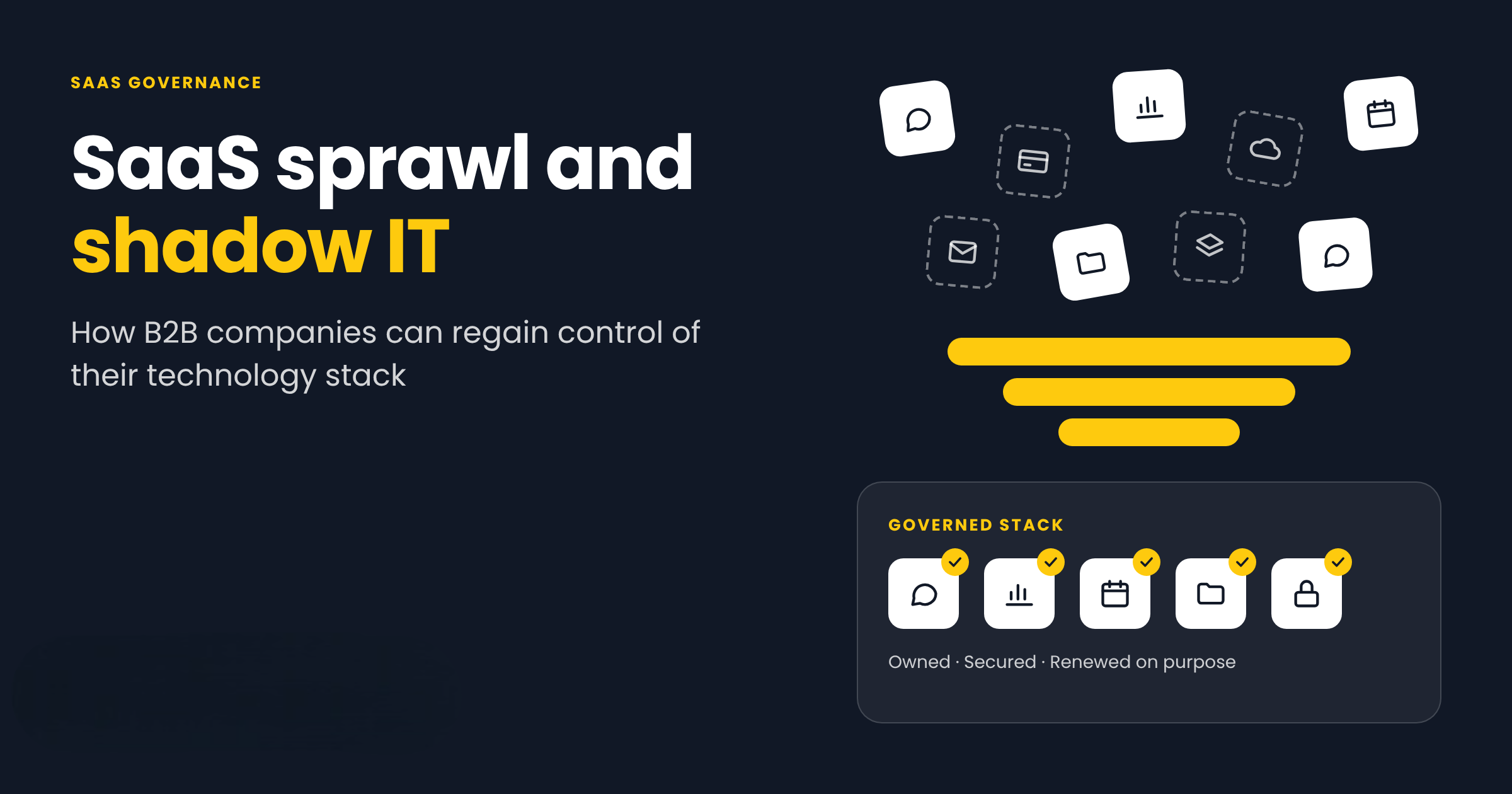
However, the rapid adoption of SaaS applications has introduced a growing challenge for enterprise IT teams: SaaS sprawl and Shadow IT. As departments independently purchase software subscriptions and employees adopt unauthorized applications to solve immediate business problems, organizations can lose visibility into their technology stack. This lack of oversight can lead to unnecessary spending, fragmented data, security vulnerabilities, compliance risks, and operational inefficiencies.
For B2B companies managing complex digital environments, controlling SaaS sprawl and Shadow IT is becoming an important part of IT governance, cybersecurity, and technology cost optimization. Organizations need a structured approach to identifying software usage, managing access, consolidating applications, and establishing clear policies for technology adoption. By regaining control of their technology stack, businesses can improve security, reduce software waste, and ensure that technology investments support long-term business objectives.
Understanding SaaS Sprawl in Modern B2B Organizations
SaaS sprawl occurs when an organization accumulates more software-as-a-service applications than it can effectively manage, monitor, or justify. This often happens gradually as different teams adopt applications to improve productivity, automate workflows, or address specific operational challenges. While each application may serve a legitimate purpose, the combined technology environment can become unnecessarily complex when software purchases and usage are not coordinated across the organization.
For example, a sales team might use one platform for customer relationship management, another for email outreach, and a third for reporting. Meanwhile, the marketing department may subscribe to separate automation, analytics, and content management tools. Human resources, finance, customer support, and engineering teams may introduce additional applications to meet their own requirements. Over time, several tools may perform similar functions, resulting in overlapping subscriptions, inconsistent data, and unnecessary operational costs.
SaaS sprawl is not simply a problem of having too many applications. It is a broader issue involving software visibility, application ownership, subscription management, integration, and governance. When IT departments cannot determine which applications are being used, who owns them, how much they cost, or what data they access, maintaining a secure and efficient technology stack becomes increasingly difficult.
For B2B organizations, addressing SaaS sprawl requires more than canceling unused subscriptions. It involves developing a comprehensive understanding of the software ecosystem and ensuring that every application delivers measurable business value while meeting organizational security and compliance requirements.
What Is Shadow IT and Why Is It Increasing?
Shadow IT refers to the use of software, cloud services, devices, or technology solutions without the knowledge, approval, or oversight of an organization’s IT department. It frequently emerges when employees or business teams adopt tools independently because they believe existing systems are too slow, complicated, expensive, or limited for their needs.
For instance, an employee might use a personal cloud storage account to share confidential documents with a client, while a marketing team may sign up for an AI-powered content platform without consulting IT or security teams. Similarly, a department may purchase a project management application using a corporate credit card without informing the technology procurement team.
The growing availability of self-service SaaS subscriptions, browser-based applications, free software trials, and generative AI tools has made it easier for employees to adopt new technologies independently. Teams can often begin using an application within minutes, without requiring infrastructure deployment or a formal procurement process.
Although this flexibility can improve productivity, unauthorized technology adoption introduces significant challenges. IT teams may not know where company data is stored, which external services can access sensitive information, or whether an application meets internal security standards. When employees leave the organization, accounts and subscriptions may also remain active if there is no centralized process for managing software ownership and access.
Shadow IT is not always the result of employees deliberately bypassing security policies. In many cases, it reflects a gap between business requirements and the technology services available through official channels. Organizations that want to reduce Shadow IT should therefore focus on understanding employee needs, simplifying software procurement, and providing secure alternatives rather than relying exclusively on restrictive policies.
The Key Differences Between SaaS Sprawl and Shadow IT
SaaS sprawl and Shadow IT are closely related, but they represent different challenges within enterprise technology management. SaaS sprawl describes the excessive growth and complexity of an organization’s software portfolio, while Shadow IT focuses on applications and technology services operating outside established IT oversight.
An organization can experience SaaS sprawl even when every application has been formally approved. For example, different departments may independently request approved tools that duplicate existing capabilities. Conversely, a company may have a relatively small software portfolio but still face serious Shadow IT risks if employees use unauthorized AI tools, file-sharing services, or cloud platforms to process confidential information.
Understanding this distinction helps IT leaders develop more effective management strategies. SaaS sprawl requires application rationalization, subscription optimization, and portfolio governance. Shadow IT requires better software discovery, employee awareness, access controls, and streamlined approval processes. A comprehensive SaaS management strategy should address both issues together.
The Business Impact of Uncontrolled SaaS Sprawl
Rising Software Costs and Subscription Waste
One of the most immediate consequences of SaaS sprawl is the increase in software spending. When departments purchase subscriptions independently, organizations may pay for multiple tools that provide similar features. In addition, unused licenses, forgotten free trials that convert into paid plans, duplicate subscriptions, and inactive accounts can gradually increase operating expenses.
The financial impact extends beyond subscription fees. Different applications may require separate integrations, administrative resources, user training, and vendor management. As the number of applications grows, IT teams must spend more time maintaining connections, reviewing contracts, troubleshooting issues, and managing renewals.
For B2B companies operating under tight technology budgets, these expenses can reduce the resources available for strategic investments. Centralized SaaS management helps organizations identify redundant applications, reclaim unused licenses, negotiate better vendor agreements, and align software spending with actual business requirements.
Increased Cybersecurity and Data Privacy Risks
Unmanaged SaaS applications can introduce security vulnerabilities because they may not follow the organization’s established cybersecurity policies. Some applications may lack appropriate encryption, multifactor authentication, access logging, or administrative controls. Others may store sensitive information in locations that have not been reviewed by the organization’s security or compliance teams.
The risks become more serious when employees upload customer records, financial information, internal documents, or proprietary business data to unauthorized platforms. Without appropriate visibility, security teams may be unable to determine where the data resides, who can access it, or whether it is being processed in accordance with company policies.
Uncontrolled SaaS usage can also increase the likelihood of unauthorized access and data exposure. If an employee leaves the organization but retains access to a third-party application, business information may remain accessible beyond the intended employment period.
To reduce these risks, organizations should maintain an accurate inventory of applications, enforce identity and access management policies, assess vendor security practices, and establish clear guidelines for handling sensitive information.
Fragmented Data and Limited Integration
SaaS applications frequently store business information in separate environments. When sales, marketing, finance, customer support, and operations teams use disconnected platforms, employees may struggle to obtain a consistent view of customers, projects, transactions, and performance metrics.
For example, a sales team may maintain customer records in one CRM platform while marketing manages campaign engagement data in another system. If the applications are not properly integrated, teams may encounter duplicate records, inconsistent reporting, and delays in sharing important information.
Fragmented data also affects analytics and artificial intelligence initiatives. AI systems and business intelligence tools depend on reliable, accessible, and appropriately governed data. When information is scattered across unmanaged applications, integrating and validating it becomes more complicated.
A well-governed SaaS environment helps businesses establish reliable data flows, reduce duplication, improve reporting accuracy, and support more informed decision-making.
Compliance and Governance Challenges
B2B organizations may need to comply with data protection laws, industry regulations, contractual obligations, and internal security requirements. Unapproved software can make these responsibilities more difficult to manage, particularly when applications process personal information, customer records, financial data, or confidential business documents.
Compliance risks can arise when organizations do not understand where data is stored, how long it is retained, which subprocessors handle it, or how access is controlled. They may also struggle to demonstrate that appropriate safeguards are in place during customer security reviews, internal audits, or regulatory assessments.
Centralized SaaS governance provides a more consistent approach to vendor assessment, data classification, access management, retention requirements, and audit documentation. This allows IT, security, legal, procurement, and compliance teams to work together while ensuring that software adoption remains aligned with organizational obligations.
Reduced IT Visibility and Operational Efficiency
As software adoption becomes decentralized, IT teams can lose a clear picture of the organization’s technology environment. Employees may use different tools for similar tasks, store information across multiple platforms, and establish integrations without considering their long-term maintenance requirements.
This complexity makes troubleshooting more difficult and can create dependencies that are poorly documented. IT teams may also spend valuable time responding to support requests for applications they do not officially manage.
Without a consolidated view of the software portfolio, leadership may find it difficult to determine which applications are essential, which should be replaced, and which no longer provide sufficient value.
Improving visibility into SaaS usage enables IT leaders to simplify the environment, establish consistent support processes, and make technology management more predictable.
How B2B Companies Can Regain Control of Their Technology Stack
1. Build a Centralized SaaS Application Inventory
The first step toward controlling SaaS sprawl is identifying every application used across the organization. Businesses should not rely solely on procurement records because unauthorized applications may have been purchased using departmental budgets, corporate cards, reimbursement claims, or individual subscriptions.
IT teams should combine information from identity providers, single sign-on systems, expense reports, finance records, browser and network security tools, procurement systems, and employee surveys. Where appropriate and permitted by organizational policy, they can also use SaaS discovery tools to identify applications accessing corporate environments.
The resulting inventory should include application names, business owners, user counts, subscription costs, renewal dates, data classifications, integration dependencies, authentication methods, and security review status. Recording these details provides a foundation for understanding the organization’s software landscape.
A centralized SaaS inventory should be maintained continuously rather than treated as a one-time audit. Applications change, new subscriptions are introduced, and existing services are retired. Regular updates help organizations preserve accurate visibility and identify emerging risks before they become significant problems.
2. Conduct a Comprehensive SaaS Usage Audit
Once the application inventory is established, organizations should evaluate how each application is being used. The objective is to determine whether a tool is necessary, actively used, appropriately secured, and aligned with business requirements.
A SaaS usage audit should examine active users, login frequency, assigned licenses, feature adoption, overlapping functionality, contract terms, data sensitivity, and integration requirements. An application with hundreds of assigned licenses but only a small number of active users may indicate a substantial opportunity for cost optimization.
IT and procurement teams should also compare similar applications across departments. If multiple teams use different tools for project management, file sharing, collaboration, or customer engagement, the organization should assess whether consolidating these services would reduce costs and complexity without affecting productivity.
The results of the audit should be categorized into clear actions: retain, optimize, consolidate, replace, or retire. This approach allows businesses to prioritize applications based on financial value, operational importance, and security risk rather than making decisions solely on subscription price.
3. Establish a Clear SaaS Governance Framework
Effective SaaS governance defines how applications are requested, evaluated, approved, purchased, deployed, monitored, and retired. Without a consistent framework, departments may continue introducing software independently, recreating the same problems even after an initial cleanup.
A practical governance policy should identify the roles of IT, cybersecurity, procurement, finance, legal, compliance, and business application owners. It should also define approval requirements according to the application’s risk profile, cost, data access, and intended use.
For example, a low-risk application used for internal task tracking may require a streamlined review, while a platform that processes sensitive customer information may need a more detailed security, privacy, and contractual assessment. This risk-based approach prevents governance from becoming unnecessarily slow while preserving appropriate controls.
Organizations should document approved applications, prohibited services, vendor evaluation criteria, renewal procedures, and data handling requirements. Employees should be able to access these guidelines easily so that they understand how to request software and where to find approved alternatives.
4. Implement SaaS Management Platforms
A SaaS management platform can help organizations centralize application discovery, usage monitoring, license optimization, renewal tracking, and software portfolio reporting. These tools are particularly useful for businesses managing a large number of cloud applications across distributed teams.
Depending on the platform and available integrations, a SaaS management solution may identify applications, highlight inactive licenses, detect duplicate subscriptions, track application owners, and provide information about upcoming renewals. Some platforms can also support workflows for onboarding, offboarding, access reviews, and application procurement.
However, businesses should evaluate these platforms carefully. Discovery coverage varies according to available data sources, integrations, permissions, and product capabilities. A management platform should complement identity management, endpoint security, procurement, and financial systems rather than be treated as a complete replacement for them.
When implemented effectively, SaaS management tools give IT leaders a more reliable understanding of software usage and enable decisions based on measurable evidence instead of incomplete departmental reports.
5. Strengthen Identity and Access Management
Identity and access management is essential for reducing Shadow IT risks and protecting applications that contain business information. Organizations should establish consistent controls for verifying user identities, assigning permissions, monitoring access, and removing privileges when they are no longer required.
Single sign-on can simplify authentication by allowing employees to access approved applications through a centralized identity provider. Multifactor authentication adds another layer of protection, while role-based access control helps ensure that users receive only the permissions necessary to perform their responsibilities.
Automated provisioning and deprovisioning can further improve control by linking application access to employee onboarding, role changes, and offboarding. When a user leaves the company, access to connected applications can be revoked through established workflows, reducing the risk of orphaned accounts.
Not every SaaS application supports centralized identity integration, so IT teams should identify exceptions and establish compensating controls where necessary. Regular access reviews can help detect excessive permissions, inactive accounts, and unexpected changes in application ownership.
6. Create a Faster and More Flexible Software Approval Process
One reason employees adopt Shadow IT is that formal software procurement can be slow or difficult to navigate. When business teams need a tool quickly, they may choose an unauthorized application rather than wait for an extended approval process.
Organizations can reduce this behavior by creating a transparent and efficient software request process. Employees should have a central place to submit requests, describe their business needs, compare approved alternatives, and understand expected review timelines.
IT teams can establish preapproved software catalogs for common requirements such as collaboration, project management, file sharing, analytics, and productivity. Applications that fall outside the catalog can undergo a risk-based review involving the relevant stakeholders.
Providing clear service-level expectations for reviews helps employees understand when they can expect a decision. When the approval process is accessible and responsive, teams have less incentive to bypass established procedures, and IT departments gain better visibility into technology demand.
7. Consolidate Redundant Applications and Optimize Licenses
Application consolidation is one of the most practical ways to address SaaS sprawl. Businesses should identify applications that provide overlapping capabilities and evaluate whether a smaller number of platforms can meet the organization’s needs.
However, consolidation should not be based on feature overlap alone. Organizations must also consider usability, integration requirements, accessibility, business continuity, data migration, employee training, contractual commitments, and the potential effect on productivity.
Once consolidation opportunities are identified, finance, procurement, and IT teams can review subscription tiers, remove inactive users, reassign unused licenses where contract terms permit, and negotiate pricing based on actual usage. Renewal dates should be monitored carefully to prevent automatic extensions of subscriptions that no longer deliver sufficient value.
Organizations should measure savings against a documented baseline. Tracking subscription expenditure before and after optimization helps demonstrate the financial impact of SaaS governance and supports continued investment in software management.
8. Establish Strong Governance for AI-Powered SaaS Tools
Generative AI and AI-enabled business applications have introduced new dimensions to Shadow IT. Employees may experiment with AI assistants, automated content platforms, meeting transcription tools, coding assistants, and data analysis services without understanding how submitted information is processed.
These tools can improve productivity, but they may also create risks when confidential information, customer data, source code, or internal documents are entered into services that have not been assessed by the organization.
B2B companies should establish clear policies governing the use of AI-powered SaaS applications. These policies should define permitted use cases, restrictions on sensitive data, requirements for human review, acceptable vendors, and procedures for evaluating how information is stored and processed.
Organizations should assess relevant contractual terms, data retention practices, access controls, and model-training policies rather than assuming that every AI service handles corporate information in the same way. Approved AI tools should be easy to discover and use, giving employees a secure alternative to unreviewed services.
By combining employee education with practical governance, businesses can support responsible AI adoption without unnecessarily limiting innovation.
9. Improve Collaboration Between IT, Finance, Procurement, and Business Teams
SaaS sprawl cannot be solved by the IT department alone. Finance understands expenditure and budget ownership, procurement manages vendor relationships and contracts, cybersecurity evaluates technical risks, legal teams review contractual obligations, and business departments understand the operational value of individual applications.
A cross-functional SaaS management process brings these perspectives together. IT can maintain the technical inventory, finance can reconcile subscription expenses, procurement can coordinate renewals, and application owners can confirm whether tools continue to meet business needs.
Regular review meetings can help teams evaluate new software requests, identify upcoming renewals, assess security exceptions, and prioritize consolidation initiatives. Clear accountability also prevents applications from becoming unmanaged when employees change roles or leave the company.
This collaborative approach creates a shared understanding of the technology stack and ensures that decisions balance security, cost, usability, and business performance.
10. Train Employees and Build a Security-Aware Culture
Technology policies are more effective when employees understand why they exist and how to follow them. A restrictive policy without education may encourage users to find alternative ways to access the tools they need, increasing the risk of hidden technology adoption.
Organizations should explain the security, financial, and operational consequences of unauthorized software use. Training can cover safe file sharing, approved AI applications, sensitive data handling, password security, phishing risks, and the process for requesting new software.
Employees should also have a convenient way to report applications that are not listed in the approved software catalog. This allows IT teams to discover unmet business needs and evaluate whether an existing tool can provide the required functionality.
The objective is not to eliminate employee initiative. It is to create an environment where innovation can happen within clear security boundaries and where employees see IT as a partner in solving business problems.
The Role of Automation in SaaS Management
Manual SaaS management becomes increasingly difficult as organizations add more applications, users, integrations, and vendors. Automation can help standardize recurring processes and reduce the administrative workload associated with managing a large software portfolio.
Automated workflows can support software request approvals, user provisioning, license reassignment, contract renewal reminders, access certification, and employee offboarding. When integrated with identity providers and human resource systems, these workflows can help ensure that application access reflects current employment status and business responsibilities.
Automation can also improve reporting by combining application usage, financial information, and security findings into centralized dashboards. IT leaders can use these insights to identify unusual changes, monitor license utilization, and prioritize applications that require additional review.
Nevertheless, automation should be introduced with appropriate safeguards. Organizations need clear ownership, accurate source data, defined approval rules, and monitoring for failed or incomplete workflows. Automated decisions involving sensitive data or significant business risk should retain appropriate human oversight.
By automating repetitive administrative tasks, B2B companies can shift IT resources toward strategic initiatives such as technology modernization, cybersecurity improvements, and digital transformation.
Measuring the Success of SaaS Sprawl Reduction
To determine whether SaaS governance initiatives are delivering value, organizations should establish measurable performance indicators. Without a baseline, it can be difficult to distinguish meaningful improvements from temporary changes in subscription spending or application usage.
Useful metrics include total SaaS expenditure, the number of discovered applications, the percentage of applications with assigned business owners, unused license rates, the number of redundant subscriptions, and the percentage of applications covered by security reviews. Organizations can also monitor average software approval time, the number of unmanaged applications identified, and the completion rate of employee offboarding access reviews.
Financial indicators should be considered alongside security and operational measures. For example, reducing software expenditure is valuable, but not if consolidation disrupts essential workflows or introduces unacceptable security risks. Similarly, reducing the number of applications is not necessarily an improvement if employees lose capabilities required to serve customers effectively.
Organizations should review these metrics periodically and compare results with their original objectives. This makes SaaS management a continuous improvement process rather than a one-time cost-cutting exercise.
Best Practices for Maintaining a Controlled SaaS Environment
Long-term SaaS governance depends on consistent processes rather than isolated cleanup projects. Organizations should maintain a current software inventory, assign a responsible owner to each application, review subscriptions before renewal, and ensure that access permissions remain aligned with job responsibilities.
New software requests should follow a documented process that balances business urgency with security and compliance requirements. Application owners should periodically confirm whether their tools remain necessary, while IT and procurement teams should monitor overlapping capabilities and opportunities for contract optimization.
Businesses should also maintain clear data handling standards and evaluate third-party services according to the sensitivity of the information they process. Where possible, approved applications should integrate with centralized identity and monitoring systems to improve visibility and simplify administration.
Finally, leadership should support a culture in which employees can request new capabilities without unnecessary delays. Providing suitable alternatives and communicating the reasons behind governance requirements helps reduce unauthorized adoption while maintaining employee productivity.
The Future of SaaS Management in B2B Enterprises
The SaaS landscape will continue to evolve as organizations adopt more AI-enabled applications, integrated cloud platforms, and specialized digital services. This growth will create new opportunities for productivity and innovation, but it will also increase the importance of software discovery, identity governance, data protection, and financial oversight.
Future SaaS management practices are likely to place greater emphasis on continuous application discovery, automated access reviews, real-time usage insights, and risk-based governance. AI-powered analytics may help organizations identify unusual software activity, detect potential license waste, and prioritize applications that require additional investigation. The effectiveness of these capabilities will depend on data quality, system integrations, and appropriate human oversight.
At the same time, organizations will need to address the growing complexity of AI-related data flows and third-party integrations. A tool that appears to be a simple productivity application may connect to other business systems or process information across multiple services. Understanding these relationships will become increasingly important for protecting enterprise data and maintaining accountability.
B2B companies that establish strong SaaS governance practices now will be better positioned to adopt emerging technologies while keeping their technology environments secure, manageable, and cost-effective.
Conclusion
SaaS sprawl and Shadow IT have become important challenges for B2B organizations as cloud-based software continues to expand across departments and business functions. Although SaaS applications enable greater flexibility and productivity, uncontrolled adoption can lead to rising software costs, cybersecurity vulnerabilities, fragmented data, compliance challenges, and reduced IT visibility.
Regaining control of the technology stack requires a comprehensive approach that combines application discovery, SaaS usage audits, centralized governance, identity and access management, software consolidation, and employee education. Organizations should also introduce efficient approval processes, strengthen oversight of AI-powered applications, and encourage collaboration between IT, finance, procurement, security, and business teams.
By implementing these practices, businesses can reduce unnecessary subscriptions, improve software accountability, protect sensitive information, and ensure that every application supports a clear business objective. SaaS management should not be viewed solely as a cost-reduction initiative. It is a strategic discipline that helps organizations balance innovation, security, operational efficiency, and long-term technology investment.
Ultimately, B2B companies that take a proactive approach to SaaS sprawl and Shadow IT can build a more transparent, secure, and streamlined technology ecosystem. With the right governance framework and continuous monitoring, organizations can maintain control over their software environment while giving employees access to the tools they need to work effectively and support sustainable business growth.
