



AI-powered B2B sales is transforming the way organizations understand customers, manage revenue pipelines, forecast opportunities, and engage buying groups. For decades, the B2B sales funnel has been one of the most familiar frameworks in business. Prospects enter at the top, marketing creates awareness, leads are generated and qualified, sales representatives engage with promising accounts, opportunities move through defined stages, negotiations take place, and a percentage of those opportunities eventually become customers.
The traditional sales funnel gave organizations a common language for understanding revenue generation. Marketing could talk about leads, sales could talk about opportunities, leadership could talk about conversion rates, and revenue teams could forecast what might happen at the bottom of the funnel.
But the B2B buying environment that made the traditional funnel useful is changing rapidly. Buyers have access to more information than ever, buying committees are becoming larger and more complex, digital interactions happen across multiple channels, and artificial intelligence can now analyse thousands of signals that humans would struggle to process individually.
As a result, the linear funnel is beginning to look less like a map of how customers actually buy and more like a simplified internal reporting model created by companies to understand their own processes.
This shift is creating a new opportunity for the AI revenue brain to become the intelligence layer that helps organizations understand customer behaviour, buying signals and revenue opportunities in real time. For organizations adopting AI-powered B2B sales, the AI revenue brain can become the foundation for connecting customer data, buying signals, sales activity and revenue intelligence into a single, continuously updated view.
The rise of AI-powered B2B sales is accelerating this transformation. Instead of relying only on static lead scores, CRM stages, and historical pipeline data, modern revenue organizations can increasingly use AI to interpret customer signals, identify buying intent, predict outcomes, and recommend the next best action.
The CRM Was Built to Record the Past
The CRM remains one of the most important systems in modern B2B organizations, but its traditional role has largely been retrospective. Salespeople enter information about contacts, accounts, activities and opportunities. Managers review pipeline stages. Revenue teams examine historical performance and use that information to make forecasts. In other words, the CRM primarily acts as a system of record. It tells the organization what has happened and what employees have chosen to record about what is happening.
An AI revenue brain changes this model by moving the CRM from a system that primarily records information to one that continuously interprets customer and revenue signals. Unlike a traditional CRM, an AI revenue brain does not simply wait for sales teams to update records. It can continuously analyse customer interactions and identify patterns that may indicate changes in buying intent, account health or opportunity risk.
The AI-enabled revenue organization requires something more dynamic. Instead of simply recording activity, the system needs to interpret activity. It needs to understand that a prospect’s repeated visits to a particular product page, attendance at a technical webinar, sudden increase in engagement from multiple employees and recent hiring activity could collectively indicate a buying signal even if nobody has filled out a “Contact Sales” form.
It needs to recognize that an opportunity marked as “proposal sent” may actually be at risk because executive engagement has disappeared, response times have increased and the customer has started researching competitors. It needs to identify that another account currently classified as a low-priority lead may deserve immediate attention because several independent signals suggest that a business initiative has recently created demand for the company’s solution.
This is where AI can change the CRM from a passive database into an active intelligence layer. The distinction is subtle but extremely important. A database waits for people to enter and retrieve information. An intelligent revenue system continuously interprets information and helps determine what deserves attention. The result is a shift from “What is happening in my pipeline?” to “What is most likely to happen next, why is it happening and what should we do about it?”
The New Sales Funnel Is Not a Funnel
The emerging B2B buying model is better understood as a dynamic network. An account may have multiple stakeholders, multiple problems, multiple buying journeys and multiple interactions with the vendor. Some signals increase buying probability while others decrease it. A single lead score cannot capture this complexity effectively because the buying process is not simply about an individual moving from one stage to another. It is about an organization gradually developing the conditions necessary for a purchase.
AI makes it possible to evaluate these conditions continuously. An AI revenue brain can connect these signals across accounts, stakeholders and interactions to create a more complete picture of buying intent. Instead of asking whether “John from Company X” is an MQL, the system can ask whether Company X is demonstrating meaningful buying behaviour. Is there increased engagement across several departments? Has the company recently announced an initiative that aligns with the product? Are relevant executives becoming involved? Has website activity changed? Has the organization started hiring people associated with the problem your product solves? Are existing customers in the same industry expanding their usage? Has the account’s technology environment changed? Individually, many of these signals may be weak. Collectively, they can create a much stronger picture of intent.
This represents a major change in how sales and marketing should think about qualification. This makes the AI revenue brain particularly useful for account-based selling, where understanding the combined behaviour of an entire buying group can be more valuable than evaluating individual leads in isolation.
Instead of qualifying individuals, organizations can increasingly qualify buying situations. That does not make lead scoring irrelevant; it makes it more sophisticated. The future may involve account-level intelligence, stakeholder mapping, buying-group analysis, intent interpretation and continuous opportunity scoring rather than a static score assigned when someone completes a form.
Marketing and Sales Finally Have the Same Customer Picture
One of the oldest problems in B2B organizations is the disconnect between marketing and sales. Marketing generates leads and campaigns while sales pursues opportunities, but the two departments frequently operate with different definitions of quality, different data and different measurements of success. Marketing may celebrate an increase in MQL volume while sales complains that the leads are irrelevant. Sales may focus on immediate opportunities while marketing argues that brand engagement and early-stage demand are being ignored.
An AI-powered revenue architecture creates the possibility of a more unified view. Instead of marketing and sales interpreting isolated datasets, both functions can work from a shared intelligence layer that evaluates the account as a whole. Marketing can understand which accounts are demonstrating meaningful engagement, while sales can see which campaigns, content and interactions are influencing those accounts.
Customer success can contribute product usage and renewal signals. Finance can contribute commercial information. IT can provide the integration and data infrastructure required to connect the systems. The result is not merely better reporting. It is a different operating model in which revenue becomes a cross-functional system rather than a collection of departmental activities.
This is particularly important because AI is only as effective as the information it can access. A highly capable model cannot create reliable revenue intelligence from fragmented, contradictory or outdated data. If marketing has one version of an account, sales has another and customer success has a third, the AI layer will simply process organizational confusion at greater speed. The first step toward an AI revenue brain is therefore not necessarily buying another AI platform. It is creating a trustworthy data foundation.
The SDR Role Is About to Change
Sales development representatives have traditionally performed a large amount of repetitive work. They research accounts, identify contacts, write outbound messages, follow up with prospects, qualify responses and schedule meetings. AI can increasingly assist with nearly every part of that workflow. But the important question is not whether AI can send more emails. It is whether the role itself should continue to be defined around activity volume.
If an AI system can identify accounts showing buying signals, research relevant stakeholders, create personalized messaging and determine appropriate follow-up timing, then the human SDR’s value shifts. Instead of spending most of the day searching for people to contact, the SDR can focus on conversations where human judgment matters. The representative becomes less of a prospecting machine and more of a commercial investigator.
The job becomes understanding why an account might buy, what internal problem is driving the purchase, who is involved and what information could move the organization forward. With an AI revenue brain supporting this workflow, SDRs can spend less time manually researching accounts and more time acting on high-confidence buying signals and developing meaningful commercial conversations.
This does not necessarily mean fewer sales professionals. It could mean fewer people performing low-value prospecting activities and more people operating at a higher level. The same principle applies throughout the revenue organization. When AI handles administrative work, humans can potentially spend more time on discovery, negotiation, relationship development and strategic account planning. The productivity gain comes not simply from doing existing work faster but from changing the ratio between administrative work and high-value commercial work.
AI Changes Forecasting From Reporting to Prediction
Sales forecasting has always involved uncertainty. Managers examine pipeline stages, historical conversion rates, deal sizes and expected close dates and then attempt to predict revenue. The problem is that CRM stages are often subjective. A salesperson may mark an opportunity as highly likely to close because they have a positive relationship with the customer, while the actual buying process may be much less mature than the CRM suggests. Traditional forecasting can therefore become a combination of historical data and human optimism.
An AI revenue brain can improve this process by combining historical sales data with current customer behaviour, stakeholder engagement and other revenue signals rather than relying only on manually updated pipeline stages.
AI can approach forecasting differently by evaluating a much wider range of signals. It can examine historical deal patterns, changes in engagement, stakeholder participation, sales-cycle duration, communication frequency, customer behaviour and other relevant information to identify patterns associated with successful or unsuccessful opportunities. Instead of treating “proposal sent” as a strong indicator on its own, the system can determine whether proposals sent under similar circumstances historically resulted in closed business.
The more powerful shift is that forecasting can become continuous. Rather than producing a forecast once a week for a management meeting, an AI system can update its assessment whenever meaningful information changes. If an executive suddenly becomes involved, the probability may change. If the customer stops engaging, it may change again. If procurement enters the process, another adjustment may occur. The forecast becomes a living model rather than a static report. This is where an AI revenue brain can provide significant value by continuously connecting pipeline activity with behavioural and business signals that influence revenue outcomes.
That does not eliminate uncertainty. No AI system can predict the future with certainty, particularly in complex enterprise sales. But it can give revenue leaders a more systematic way to evaluate uncertainty rather than relying entirely on individual judgment.
The AI Revenue Brain Needs a Memory
There is another capability that could become increasingly important: organizational memory. B2B companies lose enormous amounts of knowledge when employees change roles or leave the organization. A salesperson may know that a particular account rejected a solution three years ago because of an implementation concern. Another employee may know that the customer’s leadership team has historically preferred a particular commercial structure. Someone else may remember why a previous proposal failed. Often, this information exists only in individual memory, scattered emails or poorly maintained CRM notes.
An AI-powered revenue system could potentially turn this fragmented history into organizational intelligence. Instead of simply showing that an account had three previous opportunities, the system could summarize what happened, identify objections that repeatedly appeared, explain why previous deals were lost and highlight what has changed since then. A new salesperson taking ownership of the account would not start from zero. They would inherit a contextual understanding of the relationship.
This is especially valuable in enterprise sales, where buying cycles can span months or years and multiple employees may interact with the same organization. The CRM becomes more than a record of activity. It becomes a memory layer for the commercial organization. In this model, the AI revenue brain becomes the organizational intelligence layer that preserves and connects commercial knowledge over time. Over time, this AI revenue brain can help organizations build a persistent knowledge base of customer relationships, buying patterns, objections, successful strategies and previous sales outcomes.
Personalization Is Moving From Names to Context
B2B personalization has traditionally meant inserting a prospect’s name, company or industry into a message. That is no longer sufficient. Buyers are exposed to enormous volumes of automated communication, and superficial personalization is increasingly easy to detect. The next generation of personalization will depend less on what information can be inserted into an email and more on whether the message demonstrates a genuine understanding of the customer’s situation.
An AI revenue brain can support this approach by combining account intelligence with real-time customer signals, allowing sales and marketing teams to understand context before deciding how to engage.
AI can help analyse contextual information at scale. A message can potentially reference a company’s expansion strategy, a newly announced business initiative, a change in technology infrastructure or a specific operational challenge that appears relevant. But the goal should not be to generate increasingly clever cold emails. The goal is to improve relevance. If there is no meaningful reason for the company to engage with a vendor, AI should not simply manufacture one.
This distinction matters because automation can easily create a new version of the old spam problem. If every organization uses AI to generate thousands of personalized messages, inboxes could become even more crowded. The winners will therefore not necessarily be the companies that automate the most outreach. They will be the companies that use intelligence to determine when outreach is actually justified.
Revenue Operations Becomes the Control Centre
RevOps has traditionally been responsible for connecting sales, marketing and customer success processes, managing systems, maintaining data quality and improving operational efficiency. As AI becomes more deeply integrated into revenue workflows, the role of RevOps could become even more strategic. Instead of simply managing the machinery of revenue generation, RevOps may increasingly manage the intelligence layer that coordinates it. As this intelligence layer expands, the AI revenue brain can become an important part of how RevOps coordinates data, workflows, automation and human decision-making.
That includes deciding which signals matter, how accounts should be scored, which actions should be automated, which decisions require human approval and how different AI systems interact with one another. RevOps may become responsible for designing the rules of engagement between humans and AI. A system might be allowed to research an account automatically but require human approval before sending an external communication. Another agent might recommend pricing changes but not execute them. A customer-facing system might answer routine questions independently but escalate high-value or sensitive interactions to a human.
For RevOps leaders, managing an AI revenue brain will increasingly involve balancing automation with human oversight, data quality, security and measurable commercial outcomes.
This creates a new operational discipline around AI governance. Revenue leaders will need to know not only what their AI systems can do but also what they should be allowed to do.
IT Is Becoming Part of the Revenue Strategy
The traditional separation between business systems and IT is becoming harder to maintain because AI-driven revenue processes depend heavily on technical infrastructure. An AI system cannot deliver reliable account intelligence if it cannot access the relevant data. It cannot automate workflows if systems are disconnected. It cannot make secure decisions if identity and permissions are poorly managed. It cannot provide trustworthy recommendations if data quality is inconsistent.
This means IT is no longer simply supporting the sales technology stack. It is becoming an active participant in revenue transformation. APIs, data integration, identity management, security, observability and governance become commercial capabilities because they determine how effectively the revenue organization can use AI.
The organizations that move fastest may therefore be those that bring IT, RevOps, Sales and Marketing together early rather than allowing each department to independently purchase AI tools. Otherwise, companies risk creating an “AI tool zoo” in which every department has its own assistant but none of the systems share a coherent understanding of the customer.
The technical foundation therefore becomes critical to the AI revenue brain. Reliable integrations, accessible data, strong security controls and consistent governance determine whether AI-generated revenue intelligence can actually be trusted by sales and business leaders.
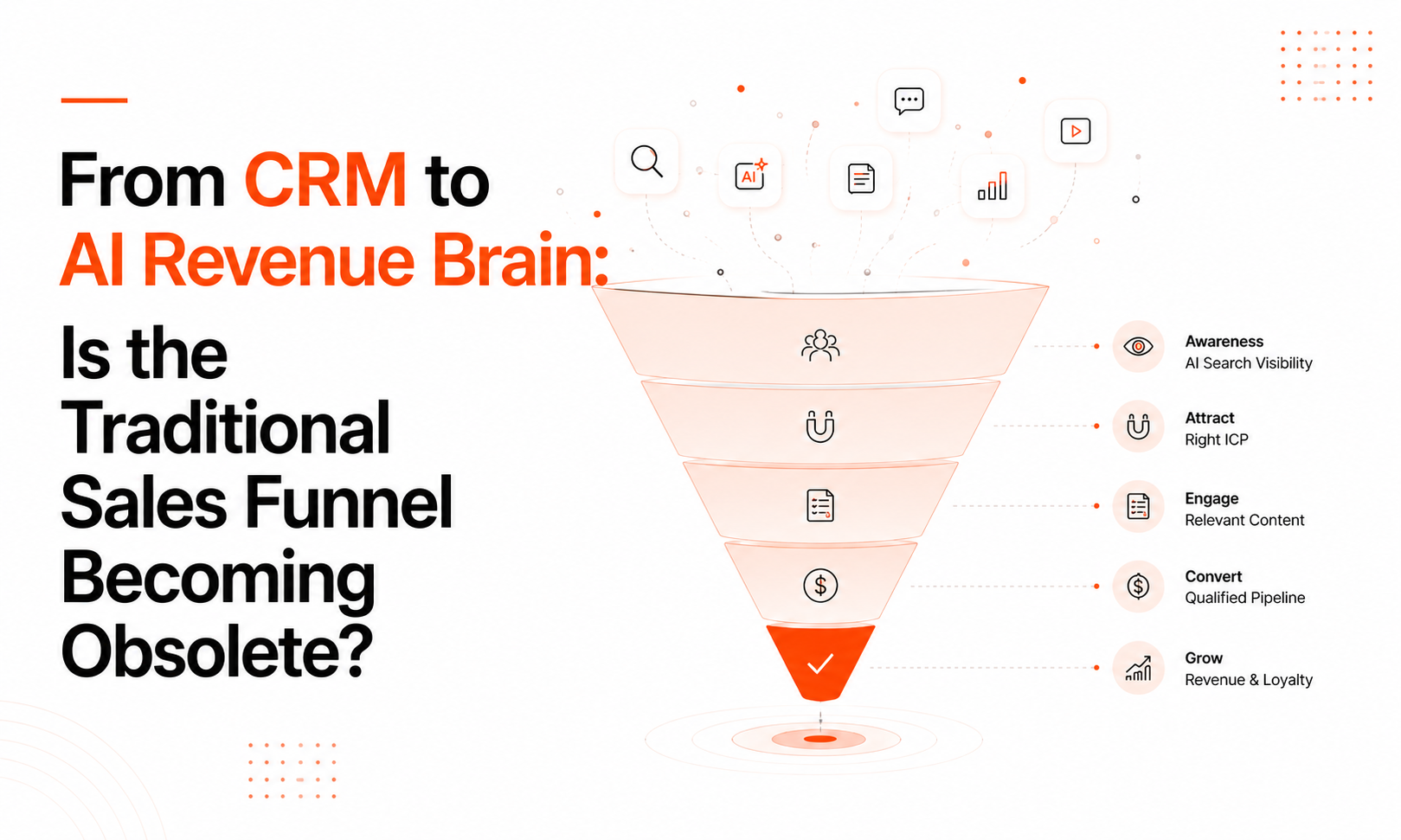
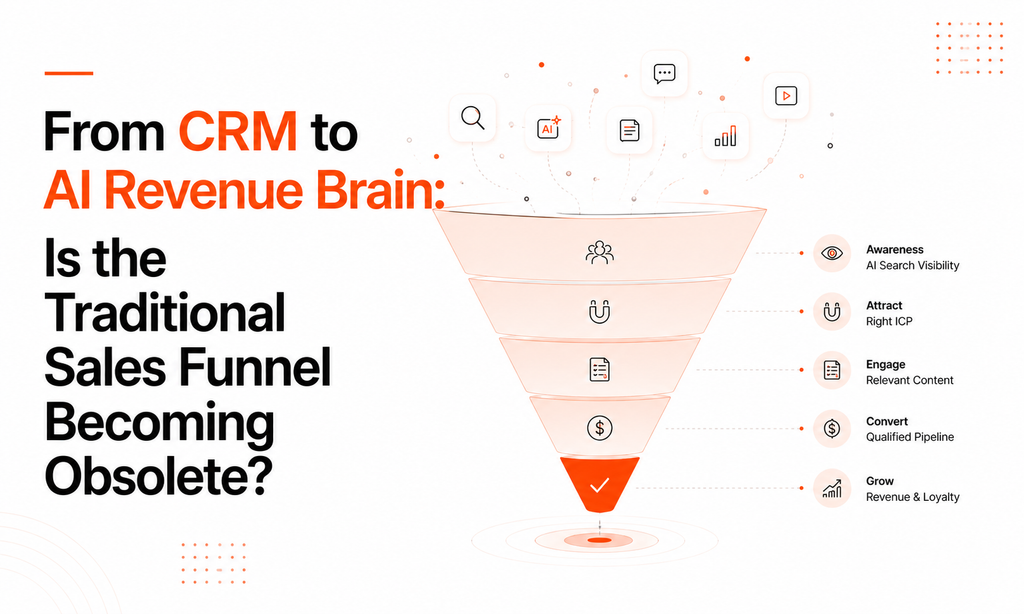
The Funnel Will Not Disappear, But Its Role Will Change
It would be premature to declare the sales funnel completely obsolete. Businesses will continue to need stages, forecasts, conversion metrics and operational processes. Leadership still needs a framework for understanding how revenue moves through the organization. The funnel remains useful as a reporting model. The problem begins when companies assume that the funnel accurately represents how customers actually make decisions.
The future is likely to involve two models operating simultaneously. Internally, organizations will continue using funnel stages because they provide structure for forecasting and management. Externally, however, customer behaviour will increasingly be understood as a dynamic network of interactions, signals and buying-group activity.
AI becomes the layer that translates the complexity of the real world into useful commercial recommendations. The AI revenue brain therefore does not have to replace the funnel; instead, it can make the funnel more intelligent by continuously interpreting the signals surrounding each opportunity.
That is perhaps the most important shift. Instead, the AI revenue brain can make the traditional B2B sales funnel more intelligent by explaining the signals behind movement between stages and identifying important activity that may occur outside the formal pipeline. It sits above it, around it and increasingly underneath it. It interprets what is happening before an opportunity formally enters the pipeline, identifies risks while the opportunity is moving through the funnel and continues analysing the account after the sale has been completed.
What B2B Companies Should Start Doing Now
Organizations preparing for this transition should begin with their data rather than their AI strategy. Before asking which autonomous agent to deploy, leaders should understand where customer information currently lives, which systems contain authoritative data, where duplication exists and which critical signals are invisible to the revenue organization. A company cannot create reliable intelligence from unreliable information. Data governance may not be as exciting as launching an AI agent, but it is likely to determine whether the agent creates genuine business value or simply produces impressive-looking recommendations.
The goal should be to build an AI revenue brain around reliable business data and clearly defined revenue workflows rather than simply adding another AI tool to the existing technology stack.
The next priority should be identifying workflows rather than tools. Instead of asking, “Where can we use AI?” organizations should ask, “Where are our employees spending significant time on repetitive information work, and where could intelligent automation improve the outcome without creating unacceptable risk?” Account research, meeting preparation, CRM administration, forecasting, customer intelligence and reporting are natural starting points because they involve large amounts of structured information. More sensitive activities should be introduced with stronger human oversight.
Companies should also begin measuring AI in commercial outcomes rather than AI activity. The number of AI-generated emails, automated tasks or chatbot interactions is not a meaningful measure of transformation by itself. Revenue leaders should ask whether sales cycles are becoming more efficient, whether representatives are spending more time with customers, whether forecast accuracy is improving, whether marketing is reaching higher-value accounts and whether customer experiences are getting better. AI should be judged by the business outcomes it enables, not by how much AI the organization has deployed.
The Revenue Organization of the Future Will Think in Signals
The most important change may ultimately be a change in mind-set. Traditional sales organizations think in stages. Modern revenue organizations increasingly need to think in signals. A stage tells you where an opportunity has been categorized. A signal tells you what may actually be happening. An AI system can evaluate thousands of signals simultaneously and determine which ones deserve human attention.
That creates the possibility of a revenue organization that is less reactive. Instead of waiting for a lead to fill out a form, sales can identify emerging demand. Instead of waiting for a deal to become “at risk,” managers can identify warning signals earlier. Instead of waiting for a customer to complain, customer teams can detect declining engagement. Instead of producing another weekly report describing what happened, leadership can receive a continuously updated picture of what is likely to happen next and what actions could influence the outcome.
The traditional CRM was built to help companies remember. The AI revenue brain is being built to help companies understand. That difference could define the next era of B2B sales.
The organizations that succeed will not necessarily be those that abandon the sales funnel or replace their CRM overnight. They will be the ones that recognize the limitations of a static, stage-based view of revenue and gradually build an intelligence layer around it. They will connect marketing, sales, RevOps, customer success and IT data, give AI systems access to reliable information, establish clear boundaries for automation and keep human judgment at the centre of high-value decisions. The result will be a revenue organization capable of seeing patterns that individuals cannot see, responding to opportunities before competitors do and allocating human attention where it creates the greatest commercial impact.
The future of B2B sales may therefore not be about moving more leads through a funnel. It may be about understanding the entire revenue ecosystem in real time. The CRM will continue to record the business, but AI will increasingly interpret it. Marketing will continue to create demand, but AI will help identify where that demand is emerging. Salespeople will continue to build relationships, but AI will help determine which relationships deserve attention and why. RevOps will continue to optimize processes, but increasingly it will also orchestrate the intelligence connecting those processes. IT will continue to build infrastructure, but that infrastructure will become part of the commercial engine itself.
The sales funnel gave businesses a way to visualize revenue. The next generation of AI-powered revenue systems could give them something much more powerful: the ability to understand revenue as it happens. his is ultimately” → “This is ultimately: moving B2B organizations from simply tracking revenue activity to continuously understanding the signals, relationships and behaviours that influence revenue.
This is ultimately the promise of the AI revenue brain: moving B2B organizations from simply tracking revenue activity to continuously understanding the signals, relationships and behaviours that influence revenue. By combining CRM data, AI revenue intelligence, buying signals and human judgment, businesses can build a more responsive and intelligent approach to B2B sales.
