


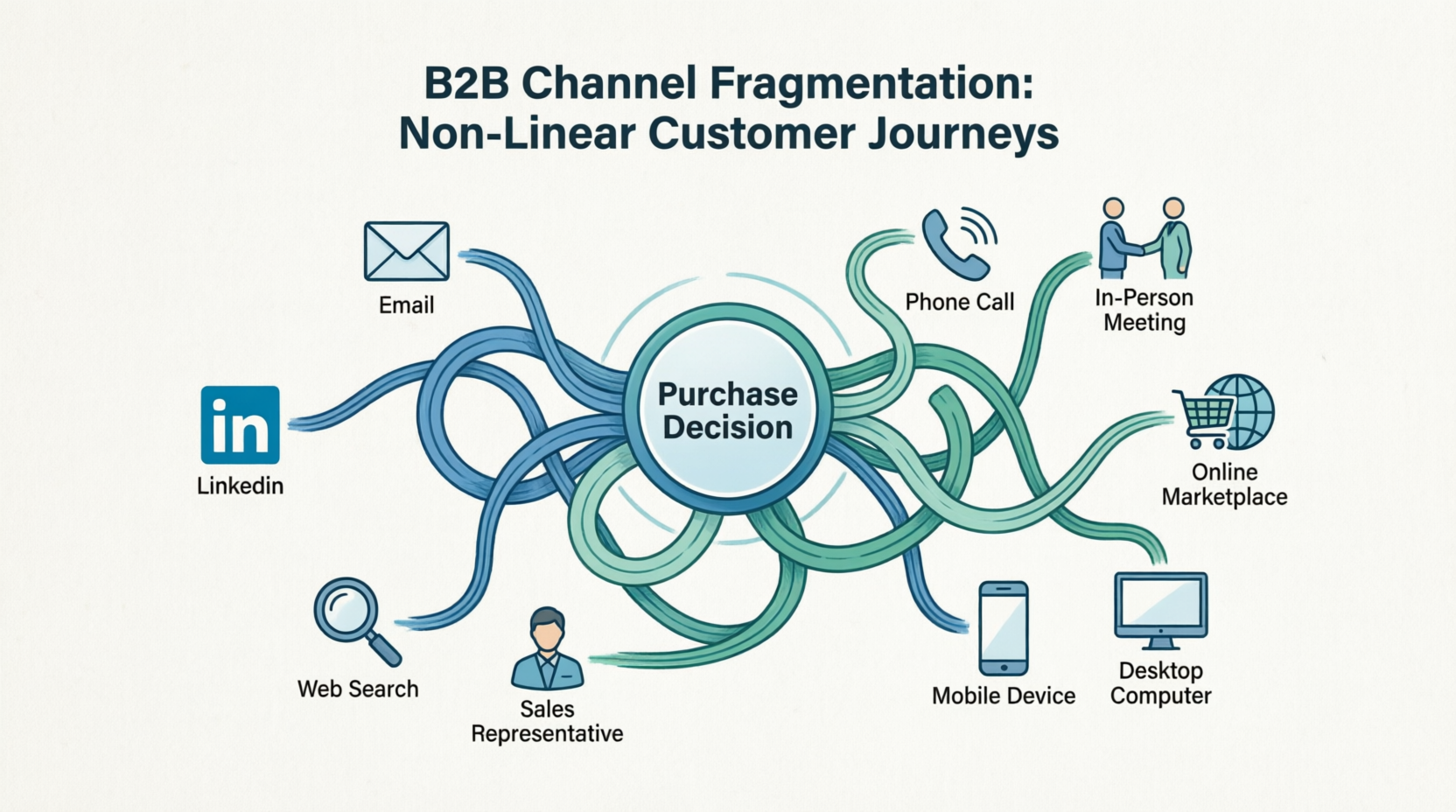

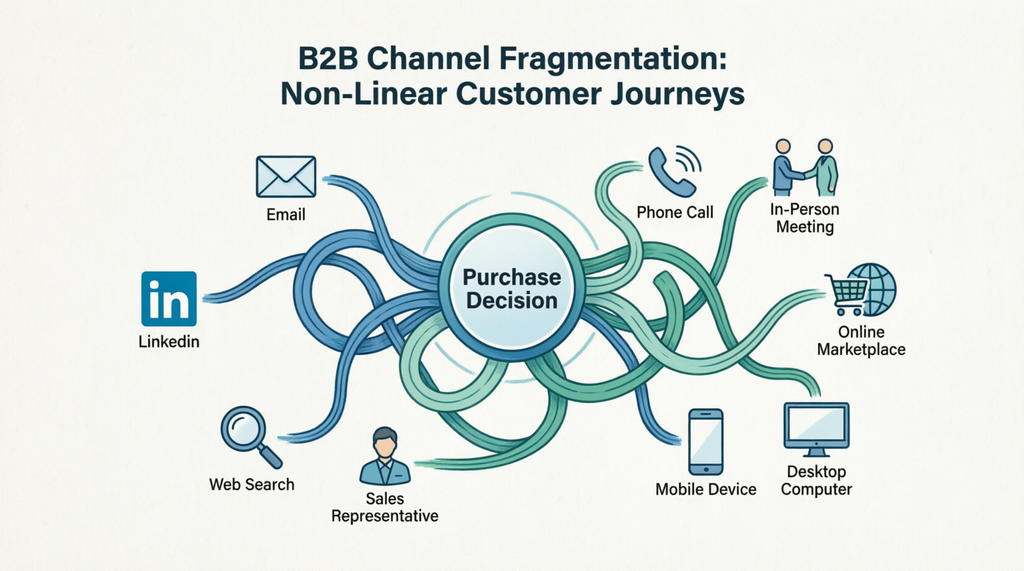
B2B channel fragmentation is changing the way businesses attract, engage, and convert customers. The traditional B2B buying journey once followed a relatively predictable path: a potential customer identified a business problem, interacted with marketing and sales, evaluated a solution, negotiated commercial terms, and eventually completed the purchase. Today, that journey has become far more complex.
How B2B Channel Fragmentation Is Changing the B2B Buying Journey
Modern B2B buyers can discover a company through search engines, LinkedIn, industry events, B2B marketplaces, partners, online communities, or AI-powered recommendation tools. They may research products independently, compare competitors, consult colleagues, review technical documentation, and request pricing before ever speaking with a salesperson.
This fragmented B2B buying journey is creating significant challenges for marketing and sales teams. Companies can no longer assume that customers will follow a single route from awareness to consideration and conversion. Instead, buyers move between multiple B2B sales channels depending on the information they need and where they prefer to engage.
For B2B organizations, the challenge is no longer simply managing more channels. It is creating a consistent and connected customer experience across those channels. Product information, messaging, technical details, pricing information, proof points, and brand positioning need to remain coherent whether a buyer encounters the company through its website, a marketplace, a partner, an event, social media, or an AI-generated recommendation.
Understanding B2B channel fragmentation is therefore becoming essential for companies developing modern B2B marketing, sales, and go-to-market strategies. Businesses that continue to rely on a linear sales funnel may struggle to understand how customers actually make purchasing decisions, while organizations that design for connected and flexible buying journeys can create stronger customer experiences and improve visibility across the entire decision-making process.
B2B channel fragmentation is not simply about having more channels. B2B organizations have always had multiple channels: sales representatives, distributors, conferences, email, websites, partners and resellers. What has changed is the way buyers move between them. A prospect might first encounter a brand through LinkedIn, investigate its reputation through search, read a technical article on the company’s website, compare it with three competitors on a marketplace, ask an internal technical team to evaluate integration requirements, speak to an existing customer and then return to the vendor six weeks later.
None of these interactions necessarily happens in a predictable order. There may be no obvious beginning or middle to the journey. The buyer can enter at almost any point and move backward, forward or sideways between channels depending on what information is needed at that moment.
Why the Traditional B2B Buying Journey Is Changing
B2B channel fragmentation creates a serious measurement problem for marketing and sales teams. Traditional B2B marketing models often assign value to visible interactions such as form submissions, event registrations, email clicks or demo requests. But fragmented buying journeys make those signals increasingly incomplete.
A buyer may consume ten pieces of content, discuss a vendor internally and compare multiple alternatives before submitting a form. Another buyer may submit a form immediately but have almost no genuine purchase intent. If the organization evaluates channel performance purely through the final measurable interaction, it may misunderstand which channels actually influenced the decision. The result is a distorted picture of demand generation in which the easiest interaction to measure receives credit for a decision that was influenced by many invisible interactions beforehand.
B2B channel fragmentation is also changing the role of the company website. Historically, a website was primarily a digital brochure, a place where businesses explained their products, displayed company information and provided contact details. Historically, a website was primarily a digital brochure, a place where businesses explained their products, displayed company information and provided contact details. Increasingly, it is becoming one component of a much larger information ecosystem.
Buyers may use the website to verify technical specifications after discovering the company elsewhere. They may visit only to validate legitimacy. They may search for customer examples, implementation information, security documentation or pricing structures. The website therefore needs to support different stages and intentions simultaneously. It must educate someone who has never heard of the company while also reassuring a procurement professional who is already comparing vendors.
B2B channel fragmentation creates another layer of complexity through marketplaces. In many B2B sectors, buyers increasingly expect to discover and compare solutions in environments where multiple vendors are presented side by side. In many B2B sectors, buyers increasingly expect to discover and compare solutions in environments where multiple vendors are presented side by side.
This changes the competitive dynamic because companies are no longer competing only on their own websites. They are competing inside shared digital environments where product descriptions, reviews, specifications, pricing and availability may appear together. A company with strong brand recognition can therefore lose a purchase to a lesser-known competitor if the latter presents a clearer proposition within the buyer’s preferred purchasing environment. The marketplace becomes a new point of competitive truth.
B2B channel fragmentation is also increasing the importance of partners and intermediaries as channel structures evolve. A buyer may discover a technology through a consulting firm, purchase through a reseller and receive implementation services from another partner. A buyer may discover a technology through a consulting firm, purchase through a reseller and receive implementation services from another partner.
The vendor may technically own the product but not control the complete customer relationship. This can create both opportunities and risks. Partners can expand reach and provide specialized expertise, but they can also introduce inconsistencies in messaging, pricing and customer experience. If a company has ten partners explaining its product in ten different ways, the buyer may receive a fragmented understanding of the offering before ever reaching the vendor.
AI is likely to accelerate B2B channel fragmentation further. Buyers increasingly have the ability to ask AI systems to identify vendors, compare solutions, summarize product differences and create shortlists. Buyers increasingly have the ability to ask AI systems to identify vendors, compare solutions, summarize product differences and create shortlists. This means the first interaction between a buyer and a B2B company may no longer happen on the company’s own digital properties. An AI-generated recommendation could become the starting point of the buying journey.
The vendor may not know that the buyer was considering it until much later. More importantly, the information used by the buyer may come from multiple sources that the company does not fully control. This makes consistent digital representation increasingly important because the brand must be understandable across an ecosystem rather than only within its own marketing channels.
Managing B2B channel fragmentation does not mean trying to dominate every possible channel. That approach can quickly become expensive and operationally impossible. The more important objective is channel coherence. The customer should be able to move between channels without experiencing completely different versions of the company. Product information, positioning, proof points, technical details and commercial messaging need to remain sufficiently consistent whether the buyer encounters the company through a salesperson, partner, website, marketplace, event or AI-generated recommendation. Each channel can have a different role, but the underlying proposition should remain recognizable.
This also requires companies to rethink how they define ownership. In the traditional model, marketing owned awareness, sales owned conversion and customer success owned retention. Fragmented journeys make these boundaries less useful.
A buyer may receive marketing content after speaking to sales, engage with a partner before entering the CRM, and interact with customer success before completing an expansion decision. The customer does not care which department owns the interaction. They experience one company. Internal structures that are optimized around departmental ownership can therefore create friction precisely when customers expect continuity.
Why Channel Coherence Matters in B2B Marketing
One practical consequence of B2B channel fragmentation is that companies will need to design for journey continuity rather than funnel progression. A funnel assumes customers move downward through defined stages. A funnel assumes customers move downward through defined stages. A fragmented journey assumes customers move through a network of information and decision points. The difference is significant.
Instead of asking only how many leads moved from one stage to another, organizations need to understand how customers navigate between channels, what information they seek at each point and where the experience breaks down. The goal is not necessarily to force customers into a predetermined path. It is to make every important entry point capable of moving the customer toward the next useful decision.
From Linear Sales Funnels to Connected B2B Customer Journeys
This can change how organizations invest in marketing and sales. A channel that generates few direct leads may still play a critical role in influencing enterprise decisions. An industry event might create awareness that becomes measurable only months later. A technical community may never generate a form submission but could strongly influence engineers. A partner may introduce a prospect but remain invisible in the CRM attribution model. This means B2B organizations need broader measurement frameworks that consider influence, progression and assisted conversion rather than assigning all value to the final interaction.
How Businesses Can Adapt to Fragmented B2B Buying Journeys
The larger strategic implication is that distribution itself is becoming part of the customer experience. In the past, companies could largely decide how customers encountered their products. Today, customers have much more control over where, when and through whom they interact with a brand. The winning organizations will therefore not be those that force buyers into the most convenient journey for the company. They will be those that make the company easy to understand and evaluate regardless of where the buyer begins.
B2B Channel Fragmentation and the Future of B2B Buying
B2B buying is becoming less like a straight road and more like a network of connected routes. Customers can enter from almost anywhere, gather information from multiple sources, disappear for weeks, return through a completely different channel and still expect the company to understand where they are in the decision process. Businesses that continue measuring success through a single linear funnel will increasingly struggle to explain what is actually happening.
The future belongs to organizations that can operate across fragmented channels while delivering one coherent commercial experience. The B2B buyer may take many routes to reach a decision, but the company should make every route lead to the same clear understanding of its value. B2B channel fragmentation is making the modern B2B buying journey more complex, flexible, and difficult to predict.
Businesses that continue measuring success through a single linear funnel will increasingly struggle to explain what is actually happening. B2B channel fragmentation means the future belongs to organizations that can operate across multiple channels while delivering one coherent commercial experience. The B2B buyer may take many routes to reach a decision, but the company should make every route lead to the same clear understanding of its value.
