


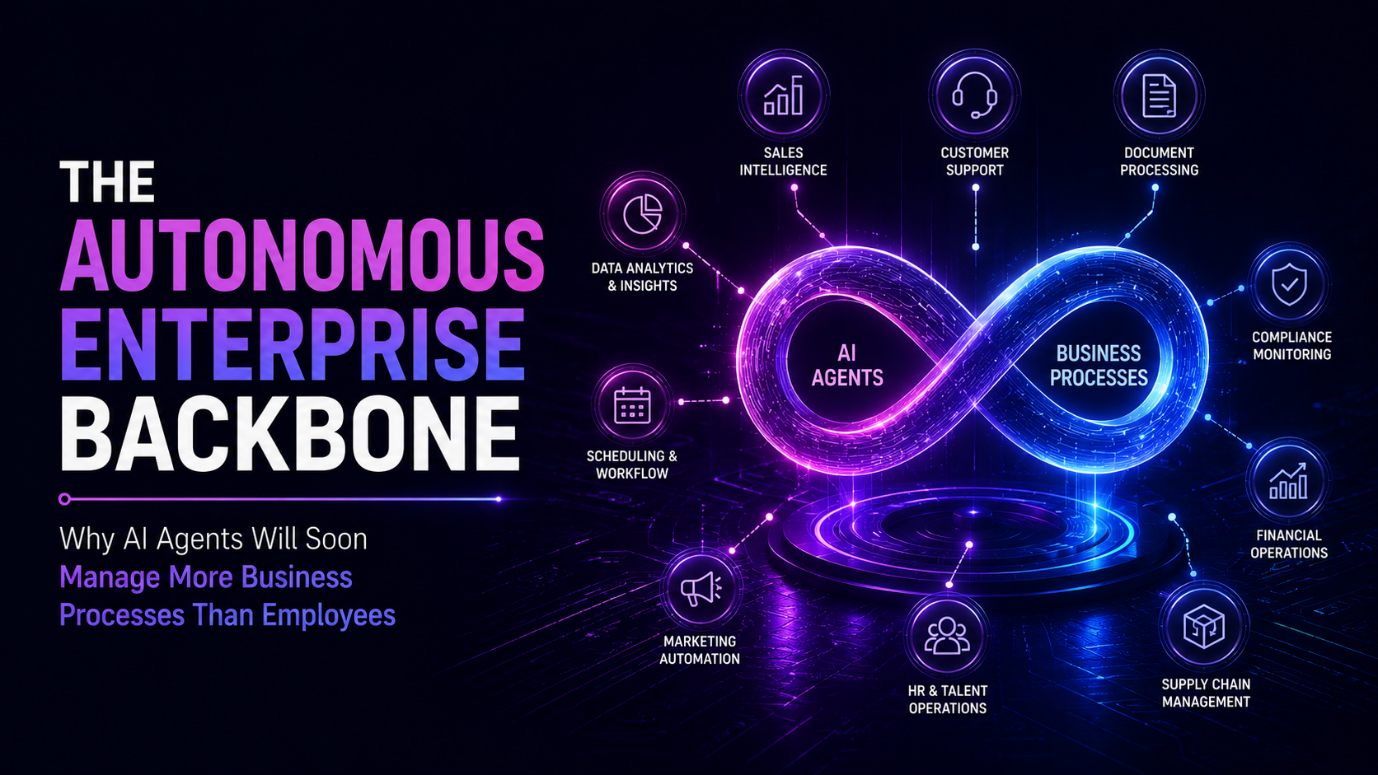

For decades, enterprise automation has focused on making employees more efficient rather than changing the structure of work itself. Organizations implemented workflow engines to automate approvals, robotic process automation to eliminate repetitive tasks, ERP systems to standardize operations, CRM platforms to organize customer relationships, and analytics tools to improve decision-making. While these technologies significantly increased productivity, they shared one common characteristic: every automated process still depended on people to coordinate, supervise, and connect the work. Employees remained the operating layer sitting between business systems, moving information from one application to another, interpreting reports, initiating workflows, following up on approvals, assigning tasks, and ensuring that operations continued smoothly across departments. Artificial intelligence is now fundamentally changing this model. Instead of simply assisting employees, AI is beginning to function as an autonomous operational workforce capable of executing complete business processes independently. This shift is giving rise to what can be described as the Autonomous Enterprise Backbone, where AI agents become the invisible operating infrastructure responsible for managing a growing percentage of day-to-day business operations.
The distinction between traditional automation and autonomous AI agents is far more significant than it initially appears. Conventional automation follows predefined rules. If a purchase request exceeds a specified amount, it is forwarded for approval. If a customer submits a support ticket, it is assigned to the relevant department. If inventory reaches a predetermined threshold, the procurement system generates an order. These workflows remain highly effective but require predictable conditions and carefully designed process maps. AI agents operate differently. They understand objectives rather than merely executing instructions. Instead of following rigid workflows, they evaluate changing business conditions, interpret context, make decisions within defined governance boundaries, communicate with multiple systems, and continuously adapt their actions as new information becomes available. The enterprise therefore evolves from automating individual tasks to delegating operational responsibility.
This transformation is becoming possible because modern AI systems no longer operate in isolation. Large language models can communicate with enterprise software through APIs, retrieve information from knowledge bases, coordinate with other AI agents, interact with employees conversationally, generate documentation, monitor business events, and trigger actions across multiple applications simultaneously. A single AI agent managing procurement, for example, can analyse supplier performance, evaluate inventory forecasts, compare contract terms, identify operational risks, negotiate within predefined parameters, generate purchase orders, notify finance, update ERP systems, and inform logistics teams without requiring continuous human supervision. The employee’s role shifts from performing operational coordination to overseeing strategic outcomes.
One of the first business functions experiencing this transformation is customer service. Historically, customer support relied on representatives responding individually to inquiries while navigating multiple software platforms to resolve issues. AI agents increasingly manage entire support journeys by understanding customer requests, retrieving account information, checking order status, initiating refunds, scheduling service appointments, escalating complex issues when necessary, updating CRM records, and communicating proactively with customers throughout the resolution process. Human agents become specialists responsible for exceptional circumstances rather than routine operational management. Customer experience improves not because AI replaces employees, but because it eliminates delays caused by fragmented workflows.
Sales operations are undergoing a similar evolution. Revenue teams have traditionally depended upon sales representatives and operations staff to qualify leads, schedule meetings, update CRM records, prepare proposals, monitor engagement, follow up with prospects, and coordinate internal approvals. Autonomous AI agents increasingly manage these operational responsibilities continuously. They analyse buying signals, prioritize opportunities, personalize outreach, schedule conversations, generate commercial documents, monitor stakeholder engagement, summarize meetings, recommend next actions, and maintain CRM accuracy without requiring manual intervention. Sales professionals spend more time building relationships and negotiating strategic opportunities because AI assumes responsibility for the operational infrastructure supporting the sales process.
Human Resources is rapidly becoming another environment where autonomous agents create substantial value. Recruitment workflows frequently involve repetitive coordination across sourcing, screening, interview scheduling, candidate communication, documentation, on boarding, compliance, and employee support. AI agents can manage these interconnected activities while maintaining consistent communication with candidates and internal stakeholders. Beyond recruitment, intelligent agents assist employees by answering HR questions, managing leave requests, updating policies, coordinating learning programs, tracking compliance requirements, and monitoring workforce engagement. HR teams increasingly focus on organizational culture, leadership development, and talent strategy while AI maintains the operational backbone of employee administration.
Finance and procurement demonstrate perhaps the clearest long-term potential for autonomous operations. Financial teams spend considerable time reconciling transactions, monitoring expenses, preparing reports, validating invoices, identifying anomalies, ensuring regulatory compliance, and coordinating approvals. AI agents continuously monitor financial activity, identify inconsistencies, recommend corrective actions, prepare executive summaries, initiate compliance reviews, and coordinate payment workflows across multiple systems. Procurement agents evaluate supplier reliability, negotiate contract renewals, monitor market conditions, optimize inventory planning, and anticipate supply chain risks before operational disruptions occur. The finance function evolves from processing information toward governing intelligent financial operations.
Perhaps the most transformative aspect of the Autonomous Enterprise Backbone is its ability to coordinate work across departmental boundaries. Traditional organizations often struggle because operational processes extend through multiple teams, each using different systems with separate priorities and performance metrics. Customer on boarding may require sales, finance, legal, IT, operations, and customer success to coordinate sequential activities, creating delays whenever communication breaks down. Autonomous AI agents operate across these boundaries by maintaining continuous awareness of process status throughout the organization. Rather than waiting for one department to complete its responsibilities before informing the next, intelligent agents synchronize activities dynamically, ensuring that work progresses without unnecessary interruption. Enterprise operations become significantly more fluid because AI eliminates much of the coordination overhead that historically slowed organizational performance.
Governance naturally becomes critical as autonomous systems assume greater operational responsibility. Organizations must establish clear decision boundaries defining which actions AI may execute independently, which require human approval, and which remain exclusively under executive oversight. Transparency, auditability, compliance, cybersecurity, and ethical accountability become foundational design principles rather than optional considerations. Trust in autonomous operations depends not only on technological capability but also on organizational confidence that AI behaves predictably, responsibly, and consistently within clearly defined business rules. Successful enterprises will therefore invest as heavily in governance frameworks as they do in AI capabilities themselves.
The emergence of autonomous agents also reshapes workforce planning. Early discussions surrounding AI often focused narrowly on job replacement, creating understandable concerns regarding employment. The more likely outcome is a significant redistribution of human work. Employees increasingly move away from routine operational coordination toward activities requiring strategic thinking, creativity, relationship management, innovation, leadership, negotiation, and complex decision-making. Organizations become capable of scaling operations without proportionally increasing administrative headcount because AI manages the growing operational complexity accompanying business expansion. Human capability shifts upward while operational execution becomes increasingly autonomous.
Enterprise software vendors are already moving decisively toward this future. Leading technology platforms increasingly introduce AI agents capable of executing workflows rather than simply providing recommendations. CRM platforms deploy autonomous sales assistants, ERP vendors introduce intelligent operational coordinators, HR systems implement workforce management agents, and productivity platforms create AI colleagues capable of completing cross-functional business tasks. While current implementations remain relatively specialized, they collectively indicate the direction of enterprise technology. Software is evolving from being a collection of digital tools into an ecosystem of intelligent workers collaborating continuously behind the scenes.
This evolution also creates a new source of competitive advantage. Historically, organizations differentiated themselves through product innovation, market reach, operational efficiency, or customer experience. Increasingly, competitive leadership will depend upon how effectively businesses deploy autonomous operational intelligence. Companies capable of allowing AI agents to coordinate thousands of routine processes simultaneously will respond faster to customers, operate with greater consistency, reduce administrative costs, improve compliance, minimize operational risk, and scale more efficiently than organizations relying primarily on manual coordination. Operational excellence becomes algorithmic rather than administrative.
Ultimately, the Autonomous Enterprise Backbone represents the next stage of digital transformation. Businesses have already digitized information, automated workflows, integrated systems, and embraced artificial intelligence as a decision-support capability. The next evolution is allowing AI to become an active participant in enterprise operations itself. Rather than existing as another application employees use, autonomous agents become the invisible workforce connecting every application, every department, and every business process into a continuously operating enterprise.
The organizations that lead the next decade will not simply use AI to make employees more productive. They will build enterprises where AI quietly manages the operational backbone of the business, allowing people to focus on the one responsibility technology still cannot replace, creating the future instead of coordinating the present.
