


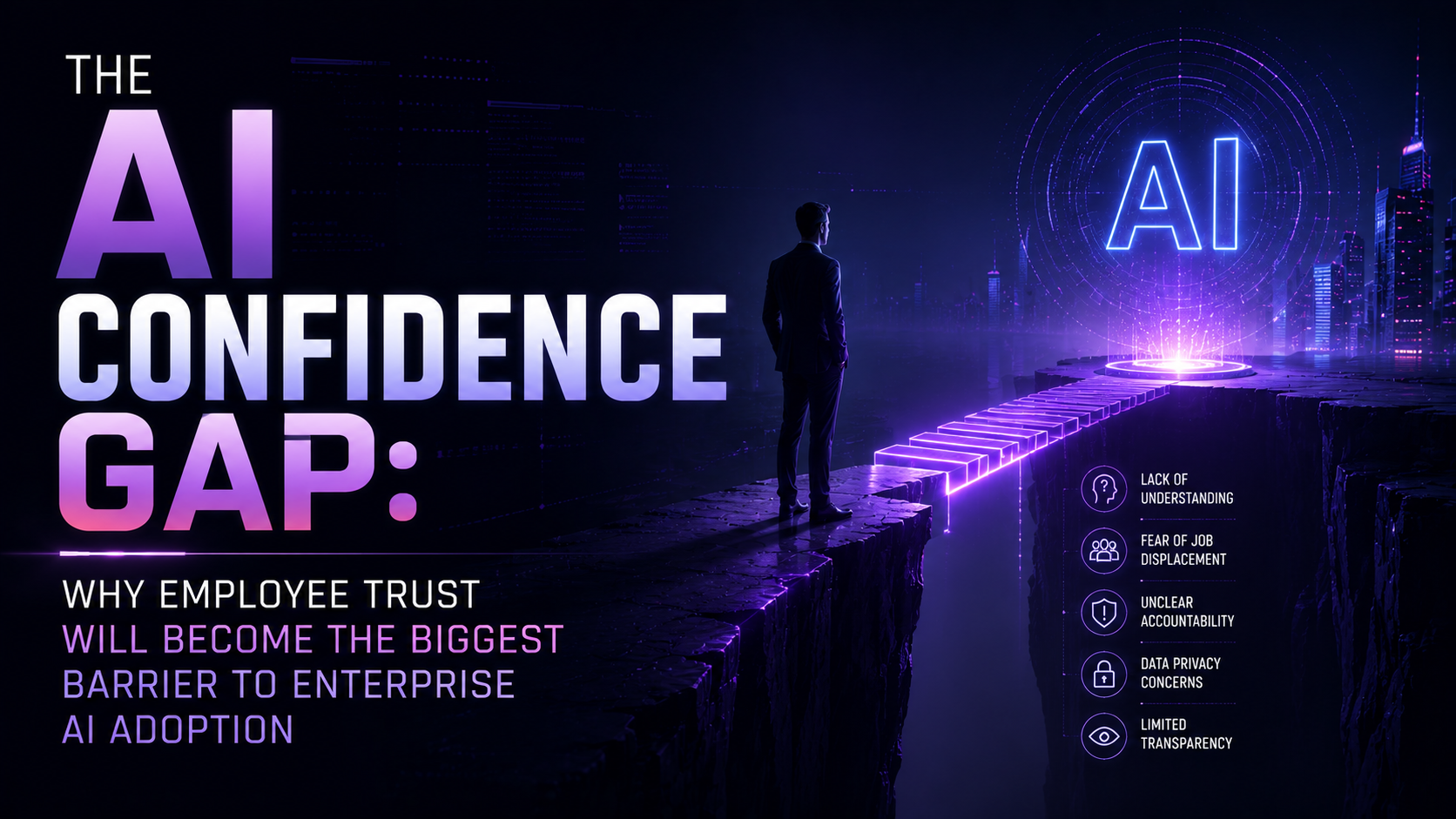

Artificial intelligence is rapidly becoming one of the most significant investments in enterprise technology. Organizations across every industry are deploying AI-powered co-pilots, intelligent assistants, predictive analytics, automation platforms, generative AI tools, and autonomous agents with the expectation that they will improve productivity, reduce operational costs, accelerate decision-making, and create competitive advantage. Executive teams often approach AI adoption as a technological transformation, focusing on model performance, infrastructure scalability, cybersecurity, data governance, and integration with existing business systems. These investments are undoubtedly essential, but they frequently overlook a factor that will ultimately determine whether AI succeeds or fails inside an organization: employee confidence. The most sophisticated AI platform cannot create meaningful business value if the workforce refuses to trust its recommendations, questions its reliability, or fears the consequences of using it. This growing disconnect between technological capability and human acceptance represents what can be described as the AI Confidence Gap, where the limiting factor for enterprise AI is no longer computational intelligence but organizational trust.
Many organizations assume that once AI tools become available, employees will naturally integrate them into their daily work. Reality has proven considerably more complex. Employees often hesitate to rely on AI-generated recommendations because they are uncertain about how conclusions were reached, whether underlying data is accurate, or how accountable they remain if AI makes an incorrect suggestion. A financial analyst may manually verify every AI-generated report before presenting it to leadership. A marketing professional may rewrite AI-produced content despite minimal improvements simply to regain confidence in the final output. HR teams may avoid using AI-assisted hiring recommendations because they worry about fairness, compliance, or unintended bias. Customer service representatives may ignore automated responses in favour of their own judgment, while managers may continue requesting manual reports even when predictive dashboards provide equivalent insights. In each case, the technology functions correctly, yet adoption remains limited because confidence has not kept pace with capability.
One of the primary causes of the AI Confidence Gap is the historical relationship employees have developed with enterprise software. Traditional business applications typically performed deterministic tasks. Accounting systems calculated financial transactions according to predefined rules. CRM platforms stored customer information exactly as entered. ERP systems processed workflows based on clearly defined business logic. Users understood why systems behaved in particular ways because outcomes followed predictable instructions. Artificial intelligence operates differently. Instead of following explicit rules alone, AI generates recommendations by recognizing patterns, probabilities, contextual relationships, and statistical inferences. This creates outputs that often appear remarkably intelligent while simultaneously making the reasoning process less transparent. Employees accustomed to deterministic software naturally struggle when asked to trust systems whose conclusions cannot always be explained through straightforward procedural logic.
Artificial intelligence also challenges established professional identity. Many employees have spent years developing expertise within their respective disciplines. Marketing specialists understand customer behaviour through experience. HR professionals rely on interpersonal judgment during recruitment and employee engagement. Sales managers recognize buying signals through countless customer interactions. Engineers identify technical risks through years of practical problem-solving. When AI begins offering recommendations within these same domains, employees may interpret the technology not as a collaborative assistant but as a competitor questioning their expertise. Even when organizations emphasize augmentation rather than replacement, uncertainty often persists because employees remain unsure how AI will influence future performance expectations, career development, or organizational restructuring.
This psychological dimension is frequently underestimated during AI implementation projects. Organizations invest heavily in infrastructure, vendor selection, cybersecurity assessments, integration planning, and governance frameworks while allocating comparatively fewer resources toward building workforce understanding. Employees receive access to sophisticated tools without first developing confidence in when AI should be trusted, when human judgment should prevail, or how both can operate together effectively. Adoption therefore becomes inconsistent across departments because technological readiness exceeds organizational readiness.
Another significant contributor to the AI Confidence Gap is the phenomenon of automation inconsistency. Employees may observe AI performing exceptionally well in one scenario while making surprisingly basic mistakes in another. A generative AI assistant produces an outstanding strategic presentation but incorrectly summarizes an internal policy. A predictive analytics platform accurately forecasts sales demand yet struggles with unusual market disruptions. A customer support chatbot resolves hundreds of inquiries successfully before misunderstanding a relatively simple request. These inconsistencies create uncertainty because employees cannot easily predict when AI will excel and when additional oversight becomes necessary. As a result, many professionals default to excessive verification, reducing the productivity gains AI was intended to deliver.
Explaining ability is therefore becoming one of the most valuable characteristics of enterprise AI systems. Confidence increases significantly when employees understand not only what recommendation AI generated but also why it reached that conclusion. Systems capable of citing information sources, displaying confidence scores, identifying influencing variables, explaining reasoning pathways, and acknowledging uncertainty enable employees to evaluate recommendations critically instead of accepting or rejecting them blindly. Transparency transforms AI from an unpredictable black box into an understandable decision-support partner. Organizations that prioritize explainable AI are therefore investing not merely in compliance but in long-term adoption.
Leadership communication plays an equally important role in narrowing the AI Confidence Gap. Employees carefully observe how executives describe artificial intelligence because leadership narratives shape organizational culture. If AI is consistently presented as a cost-reduction initiative focused primarily on automation, employees may reasonably associate it with job insecurity rather than professional empowerment. Conversely, organizations emphasizing AI as a tool for eliminating repetitive work, accelerating learning, supporting better decisions, and enabling higher-value contributions create a significantly different psychological environment. Trust begins long before employees interact with technology; it develops through the expectations leaders establish regarding its purpose.
Training strategies must evolve as well. Traditional software training focuses on teaching users how to operate applications effectively. AI literacy requires something broader. Employees need to understand the strengths and limitations of machine learning, recognize situations where AI performs reliably, identify common sources of error, evaluate outputs critically, formulate effective prompts, interpret confidence levels, and collaborate with intelligent systems responsibly. The objective is not simply technological proficiency but informed confidence. Organizations building AI literacy across their workforce consistently create stronger adoption than those limiting education to technical specialists.
The AI Confidence Gap also has significant implications for organizational governance. Policies defining acceptable AI usage, human oversight requirements, accountability structures, privacy protections, and ethical standards reduce uncertainty by clarifying expectations. Employees gain confidence when they know which decisions remain exclusively human, which can be supported by AI, and where final responsibility resides. Governance therefore functions not merely as regulatory protection but as an essential component of organizational trust.
Interestingly, confidence in AI often grows through experience rather than persuasion. Employees who successfully complete projects using AI-assisted workflows gradually develop realistic expectations regarding the technology’s capabilities. They learn where AI accelerates productivity, where additional review is necessary, and how human expertise complements algorithmic intelligence. Confidence becomes evidence-based instead of assumption-driven. Organizations therefore benefit from introducing AI incrementally through practical use cases demonstrating measurable value before expanding deployment across more complex business functions.
Another overlooked factor is peer influence. Employees often trust colleagues’ experiences more readily than vendor demonstrations or executive announcements. Teams sharing successful AI implementations, practical lessons, and realistic challenges create organizational learning that accelerates adoption naturally. Internal communities of practice, AI champions, mentoring programs, and collaborative experimentation foster confidence by making AI adoption a shared learning journey rather than an isolated technological initiative.
As AI systems evolve into autonomous agents capable of initiating actions rather than simply providing recommendations, the importance of confidence will increase even further. Organizations may soon rely on AI to negotiate supplier contracts, optimize inventory, monitor cybersecurity threats, coordinate customer interactions, or manage operational workflows with limited human intervention. Delegating these responsibilities requires considerably greater trust than merely reviewing AI-generated suggestions. Enterprises unable to establish confidence today may struggle to realize the benefits of increasingly autonomous technologies tomorrow.
The AI Confidence Gap ultimately demonstrates that successful digital transformation depends as much on organizational psychology as technological sophistication. Businesses often assume the greatest obstacle to AI adoption is building smarter algorithms, integrating more data, or deploying faster infrastructure. In reality, the defining challenge may be helping employees develop sufficient confidence to incorporate intelligent systems into meaningful business decisions without fear, uncertainty, or unnecessary skepticism. Artificial intelligence cannot transform organizations unless people choose to trust it enough to let it contribute.
The future leaders of enterprise AI will therefore distinguish themselves not simply through superior technology but through superior organizational confidence. They will invest equally in transparency, explain ability, education, governance, communication, and cultural readiness alongside technical innovation. They will recognize that trust cannot be installed through software updates or purchased from technology vendors. It must be earned through consistent experience, responsible implementation, and meaningful collaboration between people and intelligent systems. Because the next phase of enterprise AI will not be determined by which company develops the smartest algorithms. It will be determined by which company builds the most confident workforce to use them.
