


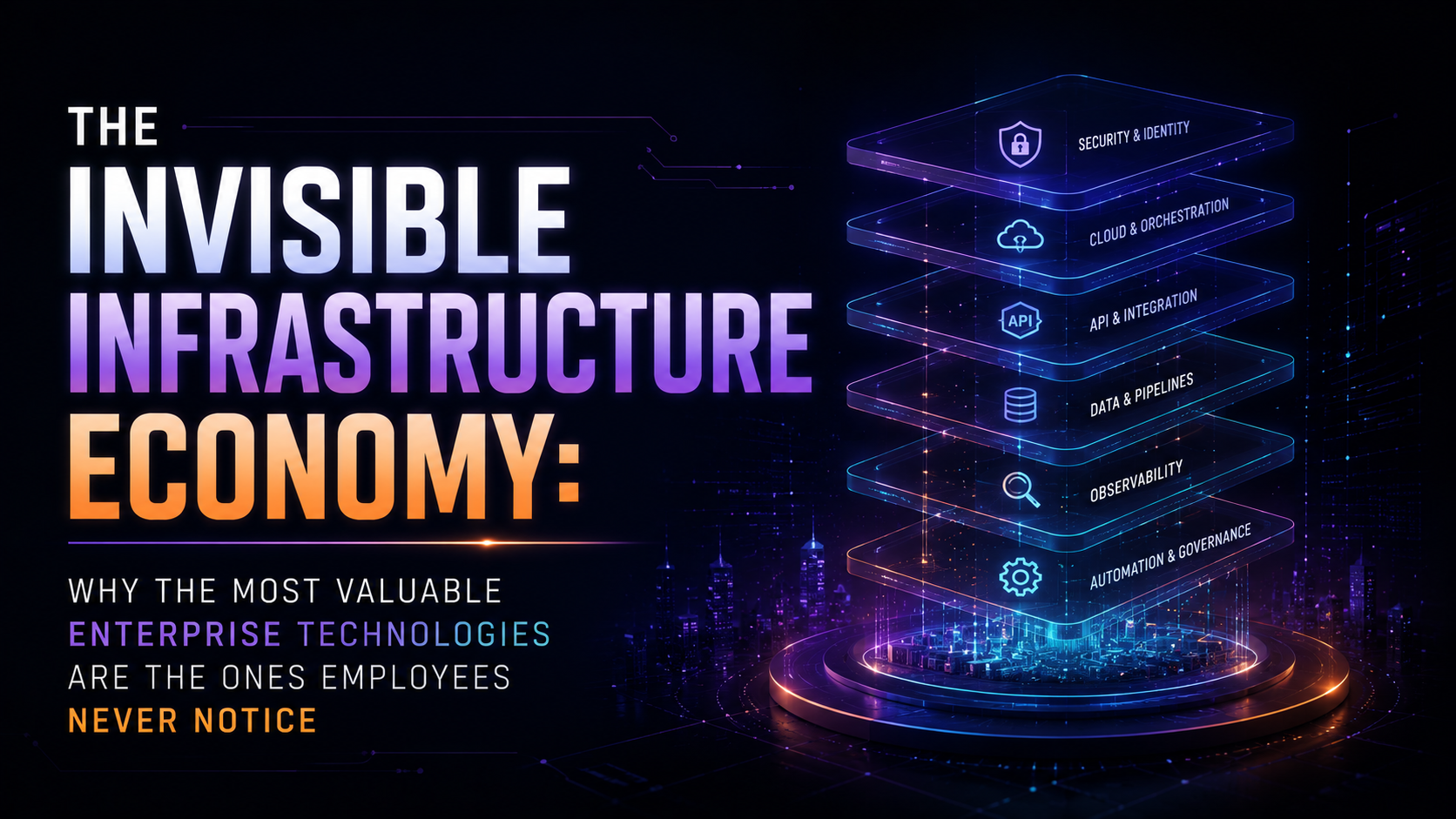

When organizations discuss digital transformation, the conversation almost always revolves around technologies that employees and customers can see. Artificial intelligence assistants, customer-facing applications, analytics dashboards, collaboration platforms, mobile experiences, automation tools, and modern user interfaces receive the majority of executive attention because they visibly demonstrate innovation. These technologies appear in product launches, keynote presentations, annual reports, and boardroom discussions because their value is immediately understandable. Yet behind every successful digital initiative lies a far less visible layer of technology that rarely receives recognition despite making everything else possible. Identity management systems authenticate users before they log in. APIs quietly transfer information between applications. Data pipelines move information across departments without manual intervention. Observability platforms detect failures before employees notice them. Cloud orchestration automatically scales infrastructure during periods of high demand. Security automation blocks threats in milliseconds, while governance frameworks ensure compliance without interrupting business operations. Employees rarely think about these technologies because they function exactly as intended. Ironically, this invisibility is precisely what makes them valuable. Modern enterprises are entering what can be described as the Invisible Infrastructure Economy, where competitive advantage increasingly depends not on the technologies employees interact with directly, but on the intelligent systems operating silently beneath the surface.
Throughout the history of enterprise technology, visible innovation has consistently overshadowed foundational infrastructure. Companies proudly announce new customer applications, AI initiatives, digital products, and workplace collaboration tools because these investments produce measurable and highly visible outcomes. Infrastructure, however, has traditionally been viewed as an operational necessity rather than a strategic differentiator. Investments in networking, authentication, monitoring, backup systems, governance, middleware, or cloud architecture often receive far less attention because they are designed to eliminate problems rather than create visible experiences. Their greatest achievement is frequently that nothing goes wrong. Success is measured through uninterrupted operations rather than dramatic transformation. This creates a paradox where the technologies contributing most significantly to organizational resilience are often the least appreciated.
Artificial intelligence is dramatically increasing the importance of invisible infrastructure. AI applications appear remarkably intelligent because they generate natural conversations, automate repetitive work, and deliver rapid insights. However, their effectiveness depends almost entirely on the hidden systems supporting them. Before an AI assistant answers a customer question, identity services confirm user permissions, APIs retrieve relevant information, data governance ensures compliance, knowledge repositories provide organizational context, observability platforms monitor system health, cybersecurity systems validate access, and cloud infrastructure allocates computational resources. Every visible AI interaction is therefore supported by a complex ecosystem of technologies operating silently in the background. Without these foundational layers, even the most advanced AI model quickly becomes unreliable.
This shift reflects a broader transformation in enterprise architecture. Businesses once built applications as relatively independent systems designed to perform specific functions. Modern organizations instead operate interconnected digital ecosystems where hundreds of applications continuously exchange information through APIs, cloud platforms, automation frameworks, and shared data services. The value of any individual application increasingly depends on the quality of the infrastructure connecting it to everything else. Enterprise competitiveness is therefore determined not only by what technologies an organization owns but also by how efficiently those technologies collaborate behind the scenes.
One of the clearest examples of invisible infrastructure is identity management. Employees typically regard logging into enterprise applications as a routine activity requiring only a username, password, or biometric authentication. Few consider the sophisticated architecture responsible for verifying identities, enforcing security policies, managing permissions, supporting single sign-on, enabling multi-factor authentication, monitoring suspicious behaviour, and integrating with dozens of enterprise systems simultaneously. Yet identity has become the foundation of digital business. As organizations adopt AI agents, remote work, cloud services, and zero-trust security models, identity infrastructure increasingly determines whether business operations remain both secure and efficient. It is not simply an IT service; it has become a strategic business capability.
The same principle applies to APIs, which have quietly evolved into the circulatory system of the modern enterprise. Employees rarely think about APIs when customer information automatically appears inside CRM platforms, inventory updates synchronize across supply chains, financial transactions reach reporting systems, or AI assistants retrieve organizational knowledge. These interactions feel instantaneous because the underlying infrastructure is designed to disappear from view. However, every automated workflow, customer experience, and digital service depends on APIs functioning reliably, securely, and consistently. Their success is measured precisely because users remain unaware of their existence.
Observability platforms represent another critical element of the Invisible Infrastructure Economy. Traditional IT monitoring focused primarily on detecting system failures after they occurred. Modern observability extends far beyond basic monitoring. It continuously analyses logs, metrics, traces, user behaviour, infrastructure performance, and application dependencies to identify emerging issues before they affect business operations. Employees may never realize that a database slowdown was automatically corrected, that cloud resources expanded to manage increased demand, or that an API bottleneck was resolved before customers experienced delays. Invisible infrastructure succeeds by preventing disruptions rather than responding visibly to them.
Cloud orchestration has similarly transformed enterprise technology from static infrastructure into adaptive infrastructure. Previous generations of enterprise systems required manual planning, hardware procurement, and lengthy deployment cycles whenever additional capacity became necessary. Today’s orchestration platforms automatically allocate computing resources, balance workloads, recover failed services, optimize costs, and scale applications according to real-time business demand. Whether an e-commerce platform experiences seasonal demand, a financial institution processes millions of transactions, or an AI application receives unexpected user traffic, orchestration systems continuously adapt without requiring direct human intervention. Business continuity increasingly depends on infrastructure capable of making operational decisions independently.
This hidden technological ecosystem also changes the role of IT leadership. Chief Information Officers have traditionally been evaluated based on system availability, project delivery, cybersecurity, and technology modernization. While these responsibilities remain essential, modern IT leaders increasingly function as architects of invisible business enablement. Their objective is not simply implementing technology but creating an environment where innovation can occur repeatedly without operational instability. Every successful digital initiative depends on infrastructure that remains reliable regardless of increasing complexity. The less employees notice this infrastructure, the more effectively it performs its purpose.
Artificial intelligence introduces another important dimension to invisible infrastructure: governance. As organizations deploy intelligent systems capable of making recommendations, automating decisions, and interacting directly with customers, governance frameworks become increasingly important. Access controls, audit trails, model monitoring, compliance verification, policy enforcement, data lineage, and ethical safeguards all operate largely outside employee awareness. Yet these systems determine whether AI remains trustworthy, legally compliant, and operationally reliable. Invisible governance therefore becomes just as critical as visible intelligence.
The economic implications of invisible infrastructure are often underestimated because traditional financial models focus on visible returns. Organizations easily calculate revenue generated by new products or productivity improvements delivered by AI applications. Measuring the value of uninterrupted operations, avoided cyberattacks, reduced downtime, improved resilience, or seamless integration is significantly more difficult. Nevertheless, these hidden capabilities frequently determine whether visible innovations succeed at all. A sophisticated customer experience loses its value if identity systems fail. An intelligent AI assistant becomes ineffective if knowledge pipelines break. Digital transformation depends upon infrastructure creating stable conditions where innovation can flourish consistently.
This realization is influencing investment priorities across many enterprises. Organizations increasingly recognize that purchasing another customer-facing application may generate less strategic value than strengthening identity infrastructure, improving observability, modernizing APIs, enhancing governance, or redesigning cloud architecture. Infrastructure no longer represents merely the technical foundation of business operations; it has become an active contributor to competitive advantage. Companies capable of deploying innovations rapidly while maintaining reliability consistently outperform those building impressive applications upon unstable technological foundations.
The Invisible Infrastructure Economy also changes how success should be measured. Instead of evaluating infrastructure solely through uptime percentages or operational costs, organizations increasingly need metrics reflecting business enablement. How quickly can new applications integrate with existing systems? How rapidly can AI services access trusted organizational knowledge? How effectively can infrastructure support new acquisitions, regulatory changes, cybersecurity threats, or evolving customer expectations? These questions position infrastructure as an accelerator of business agility rather than a background expense.
Employees themselves may never fully appreciate the complexity operating beneath their daily workflows, and perhaps they should not have to. The defining characteristic of exceptional infrastructure is precisely that it disappears into the background while enabling every visible business interaction. When meetings connect instantly, applications synchronize automatically, customers receive uninterrupted service, AI assistants deliver accurate responses, and security protections operate silently, infrastructure has fulfilled its purpose. Its success lies in remaining unnoticed. Ultimately, the Invisible Infrastructure Economy challenges one of the most common assumptions in enterprise technology, that the greatest value comes from what people can see. In reality, the most transformative technologies are increasingly those that quietly remove friction, strengthen resilience, connect information, automate complexity, and enable continuous innovation without demanding attention. As AI, cloud computing, automation, and interconnected business ecosystems continue expanding, organizations will compete less through isolated digital products and more through the invisible foundations supporting them. The next generation of enterprise leaders will discover that the technologies creating the greatest competitive advantage are not necessarily the ones featured in product demonstrations. They are the ones employees never realize are working, because they never stop working.
