



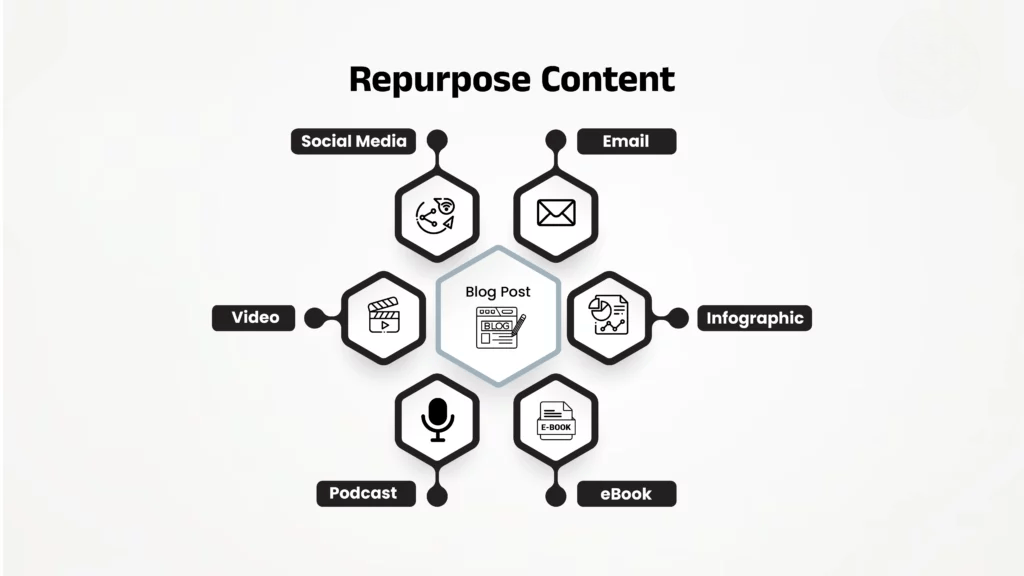
Creating high-quality content takes time, budget, and strategic effort. Yet many B2B companies publish a blog post once, promote it briefly, and then move on to the next asset. This approach limits the true potential of content marketing. A well-designed content repurposing framework ensures that every piece of content reaches multiple audiences across multiple channels — without multiplying production costs.
Content repurposing is not about copying and pasting the same message everywhere. It is about transforming core ideas into formats that match platform behavior, buyer intent, and consumption preferences. In today’s B2B environment, where decision-makers consume information through newsletters, LinkedIn posts, podcasts, short-form videos, and AI-powered search engines, repurposing is no longer optional — it is strategic amplification.
Why Repurposing Matters More Than Ever
B2B buying journeys are longer and involve more stakeholders. A single whitepaper or blog post is rarely enough to influence a buying committee. Repurposing allows you to reinforce your message across touchpoints while adapting it for different stages of the funnel.
When done correctly, repurposing helps you:
- Increase content lifespan and ROI
- Reach new audience segments across platforms
- Reinforce brand messaging through repetition
- Improve SEO through topical authority
- Support sales teams with multi-format assets
Instead of constantly creating from scratch, high-performing marketing teams build once and distribute intelligently.
The Pillar-and-Cluster Framework
One of the most effective repurposing models is the pillar-and-cluster framework. In this approach, you start with a comprehensive “pillar” asset — such as an in-depth blog, industry report, or webinar — and then break it into smaller, focused pieces.
For example, a 2,500-word blog post can become:
- 5–10 LinkedIn posts highlighting key insights
- A short email newsletter series
- A SlideShare or carousel presentation
- Short-form video clips summarizing major points
- A downloadable checklist or template
- Sales enablement snippets for outreach
This framework works because it maintains thematic consistency while allowing flexibility in format. Each cluster piece points back to the pillar content, strengthening SEO and authority.
The Format Multiplication Model
Different professionals consume content in different ways. Some prefer reading long-form analysis. Others prefer listening during commutes or watching quick explainer videos. The format multiplication model focuses on adapting the same insight into multiple media formats.
A single webinar, for example, can evolve into:
- A full blog recap
- A podcast episode
- 10 short video clips
- Quote graphics for social media
- A gated eBook compilation
- An FAQ article optimized for AI search
This approach increases visibility while catering to diverse learning styles. It also ensures your message appears consistently across search engines, social feeds, and inboxes.
The Funnel-Based Repurposing Strategy
Not all content serves the same purpose. Some assets attract attention, while others drive conversion. A funnel-based repurposing framework ensures that one core topic supports every stage of the buyer journey.
For example, if your original content is about “AI in B2B Sales,” you can repurpose it like this:
- Top of Funnel (Awareness): Educational blog posts and LinkedIn thought leadership snippets
- Middle of Funnel (Consideration): Case studies, comparison guides, and webinar deep dives
- Bottom of Funnel (Decision): ROI calculators, demo scripts, and implementation checklists
This structured method aligns content with intent, making repurposing strategic rather than random.
The Content Atomization Approach
Content atomization involves breaking a large asset into the smallest meaningful insights — or “atoms.” Each atom can stand alone while still connecting back to the original source.
For instance, a research report may contain statistics, expert quotes, frameworks, and predictions. Each of these components can be distributed separately across social media, newsletters, and sales materials.
Atomization works especially well for:
- Data-heavy reports
- Industry trend analysis
- Thought leadership interviews
- Conference presentations
By distributing insights gradually, you extend the content lifecycle over weeks or even months.
Building a Sustainable Repurposing Workflow
A framework only works if supported by process. Many teams struggle with repurposing because it feels like an afterthought. Instead, repurposing should be planned at the content creation stage.
Start by asking:
- What is the core message of this content?
- Which platforms does our audience use most?
- How can this topic support SEO, social, email, and sales simultaneously?
- What assets can we extract immediately after publishing?
Creating a simple distribution checklist ensures every major asset is systematically repurposed before moving to the next campaign.
Measuring the Impact of Repurposed Content
To maximize reach, you must measure beyond surface-level metrics. Repurposed content should contribute to broader business goals such as pipeline growth and brand authority.
Track performance across:
- Organic traffic growth
- Engagement rates by format
- Assisted conversions
- Content-influenced revenue
- Sales team usage of repurposed assets
The goal is not just more impressions — it is sustained influence across the buyer journey.
Conclusion
Content repurposing frameworks transform marketing from a production treadmill into a strategic growth engine. By building pillar assets, multiplying formats, aligning content with the funnel, and atomizing insights, B2B companies can dramatically increase reach without dramatically increasing cost.
In a competitive digital landscape, the brands that win are not those that create the most content — but those that extract the most value from every piece they produce. A structured repurposing framework ensures your ideas travel further, last longer, and generate measurable business impact.
