



Understanding Gated and Ungated Content in B2B Marketing
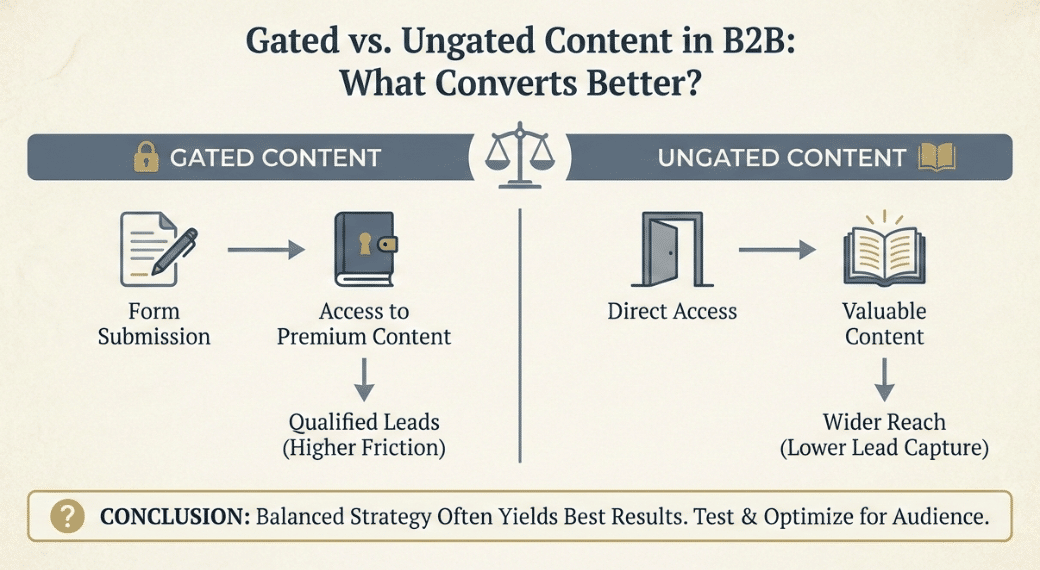
In B2B digital marketing, content is one of the most powerful tools for attracting, educating, and converting potential buyers. Gated content refers to assets such as whitepapers, eBooks, reports, templates, or webinars that require users to submit their contact information—typically via a form—before accessing the content. Ungated content, on the other hand, is freely accessible without any form submission and includes blog posts, articles, videos, podcasts, infographics, and social media content. The core difference lies in how value is exchanged: gated content trades information for data, while ungated content focuses on visibility, trust, and reach. Understanding this distinction is critical because B2B buying journeys are longer, more complex, and involve multiple stakeholders who consume content at different stages before making a decision.
How Gated Content Drives Lead Generation and Sales Enablement
Gated content has traditionally been a cornerstone of B2B lead generation strategies. By placing high-value, in-depth resources behind a form, marketers can capture qualified leads who demonstrate clear intent and interest. This approach works particularly well for mid-to-bottom funnel prospects who are actively researching solutions or evaluating vendors. Gated content also supports sales teams by providing rich first-party data such as job role, company size, industry, and pain points. When executed correctly, gated assets help prioritize high-quality leads, fuel marketing automation workflows, and nurture prospects through personalized follow-ups. However, gated content can also create friction—especially if the perceived value does not justify the form fill—leading to lower conversion rates or even user drop-off.
The Power of Ungated Content in Building Trust and Demand
Ungated content plays a crucial role in modern B2B marketing, especially in the awareness and early consideration stages of the buyer journey. Today’s B2B buyers prefer to research independently, consuming large amounts of content before ever speaking to a sales representative. Ungated content enables this self-education by removing barriers and allowing prospects to freely explore your expertise. Blog posts, SEO-driven articles, and thought leadership pieces help build credibility, increase organic visibility, and position your brand as a trusted authority in your industry. While ungated content may not immediately generate leads, it significantly contributes to long-term demand generation, brand recall, and inbound pipeline growth.
Conversion Metrics: What “Converts Better” Really Means in B2B
When asking whether gated or ungated content converts better, it’s important to define what “conversion” actually means. If conversion is measured as direct lead capture, gated content often wins because it produces measurable form fills and contact records. However, if conversion is viewed more holistically—such as engagement, time on site, return visits, organic traffic growth, and assisted conversions—ungated content often outperforms gated assets. In B2B, conversions rarely happen in isolation; a prospect might read several ungated blog posts before eventually downloading a gated report or requesting a demo. Therefore, both content types contribute differently to the overall conversion ecosystem rather than competing directly against each other.
When Gated Content Works Best in the Buyer Journey
Gated content is most effective when the buyer is already problem-aware and solution-oriented. At this stage, prospects are willing to exchange information for content that offers deep insights, proprietary data, or actionable frameworks. Examples include industry benchmark reports, ROI calculators, case studies, and product comparison guides. Gated content also performs well in account-based marketing (ABM) and targeted campaigns where the audience is highly defined. However, gating too early in the journey can limit reach and discourage potential buyers who are not yet ready to commit their information. Timing, relevance, and perceived value are the determining factors for gated content success.
When Ungated Content Delivers Higher Long-Term ROI
Ungated content excels in top-of-funnel and mid-funnel scenarios where education and trust-building are the primary goals. It supports SEO strategies by increasing keyword visibility, backlinks, and organic traffic, which in turn lowers customer acquisition costs over time. Ungated content also aligns with modern buyer behavior, where decision-makers prefer brands that are transparent and generous with insights. In competitive B2B markets, companies that share valuable knowledge freely often outperform those that over-gate their expertise. While ungated content may not produce immediate leads, it creates momentum that improves conversion rates across paid campaigns, email nurturing, and sales outreach.
Finding the Right Balance Between Gated and Ungated Content
The most successful B2B marketing strategies do not choose between gated and ungated content—they strategically combine both. Ungated content attracts, educates, and nurtures a broad audience, while gated content captures intent and accelerates pipeline growth. A balanced approach ensures that prospects are not overwhelmed with forms too early, yet still provides clear opportunities for lead capture at the right moment. Marketers should continuously test, measure, and optimize gating strategies based on audience behavior, funnel stage, and content performance. Ultimately, conversion success depends less on the format and more on relevance, timing, and value delivery.
Key Differences Between Gated and Ungated Content
- Gated Content: Best for lead capture, sales qualification, and mid-to-bottom funnel conversions
- Ungated Content: Best for awareness, SEO, trust-building, and long-term demand generation
- Gated Content Risk: Higher friction and lower reach if value is unclear
- Ungated Content Risk: Fewer direct leads but stronger assisted conversions
- Best Practice: Use ungated content to attract and gated content to convert
Conclusion: What Converts Better in B2B—Gated or Ungated Content?
In B2B marketing, the question is not whether gated or ungated content converts better, but how each contributes to conversions at different stages of the buyer journey. Gated content delivers tangible, measurable leads and supports sales enablement when prospects are ready to engage more deeply. Ungated content, however, builds the foundation for those conversions by driving awareness, trust, and sustained engagement over time. A purely gated strategy can limit reach and stall early-stage growth, while an entirely ungated approach may struggle to capture high-intent leads efficiently.
The most effective B2B marketers understand that conversion is a journey, not a single action. By using ungated content to educate and attract, and gated content to capture intent and qualify prospects, businesses can create a seamless content ecosystem that maximizes both short-term conversions and long-term ROI. The real competitive advantage lies in delivering the right content, in the right format, at the right time—while always prioritizing value for the buyer.
