How Ready Is Your Organization for Continuous Security Validation?
Understand your current security-validation approach and identify opportunities to improve testing scalability, exploitability validation, and continuous security assurance.
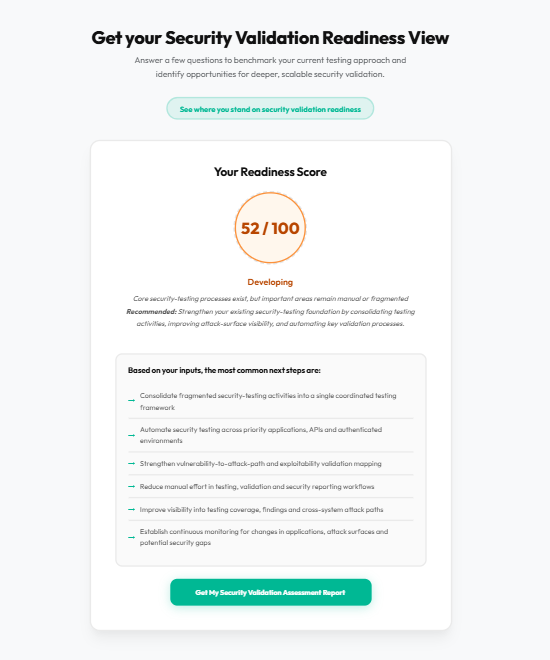
This assessment evaluates your security-validation approach across five key areas: testing approach, testing challenges, exploitability validation, security-testing coverage, and future strategy. Your responses generate a personalized Security Validation Readiness Score and indicate the stage that best reflects your current approach.
- ✔ Discover
- ✔ Analyze
- ✔ Validate
- ✔ Exploit
- ✔ Adapt
- ✔ Discover
- ✔ Analyze
- ✔ Validate
- ✔ Exploit
- ✔ Adapt
Key Benefits :
- ✔ Understand whether vulnerabilities can be validated through reproducible attack paths, exploit attempts and supporting evidence.
- ✔ Surface security gaps across authentication, authorization, business logic, attack paths and changing environments.
- ✔ Identify exploitable weaknesses and prioritize remediation across critical environments.
- ✔ Validate attack paths without exposing sensitive data—deploy as SaaS, fully on-premises or in air-gapped environments.
Readiness
Measurable outcomes from continuous security validation.
PAIStrike combines autonomous agents, adaptive attack paths, exploitability validation, and reproducible evidence to help security teams continuously validate real-world risk.
Evidence-backed outcomes from autonomous penetration testing
Standardized web penetration testing across 104 tasks, with 97 of 104 tasks successfully solved.
Working exploit paths against real, running software, with 37 of 40 tasks successfully solved.
Full-spectrum CTF problem solving across diverse challenges, with 31 of 31 evaluable challenges successfully solved.
Autonomous reasoning through chained vulnerabilities, business logic, stateful workflows, and complex attack scenarios.
Testing across SSO, OAuth, tokens, RBAC, authorization boundaries, and authenticated enterprise workflows.
Validated findings supported by attack paths, exploit outcomes, evidence artifacts, and reproducible proof.
Beyond automated scanning. Beyond scripted workflows.
Traditional scanners identify known vulnerabilities. AI-assisted tools can improve testing workflows. PAIStrike goes further by combining autonomous reasoning, adaptive attack paths, long-term memory, and evidence-based validation to continuously assess real-world exploitability.
Rule-based scanning
Predefined vulnerability checks
Autonomous reasoning
Context-driven testing
Fixed attack paths
Scripted testing logic
Adaptive attack paths
Dynamic strategy changes
Point-in-time testing
Periodic security checks
Continuous validation
Ongoing security assurance
Cloud-only tooling
Sensitive data leaves your perimeter
Deploy anywhere
SaaS, on-premises or air-gapped
Theoretical findings
Potential vulnerabilities
Exploit validation
Evidence-backed findings
Session-limited context
Knowledge resets between runs
Long-term memory
Cumulative security intelligence
Single-stage testing
Isolated vulnerability checks
Multi-step exploitation
Chained attack scenarios
Static reporting
Findings and recommendations
Auditable evidence
Reproducible attack paths
100
A clear readiness score to understand where your security validation stands.
The assessment evaluates your organisation's Security Validation Readiness across key areas. Your responses generate a clear 0-100 Readiness Score, helping you understand your current stage and the capabilities needed to move toward continuous security validation.
security validation maturity Start Assessment →
Know where your organisation stands—and what comes next.
Assess your security-validation approach, identify key gaps, and understand what to strengthen next.
Testing Approach
Understand how your organization currently performs penetration testing and security validation.
Testing Challenges
Identify the operational challenges affecting testing efficiency, scale, and coverage.
Exploitability Validation
Assess how confidently your organization can determine whether vulnerabilities are genuinely exploitable.
Testing Coverage
Evaluate the environments, applications, APIs, authentication flows, and attack paths that require security validation.
Future Strategy
Understand your organization's readiness to move toward more scalable, continuous, and autonomous security validation.
Understand & Reason
PAIStrike builds an understanding of the target environment before testing, combining application context, exposed interfaces, and available access paths to determine where meaningful security validation should begin.
- Agents analyze the target environment, application behavior, and available access paths.
- PAIStrike reasons about potential attack paths and determines where deeper validation is required.
Traditional penetration testing breaks down at enterprise scale.
Modern applications and APIs change continuously, but many
organizations
still rely on periodic penetration tests, manual validation and fragmented security tooling.
Without continuous visibility into attack paths, exploitability and changing environments,
critical security gaps can remain undiscovered.
Start the Free Assessment →
Fragmented security testing
Applications, APIs, authenticated environments and services require different testing approaches, making comprehensive coverage difficult to maintain manually.
Point-in-time validation

Periodic penetration tests provide a snapshot. They don't continuously identify what changed or whether newly introduced vulnerabilities are genuinely exploitable.
Limited attack-path visibility

Finding a vulnerability is only the beginning. Effective validation requires tracing multi-step attack paths, adapting to failures and proving real-world exploitability.
Turn security findings into validated action.
Move from discovering vulnerabilities to executing adaptive attack paths and validating genuine exploitability.
Reconnaissance
Discover assets, endpoints, services and attack surfaces before prioritizing the next testing actions.
Attack Paths
Plan and adapt multi-step exploitation strategies using live context, hypotheses and observed results.
Validation
Verify exploitability through controlled testing and produce reproducible evidence for security teams.
Connect every security finding to the attack path behind it.
Map vulnerabilities to attack paths, exploit evidence, affected assets and remediation context, so security teams can maintain a more defensible and continuously validated security posture.
Discover assets, endpoints and exposed services continuously as the attack surface changes.
Identify and evaluate multi-step attack paths based on live environmental context and discovered weaknesses.
Validate whether identified vulnerabilities are genuinely exploitable through controlled and reproducible testing.
Capture reproducible attack paths, supporting artifacts and proof of successful exploitation.
Maintain traceable security validation as applications, APIs, environments and attack surfaces evolve.
Give leadership a clearer view of real-world security exposure.
Move beyond periodic pentest reports with a live view of discovered assets, attack-path progress, validated weaknesses, remediation priorities and supporting evidence.
- What can an attacker reach?
- Which attack paths succeeded?
- What requires attention now?
Entry Points
Deploy where your data must stay.
Run PAIStrike as SaaS, fully on-premises, or in air-gapped environments. For sensitive environments, validate attack paths without sending findings, credentials or network topology to an external cloud.
Autonomous testing stays controlled, auditable and aligned with your rules of engagement.
Attack paths, exploit evidence and findings stay within your environment, making PAIStrike suited to large enterprises, financial institutions, critical infrastructure operators and government agencies.
Get your Security Validation Readiness View
Answer a few questions to benchmark your current testing approach and
identify opportunities for deeper, scalable security validation.